When I lived in Colorado, I knew where the records I needed were located. I frequented the Denver Public Library, the Colorado State Archives, the Colorado History museum’s research library, the Boulder County Courthouse, the Carnegie Library for Local Research in Boulder, and more. Moving to a new city has brought on many challenges, one of which is vital for any genealogical business: learning to research in new repositories. In Colorado, I also knew who to ask when I ran into a snag. Building a new FAN club (Friends, Associates, Neighbors) for research purposes is just as important as it is for your personal life.
The first time you walk into a new repository can be a little intimidating. You may not be familiar with the building, the parking, the streets (which ones are one way in the right direction…?), the policies and procedures of using the collection (though most of the time this can be found on the repository’s website), and you never know if the person you need to ask for help will be friendly, helpful or totally flustered because he/she is overworked and underpaid. Believe me, I’ve run into all types over the years and I still get a little intimidated visiting a new repository.
[Author’s Note: I want to publicly thank two colleagues, Teri Flack and Randy Whited, for giving me a tour and driving me around to a few of the above repositories, which really helped me understand which records are where around Austin. Thanks to the internet, attending national conferences and getting recommendations from other professionals in the field, I was introduced to these two genealogists in the Austin area and they have been so generous getting a newly relocated genealogist accustomed to the repositories in the area. Thank you! ]
The Austin History Center (AHC) is probably my favorite. The parking is easy (although not free), the staff are the friendliest of all I’ve met so far, the microfilm equipment actually works (big plus) and it reminds me a bit of the Carnegie Library in Boulder (although it’s not a Carnegie building). It is a manuscript archive so you must only bring in your laptop, phone and some loose paper. They provide a locker when you check in. They provide scratch paper and pencils (no pens). They have a fantastic collection of both manuscript materials as well as microfilms of mostly Austin-specific but also other Travis County items.
The Briscoe Center for American History is a primarily a manuscript collection pertaining to Texas history and people. It is located on the University of Texas campus next door to the LBJ Library. Like the AHC, Briscoe provides lockers and does not allow much to go into the facility (computers, loose paper and pencils only). The parking is free but you have to go in, check in, get a parking pass which you must run back out to your car. (Not a big deal except for the day I went and it was over 100 degrees and I had to cross the hot parking lot several times. I’m from Colorado. 100 degrees is too hot, but, I did survive.) This collection has many great items as can be seen in their catalog. I got to read original slave narratives on the day I was there. Very interesting, sometimes sad, reading. I also got to look at a box of all of the notes and research that went into writing a book on Texas slave history. It was fun to sort of see the thought process an author went through in constructing the book.
The Travis County Courthouse and Criminal Justice Center is located across a small park from the AHC. It is a bustling building, very busy with people navigating the legal system. There are two buildings: the county courthouse and the CJC building which houses the District Court. Finding records here has its challenges, one of them being the aforementioned hustle and bustle. The old records through the county court are not publicly accessible and have to be requested. The REALLY old records are still being searched for after my request for some from the 1880s. The District clerk does have a publicly accessible computer index to their microfilms, so once you’ve found a case number, you tell the attendant and they pull the microfilm for you. All of the clerks and attendants were friendly and helpful when I visited them. They were also busy with current events, so my request for OLD records was a little surprising to them since they are usually dealing with more recent records requests.
The Travis County Clerk’s office is located a little ways north of downtown Austin. It is easy to locate and parking is free. It seems as if the county purchased an old shopping center and converted it to county offices. (In my opinion, that is an environmentally and economically responsible move.) The Clerk’s office has several counters for requesting marriage licenses and taking care of other county business. To the right of this is the public research area, mostly containing microfilms of deeds and a few early landowner maps, complete with 6 microfilm readers. However, only two work, if you can get the pay-with-card machine to work. The first time I arrived it took me and the information desk attendant about an hour to navigate all of the quirks of the system. All of the staff were helpful despite the challenges to getting the machinery to work. They seemed to be at their wit’s end with the equipment as well. For everyone’s sake I hope new equipment is in the future budgetary plans for that office.
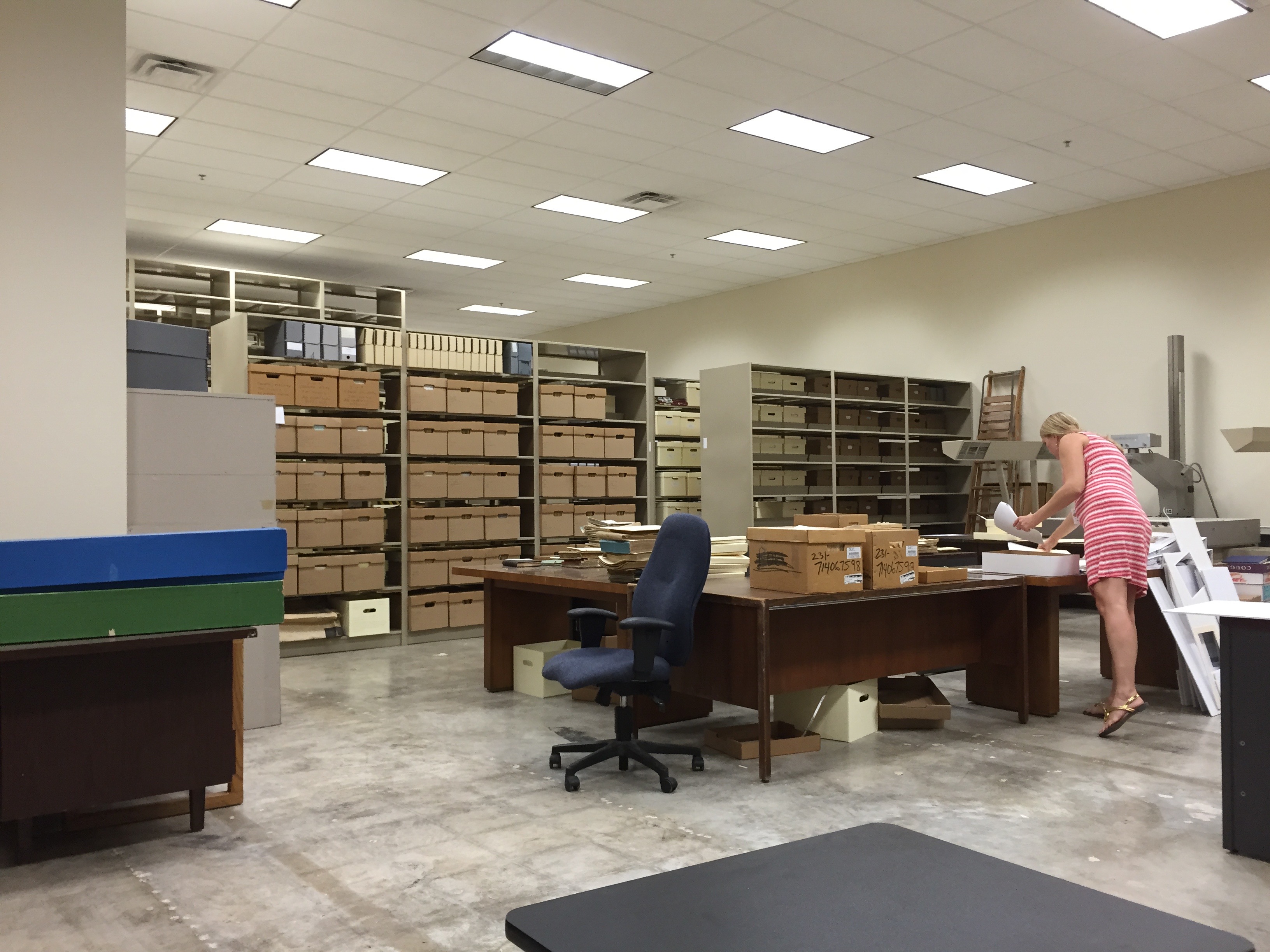
The Travis County Archives is a separate facility from the courthouse records office. This one is located within the Travis County Sheriff’s building, which is a new location for them and they are still unpacking and labeling shelves. This repository is a little more difficult to access. You can’t just show up, there are not set office hours. It is a closed facility and an appointment must be made to use it. You can email ahead of time to the archivist (a very helpful and friendly lady) and let her know what you are looking for. (She has been going above and beyond working with the County Court records office trying to locate those court records I’m hoping for.) When visiting, someone will meet you in the lobby and escort you through a maze of hallways, to the very back of the building where the archive room is located. It is a nicely lit, large room. When I arrived she had the old court minute books ready for me on a work table. It was a lot of fun to read through some of those old books.
One repository that I haven’t mentioned yet, is the Texas State Library and Archives. This facility has a vast collection of Texas materials. It is located next door to the state capitol building. Parking for this facility is a little more tricky than the other locations; there is a parking garage about a block away that may or may not be free depending on the events in the area. They have a great genealogy center, archives room, and a classroom. I have only taken a class and had a tour but have not done any research there yet.

 Genealogy Pants