Last time we looked at research planning for when you’re in the “collection” phase. Usually the collection phase happens when we are just starting out and gathering as much as we can on our ancestors, or it may happen when you are starting a new client project or a new project for yourself that you haven’t researched before. The collection phase is when you are gathering as much of the “low-hanging fruit” as you can, the easy to find documents and sources to advance your family trees.
What do you do when you get to a point of resistance, commonly called a “brick wall” in our field. We invariably get to a point where the low-hanging fruit doesn’t identify that next generation, for example, and we have to do some extra work to determine who the parents are. This is where we can really put our skills to the test, or learn new skills and methods if that is the case. Part of this is effective research planning.
I have an Evernote template that I use for more directed research. This same sort of “set up” will work in Word or Excel or your note-keeping tools of choice. The most important thing is that you figure out what works best for you, for your way of thinking, and how you view your findings.
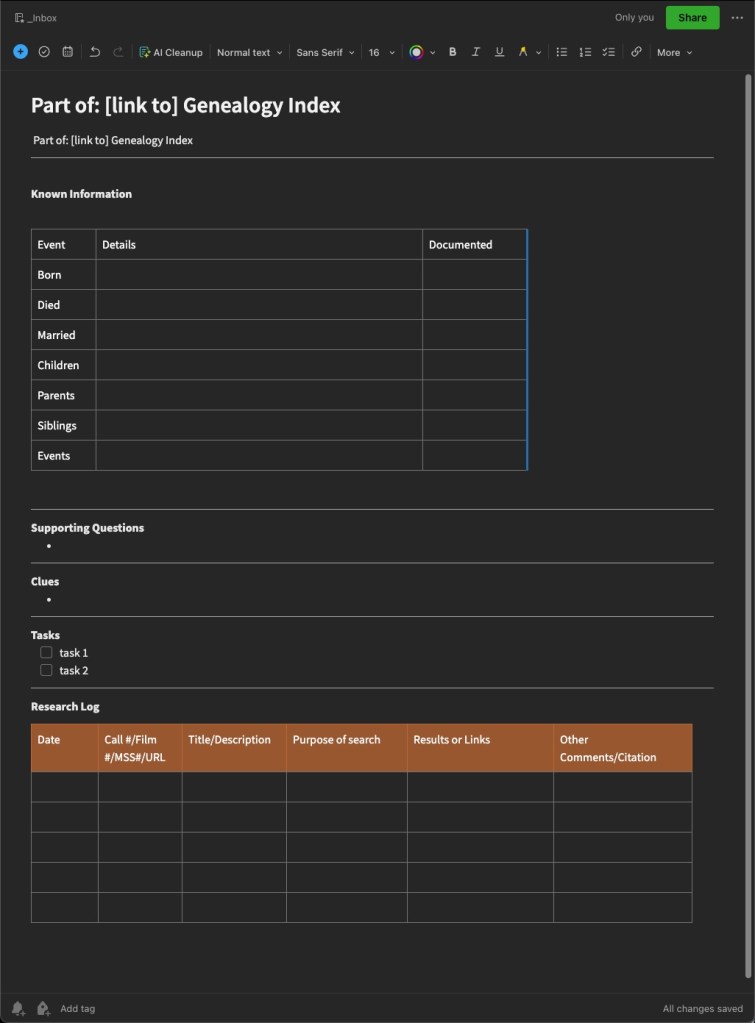
I fashioned this template after one I found online, probably from Cyndi of Cyndi’s List (click here to see all her Evernote templates.) I almost always end up changing or adapting them to fit the needs of whatever I am working on. Do not try to shoehorn yourself into something that someone else created. If that doesn’t work for you, change it until it does. You can recreate something similar to mine, find one that works from Cyndi’s list, or create your own in Word, Excel, or the program of your choice.
When I set out to work on a “brick wall” in earnest, I will start one of these “plogs” to help me get myself and my thoughts organized, and ready for research. Next time, we will look at this template filled in for a project I am currently working on so you can see how I use it in actual practice.
 Genealogy Pants
1 thought on “Research “Plogs” – the Planning Part – part 3”