We looked at a blank example of my research PLOG template that I use in Evernote last time. You do not have to use Evernote to make something like this. You could use Word, Mac Pages, Google Docs, a spreadsheet, or any other note-taking tool of your choice. This is simply how I do it. Please adapt to find something that works for you and your way of thinking.
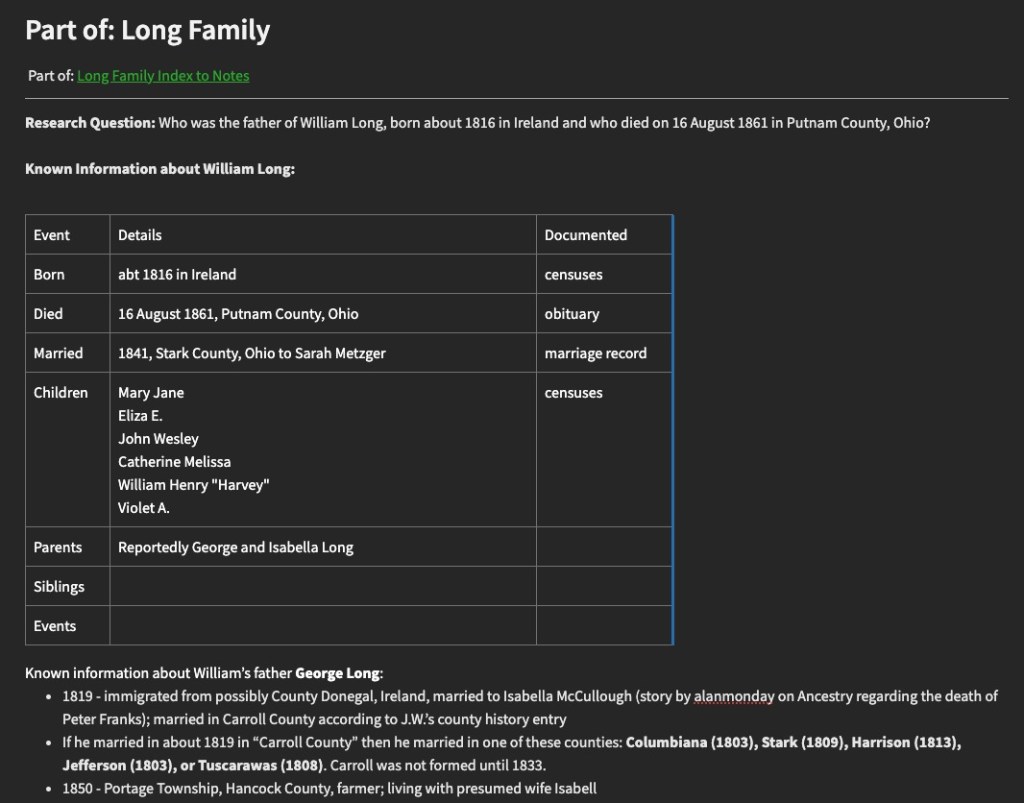
I am currently working on a project to identify the father of William Long who was born in about 1819 in Ireland and who married Sarah Metzger in Stark County, Ohio, in 1841, and died in Putnam County, Ohio, in 1861. I have only a name for his father “George Long.” The problem is, there are a lot of George Longs that could be the father of William. The son of William, John W. Long, has a biographical sketch in the Wood County, Ohio, county history that states that his grandfather was “George Long” and he “emigrated to the United States in 1817, locating in Carroll County, Ohio, where he was married and became the father of seven children: George, William, John, Catherine, Ellen, Susan, and Alexander.” There are a few problems with this, one of which is that Carroll County was not formed until 1833 from Columbiana (1803), Stark (1809), Harrison (1813), Jefferson (1803), or Tuscarawas (1808).
So, my research question is listed at the top of my “plog” template, followed by a cataloging of known information, supporting questions to answer, thoughts and analysis of the problem, some tasks, and then the research log portion of the template, which will get filled in as I complete the tasks.
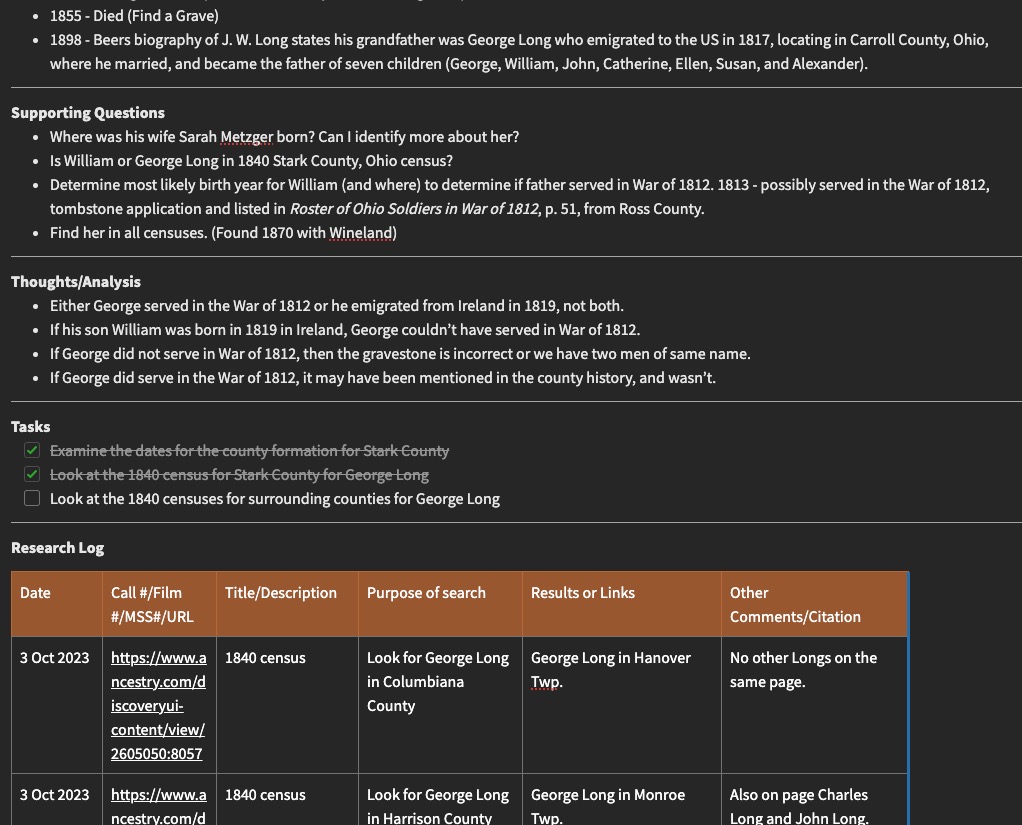
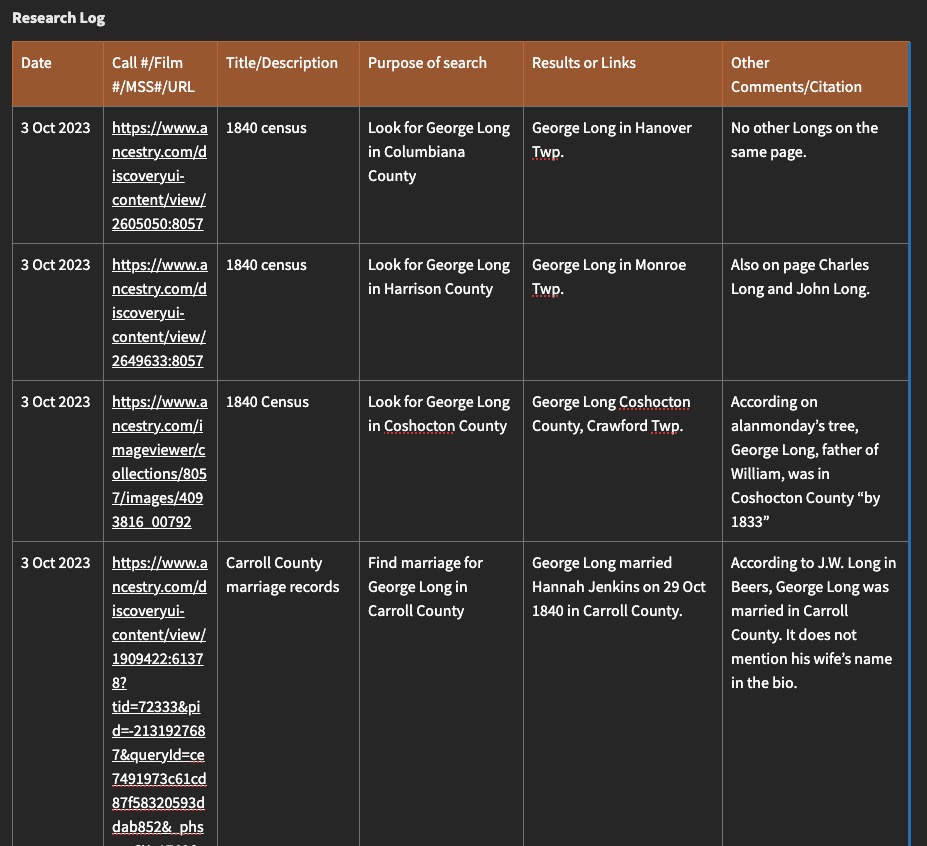
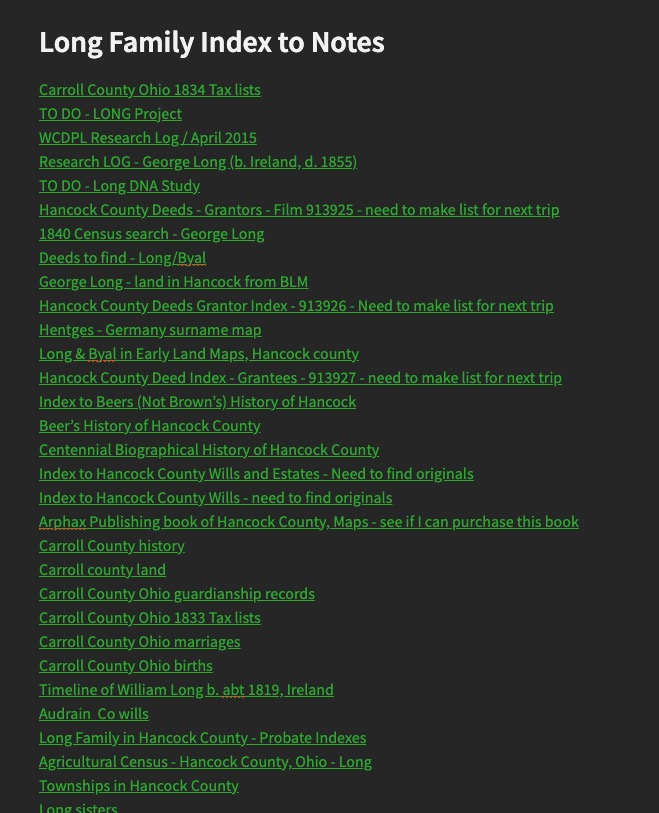
As you complete tasks, they often create more questions than they do answers. I document these in the last column and add things to the task list. Sometimes the template gets too long and too much scrolling needs to be done. One cool feature of Evernote is that you can link the notes together and essentially create an index where you can see all of your notes for one particular project in a list. Provided you titled your notes in a meaningful way, this will be great to get to notes quickly rather than scrolling through long notes. There are likely ways to do something similar in other programs.
So, that’s the mechanics of research “Plogs” and how I use them. The next post will have some final thoughts on research planning and logging in general, tips and tricks, etc.
 Genealogy Pants