Category Archives: newspapers

Using Newspapers: The Gossip Column

This may be referred to as the “Social News” section or “Local Items,” something along those lines. But really, it’s the gossip column. Back before there were privacy issues and concerns, you could find out just about anything about anyone in the newspaper. If something really scandalous happened, it may have made front page news. But those more mundane items that all nosy busy-bodies wanted to know, could be found in the newspaper. Who went where for dinner. Who went into town or the big city for shopping. Who was going out of state for vacation or to visit relatives. Who bought what on their shopping trip. Who attended a party and for who or what.

You get the idea. It was Facebook of the day. If photography existed or was easier to print, we may have even seen photos of what someone had for dinner. Let’s look at some examples.

Morning Oregonian, Portland, Oregon, 12 September 1886, pg. 3.

I mentioned it before and I’ll mention it again now. Newspapers are a fantastic way of locating an ancestor’s friends, associates, and neighbors (FAN Club). These people can often be clues to solving mysteries such as making sure you are looking at the right individual and not someone of the same name. The article above is a fun description of a birthday party, but also lists everyone who attended.

Buckeye Valley News, Buckeye, Arizona, 18 April 1935, n.p.

Here is another example of “Local News.” There is news of folks down with the flu, of new employees at the City Cleaners, an new Avon sales agent in town, and more. My great-grandfather, Sanford Sly, the Clerk at the 3-H Mercantile, spent the weekend with his family at Tucson and “they will join him here when school closes at Tucson.” I’m still not sure what the school is. But I do know that his (adopted) daughter, Alice Sly, was being treated for tuberculosis at St. Mary’s Hospital in Tucson. She was a young adult when they moved to Buckeye, Arizona from the Buckeye State (Ohio). So, I’m not sure if she was attending a school of higher learning there or if they were keeping her illness somewhat of a secret. I’m not sure.

But this local news item gives me some clues to look into. I love the gossip column and can get stuck there reading up on everyone’s mundane business. It takes me back in time to kind of see and understand what everyday life was like.

Using Newspapers: Letters Lists

Back before we had postal carriers and post boxes, mail boxes at our driveway or in a large repository at the end of a block, our ancestors had to go in to the post office to pick up their mail. If they didn’t do that often enough, they would publish a list of letters to be picked up at the post office. Let’s look at this list below published in the Guthrie Daily Leader, Oklahoma, 2 May 1900:

Lists such as these can be very helpful in pinpointing your ancestor in a time and place, and produce a FAN Club (list of friends, associates, and neighbors) of sorts for your ancestor. This list is interesting because it separates items for men and woman. I did not know why until an audience participant told me about “Ladies’ Delivery Windows” at the post office. “In an attempt to prevent “timid females” from encountering “detention, rudeness and a thousand vexations” while picking up their mail, Post Offices in some cities had a special ladies delivery window dedicated to their use.” (See “Ladies Delivery Windows” below.)

Next time you pick up your mail from your porch or driveway, think of your ancestors having drive their wagons into town to pick up their mail.

Further Reading

Using Newspapers: Advertisements

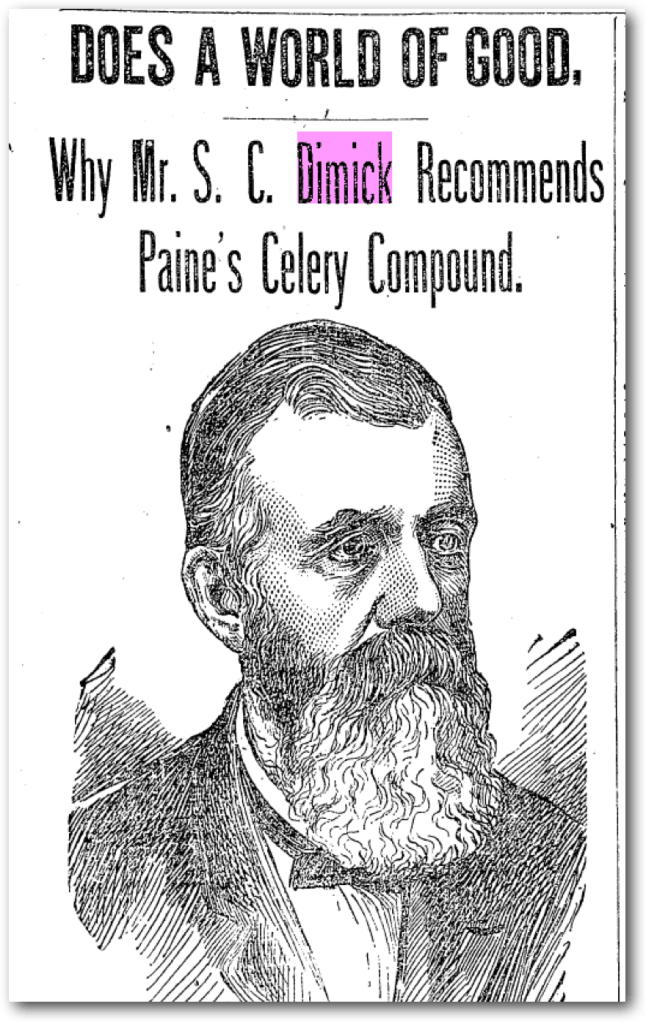
We often think to look for the obituaries, birth announcements, legal notices, and general articles to add to our genealogical research and family stories. Did you ever consider advertisements for products? I hadn’t until I came across this advertisement for Paine’s Celery Compound with a testimonial by my 3rd great grandfather, Samuel Cook Dimick:

St. Paul Daily Globe, Minnesota, February 18, 1893, p. 5.

What is great about this article is the picture of my ancestor, S.C. Dimick. Up until this article was located, I did not have any photographs of him. I had never considered an advertisement could be so useful. Who does not like finding an image of a long-gone ancestor?

Samuel Cook Dimick is one of my favorite ancestors to research because he seemed to live a very full life, and all the time I am finding new bits of information about him. For example, I learned that he worked for one year as the farm superintendent on an Indian reservation in Minnesota from his biography in the county history for Wood County, Ohio. That led me to looking at records in Minnesota. I discovered that his father, Chester Dimick, purchased 15 different sections of land in Minnesota from the Federal Government that encompassed over 1600 acres! I have not done the follow-up to find the deeds indicating where he sold the land. As far as I knew, they never actually lived in Minnesota.

I’d read the text of the advertisement before, but to be honest, was hyper-focused on the image. Rereading it today, I did not remember that it states that to help his health condition he “…decided to try a change of climate, and spent nearly three months in Minnesota.” This leaves me with several questions. Did the family keep that Minnesota land for a longer time than I previously thought? I had assumed this was a money-making plan and they bought the land cheap from the government and then likely sold it for more later, but had not done the research to confirm it. Did they keep a home in Minnesota, like a vacation home? I really need to get into those deeds!

Two points here. First, don’t overlook the advertisements section. They can have clues and sometimes pictures of ancestors. And second, you have to go back and reread your documents from time to time. Most likely, when I first read this advertisement, the Minnesota piece didn’t stick out to me because I had not learned about all the land they owned there. Rereading documents with new things you’ve learned in mind will shine a spotlight on previously overlooked clues.

And a third point: Newspapers are more than the obituaries!