Category Archives: Long

Did MY George Long Serve in the War of 1812?

When conflicting evidence rears its ugly head in our research, we have to confront it. We can’t ignore it. If we ignore it, other researchers will find it and then that puts our other conclusions into question. Many times, conflicting evidence can be easily explained and you can set aside the “wrong answer” and focus on the right one. Let’s look at this in practice with my George Long project.

“My” George Long has been attributed as having served during the War of 1812. However, my research has indicated that he arrived in 1817 at the earliest. A “Graves Registration Card” for “my” George Long, who died in Hancock County in 1855, indicates that he was a soldier during the War of 1812 and served as a Private in Lieutenant Robert Harvey’s Company.1
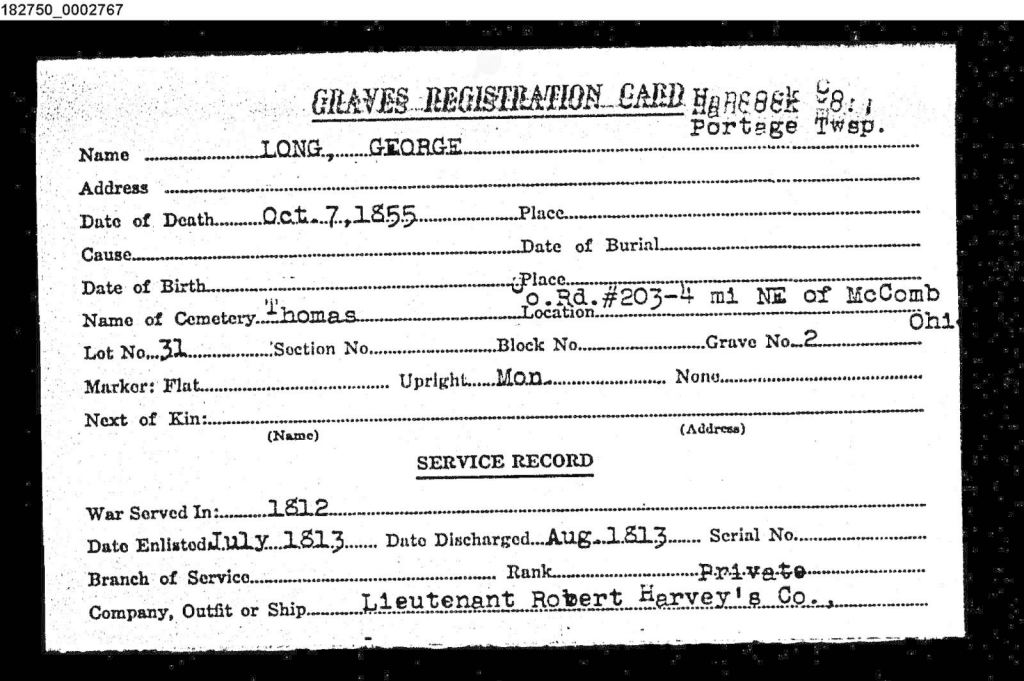
I investigated the origin of this card. As a New Deal program under the Works Progress Administration, workers attempted to identify all of the veterans who were buried in the State of Ohio. The veterans were indexed as part of the “Grave registration cards A–Z, soldiers buried in Ohio from the Revolutionary War to World War II” collection at the Ohio History Connection.2 This project was undertaken in the late 1930s under the Historical Records Survey, sponsored by the Ohio Adjutant General’s Department. 

“The project was ambitious, trying to record the grave of every veteran buried in Ohio, but the record is far from comprehensive and the information not always accurate. The information on the cards was taken from burial or cemetery records or from information on the headstones. Information about military service may have come from the county recorder’s office or military rosters or the local GAR. It is hard to say with any certainty where the information on an individual card came from.”3

Indeed, a George Long did serve in the War of 1812 for Ohio in Robert Harvey’s Company. That company’s service was from 13 July until 17 August 1813. The roster indicates the company was “probably from Ross County.”4 There is another George Long who served in Captain Isaac Pancake’s Company, also “probably from Ross County.”5 Ross County is in the south central portion of Ohio, not near the northeastern counties that would later make up Carroll County. There are no George Longs living in Ross County during the 1820 census enumeration.6 Only one George Long has been located in Ross County; a man who was about 30–40 years old was enumerated there in 1840.7 If he were born in about 1800, he would have only been 12 years old at the start of the war, too young to have served.

There are seventeen cards for men named George Long in the War of 1812 Service Record Index, two for service in Ohio.8 One served in the 1st Regiment (McDonald’s) Ohio Militia as a private.9 The other served in the 2nd Regiment (Willett’s) Ohio Militia as a private.10

If George Long arrived in 1817, he likely did not serve during the War of 1812. It is possible that he could have served, returned home to Ireland, and then returned to the U.S. with his family by daughter Catherine’s reported birth in 1820 in Ohio. However, it would have been a long and difficult voyage across the Atlantic during the 1810s and 1820s, which usually took about six weeks before the use of steam power in the 1830s. However, if George was a soldier in the War of 1812, it seems likely that his grandson’s biographical sketch would have mentioned him as one of the heroes of that war, as many biographical sketches did. Furthermore, no soldier’s pension for any George Long of Ohio, including the two Privates in the 1st and 2nd Regiments, has been located.11 Beyond the connection made in the WPA Soldiers’ Grave Registration Project, there is no indication that George Long, the father of William, served during the War of 1812. The more likely scenario is that he did not serve, and the service of another George Long has been attributed to him.

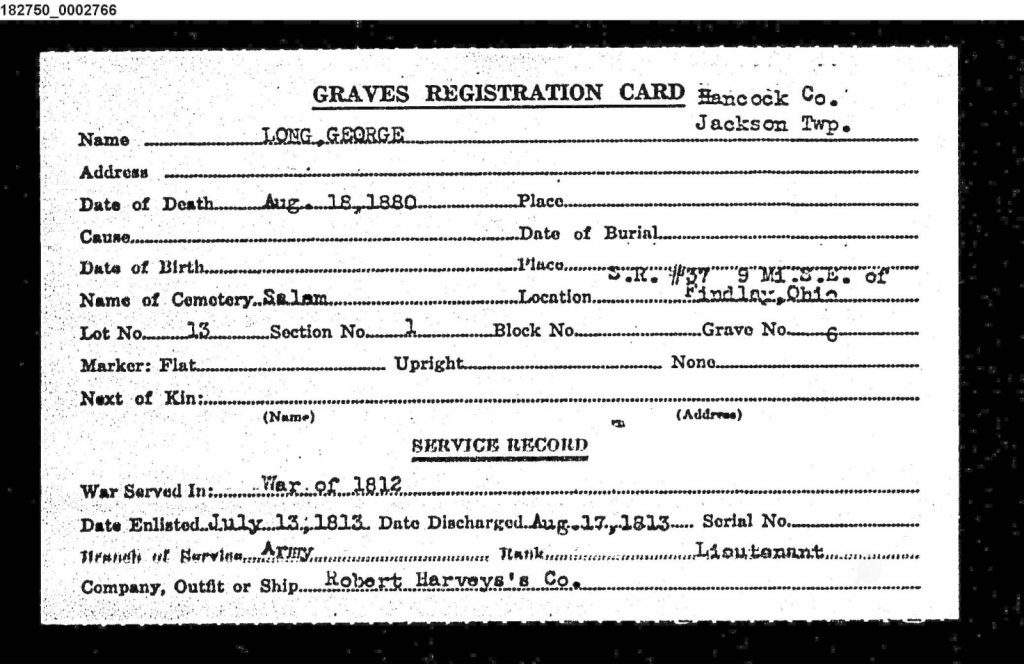
In fact, the other George Long (whom I call “Candidate 11”) that lived in Hancock County has an obituary that mentions his service during the War of 1812. It seems they both were attributed with the service of the other George Long.
This is an example of resolving conflict in my George Long project. I found a conflict that I couldn’t ignore and had to explain. This caused me to conduct research that ultimately did not apply to “my” George Long but had to be done to prove that he, in fact, did not serve during the War of 1812. Address the conflicts you find so they are explained and not left hanging.


1. Ohio, Adjutant General’s Department, “Grave Registration Cards A–Z, soldiers buried in Ohio from the Revolutionary War to World War II, circa 1810–1967,” Works Progress Administration Project, Historical Records Survey, card for George Long, died 7 Oct 1855, Thomas Cemetery; image, “US, Ohio, Soldiers Grave Registration Cards, 1804–1958,” Fold3 (https://www.fold3.com/)

2.  “Grave Registration Cards A–Z, soldiers buried in Ohio from the Revolutionary War to World War II, circa 1810–1967,” Ohio History Connection (https://ohiohistory.on.worldcat.org/), catalog entry.

3. Tutti Jackson, Library Services, Ohio History Connection (reference@ohiohistory.org) email to author on 29 Dec 2023.

4. Roster of Ohio Soldiers in the War of 1812 (Columbus, Ohio: Adjutant General of Ohio, 1916), p. 51. Neither a War of 1812 pension or service card have been located for George Long of Robert Harvey’s Company.

5. Roster of Ohio Soldiers in the War of 1812, p. 113.

6. “1820 United States Federal Census,” Ancestry (https://www.ancestry.com/search/collections/7734/). Search for George Long in Ross County, Ohio. The 1810 Federal census for Ohio is not extant. See Kip Sperry, Genealogical Research in Ohio, 3rd ed. (Baltimore, Maryland: Genealogical Publishing Co., 2023), p. 79.

7. See 1840 U.S. census, Ross County, Ohio, population schedule, Concord Twp., p. 292, George Long household; image, “1840 United States Federal Census,” Ancestry (https://www.ancestry.com/).

8. “US, War of 1812 Service Record Index, 1812–1815,” Fold3 (https://www.fold3.com/publication/875/us-war-of-1812-service-record-index-1812-1815). Search for George Long. None of the cards returned are for men in Harvey’s or Pancake’s regiments.

9. General Index Card, George Long, Private, 1st Regiment (McDonald’s), Ohio Militia, War of 1812; Indexes to the Carded Records of Soldiers Who Served in Volunteer Organizations During the War of 1812, compiled 1899 – 1927, documenting the period 1812 – 1815; Record Group 94: Records of the Adjutant General’s Office, 1780s–1917; image, “US, War of 1812 Service Record Index, 1812–1815,” Fold3 (https://www.fold3.com/). McDonald’s regiment was not included in the Ohio Adjutant General’s 1812 Roster. See Roster of Ohio Soldiers in the War of 1812 (Columbus, Ohio: Adjutant General of Ohio, 1916).

10. General Index Card, George Long, Private, 2nd Regiment (Willett’s), Ohio Militia, War of 1812; Indexes to the Carded Records of Soldiers Who Served in Volunteer Organizations During the War of 1812, compiled 1899 – 1927, documenting the period 1812 – 1815; Record Group 94: Records of the Adjutant General’s Office, 1780s–1917; image, “US, War of 1812 Service Record Index, 1812–1815,” Fold3 (https://www.fold3.com/). Willett’s regiment was not included in the Ohio Adjutant General’s 1812 Roster. See Roster of Ohio Soldiers in the War of 1812 (Columbus, Ohio: Adjutant General of Ohio, 1916).

11. “US, War of 1812 Pension Files, 1812–1815,” Fold3 (https://www.fold3.com/publication/761/us-war-of-1812-pension-files-1812-1815/description). Searched for George Long in Ohio. There are four pensions for men named George Long, in South Carolina, Virginia, and two in Maryland. One George Long who served in Captain Brown’s Company in Maryland, lived in Hancock County at the time of his pension application. That man’s wife was Elizabeth Rockey and they lived in Amanda Township, not Portage Township. That man has been identified as “Candidate 11.” See previous posts.

George Long: Separating Two Men of the Same Name

I’m going to go back to my George Long project for two more posts, then I’m going to let it lie for a bit. I was thinking about “reasonably exhaustive research” and I wholeheartedly believe I did meet “reasonably exhaustive research” for this project, at least in terms of answering the original research question, which in its abbreviated form was “Which George Long was the father of William Long?” I had clues about where they originated, I thought I had the right George Long in the right counties in Ohio, but I had to prove the right one and explain away the literal eleven other George Longs I found in the right time and place. Two instances of military records causing confusion were discovered during this project and I thought they would make great examples of the necessity and value of looking at original records, and the need to resolve conflicts you find in the records.

[If you do not know what I mean by “reasonably exhaustive research,” it is one of the tenets of the Genealogical Proof Standard. Click here to learn more.]

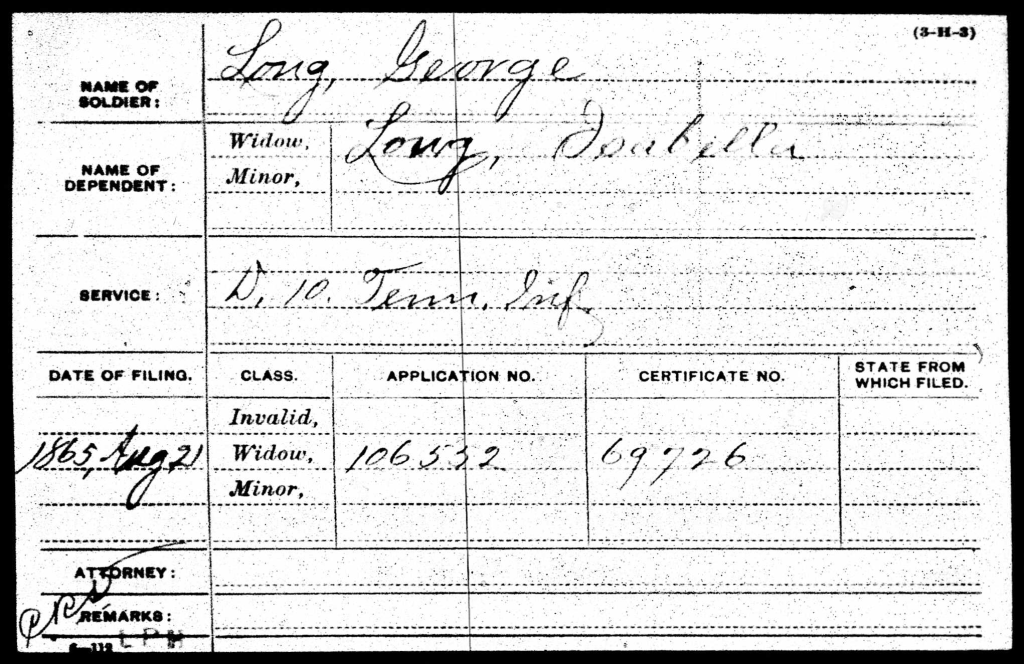
One of the records I found and saw attached in many online trees was a pension card for George Long and his wife Isabella. I have learned the hard way not to ask myself “how many George Longs could there possibly be that have a wife named Isabella in Ohio” because the answer is never “just one.” (In the case of THIS George Long project, there are at least two in the counties in Ohio I was focused on, but that’s a story for another time.) The pension card I kept seeing was indeed for George Long and his wife Isabella:

I have looked at every Ancestry tree (I think) that has what appears to be the same George Long I’ve been researching, and many of them have this card attached. My George Long lived in Ohio, but I suppose he could have gone to Tennessee to serve, though I’m not sure why he would have since there were plenty of units being raised in Ohio. However, a genealogist who aspires to conduct “reasonably exhaustive research” cannot ignore evidence items. I mean many online trees have this record attached to the same George Long I was looking at, so it should be examined.

We have all found errors, mistakes, and conflicts in online trees. But we have all also found gems, clues, and keys to solving our puzzles as well. Remember not to engage in “source snobbery.” We can’t learn much from this pension card alone. We have his name, his wife’s name, and his unit (Company D of the 10th Tennessee Infantry). We have the date his widow filed (21 August 1865). We have her application number and certificate number.

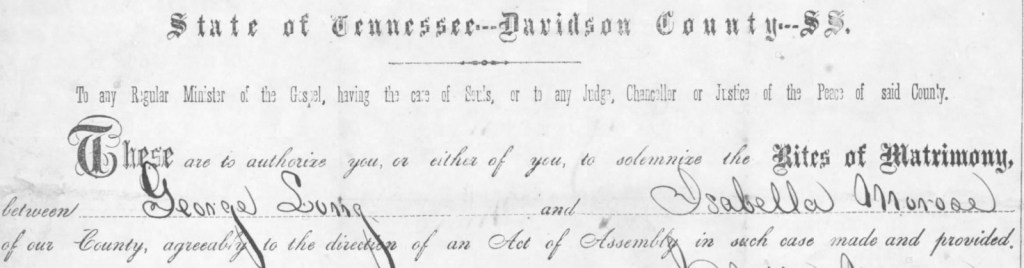
With that information, I found his pension file, this one in particular is available on Fold3. From that, I learned that Isabella’s maiden name was Morose. At the time of filing for a Widow’s Pension, Isabella (Morose) Long was a resident of Walker County, Georgia. Her husband George died on 15 April 1865 of small pox in a hospital in Nashville, Tennessee. They married on 25 July 1864 and had no children.1

However, the most obvious fact that is overlooked is that if the George Long I’ve researched died in 1855, he could not be the George Long that served during the Civil War (1861-1865).

Other datapoints do not line up either: he did not live in Tennessee or Georgia, he definitely had children, and his wife was Isabella McCullough, not Morose.

I write this post, not to cast dispersions upon other genealogists who have attached the wrong document to George Long. We have all done it. I don’t believe there is one genealogist who hasn’t made a similar mistake. I am writing this post to share my process of correcting my previous work and looking beyond an index, index card, or any other derivative (second-hand) source and examine the original. Then, pull every bit of information out of that original and compare it to the known information you are working with. Plus, understanding the chronology (see my previous posts about timelines) helps you make determinations about the records you are looking at.

We will address the issue of resolving conflict in the next post. Stay tuned!


1. Claim for Widow’s Pension, 4 Apr 1866, Isabella Long, widow’s pension W.C. 69726, service of George Long (Pvt., Co. D, 10th Tenn. Inf., Civil War); Case Files of Approved Pension Applications of Widows and Other Veterans of the Army and Navy Who Served Mainly in the Civil War and the War With Spain, compiled 1861–1934; Civil War and Later Pension Files; Record Group 15: Records of the Department of Veterans Affairs; image, “US, Civil War ‘Widows’ Pensions,’ 1861–1910,” Fold3 (https://www.fold3.com/file/288364023).

Analysis and Correlation Tools used in George Long Project: Timeline

I love timelines. They have so many benefits when it comes to genealogical research. It helps you see an ancestor’s life in order. We get so many records, bits of information, and other clues, that putting them in time order helps me to see their life. It also helps to solve some genealogical problems such as if you’re working with one man or more of the same name, like my 12 George Longs.

The main thing I use them for is to help me find holes in my research. When I find gaps in time especially if they also changed location, I start asking questions, the main one being “what records can I find that will help fill in this gap?”

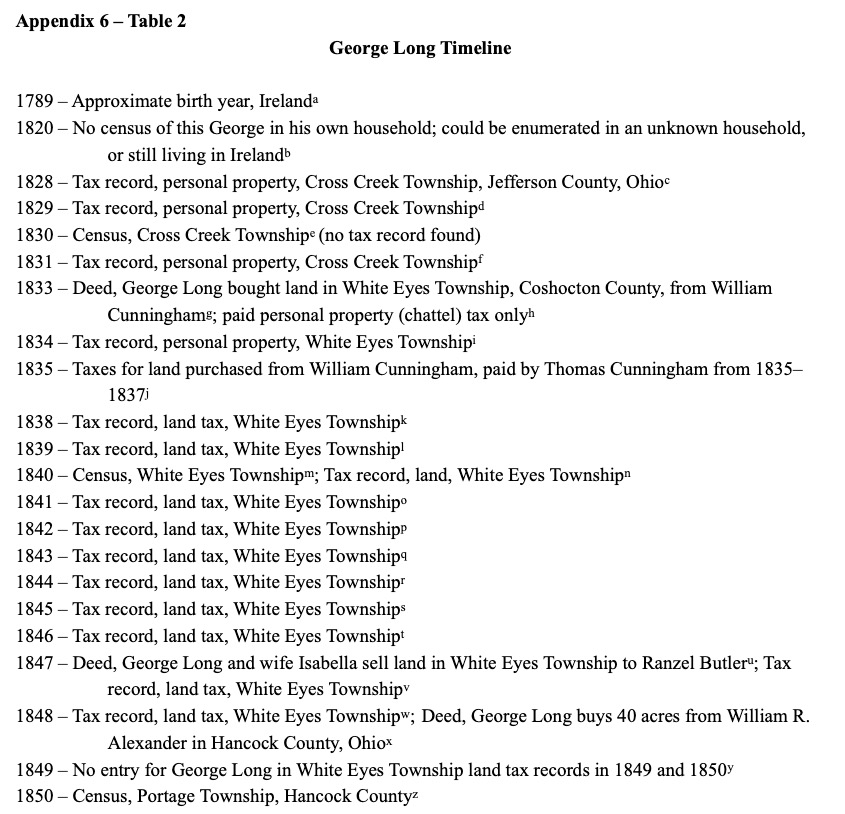
For George Long, I had twelve candidates. Many of them I could easily eliminate, usually because they didn’t end up in Hancock County, Ohio. Some of them died too early, or married women not named Isabella. But when I narrowed in on the “correct” George Long, I found him in a couple of locations before he made it to Hancock County. I had to be sure his time in those locations made sense. A timeline did this for me.

I’m just showing you part of the timeline, and I’m not showing the footnotes, but rest assured, there are citations for each fact. I needed to show that the George Long in Cross Creek Township of Jefferson County, stopped showing up in the tax lists just as the George Long of White Eyes Township in Coshocton County buys land and starts paying tax in that county. Later, I show the sale of his Coshocton County land (an him no longer on tax lists) just before his purchase of land in Hancock County.

The timeline helped me demonstrate that this was indeed one man and his life events lined up with those of the Hancock County George.

Of course, other records were used, there is a DNA portion to my case, and I had a series of conflicts I needed to resolve, but these last several blog posts have hit the highlights of my George Long project. I hope it gave you a bit of insight into my recertification process.

Analysis and Correlation Tools used in George Long Project: Mind Map

To keep track of the data, and to be able to visualize the information I was dealing with, I successfully used a mind map on this project. I shared a very zoomed out view in a previous post. I identified 12 George Long candidates! I had to figure out some way to keep track of them, determine which George Long a particular record belonged to, and compare information so I could eliminate the wrong men.

I have not used mind maps much in my previous work. They just didn’t seem to apply to projects I was working on as well as another tool did. When I am writing, I usually start with an old school outline. That’s just how I was trained in my early english writing classes, and it stuck with me and makes the most sense to me. However, it was not working when it came to dealing with all of the George Longs. I had many documents and needed to be able to distill them down to individuals. A mind map worked great for this.

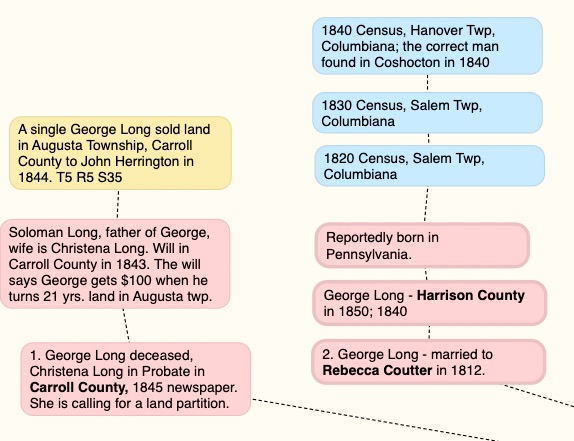
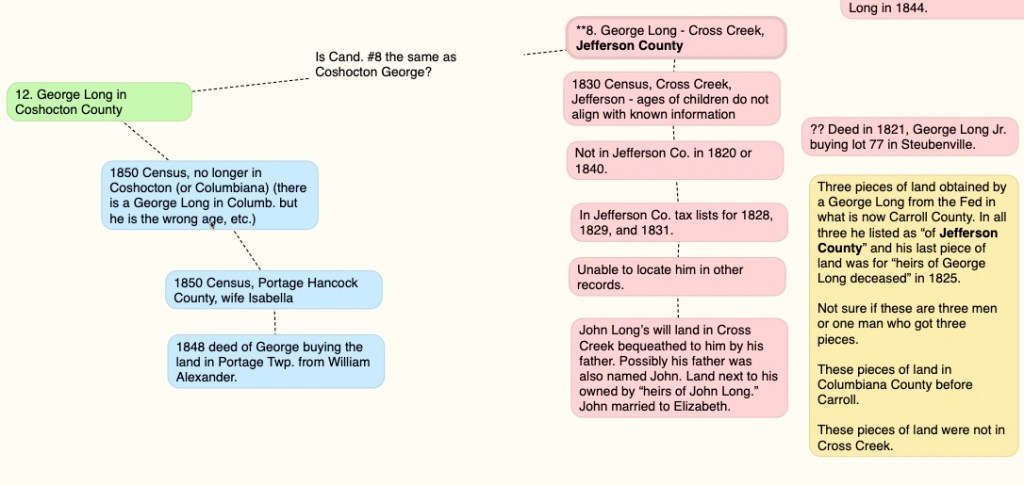
Here is a zoomed in section of my mind map for candidates numbered 1 and 2.

As I collected data from documents, and as I could determine who they belonged to, I added them as a “bubble” to my mind map. The colors didn’t mean a lot except to depict a different type of record, and I wasn’t necessarily consistent. The red bubbles were the starting point information and any records I could tell belonged to the same man.

Keep in mind, the mind map evolves over time. You’ll notice that there is a note in the image above about the 1840 census for a George Long in Columbiana County, that the correct man was found in Coshocton in 1840. That note came later, of course.

As I was working, I would suspect that two men I had were actually the same man, so I would make notes to that effect, such as the question in this image. “Is Candidate #8 the same man as Coshocton George?”

Then I would do more research to answer that question.

I would go around and around with questions and research until I felt like I had a solid understanding of who each man was and why they are not the “correct” George Long.

Again, keep in mind you are seeing the last version of this before I started writing. This was used as the outline to write up my final findings on the George Long project. The mind map, in my use of it, is never meant to be a final product. I would not publish a mind map as a visualization of my research. It is just for my own organization and visualization of the information gathered.

Next time we will look at the timeline I created for this project. It was the other major tool I used to prove which George Long was the correct George Long. Until then…

George Long in Coshocton and Jefferson Counties

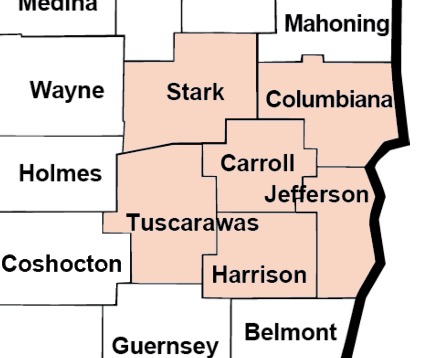
So, after combing through all of the George Longs that just didn’t fit the parameters of the George I identified in Hancock County (i.e. age, wife, names of children, etc.) I found only one that could have been the man who moved to Hancock County and bought land there in 1848. There was a George Long who owned land in Coshocton County. Why did I look at Coshocton County? If you recall from several posts ago, George Long was supposedly from “Carroll County” (but it wasn’t a county at the time that he was supposed to have been there). So my searches had to take place in the five counties that Carroll was formed from: Stark, Columbiana, Jefferson, Harrison, and Tuscarawas. You may notice that Coshocton is one county to the southeast of that cluster. Why did I look at Coshocton? George’s son, George W. had Coshocton County listed as his birthplace his obituary. We can’t leave any clue unexamined, and thank goodness I didn’t ignore that seemingly one-off comment.

In 1833, George Long purchased 80 acres from William Cunningham in Coshocton County.1 George was listed on the Coshocton County tax lists from 1833 through 1848.2 Then, an 1847 deed recorded that George and his wife Isabella sold the land bought from Cunningham to Ranzel Butler.3

If you recall from the last post, George bought land in Hancock County in 1848.

There was a George Long who paid personal property tax (no real estate tax) in Jefferson County, Cross Creek Township from 1828 through 1831. He was enumerated in the 1830 census there as well, living near Dolly Long, Hugh McCullough, and Alexander McCullough, possible relatives.4 This George Long was not living in Jefferson or Carroll counties by 1840; he had moved on to Coshocton County.

Following tax and land records and comparing them to the censuses, and one clue from a son’s obituary, allowed me to track down George Long in two counties prior to his appearance in Hancock County.

We will discuss some correlation tools I used to keep track of this information and to present it to the judges in the next post or two.

  1. Coshocton County, Ohio, Recorder’s Office, Vol. 11 (1837–1838), p. 601, William Cunningham deed to George Long, 8 Feb 1833; FamilySearch (https://www.familysearch.org/ark:/61903/3:1:3Q9M-C37X-CQF8-9), IGN 8578415. The land was described as the west half of the southwest quarter of S8, T6, R5 in the Military District.  ↩︎
  2. Coshocton County, Ohio, tax records for George Long; Coshocton County Auditor’s Office, Coshocton, Ohio. Records were searched and copied for the years listed; special thanks to Laurie Hermance-Moore MLS, AG® for visiting the Auditor’s office for me. ↩︎
  3. Coshocton County, Ohio, Recorder’s Office, George and Isabella Long, deed to Ranzel Butler, 6 Sep 1847, Vol. 21 (1846–1847), pp. 634–635; FamilySearch (https://www.familysearch.org/ark:/61903/3:1:3Q9M-CSLX-LSLC-K), IGN 8194076. ↩︎
  4. 1830 U.S. census, Jefferson County, Ohio, population schedule, Cross Creek Twp., p. 176, George Long household; image, “1830 United States Federal Census,” Ancestry (https://www.ancestry.com/imageviewer/collections/8058/images/4093942_00281).  ↩︎

Two Hancock County Georges

While trying to determine WHICH George Long was William’s father, I discovered two George Longs in Hancock County, Ohio, of similar ages.

George W. Long, Amanda Township

One George Long used the middle initial W. He lived in Amanda Township with his wife, Elizabeth. He obtained 160 acres on 20 April 1837 through a cash sale.1 That patent refers to him as of “Franklin County” which is several counties to the south and east of the original cluster of counties from which Carroll County was created. In 1830, one George Long lived in Franklin County, Ohio; there were only girls, presumably daughters, in his household.2 Examining the 1840 census, reveals still only one George Long in Franklin County.3 Comparing those two households show that it is likely the same family that shows up in Amanda Township in 1850 with probable wife Elizabeth, and daughters Susanna and Lydia.4 George W. Long died on 18 August 1880 and was buried in Salem Cemetery in Houcktown, Jackson Township, Hancock County. This George was reportedly born in Maryland in about 1794. George’s will was entered into probate on 31 August 1880. His children were listed as daughters Mary, Eliza, Mahala, Elizabeth, Susan, and Lydia; no sons were listed.5

George Long, Portage Township

George Long purchased 40 acres from William R. Alexander in Portage Township.6 In 1850, he was living there with his wife Isabella and four of his children: Susan, Alexander, Ellen, and John.7He owned the farm in Portage Township until George’s heirs sold it to Abraham Miller in 1857.8 George’s heirs were listed on the deed selling his farm to his neighbor Alexander Miller in 5 March 1857: Alexander Long and Elizabeth, his wife, Isabella Long, Ellen Long, Catharine Franks, and Susan Long.9 Missing from the list of heirs was son John (presumed deceased between 1850 and 1857) and William. William, however, sold his “undivided eighth” portion of the same land to Alexander Miller in a separate transaction on 3 April 1858.10 George died on 8 October 1855 and is buried next to “Isabel” in Thomas Cemetery, just down the road from his farm.11

Maps

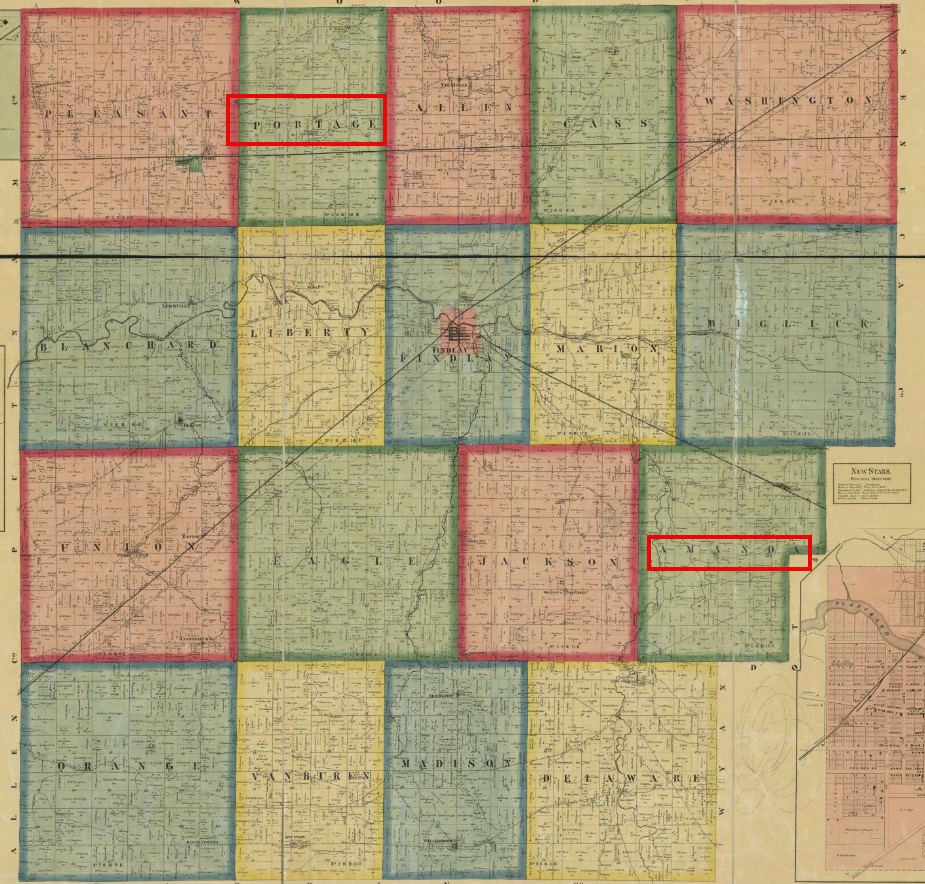
This is a good reminder to look at maps when researching your ancestors. It is one thing to say that one George was in Amanda Township and one was in Portage Township. It is another thing to see it on a map.

From the Library of Congress. Portage is in the upper left, Amanda is in lower right.

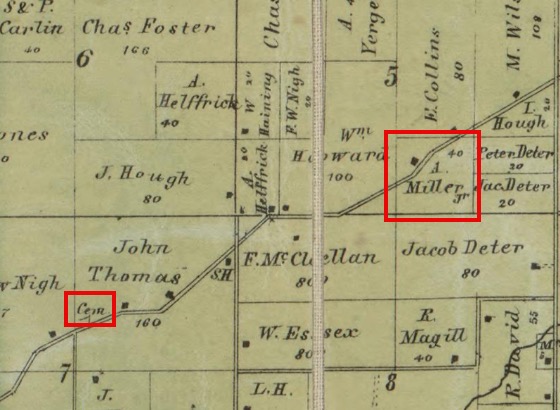
This close up shows the section of Portage Township where George’s land, that was sold to Alexander Miller, and the Thomas Cemetery, are located.

Based on the land records and the family make-up (i.e. George in Amanda Township did not have any sons), we can determine that the George Long in Portage Township is the father of William Long.

Now, where did the Portage Township George come from? Ten more candidates were found in the right times and places to possibly be the correct George. We won’t belabor all of those that I eliminated, but we will put together the pieces of the correct George and look at how I processed the information and kept it manageable next time.


  1. George Long (Hancock County), state volume patent (1837), certificate no. 174, Bucyrus, Ohio, Land Office; image, “Land Patent Search,” Bureau of Land Management, General Records Office Records (https://glorecords.blm.gov/details/patent/default.aspx?accession=OH1020__.174&docClass=STA&sid=bbz1fuho.ven). Patent for land in the Northwest 1⁄4 of S33, T1S, R12, 160 acres. ↩︎
  2. 1830 U.S. Census, Franklin County, Ohio, population schedule, Madison Twp., p. 88, George Long household; image, “1830 United States Federal Census,” Ancestry (https://www.ancestry.com/imageviewer/collections/8058/images/4093939_00192). ↩︎
  3. 1840 U.S. Census, Franklin County, Ohio, population schedule, Madison Twp., p. 19, George Long household; image, “1840 United States Federal Census,” Ancestry (https://www.ancestry.com/imageviewer/collections/8057/images/4409549_00206). ↩︎
  4. 1850 U.S. Census, Hancock County, Ohio, population schedule, Amanda Twp., p. 469 (stamped), dwelling 124, family 124, Geo. Long household; image, “1850 United States Federal Census,” Ancestry  (https://www.ancestry.com/imageviewer/collections/8054/images/4204481_00165). ↩︎
  5. Hancock County, Ohio, Probate Court, Record of Wills, Vol. 3 (1862–1884), p. 484–485, George Long’s Will, recorded 31 Aug 1880; image, FamilySearch (https://www.familysearch.org/ark:/61903/3:1:3QS7-L9M2-LP1), IGN 5430906. ↩︎
  6. Hancock County, Ohio, Recorder’s Office, Deeds, Vol. 7 (1848–1850), pp. 112, William R. Alexander, deed to George Long, 10 Feb 1848,; FamilySearch (https://www.familysearch.org/ark:/61903/3:1:3Q9M-C37X-QCZZ), IGN 8578921.  ↩︎
  7. 1850 U.S. census, Hancock County, Ohio, population schedule, Portage Twp., sheet 45A, dwelling 74, family 74, George Long household; image, “1850 United States Federal Census,” Ancestry (https://www.ancestry.com/imageviewer/collections/8054/images/4204481_00312). ↩︎
  8. Hancock County, Ohio, Recorder’s Office, Deeds, Vol. 7 (1848–1850), pp. 112, William R. Alexander, deed to George Long, 10 Feb 1848; FamilySearch (https://www.familysearch.org/ark:/61903/3:1:3Q9M-C37X-QCZZ), IGN 8578921.  ↩︎
  9. Hancock Co., Ohio, Deeds, 13: 290–292. ↩︎
  10. Hancock County, Ohio, Recorder’s Office, Deeds, Vol. 14 (1858–1865), pp. 224, William and Sarah Long, deed to Abraham Miller, 3 Apr 1858; FamilySearch (https://www.familysearch.org/ark:/61903/3:1:3Q9M-C37X-NVXQ), IGN 8578925. ↩︎
  11. “George Long (1789–1855),” tombstone photograph, Find a Grave (https://www.findagrave.com/memorial/39549214/george_long), memorial 39549214, created by “Calling~All~Angels”; Thomas Cemetery, Portage Twp., Hancock County, Ohio; tombstone photograph uploaded by “Calling~All~Angels,” 17 Jul 2009.  ↩︎

The Battle of the 12 George Longs

(The title is a Lord of the Rings/Hobbit reference in case you missed it. It made sense to me.)

I’ve mentioned a few times in past blog posts a project I’m working on to determine which George Long of the seemingly thousands in Ohio in the 1820s to 1830s is the George Long who died in Hancock County in 1855. I started working on this project as preparation for taking one of the Irish courses I’ve taken over the years… thinking I’d figure out how to get my George into Ireland. However, once I really got started, I realized I’d need to figure out WHICH George Long was even mine to begin with. And once I started analyzing things, I identified 12 George Longs who had even the slightest potential to be the right man. You have to eliminate those to be sure. The final element of the Genealogical Proof Standard is that you have to present your findings in writing, especially in tough cases that aren’t self-explanatory. If it isn’t in writing and accessible somewhere, it does no good to other researchers anyway.

[Unless you are one of those people who love to find the answer and then hoard it for yourself (like Gollum). Don’t be Gollum. He nearly destroyed all of Middle Earth.]

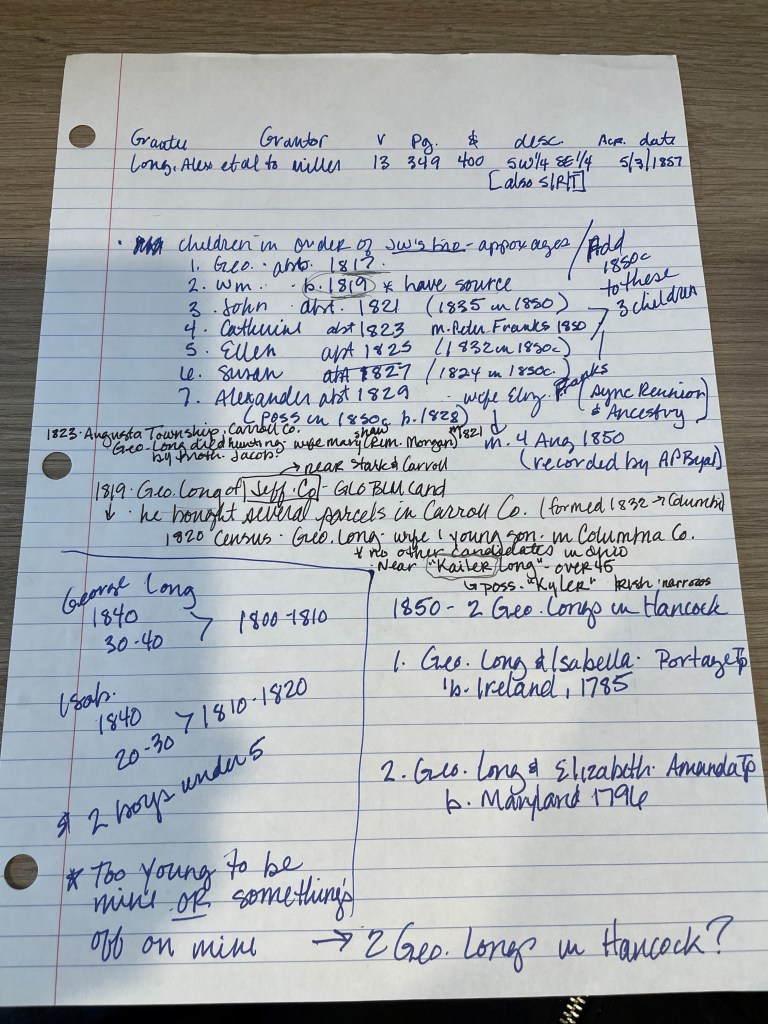
I am finishing up this project but ran across my early beginning notes, which are funny but also have part of the resolution I came to on them!

It was fun to look back at these scribbles once I’ve nearly finished and am confident in my findings. And it is good to know, even after this journey of identifying the correct George Long, that I was on the right track in the beginning.

This has been consuming my time over the past few months (along with my day job and my family), but I’ll be back to blogging more regularly (I hope) once I finalize this project and get it off my desk. In the meantime, happy scribbling!