In my recertification project, I examined census, tax, land, and probate records and identified twelve candidates in the right time and place to be George Long, father of William Long. But how did I decide on those twelve?
- Census – The biographical sketch of J. W. Long mentioned in the last post stated that William’s father was George Long and he arrived in Ohio in 1817 from “North of Ireland” to Carroll County, Ohio, where he married and had several children. I used that information to look for George Longs in the 1820 and 1830 censuses in the counties that would later make up Carroll County. They also had to have been born in Ireland, and of an approximate age to fit the other criteria such as the approximate age of William. His age was the one I left most wide open in terms of filtering results.
- Land – Knowing that many immigrants came to the United States for land opportunities, I identified George Longs in the Bureau of Land Management’s General Land Office (BLM GLO) database as well as in deed books in the five counties.
- Tax – Many counties in Ohio have tax records digitized and online for the years in which I was expecting to find George Long. Tax records can act like a yearly census.
- Marriage – Also, many counties in Ohio have marriage records available online for the counties in question in the right time frame to match the information from the biographical sketch. If the correct George Long married in one of the counties that made up Carroll County, then I should find a marriage record, ideally. (I never did.) But the marriage records let me sort out the other Georges into separate individuals.
Basically, I collected every George Long I could find in these records, matched them up as the same man, if I could with other context clues (land descriptions mostly), and boiled it down to twelve candidates. How did I keep track of everyone? Besides just textual notes in Scrivener where they were linked to their records, I also used a mind map which I created in Scapple. I am not traditionally a mind-mapper, it’s just not how I think, but it worked beautifully for this project.
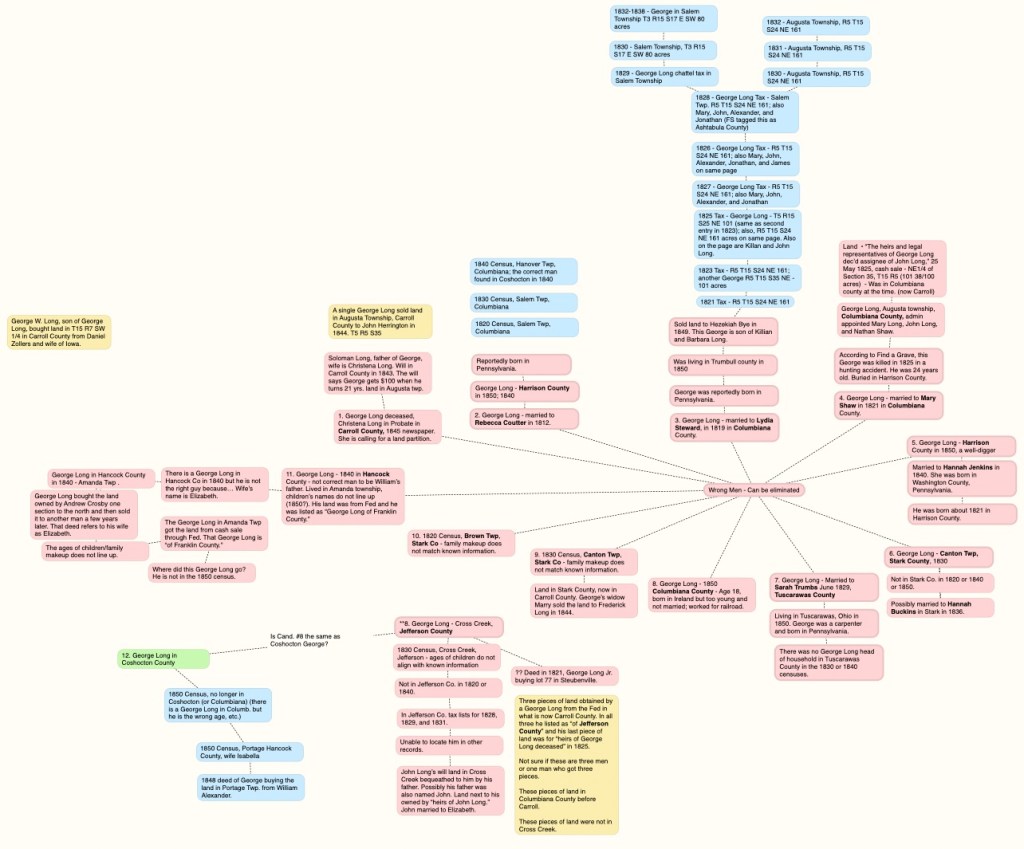
Mind mapping can be used to organize your thoughts. I’ve been to lectures and webinars on the topic. Many times they are used to help with writing in which you can just dump your thoughts into a mind map in no particular order and then later drag the pieces around to become more organized. I personally generally do better with outlines. However, as you can see, I had a lot of little bits of information I was trying to match up to individuals of the same name.
As I am looking at this mind map now, months after its use was finished, I don’t recall the point of the different colors. I believe the red/pink was definitely the wrong man but the blue and yellow I can’t remember why I used them. I’m sure I had a great reason at the time. They all ended up being the wrong man except for the green one and his connected records. And once I got to a certain point of understanding who was who, I stopped using the mind map and started writing. So, it is unfinished as a work product on its own.
Some of the boxes have questions, thoughts, reasoning, and information items. This was very useful when having to set the project aside to say, make dinner, and work, and then come back to it several days later. This allowed me to recall my thinking about a particular man and why I thought he was the wrong one.
Different tools fit different situations and different brains. You might absolutely love mind mapping and use it a lot more than I do. Someone else may prefer to have done all of this in a spreadsheet. Honestly, it doesn’t matter. What matters is that it works for you.

 Genealogy Pants