Tag Archives: evernote

Preparing for a Research Trip – Accessing Online Catalogs

Inside the Hancock County Courthouse research room. Photo by Cari A. Taplin

Before you embark on any research trip, it is wise to give yourself the time to comb through the repositories’ online catalogs and finding aids. Almost every library, archive and courthouse is going to have some kind of information online to help you plan your trip. My favorite thing to do (and the task which I usually short change myself on) is looking at online catalogs and creating a list of what I want to look at when I get there.

Salt Lake City’s Family History Library is a great example of an online catalog that is informative, easy to access and simple to plan from. If you have thought out your research goals and have a plan, then accessing the catalog and creating a “to do” list is the final step (well, before packing and filling up the car). It is like drawing a map for your visit in the library. We only have so much time before we have to leave any research trip so getting the most out of your time is essential.

There are several ways to collect the data and create the list of records, books, or micro-materials you want to access. Back in the “old days,” and by “old days” I mean before smart phones, tablets and even the wide-spread use of laptops, I used to access the catalog, print the page containing the description of the item, write on the blank space of the page or on the back who or what I was hoping to find in the record, and then would store it in a 3-ring binder. Each page was in a sheet protector and when I printed the corresponding records, they would be slipped into the sheet protector along with the catalog page. This ensured I had all of the data I need to create a source citation later.

Now, the microfilm readers have thumb drives. I can copy and store the catalog materials in Evernote. I can take photographs of the pages (even microfilm projections) with my smartphone directly into Evernote. I can sit next to the film reader with my MacBook Air (tiny, lightweight) and take notes in a spreadsheet or on Evernote. There are a million different ways to do this. Use whatever works best for you and your process.

Before you leave on your trip, but once you’ve identified what repositories you’re visiting, get online and see what online resources they have. Google is excellent at this. Just search for their catalog. One small local library I often visit is the Wood County District Public Library in Bowling Green, Ohio. Their online catalog is very helpful, allowing researchers to know ahead of time what they have in their collection. Their catalog is connected to a larger database, so if they don’t have what you are looking for you can search surrounding area libraries and see if they have the item nearby. WCDPL also has an excellent collection of newspapers on microfilm which are what I usually access when I go.

While I’m in Bowling Green, there are a few other repositories and locations I like to visit:

You can see from the above list that there is plenty to do in that one town. If I widen my range I also like to visit:

Findlay, Ohio

Perrysburg, Ohio

  • Way Public Library
  • Fort Meigs Cemetery
  • Zoar Lutheran Church (though a large portion of their records have been moved to Way PL)

These towns are within about a 45 mile range from each other, stretching north/south on the I-75 corridor in NW Ohio. There are countless cemeteries and historical attractions in between. By accessing data online before I go, I can create a plan that makes the most of my time there. When you are planning a trip, widen your range and figure out what you can reasonably visit and research with your allotted amount of time.

Set your research goals, create a map, plan your time, make a “to do” list by accessing online catalogs, take notes in your research log about what you’ve found, and have fun!
Conference Packing: What’s in YOUR suitcase?

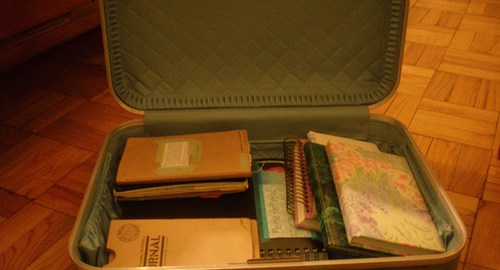
suitcase of memoriesThe FGS conference in Fort Wayne, Indiana is about a month away. I am leaving for GRIP this Saturday. I will be going on a research trip to Salt Lake City in September. My summer travel plans are ticking by. Regardless, I do have a checklist for what to bring to any given event that’s genealogy related.

  1. Bring a sweater. I don’t know about you but even though it might be 90 degrees and 99 percent humidity outside, being inside can sometimes be like the arctic. For that matter it can also be 90 degrees and humid. My point being bring a sweater and dress in layers. There is nothing more miserable that being too hot or too cold. Be prepared.
  2. I have a small zipper pouch of essential office supplies: sticky notes, sticky flags, pens (1 ball point and a few colored felt-tipped), pencils, a few paperclips, highlighters (I prefer yellow), etc. I don’t use this as much as I used to, but I am one of those people who write in the books that I buy so I use these items a lot.
  3. Business cards. I will be milling about with fellow genealogists and potential clients, so it’s important to have some cards on hand at all times.
  4. I used to always bring my laptop, but since I got a blue tooth keyboard for my iPad, I am loving the lightweight portability of just carrying around a small bag rather than my backpack or rolling suitcase. (Don’t forget the chargers for all of the electronic devices!) When going on a research trip, I make sure that I have all of my files synced with my iPad, mainly my latest Reunion file. I also put all of my travel itineraries, hotel, air, car reservations in Evernote, which syncs to my iPad/iPhone.
  5. Pre-planned list of the programs I wish to attend. I will copy the syllabus to my iPad to have with me at the lectures. I have a .pdf viewing app that allows me to highlight and make notes right on the syllabus pages. No more need to print them out ahead of time, only to realize you printed the wrong pages, or carry around the giant books they used to give out at conferences.
  6. Leave extra suitcase space for the books you might buy and the free swag you will pick up.

Of course, the above list is in addition to all of the socks, undies, t-shirts, shorts/pants, and toothbrushes needed to have an enjoyable trip. Good reading material is a plus as well. I usually have the latest NGSQ or other genealogy book with me for the plane ride. I hope to see you at FGS or any of the other amazing genealogical conferences and institutes available throughout the year.

Pray for NO DIRECT EVIDENCE!

image from wikimedia commons

So, I went “on the clock” (for BCG certification) in December 2012. In the meantime a lot of “life” has happened but a lot of “life” is going to happen when you take a step like this. I’m the type of person who needs a deadline, so I went on the clock. Once I sat down and tried to locate a family/problem for my case study, I got concerned. One look at my office, my binders, my computer files, told me that I was horribly unorganized and I needed to do a lot of catching up, fixing, data entry (I have a thumb drive with scans from Salt Lake City from 2009 that I haven’t worked with yet!) and organizing, before I could even make an educated guess on the case study.

Well, in the last week, I went through a very large pile of notes with “to-do” items on them, some dating back to 2003. They said things like “find tombstone for …” or “locate obit for …” or one sticky note “I am not convinced that ––– is really –––’s father.” (Names being left out in case this REALLY is my case study.) That one sticky note sent me on a swirl of reviewing documents, notes, computer files, quick look-ups on Ancestry and FamilySearch. I MAY just have found my case study. I have a few pieces of indirect evidence but nothing conclusive that says who the parents of my subject are.

This project is so counter-intuitive for the genealogist. If you’ve never reviewed the Case Study requirements for the BCG portfolio, it basically requires that you use the genealogical proof standard to solve a problem of conflicting evidence or by using of indirect evidence. I know that I have many of these in my family research, but finding a good one can be challenging. And then, what happens when you start to work hard on it and then find that piece of direct evidence? … ah … back to square one.

I did get through my pile of to-dos and either figured out that they had been done (recycled), or if they were easy to do (just did it), or they went into my Evernote to-do list (then recycled). Now, on to some research! So pray for my project, that I find no direct evidence on this man’s parentage and instead am able to locate a lot of really good indirect evidence!


Upcoming Event Schedule (May 2, 2013)

bigstock_calendar_54869811I just wanted to share the events I will be attending as well as the programs I will be giving for the rest of the year. I have a busy few months ahead!

  • May 4: “Evernote” Presentation – Colorado Chapter APG
  • May 23-June 2: Road trip to visit family and do a little research in Ohio
  • June 8-14: I will be attending Elizabeth Shown Mills’ course on methodology at IGHR (Birmingham, AL)
  • June 21-July 5: Family vacation to Minnesota (I don’t have any ancestors up there, so I will probably do a lot of reading and/or writing when we aren’t fishing and canoeing.)
  • July 10: “A Nose for the News” presentation – Adams County Genealogical Society
  • July 20-27: I will be attending Tom Jones’ course at GRIP (Pittsburgh, PA)
  • August 6: “Genealogical Education – Institutes and Home Study Options” – Boulder Genealogical Society‘s “You Asked For It” series
  • August 21-24: I will be attending the FGS Conference in Fort Wayne, IN
  • September 10-13: I MAY be attending a research trip to Salt Lake City with the Castle Rock Genealogical Society
  • September 21: “The Power of the Family Legend: How I am Related to Roy Rogers” presentation at Castle Rock Genealogical Society
  • October 1: “Evernote & Evidentia” – Boulder Genealogical Society’s “You Asked For It” series
  • October 5: I will be attending the first annual Rocky Mountain Genealogical Seminar featuring D. Joshua Taylor
  • November 21: “Evernote” Presentation – Larimer County Genealogical Society
  • December 3: Title still to be determined, topic is county histories and mug books – Boulder Genealogical Society