Tag Archives: Farming Ancestors

Just Keep Looking…

One of the points we are going to stress in our GRIP course “Not Just Farmers,” is to keep looking. Don’t stop just because one thing didn’t turn up any records for you. There are always more databases, digitized collections, online books, and so much more to find.

I have been researching my third great-grandfather for years. Samuel Cook Dimick and his son Marshall Chester worked a farm east of Bowling Green, Ohio, in Wood County. A few years ago I dug deeper into his life to develop his timeline for my lecture on the subject. I found so many new records about him during that research that I figured I had probably reached near the most of what I could find.

For this course, I am using him as one of my example farmers because I had already gathered so much information on him. However, while preparing for these new topics on farming, I have found so much more! Tidbits on his farm, crops, social activities in farming clubs, his involvement in the Prohibition movement, experiments and data collection he took part in for scientific studies, etc. During this work, I found new and exciting digitized collections I could access from home. I also found many finding aids and collections that I need to access in person (either myself or by hiring a researcher to go on my behalf).

My point in sharing this is to encourage you to keep looking, digging, clicking, and reading. Below are a few new things I learned about Samuel Cook Dimick.

He took part in a data collection study to improve the sugar beet industry. He was listed in an 1898 report to the Federal Government which indicates that he grew a variant called “Vilmorin’s Improved” sugar beets and the average weight and amount of sugar in the beet was collected. It also recorded that the season was favorable that year.

Progress of the Beet-Sugar Industry of the United States, 1898; available on Google Books.

He entered some items in the Wood County Fair in the “Plain Needle Work” category:
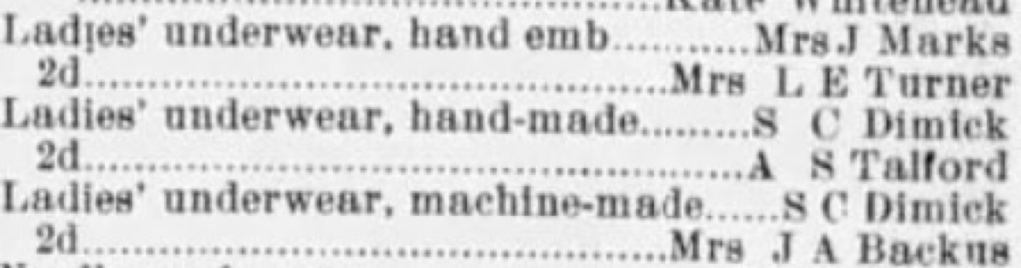
The Daily Sentinel-Tribune, Bowling Green, Ohio, 7 October 1890, p. 3. 

I had no idea.

The things you learn when you keep on clicking!
The Nigerian Prince: Swindlers and Vigilantes in Agriculture

Scammers are nothing new. They have probably existed as long as people have. And you only have to look so far as the newspapers to see them in the 1800s in the U.S. In our GRIP course, “Not Just Farmers,” I will be talking about “Farming Outside the Law.”

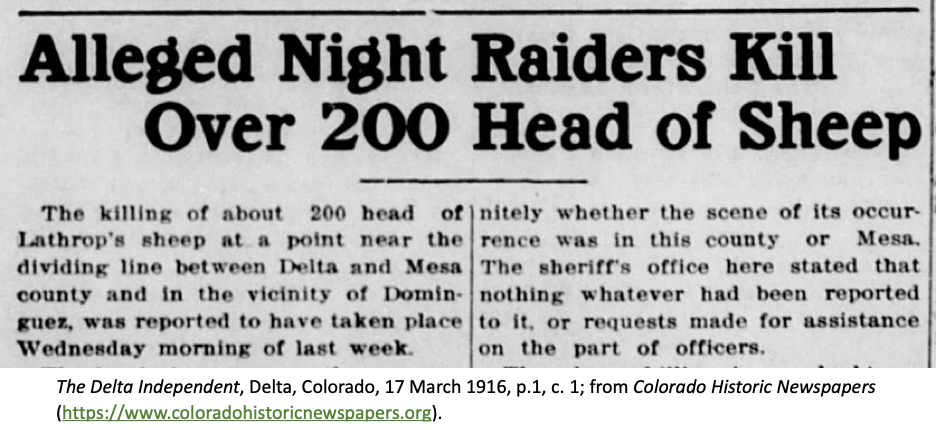
One topic I’ll be covering are vigilante groups who were not happy with the speed that law-makers moved. If they saw an injustice, they just took it upon themselves to right the wrongs. A premise I can get behind in general, but you know these groups always take things too far. One group’s goal was to intimidate sheepmen from grazing on public lands. There was a belief that sheep were inferior to cattle (longer story that I have time to go into here) and therefore groups formed to run off the sheepherders. Well, intimidation turned to violence and killing of sheep.

Another topic I’ll be touching on are the scammers, conmen, swindlers, and thieves that used an agricultural front to make their fortune. Many news articles can be found warning communities of a conman working in an area. For example…

Swindlers and people taking the law into their own hands… it’s a tale as old as time. And we’ll be talking more about it in our course. I hope you can join us!

History of Christmas Tree Sales – George Biniker

One of my lectures in the upcoming GRIP course, “Not Just Farmers,” is on historical “side-hustles.” Basically, farming families did not make enough money with farming alone to pay the bills. They added to their incomes with other jobs, sometimes off the farm. This lecture will explore that topic. One “rabbit hole” I went down while working on this topic is that of Christmas tree farms.

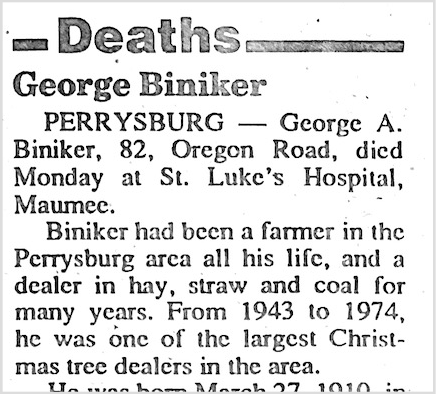
In my family tree is a man named George Biniker, who, according to his obituary, was “one of the largest Christmas tree dealers in the area.” I had always liked that little tidbit about him but never took the opportunity to research it until this course came along.

Daily Sentinel Tribune, Bowling Green, Ohio, 23 February 1993, p. 2. col. 5.

Christmas trees were originally introduced to Americans by German settlers in the early 1800s. In 1851, Christmas trees began to be sold commercially in the United States, cut down randomly from forests. The first known Christmas tree farm was a 25,000-acre Spruce farm set up in 1901 near Trenton, New Jersey by W. V. McGalliard.1 Initially, Christmas tree farms were  seen as a way to utilize poor farmland. The first national survey of the Christmas tree industry was taken in 1948. At that time, about 85% of the 21 million Christmas trees were grown in the wild. By 1971, half of Christmas trees were grown on farms as a cash crop.2

The business of a Christmas tree farm is not a lucrative business. It is a lot of work, with narrow margins, and a long lead time. Christmas trees do not grow quickly. One you might buy at a store or market is anywhere from five to 14 years old. There is a delicate balance between not selling enough and selling too many trees on any one year. As one farmer in the business states “A lot of these could be cut, but next year they will be a foot taller and 20 bucks or more.”3

George Biniker indeed was a Christmas tree dealer. He also was a dealer in hay, straw, and coal, and later was a seed agent for Pfister Hybrid seeds for the Arthur Walter Seed Company. He, like most farmers, found financial supplementation in endless ways.


1. “The History of Christmas Trees,” National Christmas Tree Association (https://realchristmastrees.org/education/history-of-christmas-trees/ : viewed May 2024).

2. Maria Hasenstab, “A Quick History of the Christmas Tree Industry,” Federal Reserve Bank of St. Louis (https://www.stlouisfed.org/open-vault/2017/december/history-christmas-tree-industry : viewed May 2024).

3. Chris Chafin, “The Barely Profitable World of the Christmas Tree Grower,” Ambrook Research, Farm Finance (https://ambrook.com/research/farm-finance/christmas-tree-grower-profits : viewed May 2024).

Another rabbit hole…Barbed Wire…collectors?

I was doing some research for the “Not Just Farmers” course at GRIP, on barbed wire and how it changed the country. It basically spelled the end of the large cattle drives because as settlers moved in and homesteaded, they also put up fencing to marking off and protecting their land for their own use. But that’s a whole ‘nother topic that is not the rabbit hole for today.

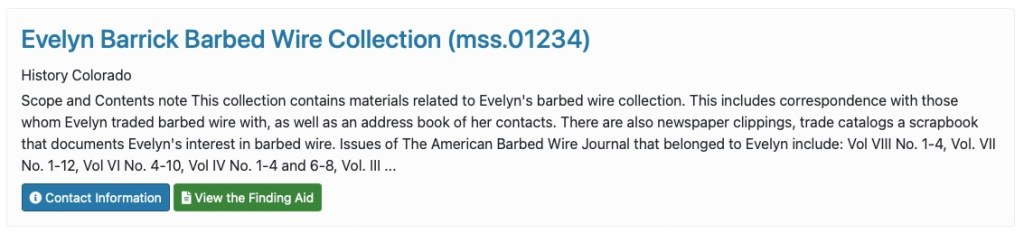
I was using the phrase “barbed wire” as a search term on ArchiveGrid to demonstrate finding records for farming inventions. And I came across a collection that is located at History Colorado titled “Evelyn Barrick Barbed Wire Collection.” The ArchiveGrid description says that the collection contains Evelyn’s barbed wire collection and correspondence with those she traded barbed wire with.

The entry from ArchiveGrid.

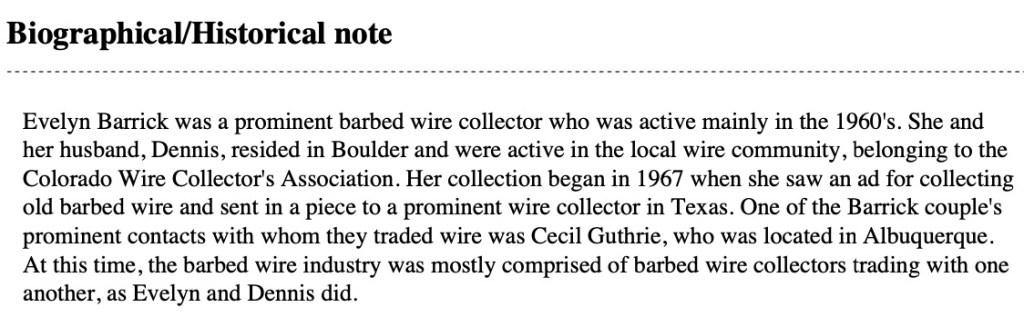
Ok, I have heard of some whacky hobbies and collections, but this one was new for me. I clicked on the item which took me to the finding aid at the History Colorado website. Turns out, there are all kinds of barbed wire collectors in the world. Evelyn and her husband belonged to the Colorado Wire Collector’s Association. I swear, there’s a club or association for everything!

Link to the finding aid.

So, it’s now on my list to someday head down to Denver to the History Colorado archive to take a look at Evelyn Barrick’s barbed wire collection. See, the things you didn’t know you needed to know.

You know you’re deep in a rabbit hole when…

This might become a regular topic on my blog. So many times I find myself down deep in rabbit holes when researching. You’ve never done that, I’m sure. As I’m preparing for the “Not Just Farmers” course for GRIP, I am finding myself on many a winding research paths and then I wonder how I got there!

This week’s rabbit hole brought to you by “History of Plant Hardiness Zone Maps” found on the Plant Delights Nursery, Inc. website. You know, those maps you find on the backs of seed packets or in gardening books. Like this one from the U.S. Department of Agriculture.

“2023 USDA Plant Hardiness Zone Map,” USDA (https://planthardiness.ars.usda.gov/). 

The history of these maps is fascinating. I won’t restate everything. You can click on the link to the article above and read for yourself. But what I found most interesting is that the first such map was published by the Arnold Arboretum at Harvard University in 1927 and compiled by Dr. Alfred Rehder from data collected from a survey about plants and their survivability in different regions. In 1938, the Arboretum published another map based on 40 years of data from the U. S. Weather Bureau.

It wasn’t until 1960 that the USDA published its first map…based on different data…resulting in conflicting information. The Arnold Arboretum maps remained the standard until 1990, “when the US Department of Agriculture, in cooperation with the U.S. National Arboretum, updated the USDA hardiness map, using data from between 4,800 to 14,500 weather stations.”

Following rabbit holes can really dig up a lot of information that may or may not be included in the course, or that course could last 2 full weeks or more! But this information can be useful in understanding our farming ancestors a little more deeply, perhaps. And may be useful come pub trivia night!

Searching for the “Chicken of Tomorrow”

As part of my presentation for the course “Not Just Farmers” at GRIP, I’ll be talking about inventions and ingenuity in agriculture over the years. Inventions and enhancements made the life of the farmer easier, improving labor conditions as well as yields of crops and animal products.

Prior to World War II, chickens were mostly bred for large eggs and large numbers of eggs. This was helpful during the Great Depression because farmers could get a protein source without sacrificing the hen. However, after WWII, chickens began being bred more for meat production, larger breasts, and better tasting meat. Howard C. Pierce worked as the “Poultry Research Director” for A&P Food Stores started the “Chicken of Tomorrow” contest, organized by the USDA and backed by A&P, aimed at breeding a better chicken.1

Indeed, there were advertisements and articles about the contest.2 The contest was seeking a “bird with a broader body and meatier drumsticks” with the ideal chicken having been determined by “months of research by leading poultry scientists and geneticists.” The prize would be a $5,000 cash award to the “poultryman who succeeds in producing the nearest equivalent to the ‘Chicken of Tomorrow'” specifications, within three years.

The Van Tress Hatchery of Maryville, California, was named the winner of the contest in June 1948. They developed a Cornish-New Hampshire crossbreed.3

The selective breeding boosted poultry yields that benefited the farmer’s sales and the food supply. Innovations and improvements have been a key part of agricultural life that we will discuss in the course.


1. Maryn McKenna, Big Chicken (Washington, D.C.: National Geographic Partners, 2017), 150-151.

2. Here is one example of an article seeing the “Chicken of Tomorrow” (https://www.newspapers.com/article/the-alexander-city-outlook-poultry-leade/145311611/)

3. Here is one of many articles that announced the winner (https://www.newspapers.com/article/fort-worth-star-telegram-chicken-of-tom/145312527/)

Grist Mills

My ancestor, William Long, was killed in a terrible grist mill accident at Gilboa, Putnam County, Ohio in 1861. The newspaper reported that his clothing got tangled in the belts and he was drug into the machinery, breaking every bone in his body.1

I will be talking about grist mills and this incident in my lecture on “Historical Side Hustles” in the “Not Just Farmers” course that this taking place at GRIP (virtual) in June. As part of the lecture, we are going to watch this video I found on how grist mills worked and thought I’d share it.

This video makes the grist mill look quite slow. However, grist mills were not just used for making flour. They also utilized the water-powered shafts to spin grinding wheels designed to sharpen tools. That’s what William was up to when he got caught in the machinery. He had gone to the mill “for the purpose of grinding his scythe; and while arranging the belt to the grindstone, his clothing was caught by another belt, and he was whirled around the shaft, which was making about ninety revolutions a minute…”

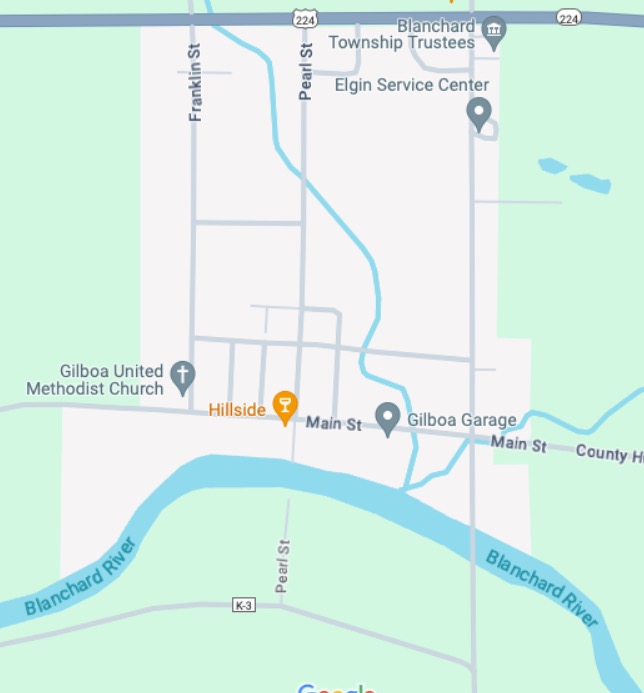
I then started looking at who owned the grist mill in Gilboa, where it was located, whether it was operated by water or not, and I came across an entry in the Putnam county history that stated that the first gristmill in Gilboa was opened by Elisha Stout in 1837.2 Gilboa is located on the Blanchard River, which also runs into Findlay, Hancock County, Ohio, where William Long lived.

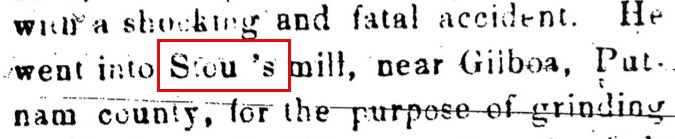
Rereading the news article about William’s death, there is a section of the print that is hard to read, but now makes sense… “He went into Stout’s mill…” The news article print is faded:

Two lessons here… First, check YouTube for short videos on how things worked to better understand what our ancestors were doing and seeing everyday. Second, as you learn more, go back an reread the materials you’ve already collected. New information will pop out at you, and old information will make sense that didn’t before.

And a third, don’t wear loose-fitting clothing when working around fast-spinning belts. It can result in a “sad accident.”


1. “Sad Accidents” William Long obituary, Hancock (Findlay, Ohio) Courier, 23 August 1861, p. 3, col. 1.

2. George D. Kinder, History of Putnam County,Ohio: Its Peoples, Industries, and Institutions, (Indianapolis, Indiana: B. F. Bowen, 1915), p. 116; available on Internet Archive at https://archive.org/details/historyofputnamc01kind.

One Tough Lady – Carry Nation

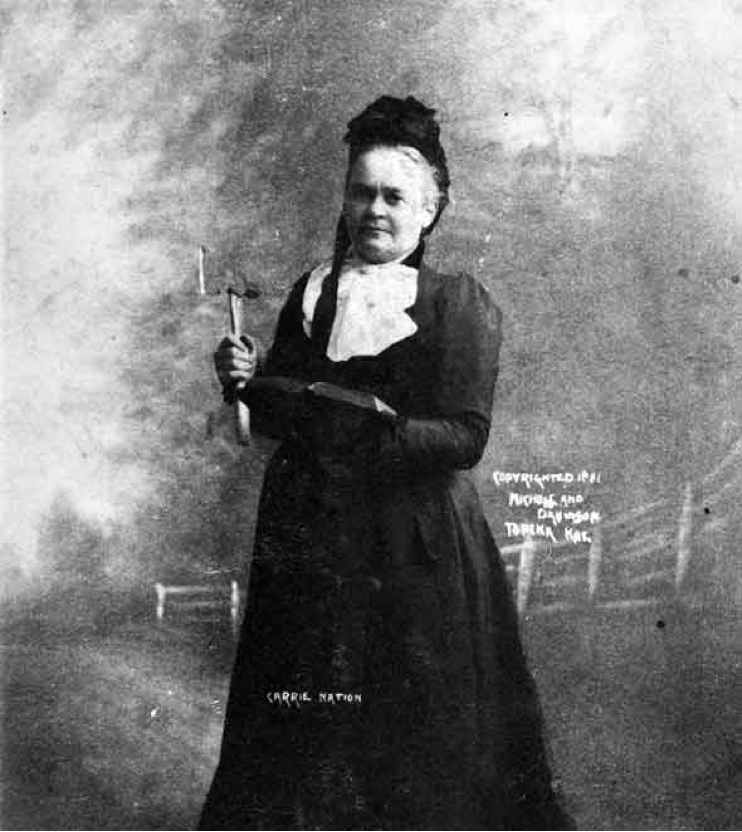
As I was reading about Prohibition and the Temperance Movement and it’s impact on agriculture, I came across a tough-looking woman, Carry Nation. She was a fighter for the cause, gaining a reputation for entering saloons and bars and breaking the liquor bottles with a stick or an axe. The axe then became her signature weapon and she posed in photos with the axe although it is claimed she more often used a lead pipe.

Carry Nation, photo from the Library of Congress.

Carry Nation grew up with an alcoholic father and a mother who suffered from mental illness. She felt that alcohol and drunkenness were a scourge and she wanted to save people from its effects.

You can read more details about her life all over the internet, but the account from History.com is one I recommend. Interestingly, a YouTube channel I follow for quilting this week added a tutorial on how to make a “Carrie Nation Quilt.” You can watch that video here if you are a quilter.

This will be part of a lecture I’m giving during our “Not Just Farmers” course through GRIP in June 2024. I hear that the course is sold out! (Thanks to those who have signed up!)

Black Cowboys

We will be discussing Black Cowboys in the ranching lecture of the farming course I am coordinating for GRIP called Not Just Farmers: Records, Relationships, and the Reality of Their Lives.

Historians estimate that one in four cowboys was Black. During their enslavement, many learned the skills needed to handle cattle herds (riding, roping, blacksmithing, leather-working, etc.) After emancipation, these skills were needed, especially in Texas where the longhorn herds were largely out of control after the Civil War. Cowboys were needed to drive the cattle north to markets where the prices were higher.

Of course, Black cowboys faced discrimination such as being banned from restaurants and hotels. Reportedly, most found respect among their white counterparts working the cattle drives together, respect that most Blacks found elusive. They sought the “largely unhindered outdoor life, fair treatment, and decent pay” that the life of the cattle drover offered; they sought a life where skill and hard work would matter more than skin color.1

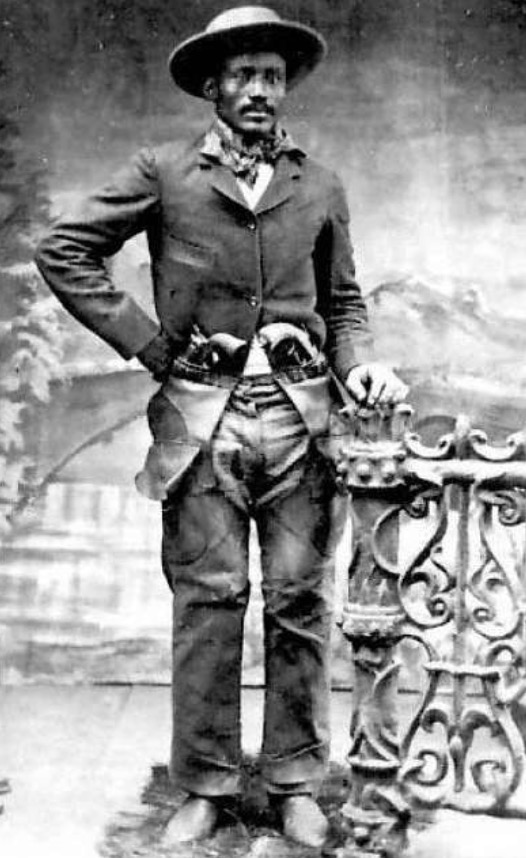
Ned Huddleston, aka “Isom Dart,” Brown’s Hole, Wyoming, 1890.

As most cattle drives ended by the early 1900s with the growth of railroads for moving cattle, the invention and use of barbed wire to parcel up the previously open range, the need for cowboys dwindled, and so did the opportunities for Black cowboys. However, the lore of the Black cowboy lived on in popular culture. From rodeos to western movies and books such as Lonesome Dove which featured Black cowboy Bose Ikard, the cowboy lifestyle lived on, as did the Black cowboy. Black cowboys had a heavy influence on cowboy ballads and music; the song Home on the Range was first recorded by a Black saloon keeper and cowboy.2

Here’s a list of movies featuring Black cowboys if you’re interested:

  • Buck and the Preacher (1972) starring Sidney Poitier
  • The Harder They Fall (2021) starring Idris Elba and Regina King and a mostly Black cast
  • Django Unchained (2012) starring Jamie Foxx and directed by Quentin Tarantino
  • Joshua (1976) starring Fred Williamson
  • Surrounded (2023) starring Letitia Wright

Watch these movies at your own risk. For example, Django Unchained is a Quentin Tarantino movie… if you’re familiar with his work, I need not say more. Enjoy!


1. William Loren Katz, The Black West, (Golden, Colorado, Fulcrum Publishing: 2019), p. 149.
2. Dom Flemons, “Black Cowboy Songs,” American Folklife Center, Library of Congress, 16 September 2020, video available online at https://www.facebook.com/watch/?v=1819161024888703. ]

Not Just Farmers…Ranchers Too!

One of the topics I’ll be teaching in our “Not Just Farmers” course at GRIP Genealogy Institute is on ranching. both cattle and sheep. We really want to cover as many agricultural pursuits as possible, and ranching and farming are interconnected.

One topic I’ll be discussing is “Texas Fever,” and unlike “gold fever” “Texas Fever” was a bad thing.

St. Louis Globe-Democrat, 28 August 1855

“Texas Fever,” or “Texian Fever” as the above article called it, sometimes also called “Spanish Fever” was a disease that Texas cattle carried. They thought the disease was tick-borne and spread in southern cattle because the weather was not cold enough to kill the ticks or disease. The cattle would carry this disease on the long cattle drives to the north. Reports in newspapers in towns all along the famous cattle drive trails reported on this disease. The Texas cattle seemed to be immune to it but when they intermingled with other breeds in the north, the northern cattle died from it, causing farmers and ranchers to lose thousands of dollars in their businesses and livelihoods.

The problem was so harmful to northern herds that vigilante groups took action on their own until laws were passed to stop the importation of Texas cattle. A law was passed in Missouri 1855 that made it illegal to bring diseased cattle into the state with a penalty of a fine and killing of the cattle.1 In 1861, another Missouri law was passed attempting to control Texas Fever. The law appointed “three competent and discreet persons”  in each township to serve as cattle inspectors with the power to “examine all Texas, Mexican, or Indian stock” driven into the township. They could order the owner to removed the cattle and if the owner did not comply, they could call the sheriff to kill the cattle.2

Cattle tick fever is still a problem. “The pathogens that cause Texas cattle fever are transmitted from infected to non-infected cattle by two closely related tick species known as ‘cattle fever ticks.’ There are no vaccines or drugs available to prevent or cure Texas cattle fever.”3


1. Revised Statutes of Missouri, 1855, Volume 2 (Jefferson City, Missouri: 1856), 1104. 
2. Laws of the State of Missouri Passed at the Regular Session of the 21st General Assembly (Jefferson City, Missouri: 1861), 26. 
3. See “Eradicating Cattle Fever Ticks” from Texas A&M.]