I’m going to go back to my George Long project for two more posts, then I’m going to let it lie for a bit. I was thinking about “reasonably exhaustive research” and I wholeheartedly believe I did meet “reasonably exhaustive research” for this project, at least in terms of answering the original research question, which in its abbreviated form was “Which George Long was the father of William Long?” I had clues about where they originated, I thought I had the right George Long in the right counties in Ohio, but I had to prove the right one and explain away the literal eleven other George Longs I found in the right time and place. Two instances of military records causing confusion were discovered during this project and I thought they would make great examples of the necessity and value of looking at original records, and the need to resolve conflicts you find in the records.
[If you do not know what I mean by “reasonably exhaustive research,” it is one of the tenets of the Genealogical Proof Standard. Click here to learn more.]
One of the records I found and saw attached in many online trees was a pension card for George Long and his wife Isabella. I have learned the hard way not to ask myself “how many George Longs could there possibly be that have a wife named Isabella in Ohio” because the answer is never “just one.” (In the case of THIS George Long project, there are at least two in the counties in Ohio I was focused on, but that’s a story for another time.) The pension card I kept seeing was indeed for George Long and his wife Isabella:
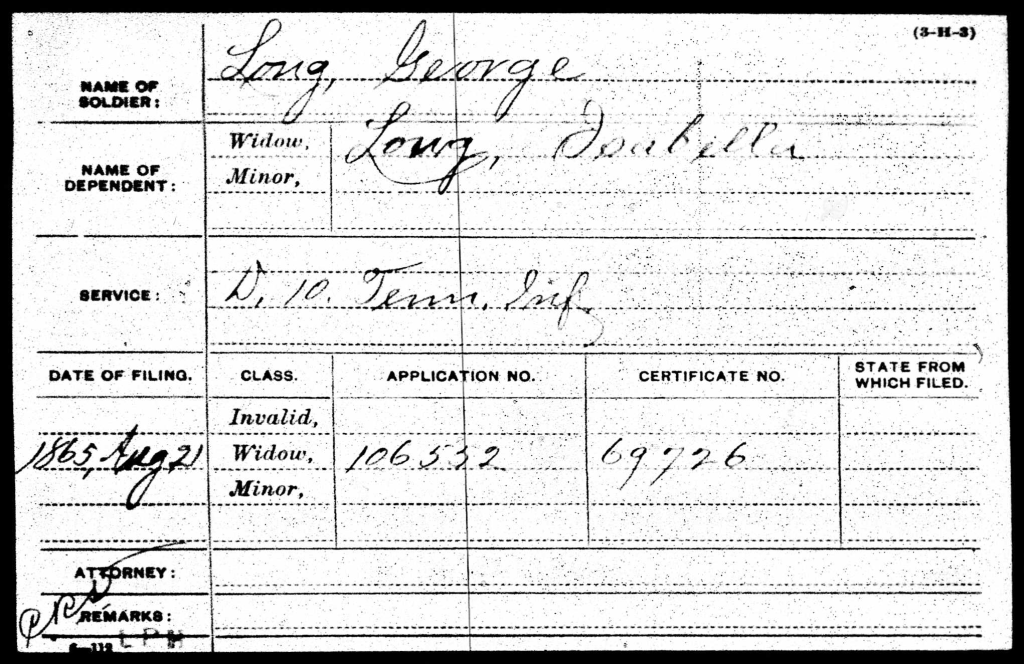
I have looked at every Ancestry tree (I think) that has what appears to be the same George Long I’ve been researching, and many of them have this card attached. My George Long lived in Ohio, but I suppose he could have gone to Tennessee to serve, though I’m not sure why he would have since there were plenty of units being raised in Ohio. However, a genealogist who aspires to conduct “reasonably exhaustive research” cannot ignore evidence items. I mean many online trees have this record attached to the same George Long I was looking at, so it should be examined.
We have all found errors, mistakes, and conflicts in online trees. But we have all also found gems, clues, and keys to solving our puzzles as well. Remember not to engage in “source snobbery.” We can’t learn much from this pension card alone. We have his name, his wife’s name, and his unit (Company D of the 10th Tennessee Infantry). We have the date his widow filed (21 August 1865). We have her application number and certificate number.
With that information, I found his pension file, this one in particular is available on Fold3. From that, I learned that Isabella’s maiden name was Morose. At the time of filing for a Widow’s Pension, Isabella (Morose) Long was a resident of Walker County, Georgia. Her husband George died on 15 April 1865 of small pox in a hospital in Nashville, Tennessee. They married on 25 July 1864 and had no children.1
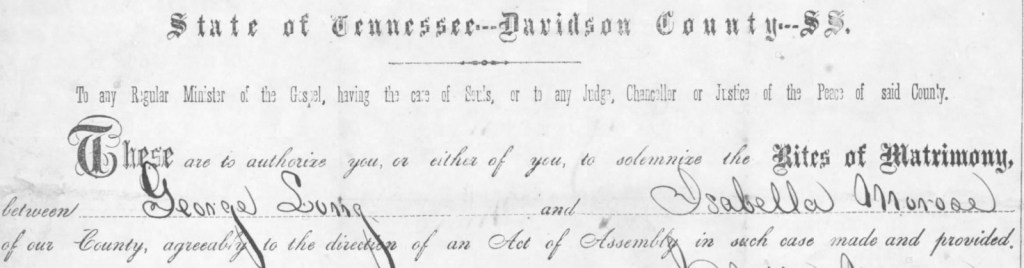
However, the most obvious fact that is overlooked is that if the George Long I’ve researched died in 1855, he could not be the George Long that served during the Civil War (1861-1865).
Other datapoints do not line up either: he did not live in Tennessee or Georgia, he definitely had children, and his wife was Isabella McCullough, not Morose.
I write this post, not to cast dispersions upon other genealogists who have attached the wrong document to George Long. We have all done it. I don’t believe there is one genealogist who hasn’t made a similar mistake. I am writing this post to share my process of correcting my previous work and looking beyond an index, index card, or any other derivative (second-hand) source and examine the original. Then, pull every bit of information out of that original and compare it to the known information you are working with. Plus, understanding the chronology (see my previous posts about timelines) helps you make determinations about the records you are looking at.
We will address the issue of resolving conflict in the next post. Stay tuned!
1. Claim for Widow’s Pension, 4 Apr 1866, Isabella Long, widow’s pension W.C. 69726, service of George Long (Pvt., Co. D, 10th Tenn. Inf., Civil War); Case Files of Approved Pension Applications of Widows and Other Veterans of the Army and Navy Who Served Mainly in the Civil War and the War With Spain, compiled 1861–1934; Civil War and Later Pension Files; Record Group 15: Records of the Department of Veterans Affairs; image, “US, Civil War ‘Widows’ Pensions,’ 1861–1910,” Fold3 (https://www.fold3.com/file/288364023).↩
 Genealogy Pants