Tag Archives: research logs

Research “Plogs” – the Planning Part – part 4

We looked at a blank example of my research PLOG template that I use in Evernote last time. You do not have to use Evernote to make something like this. You could use Word, Mac Pages, Google Docs, a spreadsheet, or any other note-taking tool of your choice. This is simply how I do it. Please adapt to find something that works for you and your way of thinking.

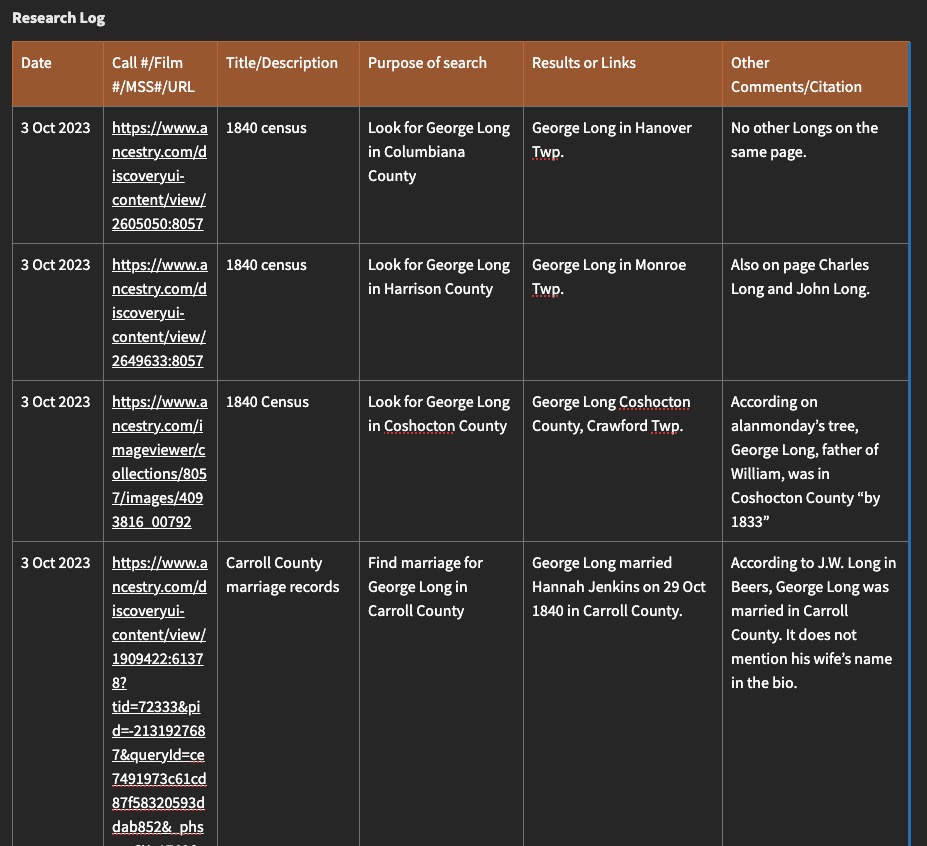
I am currently working on a project to identify the father of William Long who was born in about 1819 in Ireland and who married Sarah Metzger in Stark County, Ohio, in 1841, and died in Putnam County, Ohio, in 1861. I have only a name for his father “George Long.” The problem is, there are a lot of George Longs that could be the father of William. The son of William, John W. Long, has a biographical sketch in the Wood County, Ohio, county history that states that his grandfather was “George Long” and he “emigrated to the United States in 1817, locating in Carroll County, Ohio, where he was married and became the father of seven children: George, William, John, Catherine, Ellen, Susan, and Alexander.” There are a few problems with this, one of which is that Carroll County was not formed until 1833 from Columbiana (1803), Stark (1809), Harrison (1813), Jefferson (1803), or Tuscarawas (1808).

So, my research question is listed at the top of my “plog” template, followed by a cataloging of known information, supporting questions to answer, thoughts and analysis of the problem, some tasks, and then the research log portion of the template, which will get filled in as I complete the tasks.
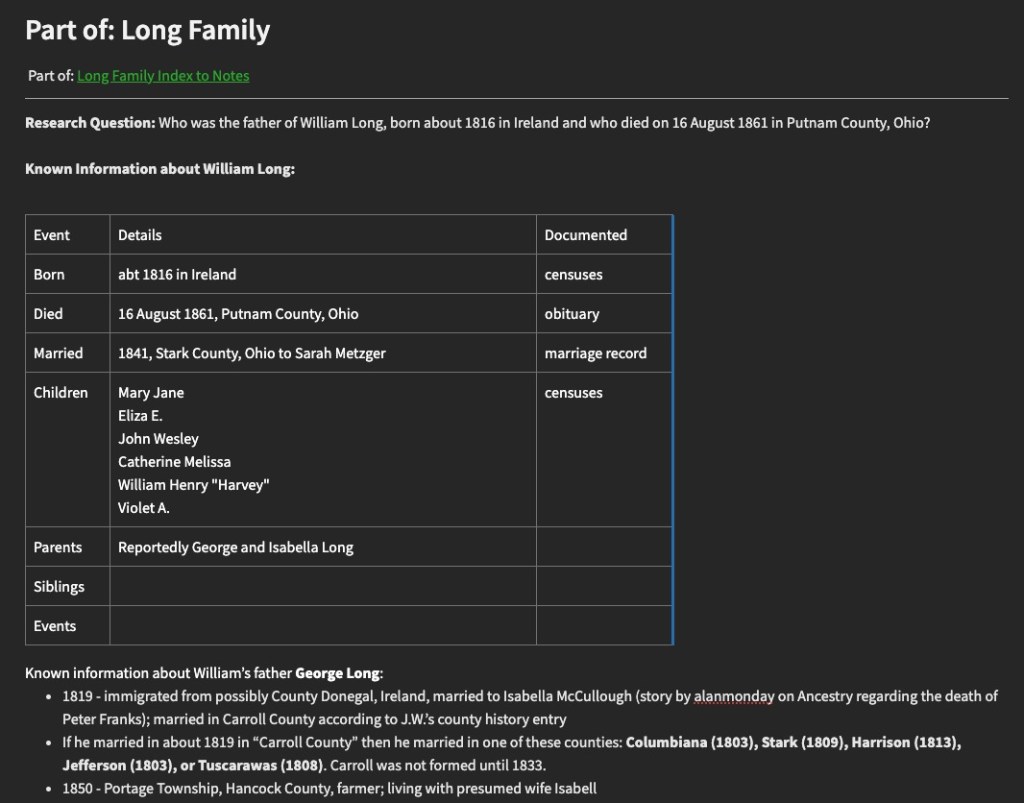
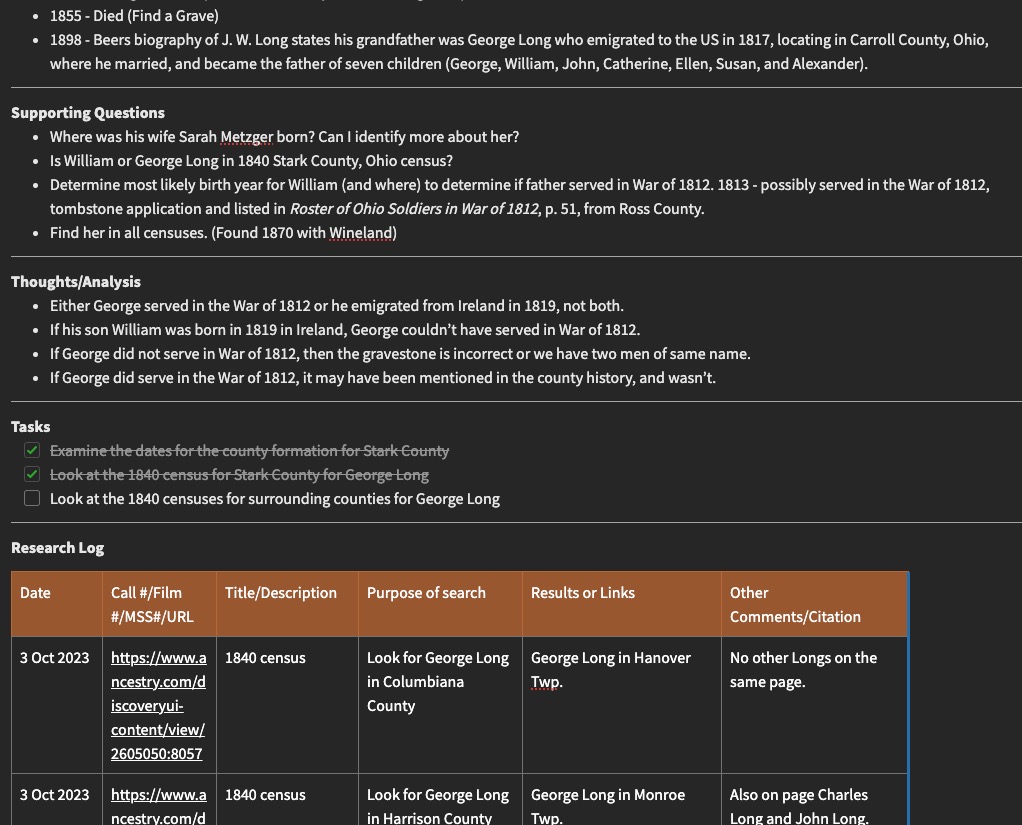
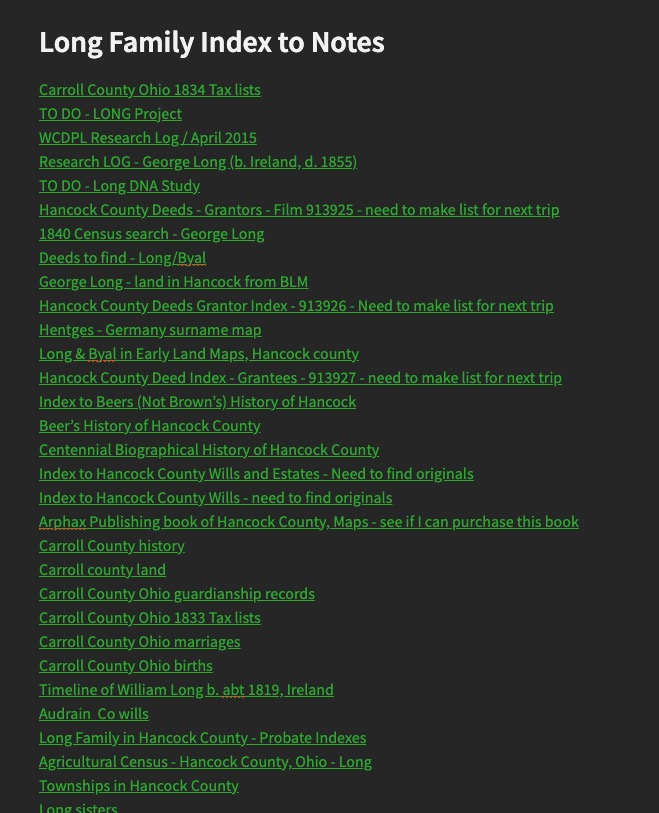
As you complete tasks, they often create more questions than they do answers. I document these in the last column and add things to the task list. Sometimes the template gets too long and too much scrolling needs to be done. One cool feature of Evernote is that you can link the notes together and essentially create an index where you can see all of your notes for one particular project in a list. Provided you titled your notes in a meaningful way, this will be great to get to notes quickly rather than scrolling through long notes. There are likely ways to do something similar in other programs.
So, that’s the mechanics of research “Plogs” and how I use them. The next post will have some final thoughts on research planning and logging in general, tips and tricks, etc.
Research Plans/Logs – Why?

When I was a “baby genealogist” I did not know about research plans or logs (I call them “Plogs” by the way) for quite some time. Then I heard someone discuss them (can’t recall exactly where or who, far too many years have passed) and I really tried to incorporate them into my research routine.

You know that phenomenon where you’ll hear about something but your brain isn’t ready to use it or understand it. And then you’ll hear the same thing years later and that “Ah ha! It makes so much sense now!” happens? That is what happened with me and research plans and logs.

Why should we even bother? They can be somewhat tedious and take up valuable research time!

Here are some of the reasons why I use research “Plogs”:

  1. I can avoid repeat searching. If we have limited research time, why waste it conducting a search we’ve already done?
  2. I can double check my previous search parameters to determine if I do need to repeat some searches. Databases change, we learn about new names or items to search for, etc. If we keep good notes about what we searched for before, we can determine if we DO need to search again.
  3. Plogs allow me to collect the data I need for creating citations.
  4. Plogs allow me to analyze information and evidence while I’m looking at it.
  5. I can put a “bookmark” in a research project if I keep good notes in my Plog.

In this series, we will look in-depth at how I use research plogs, my evolution using plogs over the years, some of my best tips, dos and don’ts, and ideas for effective, efficient research.

Preparing for a Research Trip: Research Plans

There are a variety of ways you can construct a research plan and log. Often these are taught and discussed as two separate items. However, these can be one document that is keyword searchable if you use a computer program. Popular computer programs for creating research plans and logs are: spreadsheets (Excel or Numbers), word processors using tables (Word or Pages), and note-taking software such as Evernote, One Note, or Scrivener. Of course, this is a personal preference and you may be most comfortable with paper and pencil.

Why is a research plan/log important? 

  • To be efficient with your limited time in a repository, cemetery, or with family members.
  • To keep track of what you’ve researched so you don’t unnecessarily duplicate your work.
  • To keep any notes about your search results organized.
  • To gather citation information.

Months or years later, you can search these plans/logs for more research clues or to be sure you don’t examine the same source twice, or to know if you need to go back and search for new information (perhaps you’ve discovered a new surname since the last time you looked at a particular book or film).

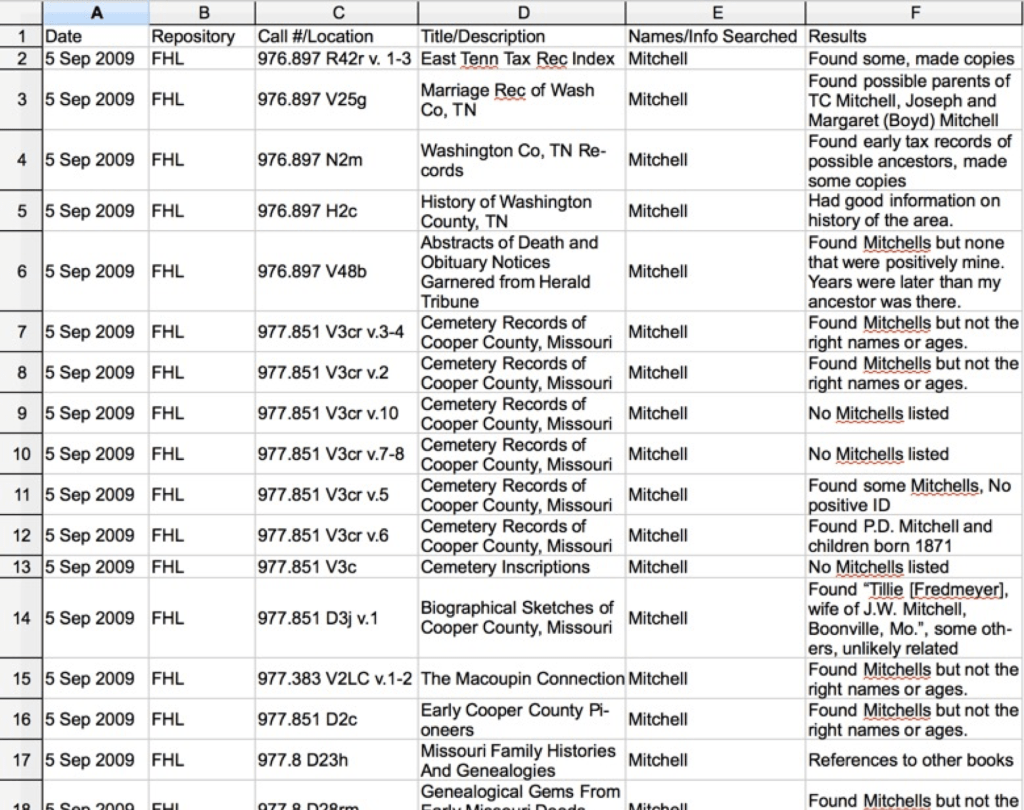
Consider including the following items in your research plan/log:

  • Date
  • Repository
  • Title of item
  • Call number or film number
  • Names/Info searches
  • Search results
  • Other comments

A research plan and log should allow you to see what you’ve done, let you see where you should or shouldn’t search in the future, and is best if it is keyword searchable such as in a computerized system.

Sample research plan/log

While you are at the repository:

  • Take the time to organize your research findings.
  • If you have time/energy in the evenings, go through your papers/files and be sure they are organized.
  • Process your work as soon as possible. Enter in your database, research log, or other system.

If you wait too long to process your work, and you forget what you were doing, it’s almost as if you never went in the first place. Be sure you record and process what you find.

“We travel, some of us forever, to seek other places, other lives, other souls.” – Anais Nin