Monthly Archives: August 2013

Genealogy Institutes – Part Six

If you’ve never been to a genealogy institute, you may not know what to expect. The first time for anything is always a little mysterious. I hope some items in this post will help dispel some of the mystery and give you a good idea of what to expect throughout your week. These tips are from my personal experiences at GRIP and IGHR. Some of the other institutes might work a little bit differently and have some aspects that I am not aware of yet. If you have been to one of the other institutes and would like to share something that I have missed, please feel free to do so in the comments.
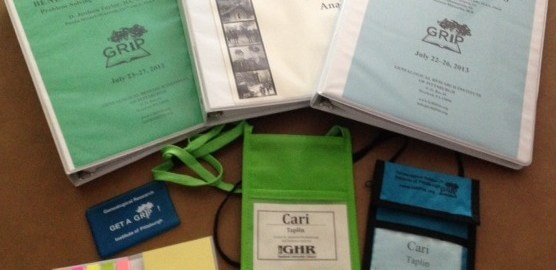
photo-13Generally registration and check-in occurs on Sunday afternoon. This is where you will be given your name badge, meal tickets, keys to your dorm room, your class binder and any other items necessary for your week. If you are not staying on campus, this is a good time to find your hotel, get acquainted with the area for any amenities you might require such as a grocery store, a coffee shop, restaurants and the like. Some institutes have a Sunday evening dinner with an orientation session. This is where you will learn about specifics for the week, what optional evening sessions might be available, any changes to the schedule, and other details about the campus or the institute. This is a great time to get to know your fellow classmates and institute attendees. In your binder will also be a schedule for the week, a class roster with contact information so you can connect with your classmates, and other informational pages in addition to your lecture notes for the week.

Plan on being in classes all week. There will be slight variations in starting and ending times depending on your course instructor. Throughout the day there are planned break and lunch times. Sometimes in the afternoon there are coordinated breaks with free snacks and drinks. Depending on the course, you might be expected to do homework. Of course this is optional, but you will get so much more out of what you are learning in class if you do the homework. Later in the week there might be a banquet with a dinner, a speaker and any awards or honors the group gives out. You may also experience the joy of class pictures day. GRIP especially loves the class picture and sells their own polo-style shirts for students to wear on picture day.

One of my favorite features of attending an institute is that the pace is slower than you might find at a state or national conference. There is time to speak with your instructors and fellow students. No one is rushing to get to the next lecture. The size of the classes is small enough to allow for very insightful discussions and meaningful relationship building. These are amazing networking opportunities and a great way to meet people at a similar experience level or who share specific interests as you. And of course, at the end of the week you earn a certificate for all of the hard work you put in all week.

I enjoy getting to learn from these distinguished instructors in a more intimate setting and I love seeing all of my genealogy friends and meeting new ones. I love attending institutes for all of the reasons I described in this series and probably some that I didn’t. The most important thing to remember is to have fun! I hope that you will try an institute in the future!

Genealogy Institutes – Part Five

It is an unfortunate fact that genealogy institutes only have so many seats for each class. If I have gotten you excited to attend an institute, great! Now, I want to share with you some tips for getting registered and sitting in one of those precious few seats. Have you ever bought concert tickets online? If so, the process is similar. If you have not, here are some tips.

Classroom
Classroom (Photo credit: James F Clay)

Each institute’s registration process is a little bit different so first you will want to become familiar with their website, locate exactly which page you need to be on to register. You may also want to set up an account ahead of time, if possible, so when it’s time to register, you don’t have to go through the entire process of entering your name, address, phone, and so forth. Once they make public the date of registration, mark that date on your calendar. I enter it into my Google calendar which also syncs with my iPhone calendar, so that on the day of registration I get a reminder before it’s too late. When the day arrives, be sure you are at your computer at least five minutes ahead of the registration time, find the correct page, and log in if possible. Then sit there and wait.

At about one minute till, I start clicking the “refresh” button on my browser. The webpage will not automatically refresh when the site opens for registration, so you’ll need to force your browser to do it for you. [UPDATE: The GRIP registration page has been changed to include a countdown timer to registration. When that expires, the page will automatically refresh for you. On their new system, it is actually to your disadvantage to click the “refresh” button.) Once that magical registration screen appears, get busy filling in the blanks. You’ll want to get through the process as quickly as possible as some of the courses have been known to fill up in a matter of minutes. Some institutes might require you to pay right then and there with a credit card. I know that both IGHR and GRIP allow you to pay by check as long as they receive the payment within 30 days of registration.

After that’s done, take a deep breath. You made it!

Up next, what to expect during the institute week and a few concluding thoughts.

Genealogy Institutes – Part Four

In my continuing quest to describe institutes and ultimately convince you to attend one if you haven’t already, this post will highlight the last two of the five major genealogy institutes that I have identified. I have not personally attended either NIGR or SLIG so the following information is a summary from what I’ve learned from reading their websites and from various friends and colleagues who have attended.

2013-08-09 12.32.26 pmI am registered to attend the Salt Lake Institute of Genealogy, or SLIG, this coming January. This institute is hosted by the Utah Genealogical Association and is held annually in January at the Radisson in downtown Salt Lake City. It offers a wide range of topics for various skill levels through 10-12 different tracks. The courses for 2014 are:

  • “American Research and Records: Focus on Families” with Paula Stuart-Warren, CG, FUGA
  • “New York Research” with Karen Mauer Green, CG
  • “Research in the South” with J. Mark Lowe, CG
  • “Advanced Research Tools: Land Records” with Richard G. Sayre, CG and Pamela Boyer Sayre, CG, CGL
  • “Credentialing: Accreditation, Certification, or Both?” with Apryl Cox, AG and Elissa Scalise Powell, CG, CGL
  • “Producing a Quality Family Narrative” with John Philip Colletta Ph.D., FUGA
  • “Researching in Eastern Europe” with Kory Meyerink, AG
  • “Advanced Evidence Analysis Practicum” with Angela McGhie and Kimberly Powell
  • “Advanced Genealogical Methods” with Thomas Jones Ph.D., CG, CGL, FASG, FUGA, FNGS
  • “Problem Solving” with Judith Hansen, AG, MLS

I will be taking the “Advanced Evidence Analysis Practicum” track and I am very excited for the experience. The benefit of this conference, like British Institute, is that it takes place in Salt Lake. Classes take place in the morning and research or homework in the Family History Library. This coming year, the Association of Professional Genealogists’ Professional Management Conference (PMC) is being held a few days before SLIG. I plan to attend that as well. At the writing of this post, their website had not been updated to reflect this yet, but the information was sent to members via email. Keep checking their website for more information.

2013-08-09 12.32.52 pmThe National Institute on Genealogical Research is held in Washington, D.C. annually in July (typically the week preceding GRIP). This institute stands out from the others in that it is very specific in scope. NIGR is not a beginning course and is aimed at a focused examination of federal records, there is only one track with everyone in the same course together. Most of the week is spent at the main branch of the National Archives with one day being spent at the Archives II in College Park, MD. There are optional evening sessions to spend at the Library of Congress and the DAR Library. This institute is different also by the registration format. This one is currently via regular postal mail only, no online registration at this time. You must go to their website and be added to their mailing list. Then, when registration time comes, you need to fill out the application and mail it back as soon as you get it. They have a limited number of spaces in the course so it is important to return the application promptly.

This institute also has two scholarship opportunities that help pay for tuition and some of the travel expenses. One scholarship is from the American Society of Genealogists, the other is the Richard S. Lackey Memorial Scholarship. The details are on their website.

That wraps up the details on the five major institutes. Up next, some tips on registering for institutes and later, what you might expect during your week.

Genealogy Institutes – Part Three

This time in my series on genealogy institutes, I’m going to describe IGHR and GRIP. These are the two institutes I have actually attended so I have my firsthand experiences to also share. Both of these institutes take place on a college campus and come with all of the perks (or not, depending on your perspective) of campus life, dorm packages and meal plans.

2013-08-08 01.32.06 pmThe Institute of Genealogy and Historical Research, also commonly referred to as “IGHR” (pronounced eye-jer) or “Samford,” takes place annually in June at Samford University in Birmingham, Alabama. There are typically ten courses offered for beginners to advanced researchers. The Samford campus is quite lovely with a lot of shade when walking from building to building. This year the temperatures were quite bearable and we experienced a few days of rain, not unpleasant for someone from Colorado where the days are mostly dry. You may choose to stay in the dorms (beware of the snakes) but there are also hotels nearby and the institute coordinates a shuttle service between the hotels and the campus. If you happen to drive, there is free parking on campus. They also have meal plans in their cafeteria or a student center with fast food, a carryout and a coffee bar.

At IGHR the courses being offered for 2014 and 2015 are posted on their website. Here is a quick look at 2014’s lineup by course number:

  1. Techniques & Technology
  2. Intermediate Genealogy & Historical Studies
  3. To Be Determined
  4. Advanced Methodology & Evidence Analysis
  5. Writing & Publishing for Genealogists
  6. Advanced Library Research: Law Libraries & Government Documents
  7. Virginia: Her Records & Her Laws
  8. Researching African American Ancestors
  9. U.S. Military Records
  10. Irish Genealogical Research

There are a lot of topics to choose from and for complete course descriptions you will want to check their website.

Also, if you are interested in attending IGHR, there is a scholarship available to pay for your tuition. It is the Birdie Monk Holsclaw Memorial Scholarship. According to the Colorado Council of Genealogical Societies website, “Distributions are awarded to those who have an interest in genealogy and wish to pursue genealogical related education at the Samford University Institute of Genealogy and Historical Research (IGHR). Application is open to all genealogists and consists of a short resume listing genealogical experience and a 150-200 word essay describing how IGHR will help advance their genealogical research skills. Deadline for Applications is October 1 each year.” There is a downloadable application on the site. Don’t miss this amazing opportunity!

-4The Genealogical Research Institute of Pittsburgh (or “GRIP”) takes place annually in July at La Roche College, located a few mile north of downtown Pittsburgh. La Roche College is a small college, easy to locate, with amenities near by. They too offer a dorm and cafeteria package. There are hotels nearby but they do not have a shuttle service yet. If you rent a car or drive to the conference there is also free parking available. This institute offers courses for varying levels of experience. The line-up and course descriptions for 2014 is posted on their website but here are the titles and instructors:

  • “Intermediate Genealogy: Tools for Digging Deeper” with Paula Stuart-Warren, CG, FMGS, FUGA
  • “Determining Kinship Reliably with the Genealogical Proof Standard” with Thomas W. Jones, PhD., CG, CGL
  • “Becoming an Online Expert: Mastering Search Engines and Digital Archives” with D. Joshua Taylor, MA, MLS
  • “Finding and Documenting African-American Families” with J. Mark Lowe, CG, and Deborah Abbott, PhD.
  • “Practical Genetic Genealogy” with Debbie Parker Wayne, CG, CGL, CeCe Moore and Blaine Bettinger, Ph.D., J.D.
  • “Law School for Genealogists” with Judy G. Russell, J.D., CG, CGL and Richard G. “Rick” Sayre, CG, CGL

These institutes are very similar in structure. The classes run from about 8:30am-4:30pm. There are set break times with free snacks provided and a great time to get up and stretch your legs and network with your classmates. Both of these institutes offered optional evening sessions on various topics. At GRIP this year we got to watch the first episode of Who Do You Think You Are? (full episodes available on tlc.com) which is a lot of fun when you do it with a huge room of genealogists!

Both of these institutes are top notch, offer a wide variety of topics and activities. They are both located in some very scenic locations with a lot of history to explore. Be sure to plan time for site-seeing and fun!

Genealogy Institutes – Part Two

There are what I would consider five major genealogy institutes: British, IGHR, GRIP, NIGR, and SLIG. Readers, if there are others that I’m missing, please don’t hesitate to let me know. I may want to attend! By institute, I mean the week-long, in-depth course you take on one topic with one or two instructors for the entire week. You can read the previous post to read my description of an institute. This post will begin the tour of those five and give some insights into what I know about each of them. They are being presented here in random order, and just to remind you, I have only been to GRIP and IGHR personally although I will be attending SLIG in January. So while some of this is firsthand knowledge, other bits are what I have read, heard or found on their websites, which I will also be linking to for easy access.

I find institutes to be invaluable learning opportunities for genealogists wanting to know more and go deeper into a topic. There are many choices within these five institutes. They all seem to have a core of classes that are taught annually and some that rotate. Check their websites for each year’s lineup.

2013-08-08 12.49.06 pmThe first institute that I will be covering is the International Society for British Genealogy and Family History Institute (or “British Institute” for short). As the title would suggest, this institute focuses mainly on British Isles research, including Irish research. It is held annually in October at the Radisson in downtown Salt Lake City which is located within walking distance of the Family History Library. Classes are designed so that you have class/lecture time in the morning with time at the library in the afternoon and individual instruction time with your instructor. For current pricing, visit their website.

This year the institute is offering four tracks:

  • “Sources For Tracing Pre-mid-nineteenth Century English Ancestors” with Maggie Loughran and Paul Blake
  • “From Simple to Complex: Applying Genealogy’s Standard of Acceptability to British Research” with Tom Jones
  • “Irish Land Records and Fragmentary Evidence Correlation” with David Rencher
  • “Using the Cloud for British Family History Research” with Graham Walter

The website currently only lists David Rencher’s course as being sold out, so there may still be time to register and go if you are interested. I have not attended this institute yet, but it is in my future plan to do so. If any of you have input on your experiences with British Institute and would like to share them, please do so in the comments.

Next up, IGHR and GRIP.


Genealogy Institutes – Part One

IMG_3920_1024This summer I attended two outstanding genealogy institutes, IGHR and GRIP. I attended my first last summer and I am hooked. If I had unlimited resources, I’d attend them as much as possible! Genealogical institutes are great because you get to delve into one topic, in-depth for a full week. Also, being in the same class with the same people all week allows for networking and relationship building that one might not get at other educational events. Plus, there tends to be more time to ask questions from the instructors that might not be available at national conferences when they (or you) might need to rush off to another lecture.

Over the next several posts, I am going to share some of the information I have collected to help those of you who have never been to one know what to expect, what to pack, things to consider ahead of time and other tips to enjoy these great opportunities for genealogical education.

Before you go there are few things you’ll want to consider. First of all, you will want to consider your travel arrangements. Depending on where the institute you will be attending is located, you may want to fly. However, taking a car, train or bus are also viable alternatives. You will want to decide if you will stay in the dorms, a hotel or on a friend’s couch (or guest room). Will you want to take advantage of the cafeteria meal plan, eat out or pack your lunch. Also, when you are there, depending on where you stay you will want to determine if you will need daily transportation to and from the venue. I usually have to locate the nearest coffee shop when I travel. And don’t forget to plan some extra time for sight-seeing. Why go all that way if you can’t see some of the local attractions while you are there?

Here is my packing list (besides toothbrush and underwear):

  • banquet clothes (often there is a banquet and you might want to dress up a bit)
  • comfy clothes (for sitting in class all day, all week)
  • walking shoes
  • computer or iPad or other electronic devices
  • power cords (you don’t want to forget these, been there)
  • business cards (if you have them as there are plenty of networking opportunities)
  • highlighters, pens, pencils, notebook, sticky notes, etc.
  • backpack/bag to carry your stuff in all week
  • cash (my trip to Pittsburgh this year included a day of sightseeing that encountered many “cash only” establishments)
  • camera (if you don’t use your phone)
  • extra reading materials (plane rides are excellent times to catch up on NGSQ reading)
  • an umbrella (if you think you’ll melt, I personally don’t own one as I have never needed it here in Colorado, some might want one though)

While I’m sure there are other things to bring. If you have been to an institute and would recommend something else, please feel free to add it to the comments below. Over the next several posts I will be looking at the 5 major institutes and give some of the unique details about each.