Monthly Archives: January 2021

Beginning Concepts: Genealogical Education

I cannot stress enough the importance of continuing education for genealogists whether you consider yourself a beginner, a hobbyist, a professional, an advanced researcher…whatever. There is always more to learn! And different people have different ways of doing things and their ideas or variations on methodology may make more sense to you and help you break through research challenges.
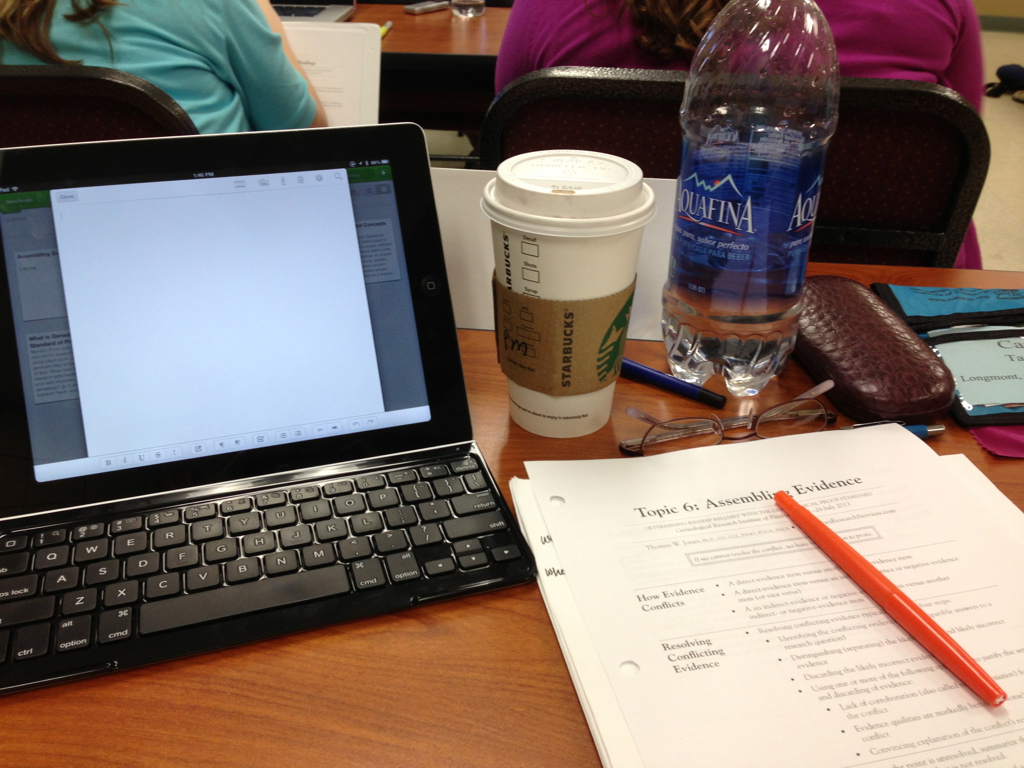
My setup at one of the genealogical institutes I attended.

If 2020, and it looks like a large portion of 2021, have done anything, they have brought genealogy education to our fingertips. Because of the COVID-19 pandemic, many educational opportunities, both large and small, have been made accessible to participants across the world. With our digital world and platforms like Zoom, we have had so many opportunities than we have ever had before. With so many week-long institutes, multi-day conferences, and day-long seminars going virtual, so many more people have been able to participate. Think about those who can’t travel for whatever reason (disability, finances, family obligations, etc.) and those who want to attend everything but can’t due to travel and time and finances. I do hope we keep offering virtual options as our world returns to whatever “normal” is after this.

My advice for genealogical education has several steps or layers:

  1. Identify where your skills and knowledge are lacking. This could be a long or short list, but determine where you’d like to grow, and write it down.
  2. Identify places that have classes, webinars, institute courses, etc. that cover those topics.
  3. Make a plan as to when you can attend those classes. Some things are available all the time (webinars at Legacy Family Tree Webinars, for example, are available 24/7 by subscription). Some are available only once per year, or rotate every couple of years. You might find books or articles on the subject(s) as well.
  4. Join a local genealogical society. EVEN if your research is not in the place where you live. Most genealogical societies offer classes, monthly lectures on various topics, and a social network of other genealogists that can help you. Many local societies are offering virtual meetings currently so see what is available in your area.
  5. Join the genealogical society (societies) in the places where you DO research. You will benefit from their newsletters, journals, blogs, monthly meetings (if they are virtual), and any other member benefits they offer. But they have the local knowledge!
  6. Join a state, regional or national society. I recommend the National Genealogical Society, the Utah Genealogical Association, the New England Historic Genealogical Society, the New York Genealogical and Biographical Society, or a state society in the area of your research. I am a member of the Ohio Genealogical Society, for example.

For a complete list of genealogical education opportunities, visit Cyndi’s List: https://cyndislist.com/education/ where you can find so much information on genealogical classes, course, study groups, institutes, webinars, books, and so on.

Family history is an important part of our identity; the more we understand our heritage, the more we understand ourselves. And I hope, whether you are a beginner or have been doing this for a long time, you found some useful items in this Beginning Concepts series.

Beginning Concepts: The Research Plan Part 2

Last week I described why a research plan/log or PLOG, is a good idea. This week, let’s get into some of the nitty gritty of what a research PLOG looks like.

First, you will want to have several research plans. They should be based on a particular project you are working on. Remember, we are past the “collecting” phase and are now into the FOCUSED phase of our research. (Refer back a few weeks to the post on Getting Focused.) Your research plans and logs will want to reflect that focus. I have a research plan for each individual project I’m working on. And my projects are generally driven by my research questions. So, I have a PLOG that holds research tasks and findings relative to a particular research question I am trying to solve.

You can create these PLOGs in any platform that works for you: word processor, spreadsheet, Evernote or One Note, Scrivener, and so on. Even paper. I’m not here to tell you which one to use. But I will share what I use: Evernote. Now there was a recent Evernote update that had a lot of people upset, they didn’t like the changes. Well, who likes change? I know I don’t. I am still working with the new update and forming my opinions, but so far, everything has been working ok with a few minor hiccups.

I like Evernote because of its ability to sync between my laptop, my phone, my iPad, and a web version, so I literally have access anywhere I have the internet. I can also access my notes offline as long as I synced everything before I left the land of the internet. It also acts like a word processor and I can add tables, images, links to other notes, and more. I can also search my notes by keyword or tags (if I added them).

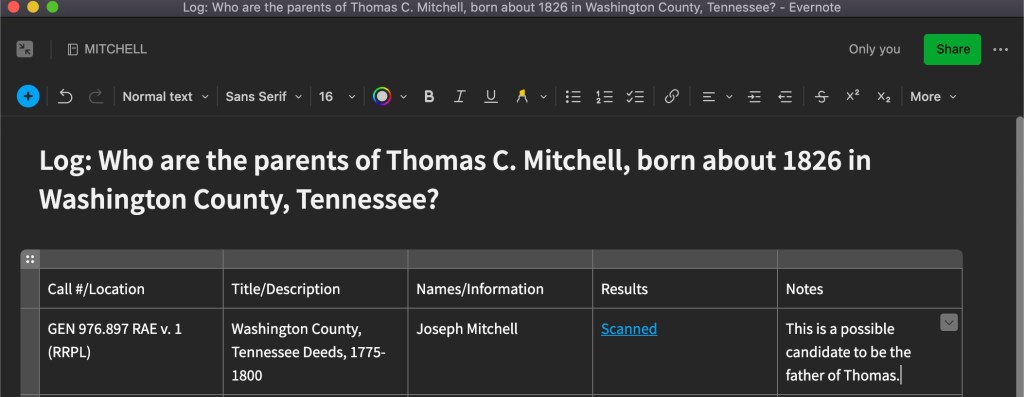
When I create a research plan/log in Evernote, I put the research question at the top so that I remain focused and my notes are categorized and organized. I then have a table with the following column headings: Call#/Location, Title/Description, Names/Information I’m looking for, Results (notes, or a link to another note that holds the scanned images), Notes reflecting my thoughts. See the example below:

Screenshot of my new project’s PLOG to identify the parents of Thomas C. Mitchell.

I have several variations, and they change depending on circumstances. Sometimes I add a column for the date or the repository if it is a PLOG that covers many repositories. Most often, I have another note that contains the actual contents of what I found, usually photos I took with my phone and uploaded to Evernote. On those Evernote notes, I will write out the citation for that item, so they are together.

I also have research PLOGs that are repository focused. Pre-pandemic, there were repositories I visited on a semi-regular basis, so as I worked from home and identified things I wanted to examine at a particular repository, I would add them to those PLOGs, with a link to the overall log for that research question.

You can do a similar thing in other platforms. In a spreadsheet, for example, you can have multiple tabs in one spreadsheet. Perhaps you have a spreadsheet about your John Smith family and organize those tabs by the particular generations, brick wall problems, repositories, and so on. Or, if you prefer word processing documents, organize your hard drive in a similar way: a folder for each surname, then perhaps broken down by generation or research problem, and then the various documents within that pertain to that problem. The sky is really the limit in terms of how you organize.

The main point with the research plan and log is that you create a system whereby you can collect what you plan to look at and what you found, in an easy, effective, and efficient way that works for you. Then, when it is time to sit down and really analyze what you have, it is all logged in one location.

If you are a longtime reader, you know a phrase I often say in this blog and when I’m presenting to an audience: “Do what works best for you. But do it!” So, go get a system set up that you think might work for you. You’ll end up modifying it as you learn and grow as a researcher, but just get started.

Beginning Concepts: The Research Plan

In genealogy, there are two things you really ought to keep track of to help your research be FOCUSED and effective. Several weeks ago I wrote about how when we all begin, we are collectors of family history information, but eventually, we have to get focused to solve any of the “brick walls” we encounter. Two things that help you be focused are utilizing a research PLAN and a research LOG. In my world, these are the same document. I lovingly call them my Research PLOG (patent pending).

Different researchers have different techniques. Look around at what others have to say on the topic if my system doesn’t work for you or make sense for how you work. The main message here is to do it!

I’ve written about research plans twice before:

Both of those previous posts come from the angle of preparing for a research trip. However, you don’t have to be going on a trip to create a plan. It will make your time at a repository more efficient and effective if you have a pre-planned list of what you want to look at when you arrive. But we have all been stuck at home for a year, and it looks like we will be for a bit longer. Have you been planning your research before you do it at online “repositories”? I know I have not been doing it enough. I have an idea of what I want to find, I go look for it, I don’t find it, I move on to the next thing… but months from now, I am not going to remember that I did that search and will do it again. And if I don’t utilized my PLOG, I’ll do it again in another several months.

A research plan/log allows you to plan your research “attack” and record your findings so that you can review what you’ve done on a given project and NOT DO IT AGAIN! (I am sure I am not the only genealogist in the world who spent precious research dollars ordering the same death certificate twice…or three times?) A research PLOG, if used correctly, can save you time and money. I wish I had learned about research plans and logs earlier in my genealogical journey!

Of course, there are databases that are constantly growing, that you should go back and search again at a later time. Be sure to note in your log what years those databases covered at the time you looked at them (we will get into more on this later). Also, a caveat to using a PLOG correctly…you have to review it before you start in on another research session. This is where I find myself failing many times. I just don’t take a moment to read my log for a given project. So, it’s like I never logged anything if I don’t go back and review it!

Now that I’ve convinced you that you need to start utilizing a log, next I will get into the nitty-gritty of what my research PLOG system looks like.

Any plans for 2021?

2020 is in the rearview window. But what does 2021 look like? For me, it is still too full of unknowns. So I am only planning what I can reasonably expect to do from home until more is known and settled.

In the meantime, we’ve made the move back to Colorado and are in the process of buying a new home….so we will be moving again. But for the last time for a long time I hope.

I have some speaking plans for 2021, all virtual at this point. Click here to go to my speaking calendar.

The biggest project I have on my plate is teaching a newly revised and restructured course at GRIP this summer on the Great Lakes Region. I will also be teaching in Paula Stuart Warren’s course as well. All of the information on GRIP courses can be found on the GRIP website.

If you have “tackle writing citations” on your genealogical resolutions list, you might consider taking my study group based on Tom Jones’s book Mastering Genealogical Documentation. This is a seven-week study group that goes through the book together and discusses some of the exercises in the book. We have two sessions, daytime with Cyndi Ingle (of Cyndi’s List) or evening with me. More information on that course can be found here. Or click on “Services” at the top of this page, then “Classes and Study Groups” and then after browsing all of the study groups we are offering, find Mastering Genealogical Documentation toward the bottom of that page.

I hope we all find 2021 a better year!