Monthly Archives: March 2022

Many Paths to Sources: City Directories

Commonly called “city directories” but for my purposes, that is a bit of a misnomer. When I talk about “city” directories, I also include rural route, agricultural, and other directories that put people in a time and place, often on an annual basis. City directories don’t often give a ton of information, but they put your ancestor in a location in years between the census.

City directories have a long history. A fantastic blog post titled “Direct Me NYC 1786: A History of City Directories in the United States and New York City,” posted by the New York Public Library indicates that the first precursors to city directories were published in England in the 1500s; the oldest surviving print directory was published in 1677 in London; and a manuscript directory A Directory for the City of New York in 1665, compiled shortly after the British colonized New Amsterdam. Read this blog post if you are interested in the history of city directories.

Cities across the U.S. had directories published. Whether or not they were well preserved is another matter. And, keep in mind, there were directories for many topics, avocations, clubs, religious organizations, and so on, that can be utilized in the absence of a traditional city directory.

1871 Toledo, Ohio City Directory

I have a few “first stops” when I’m looking for a city directory in a particular location before I widen my search:

Do not skip reading through this useful research guide at the Library of Congress – “United States: City and Telephone Directories.”

If I don’t find what I’m looking for in the above list, then I start digging deeper. We will do that digging next week.
Many Paths to Sources: Newspapers, Part 3b

So, what do we do when newspapers are not digitized, like those I mentioned in the last post that are on microfilm at the Wood County (Ohio) District Public Library? There are some options, not all are going to work for each case. Each library will have different services, policies, etc. that might interfere with some of my suggestions. Your task is to figure out which might work with your situation.

  • Does the library offer any kind of look-up or research service that you can take advantage of? Sometimes they will have a free (for a limited amount) or a free service if you have enough information to point them to a few days in a newspaper. If the service they offer is free, please send a small donation as a thank you!
  • If the library does not offer a look-up service, does the library work with a local genealogical or historical society who might do look-ups? Check the library website for such a connection. Also, look at the local society websites as well. Some societies have look-up/research services for a fee to earn some money for their society. Again, consider adding a donation to your fee as a thank you for this service.
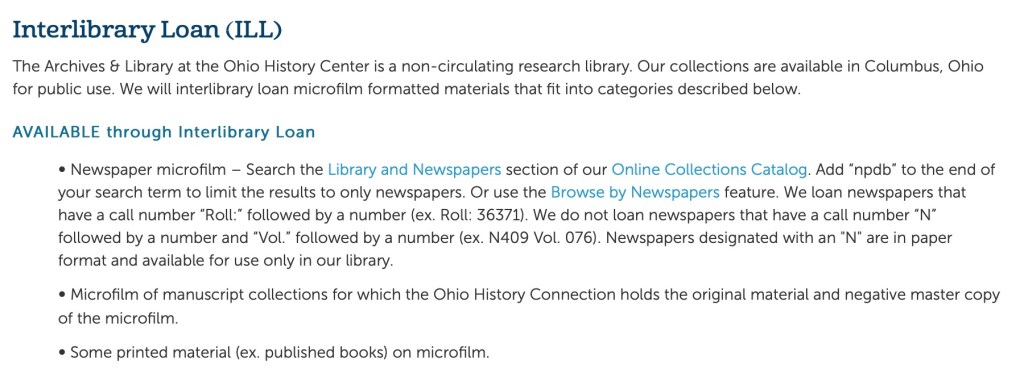
  • Is interlibrary loan a possibility? Before you assume it isn’t for newspapers on microfilm, let me point to you to the Ohio History Connection website. They offer interlibrary loan on their newspapers on microfilm! I don’t see this option often, so my point is: LOOK at what services are available for a given repository.
ILL section at the Ohio History Connection website.
  • You may locate a professional genealogist in the area to do your research for you. Sometimes the local genealogical and historical societies, archives, and libraries might offer a list of researchers available for hire for a particular repository. For example, when I lived near Austin, Texas, I was on the list of proxy researchers for the Dolph Briscoe Center for American History. Look for such a list at the repository you are needing to access. There are also directories available from both the Association of Professional Genealogists, Board for Certification of Genealogists, and International Commission for the Accreditation of Professional Genealogists (ICAPGEN) that might offer a genealogist in your area of need.
  • Finally, as the world opens up to us again and travel becomes safer, consider taking a trip to these locations. I know that this is not always feasible, you may only need one newspaper article in one far-flung area. I keep lists of things I need in various locations, and if it isn’t a critical piece for a project, I wait. When that list gets “big enough” and perhaps I can conjure up another reason to go visit that location (or nearby), I like to take trips. I like to do the research myself. If waiting to take a trip is not going to work, then one of the other suggestions will, I hope.

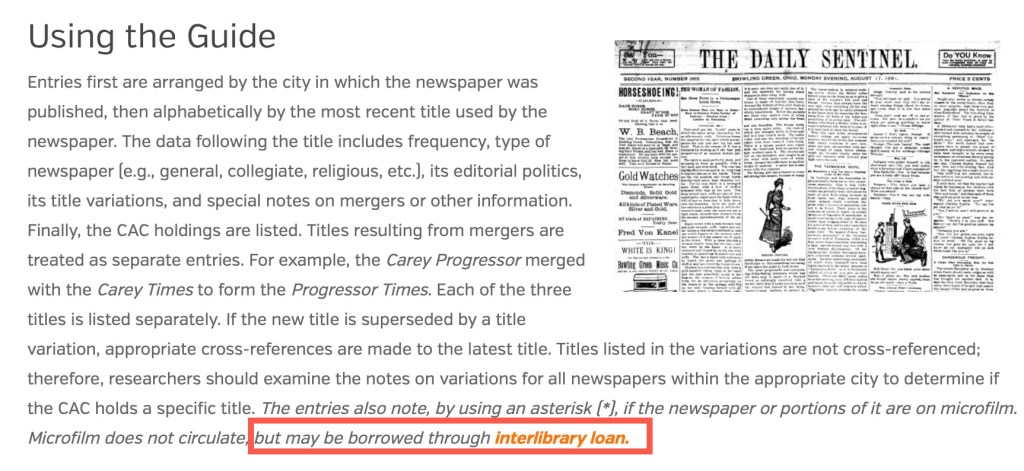
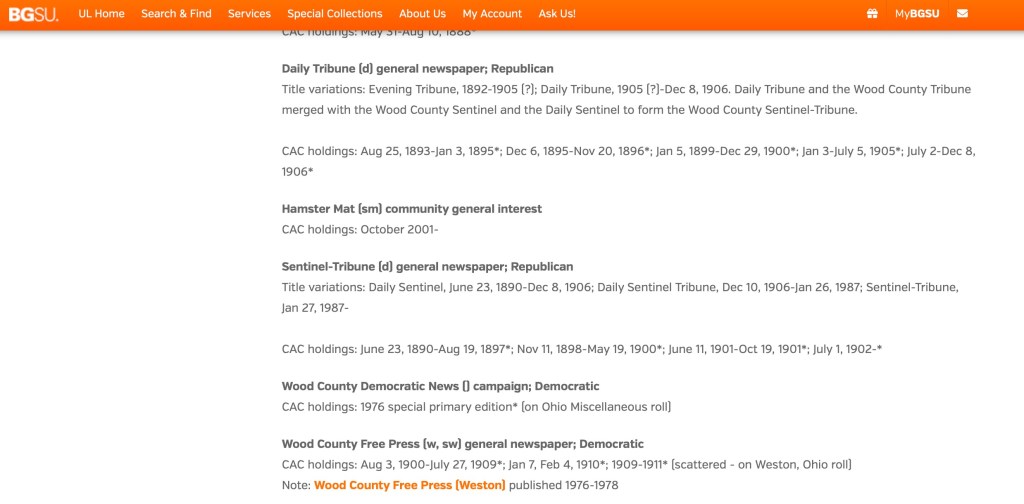
I have been able to access just about everything I need using one of the methods described above. I’d also like to point out that usually there is more than one run of those microfilm in other locations. For example, the Daily Sentinel Tribune from Bowling Green, Ohio is also available on microfilm at the Center for Archival Collections on the Bowling Green State University Campus.

CAC Newspaper list showing the Sentinel-Tribune.

CAC also offers interlibrary loan.

CAC website showing Interlibrary Loan as an option.

If one library or archive does not have what you need, look at another. At some point you will find a way to access what you are looking for.

Many of the principles shared in the last several blog posts are going to apply to any resource. However, we will look at some other types of resources and ways to access them. The biggest favor you can do for yourself, is to keep looking. Just because you get stopped at one repository does not mean there aren’t other options. Keep looking.

Many Paths to Sources: Newspapers, Part 3a

(I know these titles are getting a little bit ridiculous, but there are a couple of steps to this third part and I figured I’d break it down into bite-sized chunks.)

The last two posts talked about online options for finding newspapers. You’ve got the “bigger” websites such as Newspapers.com, but there are also smaller, lesser-known projects out there to discover as well. Now, once you’ve exhausted every online resource you have been able to discover, what then?

I know this might come as a shock to some, but it isn’t all online. I know it seems like it is, because so much is! But it’s not. So, what do you do when you’ve discovered that there are no online options for what you are hoping to find in terms of newspapers. You have to jump in to what I refer to as “two-step” research. The first step is to determine if and where an offline record exists, and most of this first step can be done online or from home with some phone calls. The second step is determining how best to access those offline newspapers.

The first step of this I also call the “pre-research.” If you’ve listened to any of my lectures, I use this phrase a lot. It is the research you have to do to be able to do the research. Make sense? Clear as mud? Well, let’s clear it up. I have a perfect example. I conduct a lot of research in Bowling Green, Wood County, Ohio. That’s where I was born. Many generations of my ancestors lived in Wood county since at least the 1840s. Newspapers from Wood County are only slightly digitized and available online. The main newspaper for Bowling Green is not. So, what’s a researcher to do.

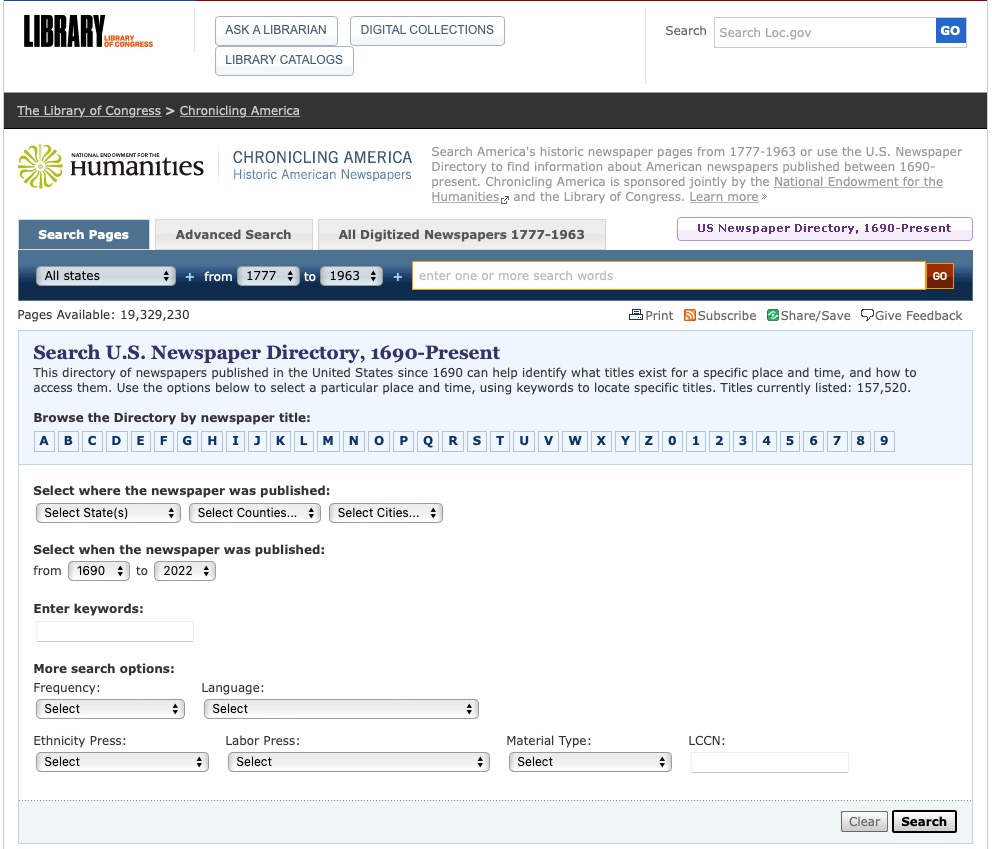
My first stop when looking for any newspaper in the United States is Chronicling America’s “US Newspaper Directory, 1690-Present.” The Library of Congress has put together this directory of newspapers published in the United States since 1690. The best part is that it tells you what newspapers existed for a time and place, AND how to access them.

Chronicling America’s US Newspaper Directory

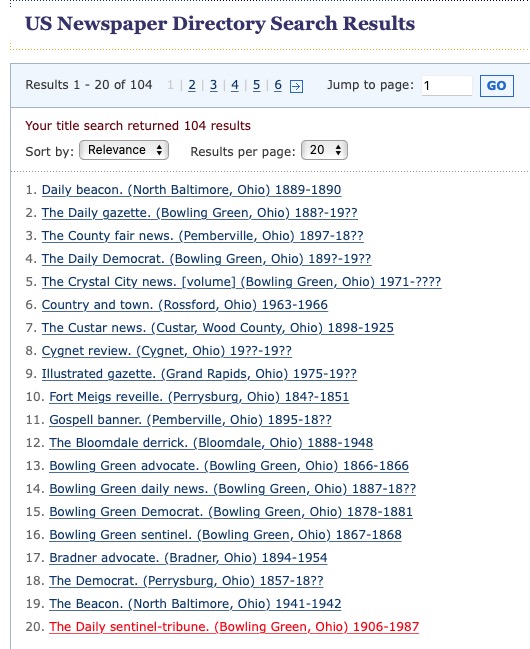
Selecting Wood County, Ohio shows that there are 104 titles in Wood County. The one I most want to access is the Daily Sentinel-Tribune (in red below).

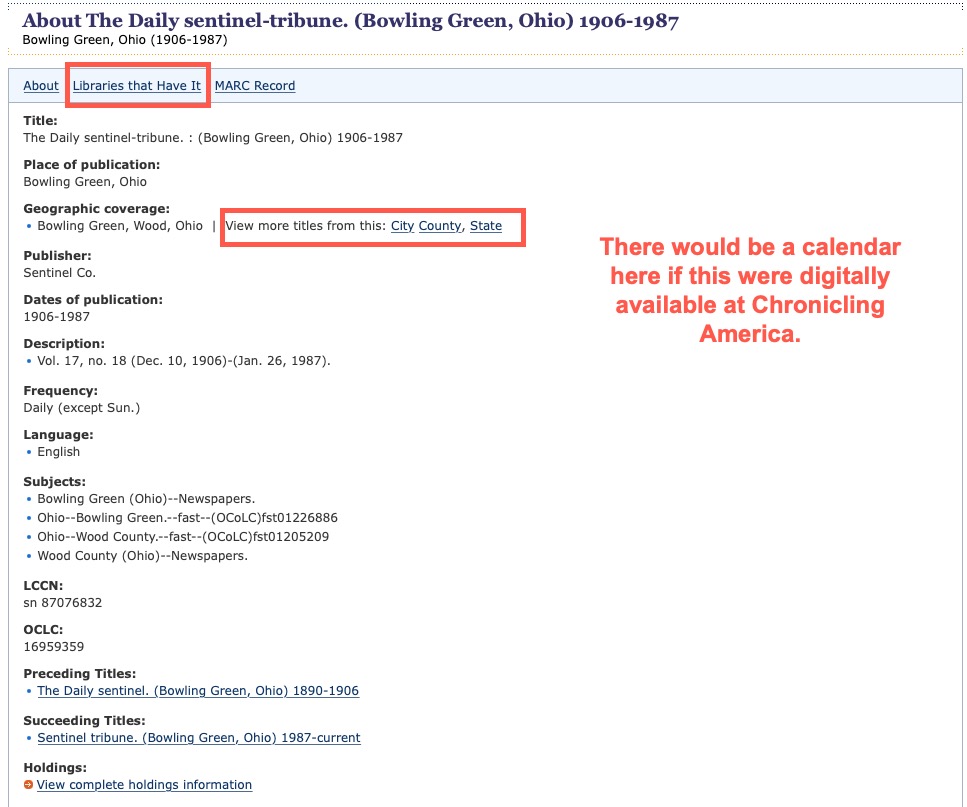
Clicking on that link provides you with a nice informative screen about that particular newspaper, including when it was published and preceding and succeeding titles.

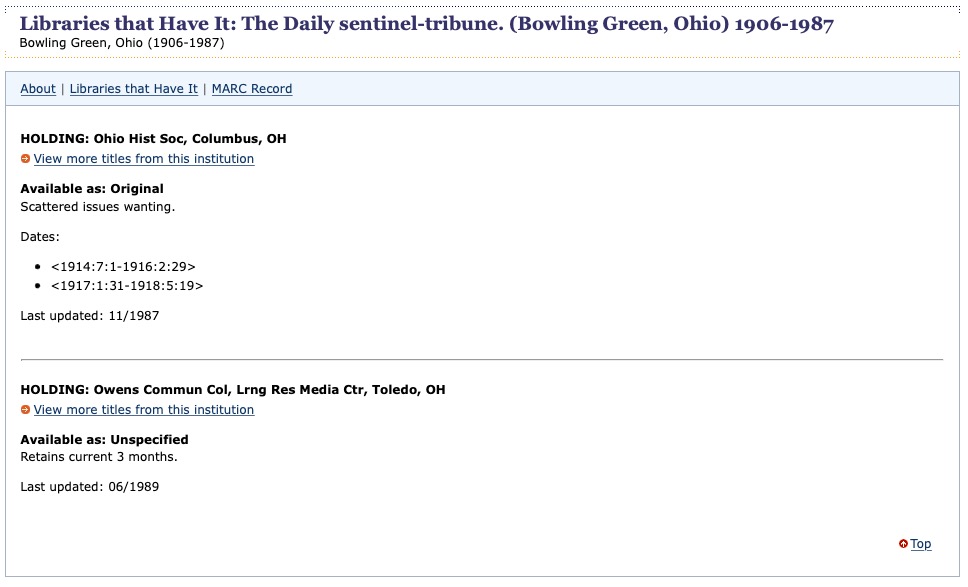
If there were a digitized version at Chronicling America, there would be a calendar view of available issues in the large white space to the right of the catalog entry. In this case, there is not. If you want to see other titled in that city, county, or state, there is a button for that. However, the most valuable button on this catalog is the “Libraries that Have It” link at the top. I issue a word of caution, however. This particular entry does not list the Wood County District Public Library in Bowling Green, which I know for a fact holds the entire run on microfilm. I’ve spent countless hours there going through the films.

My point here is to not stop looking… again. Just because the LOC doesn’t list a local library for a source for newspapers, do not stop looking. ALWAYS, ALWAYS check that local public library for the possibility that they hold the records you are looking for.

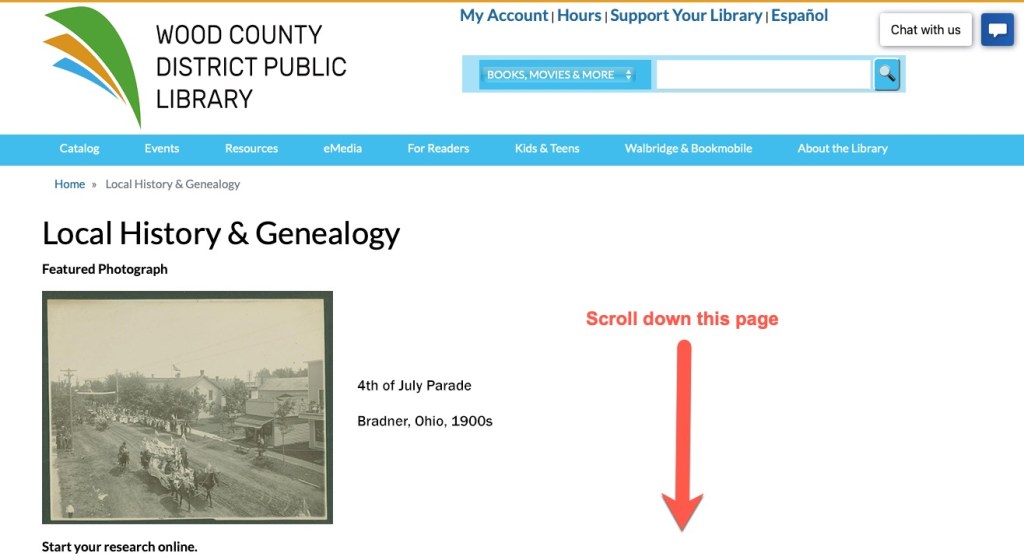
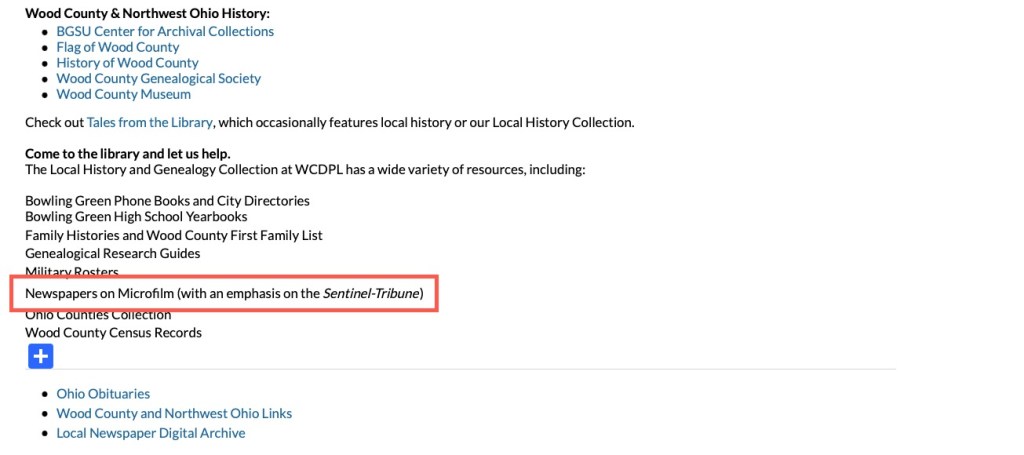
The Wood County District Public Library Website for Local History and Genealogy

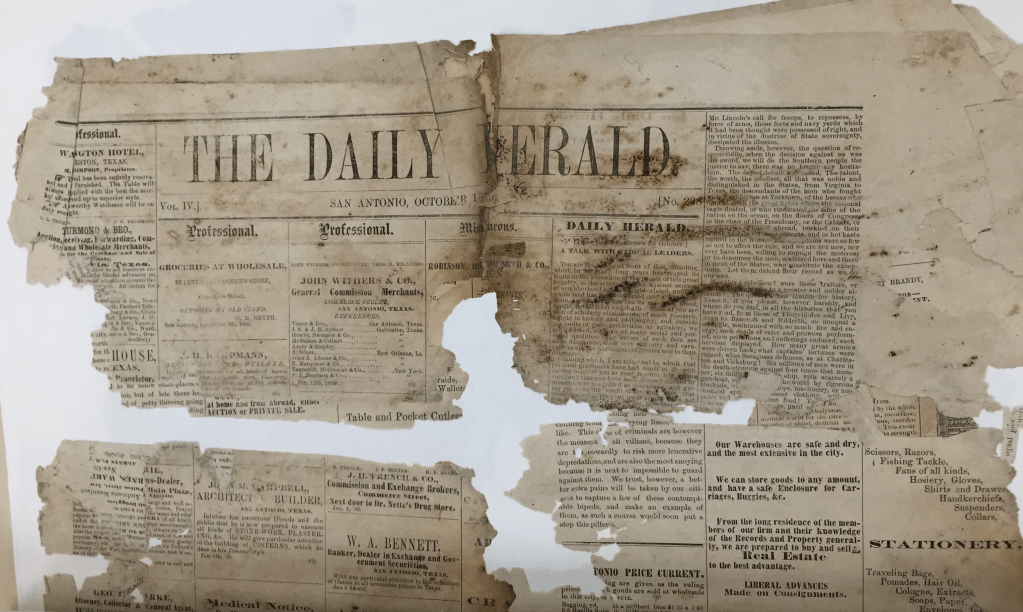
If I hadn’t already known that the WCDPL holds those microfilms, I may have stopped there and assumed that the newspapers did not exist anywhere. Which is not unreasonable. Newspapers were not printed on acid-free paper and stored in temperature and humidity-controlled rooms until sometimes it was too late.

Newspaper crumbles, photo taken by author

Do you see what I mean by “pre-research”? You have to research where the sources are before you can access them. Next up, how to best to access the newspapers that are not online.

Many Paths to Sources: Newspapers, Part 2

Last time we looked at some of the big and obvious sources for finding online newspapers. But there’s more out there. You just have to have a lot of persistence and a little bit of luck. I’m talking about not stopping at just the major sites I shared last week. That is literally the tip of the iceberg. There are so many digital collections that are separate, part of a small local project, and just not known to the larger outside world. Here’s where you start (one of these, not in any particular order):

  • Local public libraries, especially if they have a local history collection
  • Local historical societies and museums
  • Local genealogical societies (“local” might mean regional, look at the next biggest town)
  • Nearest university (and then the next, etc.)
  • Town, city, county, state (and whatever the jurisdiction setup is in other countries) repositories such as an archive, library, historical and genealogical society, and so on

To learn about these you could do a simple Google search (‘Wood County Ohio public library,’ for example) or you could use other resources such as Cyndi’s List or the FamilySearch Wiki for genealogically specific information. Let’s look at an example.

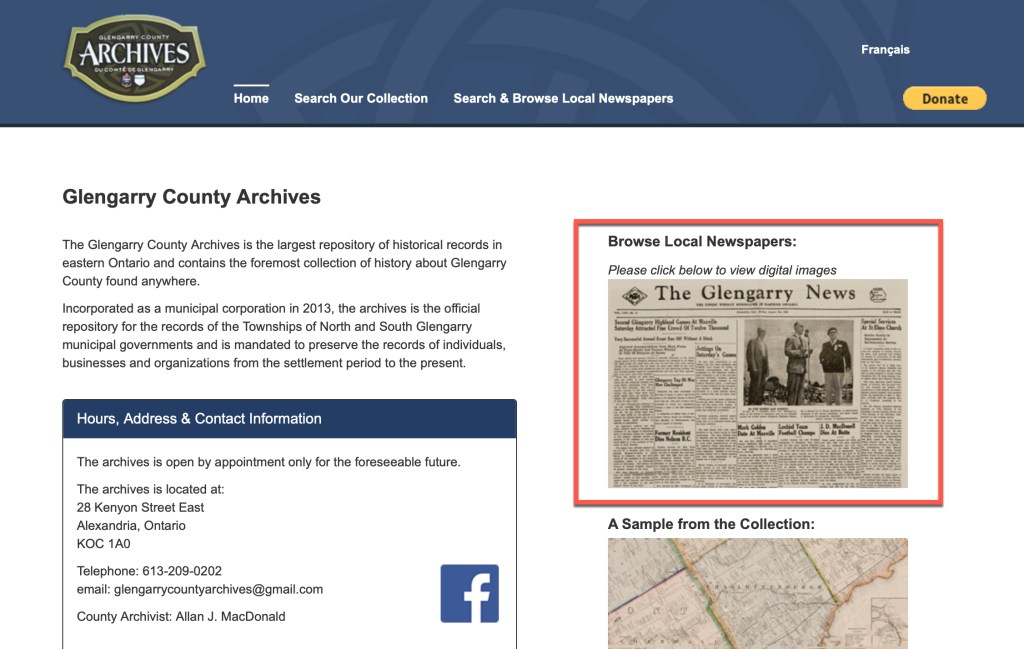
I had a client who’s ancestors were from Glengarry County, Ontario but one of a set of sisters had moved to New York City where she became a nurse. I needed to prove that the particular sister was in New York City at the right time to have given birth to my client’s grandmother. Of course, this is between census years; city directories were not easily available for the right years for the right borough; and etc. I was also unable to find mention of this sister in any newspaper in New York City and vicinity. However, I found a treasure trove of digitized newspapers at the Glengarry County archives.

Glengarry County Archives – Browse Local Newspapers

Lo and Behold! I found articles describing when the sister went to New York for nursing school, when she came home for visits, her progress, her graduation, her new job in a New York hospital, and more. I was able to prove that she was in New York City at the right time and place. This is not a collection that is highly visible through other sites. These digital images are not a part of a large subscription service.

I found this resource that helped solve my client project because I have a list of places I start looking when the “big” sites fail. That list is the bullets listed above: libraries, historical societies, genealogical societies, universities, county and state level archives. This method has worked too many times for me not to follow it. If it helps, make a sticky note with that list on it and keep it near your computer.

Whatever you do, don’t give up when those major sites do not provide what you are looking for. You can’t give up until you’ve exhausted those and this list. Next time, we will discuss what to do when you’ve exhausted both of those. Keep searching!

Many Paths to Sources: Newspapers, Part 1

First, let’s take a look at newspapers. Newspapers are one of my favorite subjects to speak about. Finding your ancestors in the newspaper gives you a nice, albeit often short, snapshot into their lives and gives their lives extra flavor. It helps turn them into real people that existed rather than just names on a document.

There are some fantastic online options for finding newspapers. The big three sites for subscriptions:

And there is not one that is better than the other. They all have different collections, so the one that is right for you, is the one that has the series of newspapers with your ancestors in them. Be sure to check their catalog for coverage before buying a subscription. All of these sites let you do that, so don’t skip this step and then get disappointed if they don’t have the papers you needed.

There are many free sites for newspapers across the U.S. Many states have a state digitization project and corresponding website. Here are just a few:

Of course, there is the Library of Congress’s collection of digitized newspapers:

Internationally, there are also some free digital newspaper sites as well. I know of a couple where I’ve done research:

Then there are link sites such as:

The above, is a lot. But is is literally just scratching the surface of what you can do with newspaper research. In Part 2 we will look more closely at finding newspapers online. In Part 3, we will delve into finding and accessing newspapers offline.