Monthly Archives: May 2023

Having a Good Research Question

I know at the end of the last post I said I would next be talking about the Ancestry catalog. But as I started that, I felt like I needed to give a little background on why I’m even writing this series. I’ve probably talked about this before on this blog, but it is so important, that I’m going to say it again. Good research begins with a good research question. If you don’t know what you are looking for, how are you going to know when you find it?

I talked previously in this series about the two phases I’ve seen and experienced throughout my genealogical lifespan, collecting and then focused research.
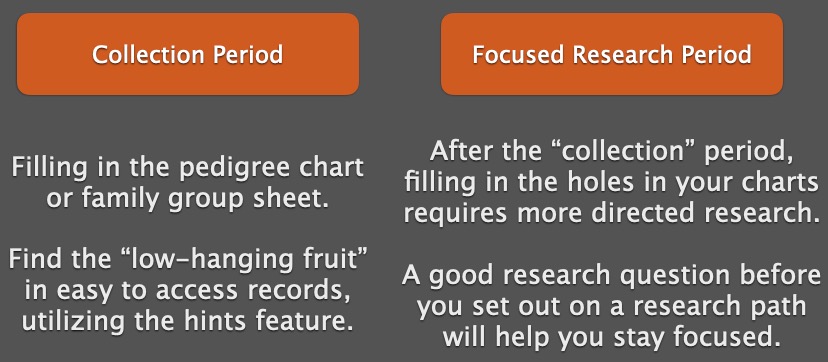
The two genealogical phases.

Having a good research question guides your research in the second phase. It helps tell you where to look for answers.

There’s a Goldilocks effect when it comes to research questions. They can be too broad, too narrow, or just right. And we aim for the “just right” question. The question needs to identify a unique person in time and place, and it needs to be answerable. For example:

Who were the parents of Thomas Carroll Mitchell who died in Montgomery County, Missouri on 29 April 1914?

This question identifies a unique person by giving a full name and death date and location. It says “I’m talking about this specific Thomas Mitchell, not the man of the same name who lived two counties over and died a year later.”

A question too broad will not give those details: Who was Thomas Mitchell? Who were Thomas Mitchell’s parents? When was Thomas Mitchell born? All these only provide a name, and not a full name (use it if you have it), and not location or dates. There are far too many Thomas Mitchells in the world for these to be useful questions. They do not give enough information to even know where to start.

A question too specific might be: What was Thomas Carroll Mitchell’s exact date of birth? Believe it or not, some people did not know their exact birth dates, or records may not have been left that provide that information. A better question might ask for “when was he born” which can be answered with a date range or a year only.

The “just right” question will give enough information to guide our research. Let’s look at the example above. From that question, we know where and when Thomas died. Likely we have a document (death certificate or burial records) that provided that information. Now, we can work backwards to try to identify his parents. We know he died in 1914, so one step in our research plan might be to find him in all of the censuses starting with 1910 in Montgomery County, Missouri, provided he didn’t recently move there.

Based on what you find in the censuses, you then decide where to go from there. Part of that is what I call “pre-research.” How do you know where to go to find the records you want to look at? Guess what. It’s the catalog.
Using Websites’ Card Catalogs

I’ll bet many of us (most of us?) go to a genealogical website and plug our ancestors’ names into the first search box we see and hope for the best. At least at first. In the past, this was exactly how I conducted my research. Rather haphazardly, with varying success.

In my experience, I think there are two phase in the life cycle of the genealogist (there may be three or more, but I haven’t gotten there yet). First, there is the collection phase. We’ve just gotten started, we know a few details from our parents or grandparents, and we just start collecting records and filling in the pedigree chart as fast as we can. In this phase we find the “low-hanging fruit” in terms of records. And that is fine, but eventually, you get to the second phase. In the second phase, you’ve run into some trouble. You’ve found some conflicting records or some brick walls and have some harder work ahead of you.

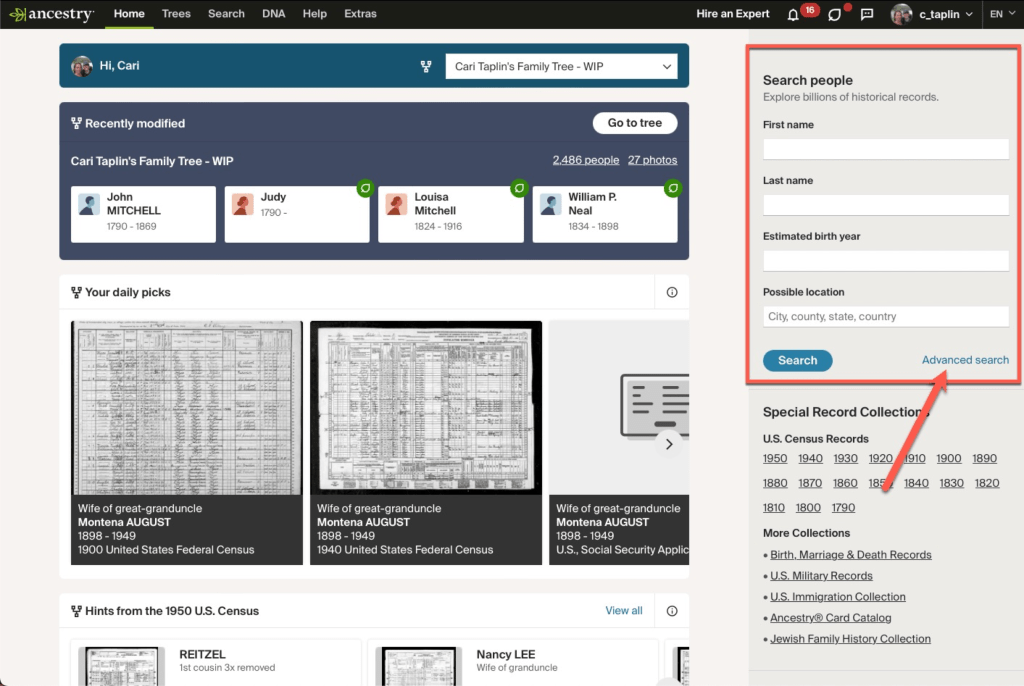
Ancestry’s Front Page Search Box – Arrow Points to Advanced Search Option

Each of the major genealogical websites has a front page with that ever-tempting search box in it. That is their way to get quick engagement with website users and potential subscribers. This blog series is going to assume that we are all subscribers. If you try to do some of the things I’ll discuss, it will likely ask you to subscribe to see the documents or the search results anyway. Just be aware. This is not meant to be a blog series that discusses only FREE websites or databases. FamilySearch is the only free site I’ll be discussing.

The main front page search box is going to be great for that collection phase, but not so great for the phase where you work on more difficult problems. This series is going to help you learn some other facets of these websites to make your searching more targeted and efficient. That front page search may also be a hindrance if you are working with common names or don’t have much information to help narrow down your search results. When working with general search results, we have to pay extra attention to details so we don’t end up “adopting” the wrong family into our family tree.

Up next… Ancestry’s Card Catalog

I had a little break…

Hi loyal readers. You might have noticed I took a bit of a break from my blog. I just had so many things come up that something had to give for a while. But I’m back, so never fear, all is well and I’ll try to get back into my blogging routine.

First, what have I been up to? Well, the biggest event was that I was the keynote speaker for the Ohio Genealogical Society Conference that took place at the end of April. My keynote followed the theme of the conference “What Brought Them Here?” and focused on why families move and how might those who moved to the Great Lakes area have made their way there. I also gave a workshop on using Google’s MyMaps, as well as five other lectures. It was a busy week! And all of the time leading up to that event was when I took a blog break. I had to make sure all of my materials were ready!

Second, what am I up to for the rest of the year? The biggest thing going forward is that I’m coordinating a course and teaching in another for the Genealogical Research Institute of Pittsburgh. My course is “The Spirit of the Inland Seas: Research in the Great Lakes States” along with Cyndi Ingle, Paula Stuart-Warren, and Judy Russell. There are a few seats left if you’d like to join us! It is virtual so held entirely online and from the comfort of your own home. The other course I’m teaching in is “Digging Deeper: Records, Tools, and Skills” coordinated by Paula Stuart-Warren.

I also have some webinars planned:

You can follow my speaking calendar here.

Third, what’s the next topic for the blog? I’m going to share some tips and techniques for using various online catalogs at websites many genealogists use frequently, starting with Ancestry, but we will eventually get to FamilySearch, FindMyPast, MyHeritage, and others. With this series I’m hoping to share some different ways to utilize the websites that you may not have thought of.

Happy Spring!