Monthly Archives: March 2024

Black Cowboys

We will be discussing Black Cowboys in the ranching lecture of the farming course I am coordinating for GRIP called Not Just Farmers: Records, Relationships, and the Reality of Their Lives.

Historians estimate that one in four cowboys was Black. During their enslavement, many learned the skills needed to handle cattle herds (riding, roping, blacksmithing, leather-working, etc.) After emancipation, these skills were needed, especially in Texas where the longhorn herds were largely out of control after the Civil War. Cowboys were needed to drive the cattle north to markets where the prices were higher.

Of course, Black cowboys faced discrimination such as being banned from restaurants and hotels. Reportedly, most found respect among their white counterparts working the cattle drives together, respect that most Blacks found elusive. They sought the “largely unhindered outdoor life, fair treatment, and decent pay” that the life of the cattle drover offered; they sought a life where skill and hard work would matter more than skin color.1
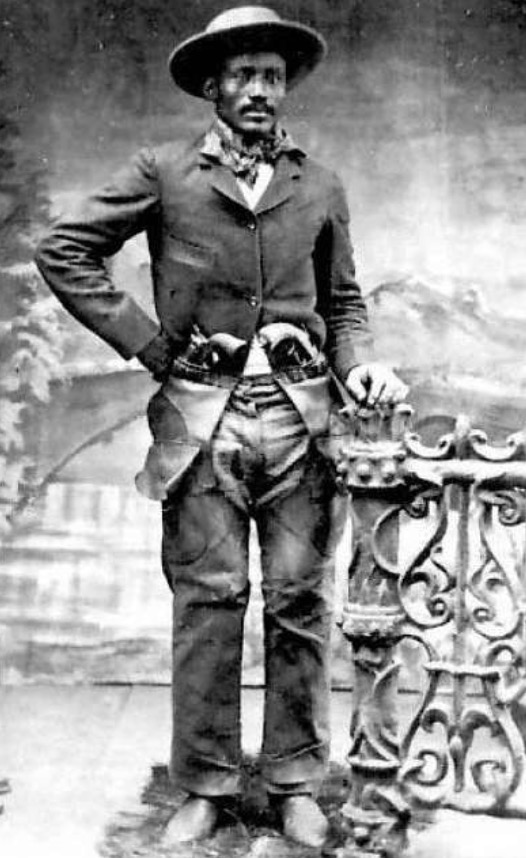
Ned Huddleston, aka “Isom Dart,” Brown’s Hole, Wyoming, 1890.

As most cattle drives ended by the early 1900s with the growth of railroads for moving cattle, the invention and use of barbed wire to parcel up the previously open range, the need for cowboys dwindled, and so did the opportunities for Black cowboys. However, the lore of the Black cowboy lived on in popular culture. From rodeos to western movies and books such as Lonesome Dove which featured Black cowboy Bose Ikard, the cowboy lifestyle lived on, as did the Black cowboy. Black cowboys had a heavy influence on cowboy ballads and music; the song Home on the Range was first recorded by a Black saloon keeper and cowboy.2

Here’s a list of movies featuring Black cowboys if you’re interested:

  • Buck and the Preacher (1972) starring Sidney Poitier
  • The Harder They Fall (2021) starring Idris Elba and Regina King and a mostly Black cast
  • Django Unchained (2012) starring Jamie Foxx and directed by Quentin Tarantino
  • Joshua (1976) starring Fred Williamson
  • Surrounded (2023) starring Letitia Wright

Watch these movies at your own risk. For example, Django Unchained is a Quentin Tarantino movie… if you’re familiar with his work, I need not say more. Enjoy!


1. William Loren Katz, The Black West, (Golden, Colorado, Fulcrum Publishing: 2019), p. 149.
2. Dom Flemons, “Black Cowboy Songs,” American Folklife Center, Library of Congress, 16 September 2020, video available online at https://www.facebook.com/watch/?v=1819161024888703. ]

GRIP: Digging Deeper

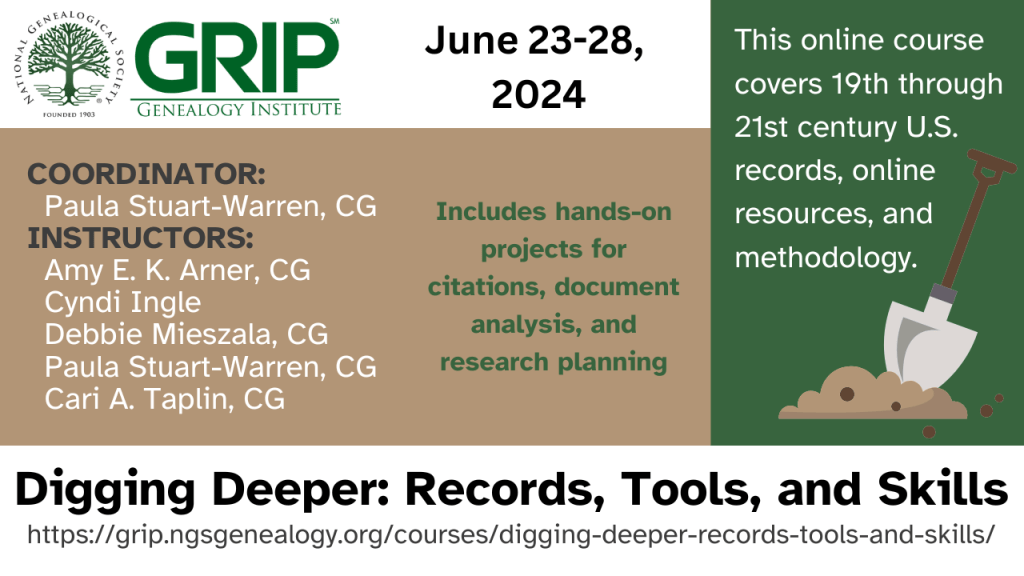
Another course offered at GRIP Genealogy Institute this summer is coordinated by Paula Stuart-Warren, CG, FMGS, FUGA. It is called “Digging Deeper: Records, Tools, and Skills.” I am one of the instructors for this course and am looking forward to it!

For the complete details and to register, visit this link.

Paula is a fantastic instructor. She does an excellent job with hands-on experiences in addition to the lectures. This course is great for anyone wanting to expand or polish their genealogical skills.

I’ll be teaching two classes, one on PERSI (Periodical Source Index) and one on Probate Records.

Paula is also teaching in the “Not Just Farmers” course I am coordinating and in “Midwest Family History Research: Migrations and Sources” coordinated by Jay Fonkert. She wrote a blog post about this here.

There are a lot of educational opportunities coming up this summer. This class is one you should consider if you haven’t taken it already!

For the complete details and to register, visit this link.

Virtual Seminar with Cyndi Ingle and Cari Taplin!

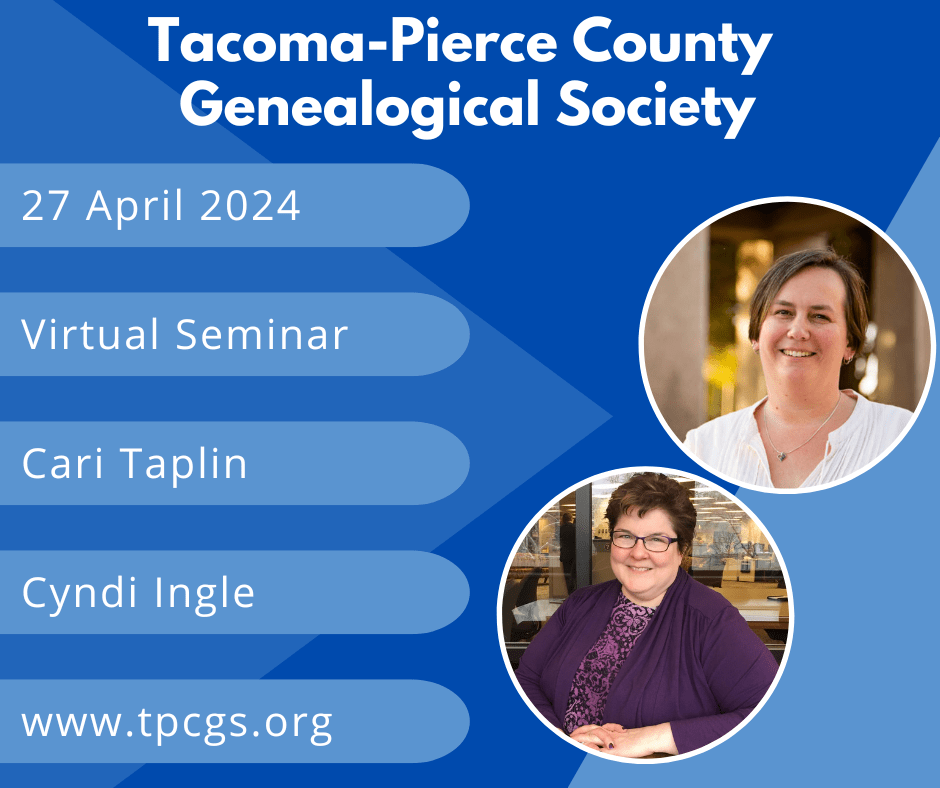
Coming up at the end of April, an all day seminar with Cyndi Ingle (of Cyndi’s List) and myself hosted by the Tacoma-Pierce County Genealogical Society. This is a VIRTUAL seminar so you can join us from the comfort of your own home! There will be two lectures by each of us.

Cyndi’s Topics:

  • Smarter Searching: Refining Search Parameters for Genealogists
  • Off the Shelf: The Unexplored Potential for eBooks in Genealogy

Cari’s Topics:

  • Using Timelines to Analyze Your Research 
  • The Heart of it All: A New Hampshire to Ohio Migration Case Study

Seminar Schedule – Pacific Time, so convert for your time zone:

08:30 – 08:45 Enter the Zoom meeting
08:45 – 09:00 General announcements; troubleshooting
09:00 – 10:00 Presentation 1
10:00 – 10:30 Break & chit-chat
10:30 – 11:30 Presentation 2
11:30 – 12:30 Lunch break & chit-chat questions
12:30 – 01:30 Presentation 3
01:30 – 02:00 Break & chit-chat
02:00 – 03:00 Presentation 4
03:00 – 03:15 Q&A with the Speakers

Click this link to get the full details and registration instructions.

We hope to see you there!

Not Just Farmers…Ranchers Too!

One of the topics I’ll be teaching in our “Not Just Farmers” course at GRIP Genealogy Institute is on ranching. both cattle and sheep. We really want to cover as many agricultural pursuits as possible, and ranching and farming are interconnected.

One topic I’ll be discussing is “Texas Fever,” and unlike “gold fever” “Texas Fever” was a bad thing.

St. Louis Globe-Democrat, 28 August 1855

“Texas Fever,” or “Texian Fever” as the above article called it, sometimes also called “Spanish Fever” was a disease that Texas cattle carried. They thought the disease was tick-borne and spread in southern cattle because the weather was not cold enough to kill the ticks or disease. The cattle would carry this disease on the long cattle drives to the north. Reports in newspapers in towns all along the famous cattle drive trails reported on this disease. The Texas cattle seemed to be immune to it but when they intermingled with other breeds in the north, the northern cattle died from it, causing farmers and ranchers to lose thousands of dollars in their businesses and livelihoods.

The problem was so harmful to northern herds that vigilante groups took action on their own until laws were passed to stop the importation of Texas cattle. A law was passed in Missouri 1855 that made it illegal to bring diseased cattle into the state with a penalty of a fine and killing of the cattle.1 In 1861, another Missouri law was passed attempting to control Texas Fever. The law appointed “three competent and discreet persons”  in each township to serve as cattle inspectors with the power to “examine all Texas, Mexican, or Indian stock” driven into the township. They could order the owner to removed the cattle and if the owner did not comply, they could call the sheriff to kill the cattle.2

Cattle tick fever is still a problem. “The pathogens that cause Texas cattle fever are transmitted from infected to non-infected cattle by two closely related tick species known as ‘cattle fever ticks.’ There are no vaccines or drugs available to prevent or cure Texas cattle fever.”3


1. Revised Statutes of Missouri, 1855, Volume 2 (Jefferson City, Missouri: 1856), 1104. 
2. Laws of the State of Missouri Passed at the Regular Session of the 21st General Assembly (Jefferson City, Missouri: 1861), 26. 
3. See “Eradicating Cattle Fever Ticks” from Texas A&M.]

Blogging has Taken a Backseat to Farming

Hello friends. You may have noticed (or maybe not) that my blog went a bit silent there for a bit. That’s because I’ve been in writing overdrive preparing for my newest course “Not Just Farmers: Records, Relationships, and the Reality of Their Lives” that will occur at the NGS GRIP Genealogy Institute (formerly the Genealogical Institute of Pittsburgh), virtually, June 23-28., 2024. Registration is now open. Of course, I’m not the only instructor. I am being joined by Cyndi Ingle and Paula Stuart-Warren as well.

I get tired of hearing genealogists of all kinds say “oh my ancestors weren’t that _____ (interesting, important, etc.) because they were ‘just farmers.'” There is a commonly held belief that they did not lead interesting or important lives, and that they just didn’t leave many records. So, this course is designed to defy all of those misconceptions. There is nothing more important than providing food and other necessary supplies to your family and community.

The focus of our course is on North American farming and agricultural ancestors and their families. The course will dispel the myth that our ancestors are “just farmers” without a rich and documented life. Farmers have often been dismissed by the assumption that there is not much to find or to learn about their lives and the issues they faced. The variety of records–often underused or undiscovered–give depth and breadth to the lives of our ancestors. Understanding the history of farming and learning about the unique records of the people, products, and land, will give a deeper picture of what hearty families we descend from. Students will build an “agricultural profile” for their farming ancestors by the end of the week. This profile can help to craft a robust background of their “just farmer” ancestors.

My Grandpa Karl Miller on His Tractor

The full breakdown of the courses and who will be teaching those can be seen on the GRIP website. My topics include:

  • Inventions and Ingenuity: Advancement in Farming Over Time
  • Get Along, Little Doggy! The Agricultural Contributions of Ranches
  • Historical Side-Hustles: Other Income Streams of Our Farming Ancestors
  • Farming Outside the Law: Squatters, Tax-Evaders, and Bootleggers
  • Female Farmers: Women’s Issues in Agricultural Families
  • Taking Care of the Farmers: Social Programs Benefitting Our Farming Ancestors
  • A Case Study – Building Your Ancestor’s Agricultural Profile

I am going to share tidbits that I’ve been writing and collecting for this course on my blog over the next several months. So, break out your bibbed-overalls and work boots, and hang on to the tractor’s steering wheel and let’s go for a hay ride through farming lives and their records. (Did I get enough farming metaphors in there?)