My ancestor, William Long, was killed in a terrible grist mill accident at Gilboa, Putnam County, Ohio in 1861. The newspaper reported that his clothing got tangled in the belts and he was drug into the machinery, breaking every bone in his body.1
I will be talking about grist mills and this incident in my lecture on “Historical Side Hustles” in the “Not Just Farmers” course that this taking place at GRIP (virtual) in June. As part of the lecture, we are going to watch this video I found on how grist mills worked and thought I’d share it.
This video makes the grist mill look quite slow. However, grist mills were not just used for making flour. They also utilized the water-powered shafts to spin grinding wheels designed to sharpen tools. That’s what William was up to when he got caught in the machinery. He had gone to the mill “for the purpose of grinding his scythe; and while arranging the belt to the grindstone, his clothing was caught by another belt, and he was whirled around the shaft, which was making about ninety revolutions a minute…”
I then started looking at who owned the grist mill in Gilboa, where it was located, whether it was operated by water or not, and I came across an entry in the Putnam county history that stated that the first gristmill in Gilboa was opened by Elisha Stout in 1837.2 Gilboa is located on the Blanchard River, which also runs into Findlay, Hancock County, Ohio, where William Long lived.
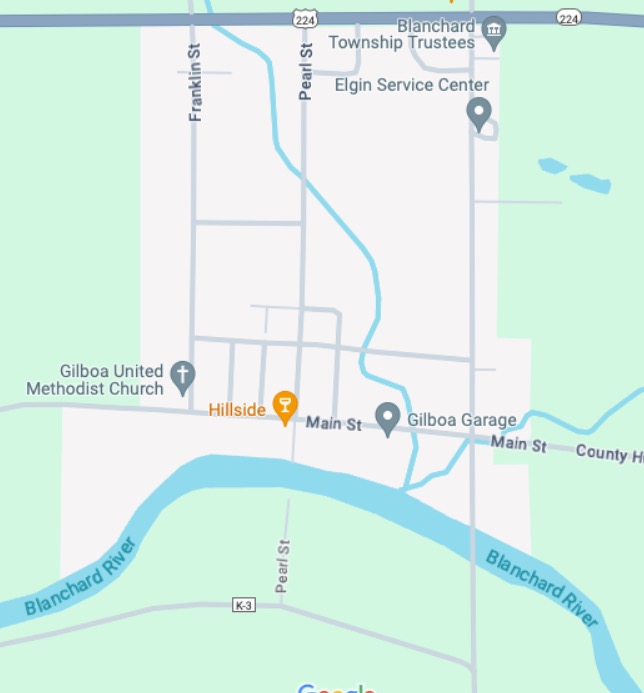
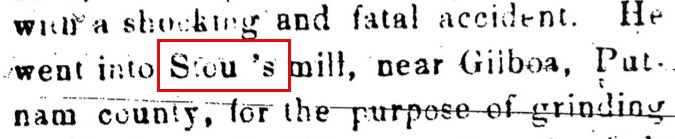
Rereading the news article about William’s death, there is a section of the print that is hard to read, but now makes sense… “He went into Stout’s mill…” The news article print is faded:
Two lessons here… First, check YouTube for short videos on how things worked to better understand what our ancestors were doing and seeing everyday. Second, as you learn more, go back an reread the materials you’ve already collected. New information will pop out at you, and old information will make sense that didn’t before.
And a third, don’t wear loose-fitting clothing when working around fast-spinning belts. It can result in a “sad accident.”
1. “Sad Accidents” William Long obituary, Hancock (Findlay, Ohio) Courier, 23 August 1861, p. 3, col. 1.↩
2. George D. Kinder, History of Putnam County,Ohio: Its Peoples, Industries, and Institutions, (Indianapolis, Indiana: B. F. Bowen, 1915), p. 116; available on Internet Archive at https://archive.org/details/historyofputnamc01kind.↩
 Genealogy Pants
This was a very, very interesting post on grist mills. The video was excellent in understanding the process. I was surprised that turbines were used and how complex the process was by then. My “family” mill dated from the 1840s in Illinois and was run from a water wheel on the side of the buiilding. A creek was damed above the mill to provide enough water to run it. That process (without turbines) was probably a lot less reliable due to variable amount of water in the dam on the small creek. Your email also made me wonder what ever happened to the grinding stones to my family mill. The building later was used just as a home and finally for storage. There never were any stones nearby in my lifetime. I would guess the stones were probably sold at some point to someone starting a mill elsewhere. Thank you, Linda Bixby Fulmer