Monthly Archives: September 2025

Revisiting My Roots: Census Records

Censuses are one of the foundational records for building a family group. They take a snapshot of a family’s structure every 10 years. One thing many census records have in common is poor visibility, whether that’s because of poor handwriting, faint pen/pencil on the original, poor quality scanning, or something else. They can just be hard to read, especially in printed form. In my binders, I find it annoying to have to find the family of interest on the page, and then see and/or interpret the writing every time I want to review my research. I can do some zoomed in screenshots and print those as well. However, I prefer to transcribe.

To solve this, I transcribe the census information and print it out, putting it into the other side of the sheet protector so I have the original and the transcription together in one page. I use a set of fillable forms from CensusTools.com. (This is NOT a paid advertisement.) They have created spreadsheets for every federal, state, special, and international census. The cost today is $13.95 for 40 fillable spreadsheets. However, if funds are tight, feel free to make your own, or just transcribe the information into a word processing document. I just appreciate having the form match the original census forms, making it easier to see the data at a glance.
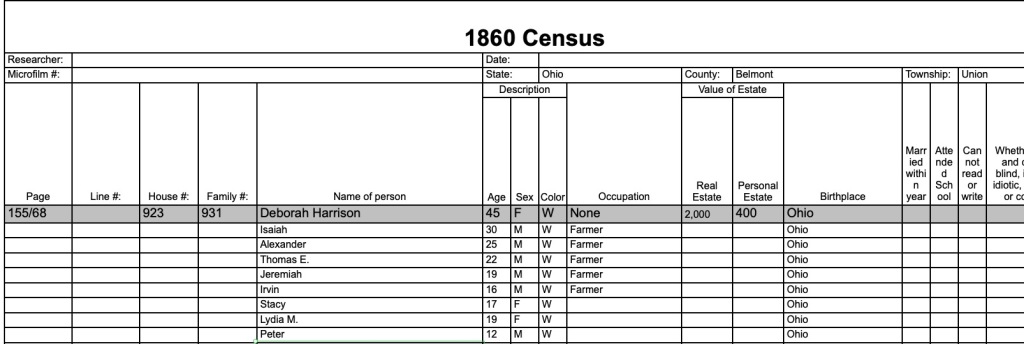
Sample from one transcription of the 1860 census for my Harrison family.

Since this is a spreadsheet, you can add columns or rows, transcribe 10 households up and down the page, or collect all persons in a county of the same surname. Whatever your project needs, you can do. These are nice because they are already formatted matching the original forms.

I add this sheet to every census I have for a family and add it to my binder. It makes reviewing those records much quicker and easier on the eyes.

Revisiting My Roots: Handling Each Document

As we drill down through my system of revisiting old work, I want to share the process I do with each document. I do this with the entire binder before I start with new research because the process I do now is way more detailed than the process I did in 2000. So, some of these things were not done back then and I want to bring my binders up to the same level of “doneness.”

This process includes:

  • Write a full citation for each item. I put that citation in my touch-it-once citation list as well as in my desktop software. I never have to write the same citation more than once. I do have to fiddle with them from time to time based on writing project, audience, and any style changes that invariably happen over time, but the bulk of the citation is done once and forever.
  • Print that document, with the citation affixed to the front of the page in some way. I personally use Snag-it most of the time to add my citations in a text box on the page. You can also use Word or Mac Pages. This fulfills the genealogy standard regarding the separation of document from citation.1
  • I put my documents into sheet protectors and file them in my binders in chronological order, with the children of the couple in their own section. This makes a visual timeline of their lives.
  • I also file that digital document in my electronic filing system that mirrors my binders. The main part of this step is with the file name so that the folder’s contents are in order to match the binder. This is largely done by putting the year first.
  • I make sure that document has been added to my Ancestry tree and my desktop software. I do have trees on other sites, but they are mostly for cousin bait and are not my full tree. My Ancestry tree (which is private) is where my work happens. It contains verified and unverified information, which is why I keep it private. I do have a public tree that I have attached to my DNA but it is a bare-bones tree with only the main details to get DNA matches the information they need. I also do not use a software that would sync with Ancestry (like FamilyTreeMaker). I like to have control over what is uploaded and downloaded. Plus, the act of adding items to trees sometimes reminds me of something else to do or shows me where I’ve made an error.

As I conduct new research to fill in the gaps from by “baby days,” I do the above as well. I don’t get “too crazy” with the children of each couple (except the one I descend from) unless I need to for a particular project. Remember, this is just the basics. I’m finding vital records, census, and newspapers as available. But I didn’t even do the basics when I didn’t know any better, so these binders have a lot of holes.

I’ll share some of the other things I do in my binders to make reviewing my research easier for myself. My future self thanks me when I do them and curses me when I don’t. Until next time…

  1. For more information on Genealogy Standards, visit the Board for Certification of Genealogists.  ↩︎

Revisiting My Roots: My Basic Process

I started (in my spare time) revisiting the work I did on some of my family lines back when I didn’t know any better. I refer to myself as a “baby genealogist” during that time. We all start somewhere and don’t know what we don’t know in the beginning. Well, now with 25 years of experience under my belt, I’m revisiting some of those lines I haven’t touched in almost as many years.

I have a binder and electronic filing system that should mirror each other. If you only do one, good for you! Seriously. I just can’t bring myself to trust one or the other and feel the need for redundancy. And I think if I were to disappear (hit by a bus, win the lottery and just move to a deserted island, whatever) I’m not sure my kids would know where to look on my computer to find the work I did. But I will have the binders. And someday I may have a “Read Me” file prepared directing them to the electronic files. But it is not this day.

First, I have to clean up the mess… ok, it’s not a mess, I just didn’t know any better at the time. So it is filling in blanks with the new knowledge, experience, and changes in the genealogical world that have happened since I began back in 2000.

I’m going to share my basic process and I’ll go into most steps in more detail as the series moves on. To have some background, you might revisit my posts on my organization system. You might also look at my post on “touch-it once citations.” I’ll be referring to items from these posts along the way.

My basic steps:

  1. Review what I have in each binder and digital file. If I don’t have sections for each child in the binder and/or digital folder, add them, even if they have nothing in them yet. This is a stage to help get me ready and stay organized as I conduct new research.
    • I work by couple and their children (except the one I’m descended through because that person will be part of a couple). Each binder represents a couple (unless I have very little then couples might share binders until they get too much stuff).
    • I use those binders that have a plastic envelope on the outside that lets you slip papers in. On the front I have a family group sheet for that couple and on the back I have a pedigree chart showing this couple’s placement in the larger family tree. I print these from my desktop software.
  2. I work on each couple and their children (I don’t go any further unless I need to for a specific project, these are just the basics remember.) I find the basic records that should exist for each such as:
    • Census for each year they should be there.
    • Vital records if available (state, county, or city).
    • Newspaper articles, especially obituaries.
  3. As I work on the basics listed above, invariably something else pops up. I will either capture it right then or put it in a list (with a link and detailed notes) to work on later. It depends on how much of a time crunch I’m working with.

I have a process I do with each document as well. I’ll go over those details in the next post so stay tuned!