Tag Archives: comparative timeline

Timelines: Special Projects, In and Out Tables

Sometimes in our research, we come across an ancestor who did a lot of land deals. And you may want to understand what he was up to in more detail. Putting those land records into a timeline can really help. These are sometimes called “in and out” tables and may not necessarily be intended as timelines, but if you set up your spreadsheet or table in a way that allows you to sort by date, that’s exactly what you’ve created. You can follow a particular piece of land AND you can follow a person’s land transactions.

While working on my George Long project, I needed to disambiguate two George Longs in Hancock County, Ohio. One bought and sold land frequently in that county, the other owned one piece of land. (Can you guess which one mine was?)

Here is the table. The first image shows each piece of land next to each other, color coded to match. You’ll notice that in some cases, there’s only one entry. That means I did not find the “in” or “out” deed for that land in the timeframe I was working in. The land could have been inherited or disposed by will rather than in the deed books I was looking through. More research could be done to find those. (However, this is NOT my George Long, so I don’t think I’ll be doing that research.)
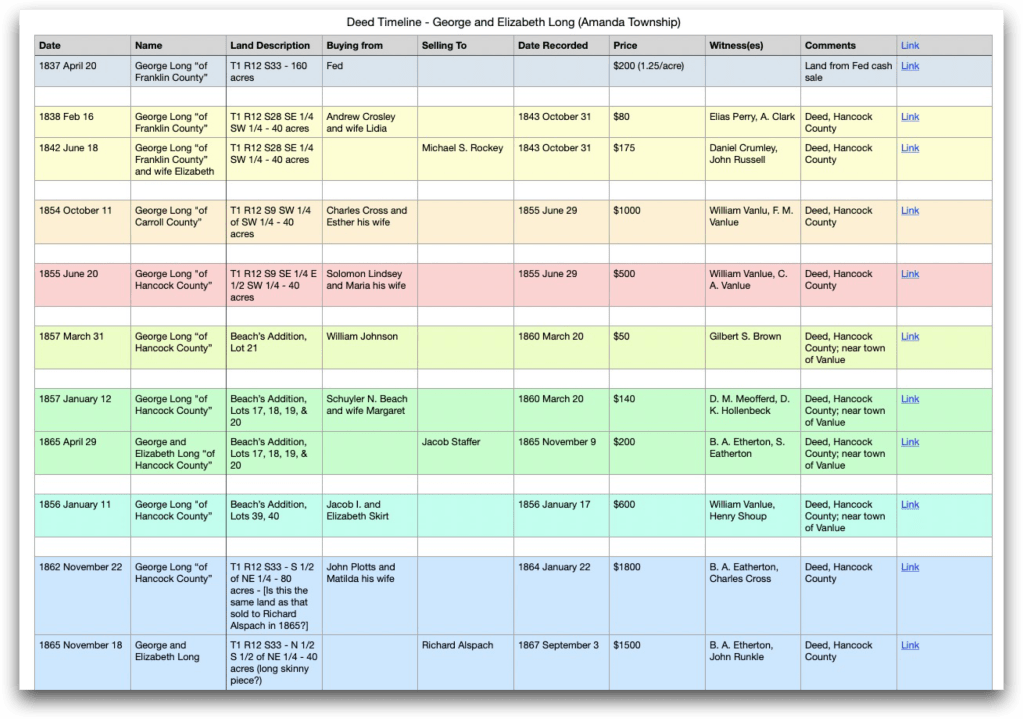
The above table is organized by piece of land. However, because of how I captured the data, one click turns this into a timeline.
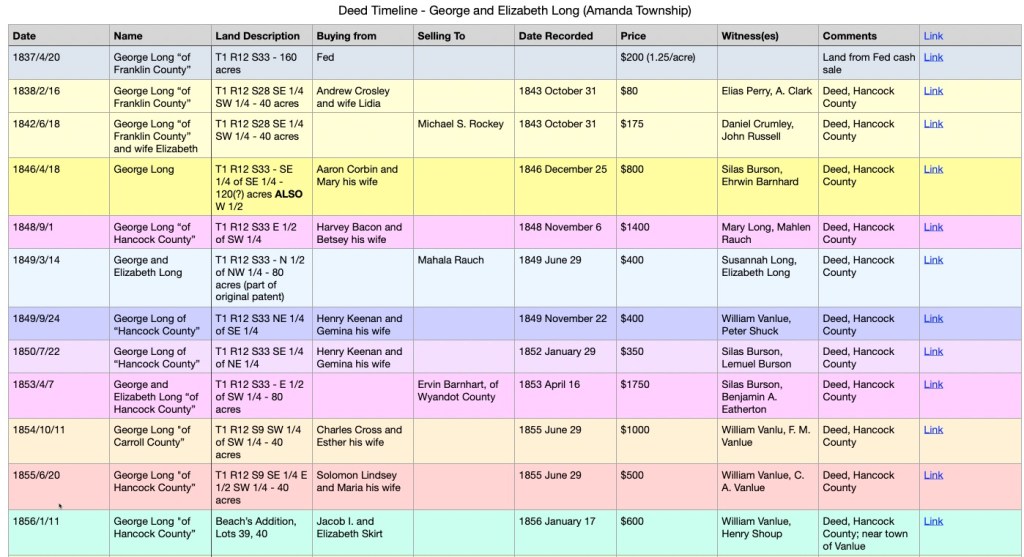
Timeline sorted by date.

If you are paying attention, and have read this far, you may have noticed that the first table is in fact NOT entered such that it will sort properly on the date. And if so, you get a gold star for the day. I had to go fix that for this blog post. It sorts alphabetically, essentially, so if you type of the names of the months, they will not be in proper month order. I had to go back and put the dates in by number instead of name so it would sort properly.

Couldn’t “they” have named the months in some kind of alphabetical order? I prefer the names over the numbers, myself, but that doesn’t sort right, so humbug.
Timelines: Special Projects

Timelines can also be use to visualize other types of projects or research goals. Probably the best two examples I can share from my own research are when trying to disambiguate two people of the same name (do we have one person or two?) and when trying to compare deeds for someone who did a lot of buying and selling of land (often called an “in and out” table, but they can also be timelines if you set them up in your spreadsheet to be able to sort them chronologically).

“One person or two of the same name?” is a common genealogical problem, especially in an area where a family lived for several generations. All the brothers named sons after grandpa and pretty soon, no matter how unique a name may be, suddenly there are multiple men with the same name in the same county at approximately the same time. How do you differentiate them? One tool is a comparative timeline or a “side-by-side” timeline.

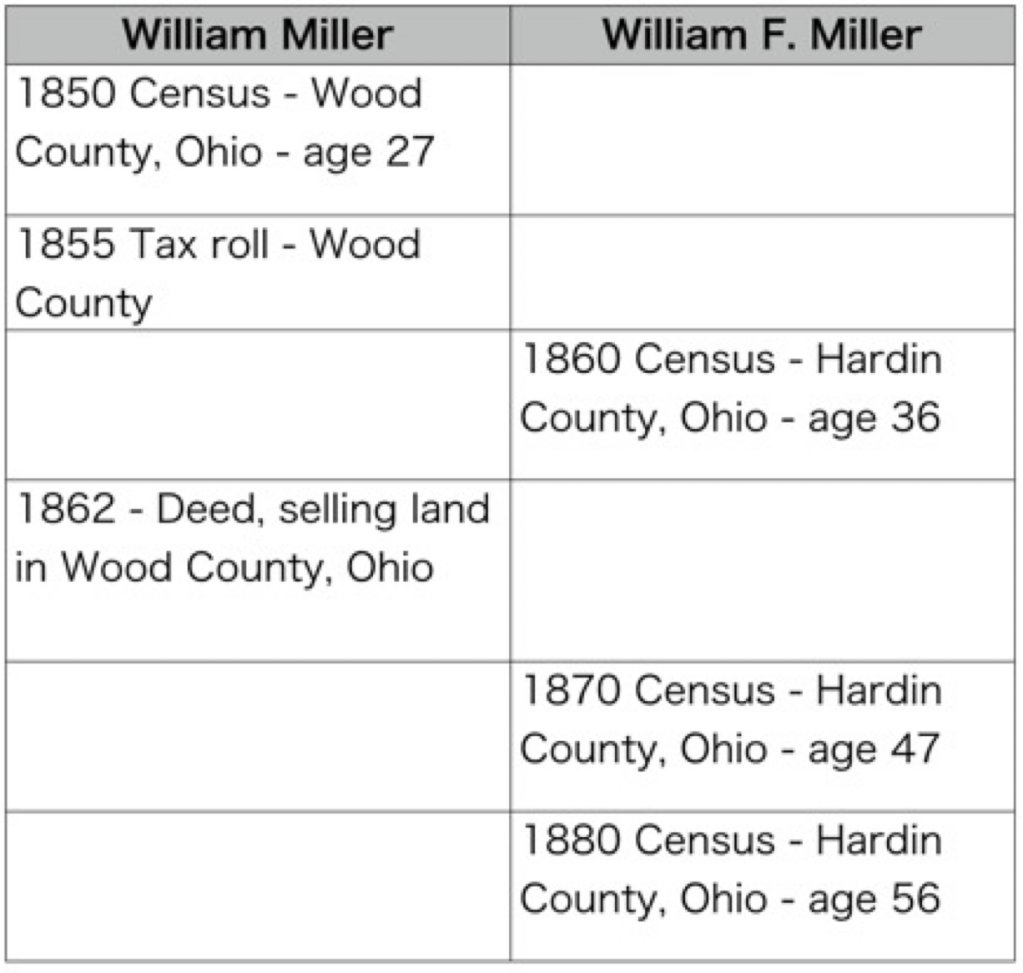
Make columns for the same-named people. In my example below, we’ll just look at two to keep it simple. I then put abbreviated information in each box/cell for that person. Enough to put it in chronological order, see a location, an age, and the source. In the case below, you can see a census, tax, or deed year, a location, and an age for William Miller and William F. Miller.

An example of a comparative or “side-by-side” timeline.

In this simple example, the two men do not overlap in records or location, at least as presented in this timeline. You need to ask yourself questions to fill in any gaps and to try to prove or disprove that this is one man or two men. Some general questions I ask myself:

  • What time gaps are there that I can fill?
  • What records might fill those gaps?
  • What historical events were happening that might explain those gaps?

Some questions specific to this project I ask:

  • Can I find William F. Miller in Hardin County in the 1850 census?
  • Are tax rolls available for Hardin County where I could look for William F. Miller?
  • Can I find William Miller in Wood County in 1860 or 1870?
  • How far away are Wood and Hardin counties from each other?

Of course there are more questions and more research that could be done on the above. It is just meant to be an example. (I have my Miller ancestors squared away during this time period.)

The first set of questions work for a single timeline as well. One of my favorite examples of this has to do with my ancestor Samuel Cook Dimick. We will look at his specific timeline in a later post. By looking at data in a different way, we can see patterns or gaps that may have missed before.