Tag Archives: history

NEW! Study Group Based on Evidence Explained 4th Ed.

We (Cyndi Ingle and I) have developed a five-week study group based on Elizabeth Shown Mills’s book Evidence Explained 4th Edition. This will be a nice companion to our study group based on Tom Jones’s book Mastering Genealogical Documentation. While it is not a requirement to have taken the MGD study group first, we will discuss some of the similarities and differences in their approach to documenting your genealogical research.
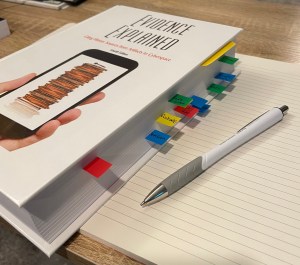
Image of the book Evidence Explained 4th Edition by Elizabeth Shown Mills.

Basically, outside of some standard conventions, there are also a lot of options when it comes to creating your citations. Mills’s book offers some differing options, provides ample explanation of the “why” behind her suggestions, and provides us with this fantastic tome to help everyone through their citation anxiety.

The five-week group will cover the first three chapters of the book. We will have a reading assignment along with guided homework questions to be completed before the discussion sessions. We will have a private Facebook group for discussion between sessions. Each session will be about an hour. You must own a copy of the book which can be purchased at Genealogical Publishing Company or on Amazon.

The cost for the 5-week course is $75. Click the links below to register. Please pay attention to the days, dates, and times when making your selection since they vary.

There will be three sessions (limited to 25 students):

If you can’t make it this time around, sign up on our Waitlist to be notified of the next session when it is scheduled.

We hope you will joint us as we continue to try to demystify the practice of creating citations for your genealogical research.
Building a Locality Guide: Historical Background

Let’s dive into more specifics about the sections of my locality guide set-up. I like to include four major sections: Historical Background, Geography, Repositories, and Records. This week, let’s examine the historical background section.

This is not an all-inclusive list, and it may change depending on the specifics of the place I am working on, but I like to include the following in my “historical background” section:

  • Military actions, battles in the area that may have affected migration or records
  • Major ethnic and/or religious groups that settled in the area
  • Natural or man-made disasters that may have affected people, migration, and records
  • Native American influences and interactions
  • Types of industry or agriculture, what might have attracted people to live there
  • Laws, particularly those requiring record-keeping
  • Transportation routes

There are probably a thousand more topics that could be included here. But I’m not trying to make a whole new book with the locality guide. I’m building a resource that is “just enough” for me to remember important items, or point me to resources to learn more. In my guides, the above may be a sentence or a couple of bullet points, or a couple of paragraphs. It all depends on how detailed I feel like being, how useful I feel that information is going to be in a saved format like this, and how much time I have to spend on developing it. I don’t always have the time, so I might do bullet points with links to other resources.

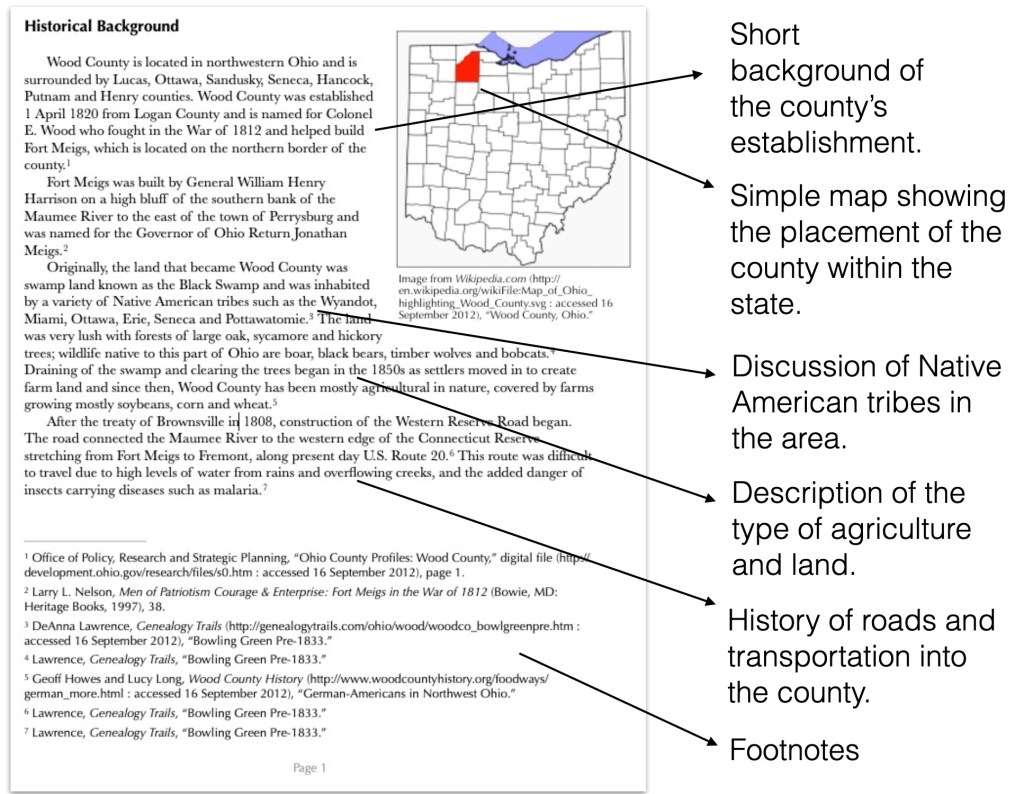
Let’s look at a section of my guide I wrote for Wood County, Ohio.

A sample page from my locality guide on Wood County, Ohio.

I collect this information from books, articles, websites, and so on, and of course, a footnote is provided for that information. While this guide is normally just for my use, I often find myself wondering where I got a particular piece of information. Having a citation helps me find it again. If I ever share my guide with someone (a library, for example), it is basically ready to go.

The historical background section I try to keep to about a page. Like I said, I’m not writing the definitive work on a particular county. I’m simply trying to collect enough information for my own knowledge and use in research. If you want to collect more or less, that’s completely up to you. And sometimes a particular county might have a lot of history to it that you want to collect.

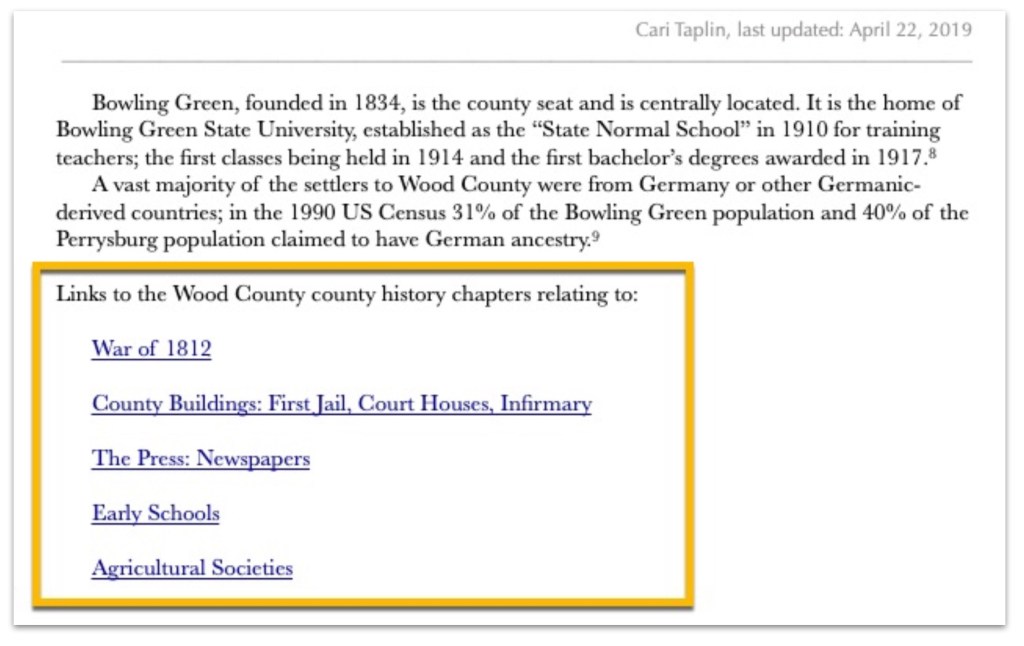
I mentioned that sometimes I will put in a list of bullet points with links rather than typing up a lot of narrative. Electronic systems allow you to add live hyperlinks to your text, so it is very easy to collect a links to add to your guide. The following shows a list of links to particular chapters in the county history for Wood County available on Google Books.

A sample page with hyperlinks to other resources.

Instead of writing up a bunch of information about specific events or topics, linking to those chapters in the county history available online allows me to save some time while also capturing resources for use later.

Next week we will go on to the geography section. In the meantime, pick a county (or other region) and perhaps start building the historical background section.