Tag Archives: NGS

A Great Lakes Interlude

Before I continue on with the George Long discussion, I wanted to take a moment to share some details about something that is coming up. Registration is open for GRIP Genealogy Institute.

I have the great pleasure to coordinate a course on the Great Lakes, and I wanted to share some information about the course’s contents and why it is an important region for genealogical research. I grew up near Lake Erie and enjoyed learning about the history of the area when I was a kid (well, to be honest, I didn’t retain a lot, what child really does?) but I appreciate it more now as an adult learning about my ancestors and how the region affected them and their livelihoods.
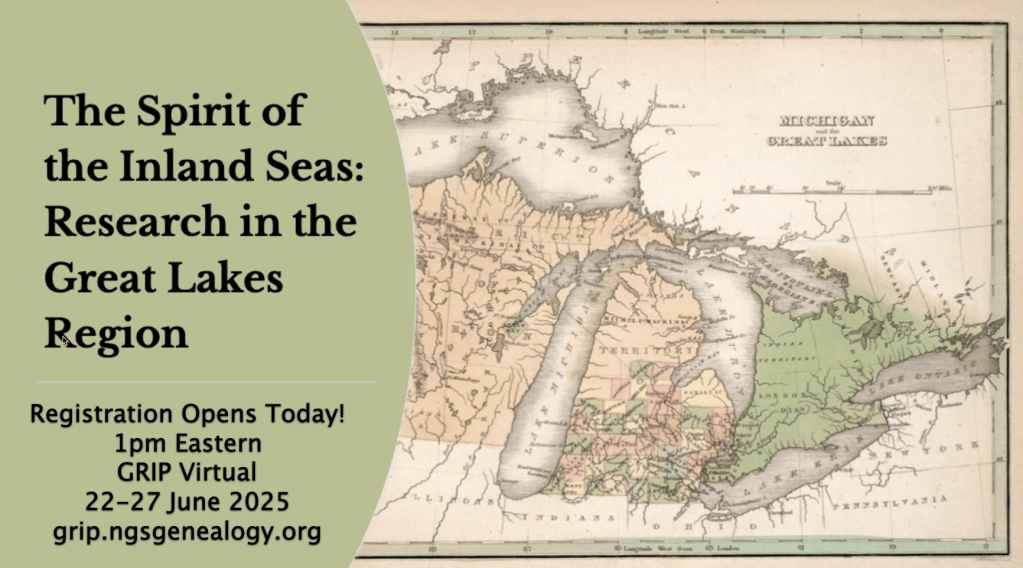
The lakes served as a vital transportation route that contributed to the westward expansion of the U.S. and Canada. If you had ancestors that lived around the lakes, they were likely impacted by the lakes’ usefulness in some way. Shipping routes and advancements in shipping technology, both for resources and people, contributed to the growth of the region. The fluidity of the border between the U.S. and Canada allowed border-dwellers to cross often for commerce, trade, occupations, shopping, attending church, and so on. Border crossing requirements were not put into place until the mid-1890s. The course will walk attendees through not only the history of the area but also has a deep focus on records in terms of what is available and how to access them.

I have a fantastic team of women teaching in the course with me: Cyndi Ingle, Paula Stuart-Warren, and Judy Russell. We will join forces to bring this important area to life through the following topics:

The sessions, and a bit about each:

  • Early to 1850s Geography, History, and Migration – Cyndi Ingle, in which she starts the day off with the early Mesozoic Period and brings us into the 1850s.
  • 1850s to Modern Geography, History & Migration – Cari Taplin, in which I get the better deal and only have to cover about a century of history.
  • Cash, Bounty, Homestead, and Timber: Land in the Great Lakes Region – Cari Taplin. I will discuss the ways in which settlers obtained land, the resources they discovered, and records for both the U.S. and Ontario.
  • Census Records in the Great Lakes Region – Cari Taplin. We all probably know all about census records, but this presentation will dig deeper into the censuses and census issues particular to this region, examining both countries’ records, and we will discuss some helpful methodologies for using censuses in this region.
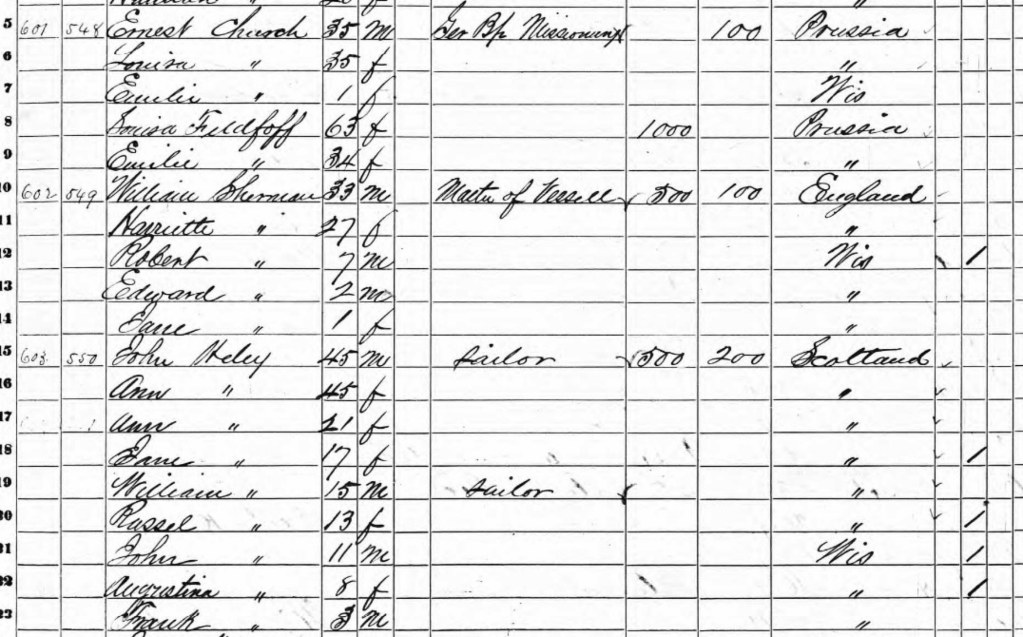
1860 Racine, Wisconsin, Ward 1
  • Finding Birth, Marriage and Death Records in the Great Lakes Region – Cyndi will take a deep dive into vital records and alternative records for the times before vital registration was required. She will help students find challenging records for births, marriages, and deaths in both the U.S. and Ontario.
  • Crossing the Border Between the United States and Canada – Cyndi walks the class through the many records that are available regarding border crossings, including the St. Albans List.
  • Steamers, Tugs, and Schooners: Shipping and Commerce on the Great Lakes – Cari Taplin. This is quite possibly my favorite topic in the Great Lakes course. The Great Lakes waterways were instrumental in the growth of the region, for both Canada and the United States. In this class, we will examine the major shipping routes and ports, discuss passenger lists, shipwrecks, military defense, and transportation, and how that led to population growth. We will also talk about the major businesses that boomed with the expansion of shipping on the lakes.
  • Military Records on Both Sides of the Conflict – Cari Taplin. From the Revolutionary War to the War of 1812, and on to present day, we will discuss the Great Lakes region in terms of defensive strategies for military conflicts, but also about the records that exists for soldiers who moved to the area and left records.
  • Paupers, Pews & Planks: The Law of the Great Lakes – Judy Russell is as entertaining and educational as ever as she walks us through the laws in the Great Lakes region. She will discuss law issues from its origins in the Northwest Territory through individual territorial legislatures and on through statehood. The law of the Great Lakes Region has reflected the particular needs and concerns of its people and its economies. Most importantly, Judy will guide students to resources where they will be able to find the law applicable to genealogical questions at various times in the region’s history, with examples of how knowing the law can help explain records and solve genealogical problems.
  • On a Mission: Religion in the Great Lakes Region – Cari Taplin. Some of the earliest settlers and explorers in the Great Lakes were missionaries of various faiths, looking to convert the native tribes and indigenous peoples living in the area. This class will focus on major religions in the Great Lakes region, a history and timeline of their arrival and expansion in specific areas, and will include a discussion on the main denominational repositories for research.
  • Tracing French Canadian Ancestors – Paula Stuart-Warren will cover the important topic of the French Canadians in the Great Lakes region. If you have an ancestor from a Great Lakes state or province, it’s likely you have found a French Canadian connection. Your German or British Isles ancestor or their sibling may have married into a French Canadian family. Whichever is the case, the records are amazing; the names of parents are generally found. Learn about the general history of the people, the fantastic records created, the books and online resources, the repositories, and meet some new cousins. 
  • Researching in Ontario – Paula Stuart-Warren. Ontario is the only Canadian province to border the Great Lakes. Paula will walk students through researching in this important province. She will talk about the major resources that are available to researchers with connections to Ontario.
  • Great Lakes Newspapers: Defy the Borders – Cari Taplin. We will discuss the importance of newspapers in the Great Lakes region and how the news did not pay attention to the borders. We will discuss the importance of newspapers in the daily lives of our Great Lakes ancestors, and what riches can be unearthed between the sheets of newsprint. The availability of U.S and Canadian newspapers in the Great Lakes Region repositories will be shared.
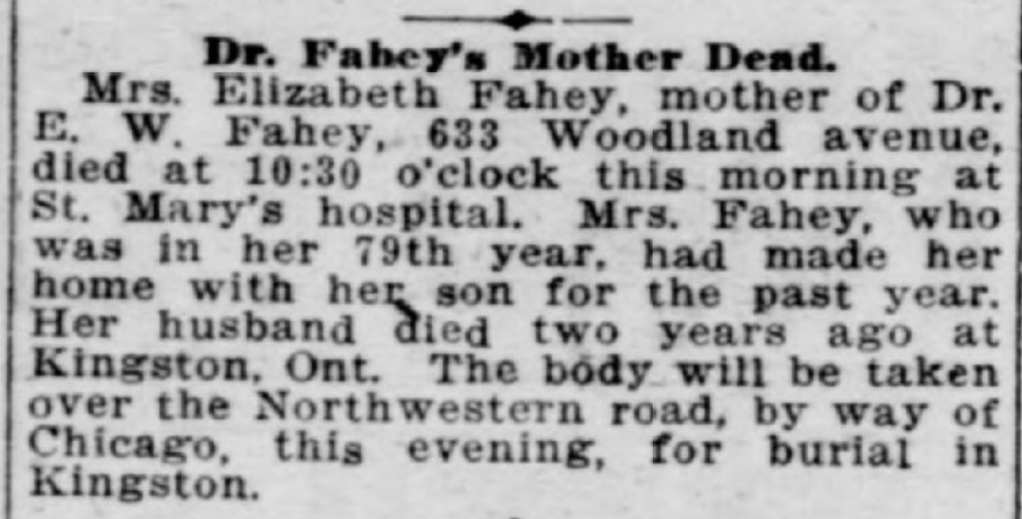
Duluth Herald, 29 July 1918, p 2.
  • Naturalization and Citizenship in the U.S. & Canada – Paula will share information about migration between Canada and the United States, and as it progressed, new residents may have become citizens. This process was important to immigrants in order to assimilate into their new home, obtain land, vote, and take part in other government programs. This class will discuss important aspects of the naturalization process focusing on the Great Lakes region. First papers, declarations, final papers, passports, and other records useful for tracking down immigrant ancestors will be examined and methods for locating those records will be discussed.
  • Beyond Shipping: Making a Living in the Great Lakes Region – Cyndi will discuss the unique occupations in the Great Lakes region. Occupations went far beyond shipping and fishing. Farming, trapping, mining, timber, and railroads drew our ancestors to live and work in this area too. She will discuss the history of various industries that helped grow the area.
  • Major Archives and Libraries in the Great Lakes Region and their Fantastic Records – Cyndi will focus solely on repositories in this session. The research repositories in the area offer extensive in-house and online material for family historians. We’ll cover some at local, provincial, state, and country level. Overlooked treasures offer information that just might fill in those missing family details.
  • Mapping the Great Lakes using Google Earth – Cyndi will dazzle and amaze us with the capabilities of Google Earth and demonstrate how to create migration maps, plot out land owned by our ancestors, and make historical map overlays to show the changes in the Great Lakes region over time.
  • Bringing it all together: Two Case Studies – Captain Stephen Meeker, Sailor on the Great Lakes, and Those Loyalist Taplins – Cari A. Taplin. I finish out the week by sharing two Great Lakes families I continue to research. First, we will examine sailor, Captain Stephen Meeker, descendant of sailors and shipbuilders, who successfully brought the Percival Roberts through a storm. Second, follow the migration of the Taplin family around the Great Lakes as they arrived in the U.S., moved to Canada to avoid the Revolutionary War and ended up in Minnesota and Wisconsin around the time of the Civil War.

We do hope you will join us for a week full of fun and genealogy!

Visit this website for more information and to register: https://grip.ngsgenealogy.org
Upcoming Institute Course: Research in the Great Lakes

This summer, I have the pleasure of coordinating the course “The Spirit of the Inland Seas: Research in the Great Lakes Region.” Three other outstanding instructors—Cyndi Ingle, Paula Stuart-Warren, and Judy Russell—will share their expertise with us. They are all amazingly talented and knowledgeable women.

We will discuss topics such as the area’s historical significance, especially in the growth and development of the U.S. and Canada. The resources in the Great Lakes area were major attractors for mining, timber, farming, etc. The lakes acted like highways, moving people and goods from one place to another with more speed and ease than previous modes of transportation.

Not only will you hear from some spectacular instructors, but we all put a lot of time and energy into creating an extensive syllabus that contains not only what we discuss during the presentations but also extra information we don’t have time to cover. Also, it never fails that as we are preparing for the institutes, we find more information that we couldn’t fit into the syllabus before the deadline, so we make addendums that we share during the week. We are committed to providing a high-quality experience and an in-depth dive into the subjects.

The course will be held VIRTUALLY, so you can attend from home, 22-27 June 2025, through GRIP Genealogy Institute. Details about the institute can be found here: https://grip.ngsgenealogy.org/#1#schedule

Registration opens on 4 February 2025 at the link above. Be sure to put that on your calendar! We have a lot of fun in our courses and hope to see you there!

FGS Week was a Success!

I know this is going to come out a little bit late to my readers… but frankly, I was exhausted after the Federation of Genealogical Societies (FGS) conference that took place in Washington DC. I serve as the VP of Membership for the organization and so that came with some responsibilities. I was in charge of the Society Showcase area. Despite a few minor hiccups in the beginning, we got it all looking good! I worked the FGS booth quite a bit, I also volunteered at booths for the Association of Professional Genealogists (APG) and the Board for Certification of Genealogists (BCG). I was able to attend three lectures!

The big news out of this conference was the planned merger between FGS and the National Genealogical Society (NGS). NGS’s general focus is on genealogy education, methodology, their scholarly journal, and other aspects for the individual genealogist. FGS’s focus has been on society management and support. Both have held national conferences and focus on Records Preservation and Access (RPAC). To read the official press release, click here.

Personally, I am excited about the merger. As a board member, I have seen our strengths and weaknesses and believe that we can be supportive to each other rather than separate and competitive entities. I believe cooperation and collaboration is the direction we need to move toward. Helping each other and coming together rather than having a separation in the field. I often found that there were people who were “team FGS” or “team NGS” rather than seeing the two as complementary. So I do think this will be good for the field.

However, I don’t have a crystal ball and don’t really know what the future holds. Time will tell, for sure.

It’s National Genealogical Society Conference Week!

This week I am attending the NGS Conference and am so excited to participate! My schedule is quite full this time! First, I am attending the BCG Education Fund’s “Putting Skills to Work” day to refresh and update my skills.

During the conference I am presenting three lectures:

  • Session W154, Wednesday, 4PM, “Breaking New Ground: Creating a Locality Guide for New Research Areas”
  • Session F328, Friday, 11AM, “How’d You Find That?!? Tips for Locating Obscure or Hidden Records”
  • Session S421, Saturday, 11AM, “Family History Piecework: An Approach to Writing” (BCG Skillbuilding Lecture)

Working at the booths for the Federation of Genealogical Societies (FGS), the Association of Professional Genealogists, and the Board for Certification of Genealogists is also on my agenda.

Beyond this, I am looking forward to new and exciting “things” in the exhibit hall, learning new techniques at lectures, and catching up with old friends and making new.

Audio Recordings from NGS 2018

Audio recordings of many of the NGS lectures are available for sale and download at PlaybackNGS. There were many fantastic sessions, some I made it to, some I missed due to speaking or other obligations, and so I’m compiling my list right now.

7780-banner2If you couldn’t make it to NGS (or even if you did) this is a great way to hear some fantastic lectures.

I do have three lectures available if you are interested:

  • The Third Coast: How the Great Lakes Shaped America (W144)
  • Casting the Net: Denominational, Ethnic, and Specialized Newspapers (S443)
  • Using PERSI Like a Pro (S451)

I thought Grand Rapids, Michigan and this NGS conference was one of the best I’ve been to. The level of education, the exhibit hall, and the city offerings were fantastic.

Next year’s NGS is 8-11 May 2019 in St. Charles, Missouri. And 2020 will be 20-23 May in Salt Lake City, Utah. Mark your calendars!

NGS Conference Live Stream Details Announced

The National Genealogical Society’s Annual Conference is coming right up! I am honored to be going to present three lectures among a wide variety of very talented speakers. The conference is being held in Grand Rapids, Michigan from 2-5 May 2018. If you are unable to attend in person, NGS just announced their live stream schedule option. You can read the full release with sign-up instructions and fees here.

ngs-2018-conferencesitebanner-060
National Genealogical Society Conference Banner

The schedule is as follows:

  • Thursday, 3 May 2018: Viewers will be able to stream five lectures from 9:00 a.m. through 5:00 p.m., including:
    • Reasonably Exhaustive Research of African American Ancestors who came out of Slavery—LaBrenda Garrett-Nelson, JD, LLM, CG®
    • The Price of Loyalism: American Loyalists in the Revolutionary War—Terry Koch-Bostic
    • The Y-DNA Test Should be Your Favorite—Diahan Southard
    • Your Cousins are Your Secret Weapon—Angie Bush
    • Native American DNA: Separating Fact from Fiction—Blaine Bettinger, PhD, JD
  • Friday, 4 May 2018: Five BCG Skillbuilding lectures will be live streamed from 8:00 a.m. through 5:00 p.m., including:
    • History, Records, and Context: Researching the Locations Your Ancestors Lived—Angela Packer McGhie, CG
    • Samuel Witter vs. Samuel Witter: Separating Same-Name Soldiers, War of 1812—Elizabeth Shown Mills, CG, CGLSM, FASG, FNGS, FUGA
    • Using Indirect and Negative Evidence to Prove Unrecorded Events—Thomas Wright Jones, PhD, CG, CGL, FASG, FNGS, FUGA
    • A Matter of Standards: DNA and the GPS—Judy G. Russell, JD, CG, CGL
    • Deeper Analysis: Techniques for Successful Problem Solving—Elissa Scalise Powell, CG, CGL

Details about the live stream program, plus additional conference recordings, can be found on the PlaybackNGS Website.

If you’d like to attend, but can’t make it in person, this is a wonderful opportunity to attend from home.

This Year’s Plans (2018)

2018 Started with a BANG! I taught my first ever course at SLIG, co-coordinated with Kathryn Lake Hogan of Ontario, Canada. The course was “The Third Coast: Research in the Great Lakes Region.” It was a lot of fun and went very well. However, it was an intense process to prepare for such a large endeavor. Needless to say, I’m happy I did it and I’m equally happy that it’s done. And I will likely do it again in the future.

SLIG and a week of research at the FHL started this year for me, so I’m just now able to take a breath, take stock, and make plans for 2018 in terms of my speaking schedule and my own educational plans. My speaking schedule is light, which I chalk up to spending so much of my energy last year prepping for SLIG and not spending any time marketing myself or planning for 2018, with a few exceptions. I’m happy to have a bit of a break, however!

Here’s where I’m planning to be this coming year:

  • Beginning in April, I will be facilitating a discussion group on the topic of becoming a Certified Genealogist® hosted by Jill Morelli and the Seattle Genealogical Society. (For more information email: jkmorelli@gmail.com)
  • National Genealogical Society Annual Conference, Grand Rapids, Michigan, May 2-5 where I am presenting: W144 “Third Coast: How the Great Lakes Shaped America”; S423 “Casting the Net: Denominational, Ethnic, and Specialized Newspaper Research”;  S456 “Using PERSI Like a Pro”
  • Institute of Genealogy and Historical Research (IGHR), Athens, Georgia, June 2-7 where I will be taking “Writing and Publishing for Genealogists” taught by Tom Jones
  • Genealogical Research Institute of Pittsburgh (GRIP), Pittsburgh, Pennsylvania, July 22-27 where I will be taking “Women and Children First” by Judy G. Russell
  • International Society for British Genealogy and Family History (ISBGFH), Salt Lake City, Utah, October 15-19 where I will be taking “Researching Your Irish and Scots-Irish Ancestors” by Fintan Mullan and Gillian Hunt and my husband will be taking “Scottish Research: The Fundamentals and Beyond” with Paul Milner

There are some other items in the fall that are still materializing but this is what I have planned so far. I hope you make the investment to enhance your genealogical education plan with conferences and institutes. Nothing beats being in class with other genealogists!

And if your society is planning an all-day seminar, consider me for your speaker. I have a lot of topics to choose from. Check my Lecture Topics page for a complete list.

Home Study Course

NGSLogoDuring 2012 I started and completed the National Genealogical Society’s American Genealogy: A Home Study Course. Overall it was a great experience, taking me through many different record sets, repositories, methodologies and techniques many of whom I hadn’t fully utilized in my research. The course was very valuable to me in that it gave me a broader experience in these areas and taught me some different ways to organize and analyze my research.

The program does have a few drawbacks which I know the organization is aware of. First of all, it is all on CD. Therefore, there are no opportunities for updates to the lessons, links, etc. This did become a little frustrating when, after following the directions on the assignment, it was returned to be reworked because of a change I was unaware of. Secondly, the price was a little high for the actual return value… meaning, the grading is done by volunteers and therefore, some lessons weren’t returned for months after submitting them, which I think was pushing the limits since I did pay $475 for the graded option of the course. Third, the online list-serve was not archived, for which they had their reasons (I’m not sure I ever understood why) so if you asked a question, it may have been asked and answered a million times before. The overall tone on the list-serve was negative and after about a month, I unsubscribed because I found it challenging to read.

I attended the NGS conference in Cincinnati in May 2012, and attended a lunch-time review of upcoming changes to the program. They intend to put the course into an online format and update the lessons to match the technology of today. They gave us a preview and showed off many amazing features that will really improve this course. I think this is one of many benefits of being a member of the National Genealogical Society and I am excited to see changes and updates to the course. They didn’t have an exact timeline for this new platform so keep checking on it.