Monthly Archives: April 2021

Spring and Summer Activities

As some deadlines loom for some of my spring and summer activities, I figured I would take a moment to recap some of the upcoming events I will be participating in.

  • Mastering Genealogical PROOF Study group started last week. Upcoming study groups led by Cyndi Ingle and myself can be seen here.
  • May 1, 2021 – Tulsa Public Library will host 4 of my lectures, pre-recorded, for one month. For more information, see this link.
  • May 13, 2021 – Pastfinders, South Lake County, Florida – Webinar “Using Timelines”
  • June 5, 2021 – Webinar for Florida Genealogical Society Tampa – “Who Lived Next Door? Using the FAN Club in Your Research”
  • June 17, 2021 – Webinar for Portsmouth Public Library – “Heart of it All: New Hampshire to Ohio Case Study”
  • June 20-25 – Teaching at GRIP (Genealogical Research Institute of Pittsburgh), I am coordinating the Great Lakes course and teaching in Paula Stuart Warren’s course “Digging Deeper.”
  • July 8, 2021 – Webinar for the Denton Public Library – “Family History Piecework: An Approach to Writing”
  • July 10, 2021 – Conference for the McHenry County, Illinois Genealogical Society with “The Genealogy Squad,” Cyndi Ingle, George Morgan, Drew Smith, and myself.
  • July 25-30 – I am A STUDENT and attending IGHR! (Taking the Irish Course)
  • Our study group for Mastering Genealogical DOCUMENTATION begins on August 4, 2021. See more details here.

Not every website has their events posted yet. I still have a few things that are not under contract yet and so aren’t posted here. You can always click on my calendar to see my upcoming events. My fall activities are still shaping up. I’m doing everything virtually again this year and will probably do so for at least the early part of next year. Here’s hoping for a better 2022!
Spring Cleaning: Binder Components

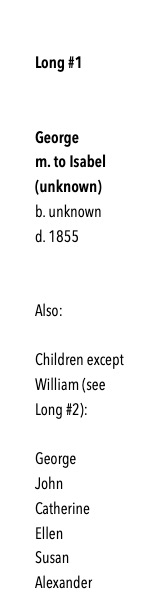
As I am working through George Long’s digital folder and corresponding binder, I like to include a couple of documents with the binder so I can see at a glance what is going on without opening more than the front cover. I use the white binders with clear covers so you can slip in papers in the front, back, and on the spine. For the spine, I title the binder: last name, first name of main couple, birth and death years, and a list of their children, noting which child will have their own binder. George Long’s current binder spine is on the left.

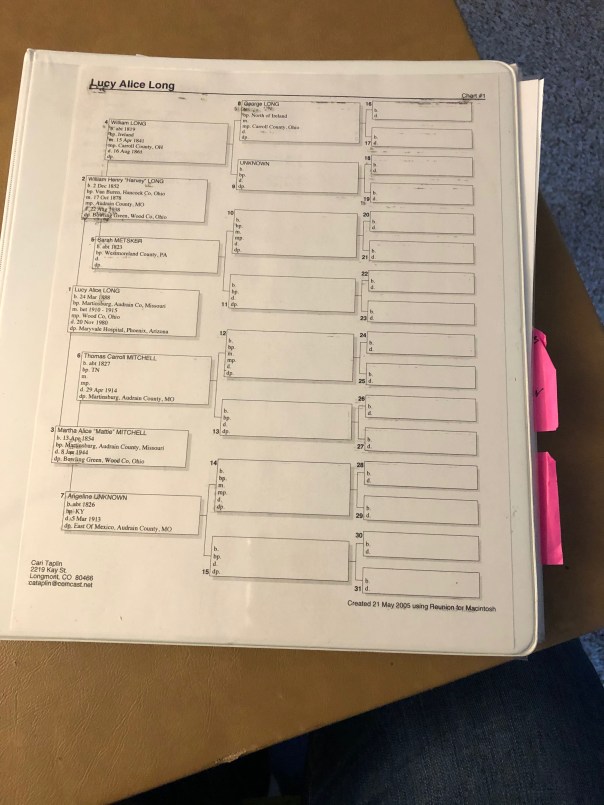
For the back, I like to include a simple cascading pedigree chart, printed from my desktop software, that shows George’s place in the grand scheme of things. At a glance I can see what generation I’m working on.

For the front, I print a family group sheet from my software that shows me at a glance, everything I know about the family group.

Inside the binder, usually in a plastic sleeve, I have a word document that is simply a timeline of the documents that are held within. This document has a couple of purposes. First, it acts like a table of contents. I can see quickly what documents I have for a given ancestor. Second, since they are in chronological order, they create a quick timeline for the ancestor’s life. I can see where there might be gaps and where more research could be done.

As new information is gathered, these documents are updated, reprinted, and replaced in the binders. I don’t do this for every single little change, but after four or five major additions to the information added to the binder, I’ll reprint these documents so that everything is up-to-date.

Years of doing research but not organizing along the way, has been a mistake. Getting the binders organized and up-to-date will allow my research time going forward to be more efficient. For a fantastic webinar on keeping yourself organized as you go, check out Cyndi Ingle’s presentation at Legacy Family Tree Webinars. (A subscription is required, but consider clicking this affiliate link to get a subscription. It’s the best inexpensive but high-quality education money can buy!)

Spring Cleaning: George Long Digital Folder

Genealogy is a work in progress. You know that, right? It is never finished, can always be refined, one more thing can be researched, and so on…forever.

I did make a little progress in organizing my George Long binder. But as I was doing that, I discovered that I really needed to work on his digital folder so that it would match up with the binder, and then I could work on both at the same time as I work through documents.

My document process is (not necessarily in this direct order, but all of these things are done with each document):

  1. Look at the document. Decide to whom it belongs.
  2. Make sure the document is scanned if it wasn’t already digital.
  3. Affix a citation to the image. If it is already printed I sometimes make a label to stick to the printed document. If it is possible, I use my word processor (Mac Pages) or Snag-It to digitally affix a citation to the image. I then reprint if necessary. But by whatever means, I get a citation on that document.
  4. I make sure the citation is in my master footnotes list. (See “Touch it Once Citations“)
  5. Put the digital item in the correct folder.
  6. In my genealogy software (Reunion) I input the data if it hasn’t been already. I link the digital image to the source in the software.
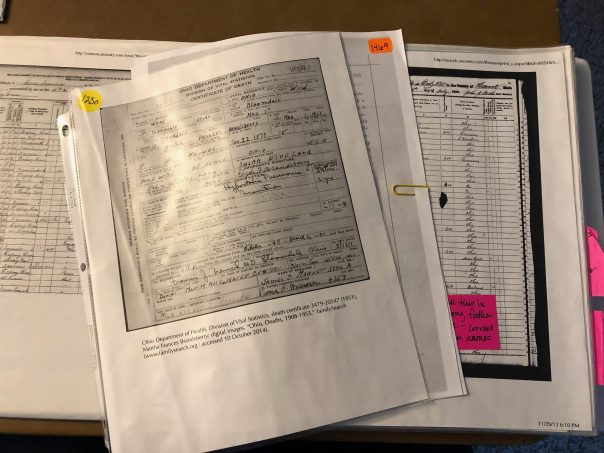
  7. I put the document in a plastic sleeve and put it in the correct location in my physical binder.

As I was working on George Long, I kept getting hung up when I needed to put the document in the digital folder. So, I took the time to get George’s folders titled and organized properly.

My Long Family Digital Folders

The digital filing is not complete, by any stretch. You can see some “Brandeberry” files that I need to put in the correct location. This was a second marriage for daughter Martha and I just need to decide how I create second marriage folders. Right now, I can think of two solutions. One, create a sub-folder within the folder titled “LONG (ch8) Martha & Jacob Hentges” that is titled “LONG Martha & BRANDEBERRY – second marriage.” Or two, create a folder “LONG (ch8) MARTHA & John Brandeberry” and leave it in the same level of folder. What I don’t recall and will need to investigate is did that second marriage produce any children? Are there any documents I need to store for John Brandeberry? If I don’t have much of anything or if they had no children, I may not make a digital folder. I may just put the documents in the Jacob Hentges folder. (I would still enter the data for this second marriage in my genealogy software, of course.)

These the kinds of decisions you have to make when you are getting your files organized. How do I do it? You have to decide what is going to work for you and stick to it. I will get back to organizing the paper files now that I have this organization system ready to go. I learned that I can’t think of it as two separate projects/systems. They really are each part of the larger system.

Spring Cleaning: George Long Binder

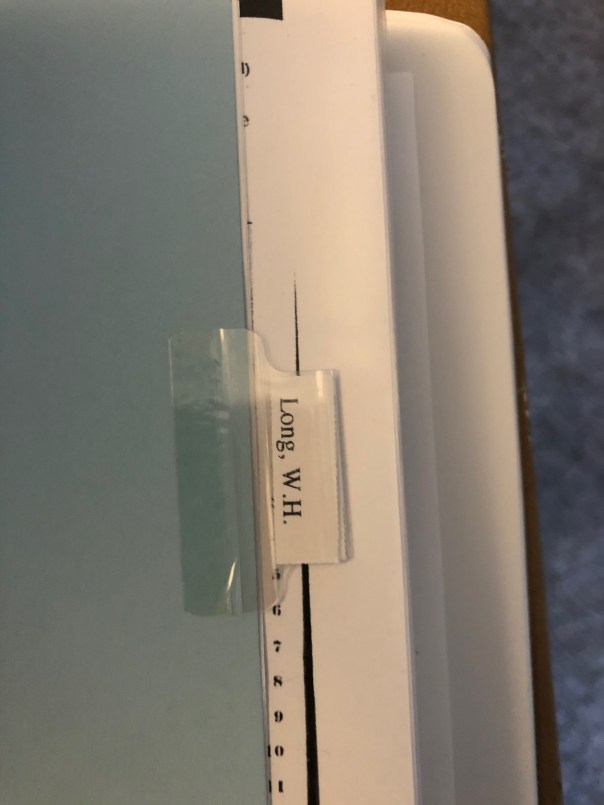
I’ve been slowly, ever so slowly, making some progress on my Spring Cleaning projects. I’ve made a small amount of progress scanning while also watching some Netflix (Hannibal, in case you’re wondering). And I’ve started working on one of my project ancestors, George Long and his family group. He came to the U.S. from Ireland (where? “North Ireland”), got married, had a couple of kids, and then was killed in a machinery accident in 1855 at a mill in Gilboa, Putnam County, Ohio. I’d really like to know where in Ireland he is from. Well, I’m not going to figure it out with the state of affairs that is his binder, digital folder, his entry in my Reunion file, and so on… it’s a mess, to say the least.

The George Long binder has loose pages I haven’t fully processed, sticky notes with to do items, no separate tabbed sections for all of the children… it’s a mess, as I said. So, my next project is to just get this binder organized physically. Then we will delve into the digital side of this project. As a forewarning… none of the digital records are organized either!