All posts by cattaplin

Unknown's avatar

About cattaplin

Researcher, writer, speaker

Revisiting My Roots: Another Case in Point

I’ve been working through my prior research on my Avery family from Wood County, Ohio. I’ve been going through my old research and mostly filling in blanks with the now low-hanging fruit of “easy” records hinted to me from Ancestry. Things such as census records, vital records, obituaries, and so on. I found another example of “trusting” old research in my binders.

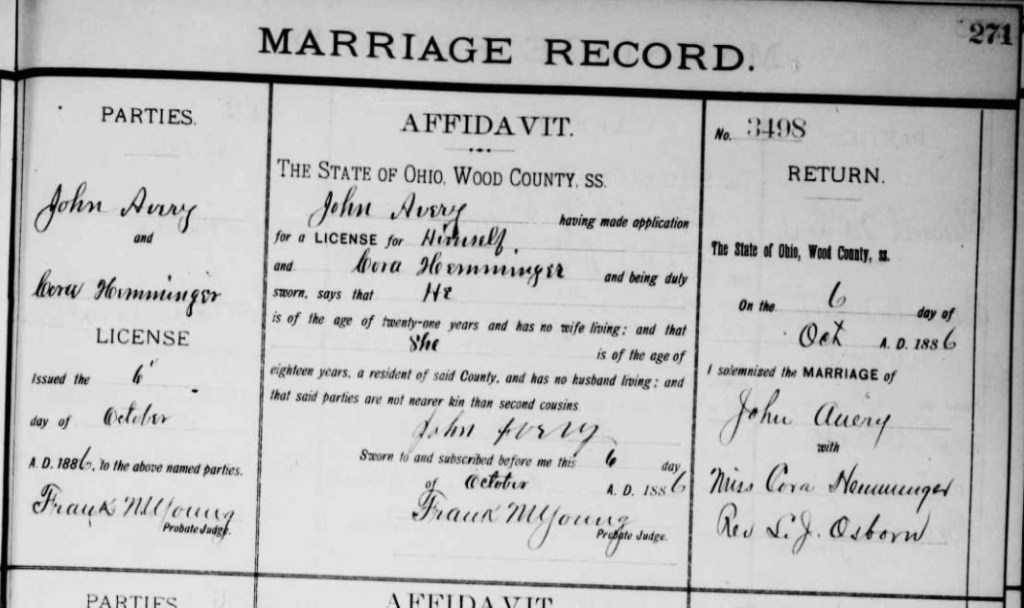
I’m working through the children of Gilbert Z. Avery, just grabbing their basics: birth, death, census, marriage, and obits, generally. According to my previous “research,” Gilbert’s son John B. Avery was married to Cora May Hemminger. I have their marriage record. They married in Wood County on 6 October 1886.1 However, as I’m working through the records this time, starting with Gilbert’s obituary and working through finding his children in the census records as adults, I found John B. Avery, in Arkansas where his father’s obituary said he would be. His wife was not Cora; it was Josephine.

Not to worry. He may have married twice. When did Cora die? Hmmm, not until 1939. John is in the census with his wife Josephine for most of his adult life. He and Josephine married in about 1878, a full ten years earlier than the marriage record for John and Cora. John and Josephine are together in the census from 1880-1930. John died in 1932 in Pine Bluff, Arkansas. So, John could not have been married to Cora. I set out to figure out where I went wrong.

It was another case of believing research done before me. This time from a genealogist cousin who had done a lot of the Avery research and who was kind enough to share it with me to get me started. I was looking back over her original family group sheet she shared, and there it says that John B. Avery was married to Cora Hemminger. There is a note that he “resided in Pine Bluff, Arkansas?” So, she wasn’t sure about that, but there is no mention of Josephine.

I found the marriage record back in my early days and didn’t question it. And I didn’t go looking for him in the census. I DID put him in one of my early public trees. I did some searching in online trees for him, and I’m happy to say that most trees did not make the same mistake I did. Phew. Most of them have Josephine or no wife at all. Thank goodness.

I also did some searching on Cora Hemminger. I wanted to make sure she was a real person and who she was married to if not John B. Avery. In my Ancestry tree, she has a lot of hints. And she is married to John Avery, of course. But she’s married to John Orlando Avery. They also lived in Bowling Green, Ohio. John Orlando Avery’s parents are Joshua Orlando Avery and Harriet J. Manley, of Groton, Connecticut. My Averys were from New York state. So, I’m not sure they are related.

Let’s be fair. The internet, digitized images, and revolutionary tools like full-text did not exist when my cousins began their research. This has definitely made it easy for me to figure out the mistake in a matter of minutes. This is all at my fingertips now, whereas it wasn’t “back in the day.” The moral of the story? It’s a good idea to check your old research and reevaluate some of the early work you trusted.


1. The marriage record is at FamilySearch: https://www.familysearch.org/ark:/61903/3:1:939K-BP64-D

Revisiting My Roots: A Case in Point

Several posts ago, I talked about how I “believed” others who had built the family tree before I started researching. I put a lot of “trust” out there.

“I believed everyone out there doing genealogy on the same families as me had been doing it longer and therefore must know more than I did, must have found the records already, and therefore their pedigrees, family group sheets, and trees posted online were correct.”

Well, I have just discovered an error that I’ve believed, and other genealogists before me had believed as well.

During my tree cleanup, I have recently been working on the Avery family. In one generation, the Averys and the Meekers lived next door to each other. From that, four Avery siblings married four Meeker siblings, creating a lot of chaos in my family tree. One generation down from this, I had another Avery marrying another Meeker. I hadn’t noticed before, because the Averys and Meekers are so intermingled. However, today, I noticed that this coupling was not in the right generation. I have in my tree, as many others do, that Mahlon I. Meeker married Pauline Avery. This would make these two first cousins. As I set out to research that, I could not find a marriage record for them, at a time when the marriage records exist and are pretty good.

So, I did a more global search for the Avery bride. I noticed a hint to another online tree that had the right groom, but the bride was Pauline Dunning, not Avery. At first, I thought this tree must be incorrect. So many trees have Pauline Avery as the wife of Mahlon I. Meeker. Well, I’ve learned that genealogy is not democracy, and just because there are so many “votes” for one thing does not make it true.

I reviewed the information I had that gave Pauline’s husband as Mahlon I. Meeker: they were all things from other researchers, not actual records. (See, I was believing them.) Then I reviewed the actual records I have. Pauline’s father’s obituary lists only “Polly deceased.” It does not give her a married name like her other siblings. Following the records for Mahlon I. Meeker, I do find a marriage record for him to Paulina Dunning. He is the correct Mahlon I. Meeker, but she was not the correct Paulina. I did consider that maybe Paulina was previously married before marrying Meeker, but I did not find that to be true. Mahlon’s wife’s maiden name was in fact Dunning and her parents have been identified; they are not Averys.

This was just the perfect situation to demonstrate why it is important to go back through your old research and clean it up. The good news, at least in this situation, is that both Mahlon and Paulina Avery are still in my tree, so I’m not lopping off an entire branch in this case.

Now on the hunt to find out what happened to the “real” Paulina.

Educational Opportunities in 2026

As 2025 winds down, I want to let you know about some of my plans in 2026.

The study groups that Cyndi Ingle and I lead are planned for 2026 and the schedules are posted on this website here: https://genealogypants.com/studygroups/

The only ones open for registration currently are the NGSQ study groups. These start in January and run for 11 months (we take December off). You can find more details and the registration links here: https://genealogypants.com/studygroups/ngsq-study-groups/ The other study groups open as we get closer to their start dates.

Also, coming up in February 2026, I’ll be presenting an all-day seminar for the lovely folks down at the West Valley Genealogical Society in Sun City West, Arizona. I for one am exciting to visit Arizona in the cold part of the Colorado winter! It is going to be a fun day in case you’d like to get out of the cold and join us. Details on that event can be found here: https://azwvgs.org/education/seminar/

Springtime with IGHR I’ll be teaching in the course “Repository Research: From Website to Doorway” which begins on March 12, 2026. Registration is open! You can find more details about this course or the many others here: https://ighr.gagensociety.org

I’ll be teaching at GRIP Virtual this summer in June with our course on “Not “Just” Farmers: Records, Relationships, and the Reality of Their Lives” with myself, Cyndi Ingle, and Paula Stuart-Warren. This course sold out last time so be ready when registration opens. For those details, see: https://grip.ngsgenealogy.org That week I’ll also be teaching in Paula Stuart-Warren’s course “Digging Deeper.” I hope you’ll join us!

That gets me through the summer… I’ll post more as new opportunities pop up. Consider adding one or more of these to your genealogical education plan for 2026.

Revisiting My Roots: Ancestry Tree Cleanup

Part of my process for cleaning up my work from when I was a “baby genealogist” involves cleaning up my Ancestry Tree. A few things about my tree on Ancestry. First, it’s a mess. Second, I keep it private now, mainly because it’s a mess and I don’t want people copying “bad” or incorrect information. Third, did I mention it’s a mess?

“Back in the day,” I uploaded a GEDCOM file from my Reunion software to start my Ancestry Tree. That was a huge time-saver because I had already done quite a bit of information collecting and data entry of family history information. Actually, I started with a freeware family tree software program (I in no way remember what that was called) (and then probably another one) before I uploaded that GEDCOM into Reunion. So, there were a couple of GEDCOMs created and uploaded before I got it into Ancestry. If you’ve ever imported GEDCOMs from one program to another, and especially in the early 2000s, you probably have noticed that sometimes the fields did not transfer all neat and tidy. And to say that my Ancestry tree is a mess now is no exaggeration.

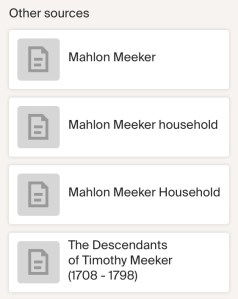
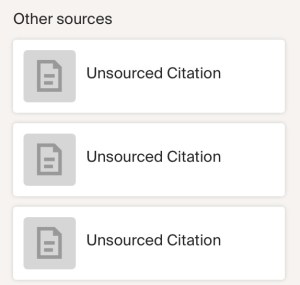
It’s not that the information is wrong, though some is. It’s more that citations didn’t port over neatly, or sometimes, if Ancestry didn’t know what a field was about, it just made it an “unsourced citation” or it just gave it a name, like this:


Some of these weird citations, I know exactly where it came from. Sometimes not. But part of my clean-up process is to just go through each person (as I’m working on a project or a family group) and fixing those up. The ones that say “Mahlon Meeker Household” are citations to censuses. I make sure the census in question is attached and then delete this “other” source. Those that are actual citations to books or records not online, like “The Descendants of Timothy Meeker (1708-1798)” I leave there. I may check to make sure all of the pertinent information followed over such as page numbers, or if there is a link to it on another website.

I also make sure all of the place names and dates are in a consistent format.

This is the kind of task I can do while sitting on the couch watching a show or a movie I’ve seen before and don’t need to concentrate on.

These are the minutiae that just makes things feel better, seem cleaner, look nicer. It is a form of decluttering and I find it helps me concentrate later on more important things, like research.

NERGC Conference Coming Soon!

I’ll be one of the speakers at this year’s New England Regional Genealogical Consortium (NERGC). The conference is taking place October 29–November 1, 2025 in Manchester, New Hampshire. The pre-registration is closed but they also take walk-ins.

I am excited about the presentations I’ll be giving:

  • Wednesday, Oct 29, I’ll be providing a workshop on “Using Google’s MyMaps as a Research Tool.” I will show the attendees maps I’ve made for various uses on Google Maps.
  • Thursday, Oct 30 is “Genealogical Side Quests and Treasures Discovered,” a new lecture I’ve developed that talks about those research tangents we all find ourselves on and when that’s Ok and, when it’s not, tips for dealing with our curiosity to stay on track.
  • Friday, Oct 31 I’ll be sharing tips for “Utilizing Ancestry’s Databases: Beyond ‘Search’” and showing the audience ways to maximize the records at Ancestry.
  • Saturday, Nov 1 I start the day with a presentation on “Who Lived Next Door? Using the FAN Club in your Research” which walks the audience through using this strategy to advance our research and break down brick walls.
  • Another Saturday presentation is “Using Lists to Find Proof” where I discuss the various kinds of lists we encounter as genealogists and how using lists can be used to meet genealogical standards.
  • Saturday, Nov 1, Dinner Talk features stories of my kids in genealogical pursuits in “How Potty Training Helped My Genealogy.”

For more information on the conference, visit: https://nergc.org

After the conference, my husband and I are taking some much needed time off to explore New England and do some genealogical research while we’re at it.

Revisiting My Roots: Correcting Errors

Back when I was a beginner, I trusted. A lot. I believed everyone out there doing genealogy on the same families as me had been doing it longer and therefore must know more than I did, must have found the records already, and therefore their pedigrees, family group sheets, and trees posted online were correct.

What a sweet summer child I was!

Every day I see trees full of … how shall I say it nicely…? Garbage? Is that too harsh? I don’t mean to disparage anyone who is a beginner. Not at all. But I am criticizing myself a little bit. And I am definitely admonishing those that don’t go back and review their work. Especially before posting it to a public tree where thousands of beginners like me just blindly copy that garbage. For example, why didn’t I notice that someone found in the 1880 census couldn’t have died in 1876? (This is a mistake I am literally fixing at this very moment in my own database.)

I came to realize that many family historians out there didn’t know more than I did. They too were flailing around trying to grasp on to any information to fill a hole in their tree.

Again, I don’t mean to be harsh. We all started somewhere. And we all didn’t necessarily understand how invasive and far-reaching the internet would be when we posted those trees with less than accurate information on them. I know, from Facebook groups I’m in and discussions with colleagues, even NGSQ articles working to correct mistakes, that I’m not the only one dealing with this phenomenon.

One thing I did several years ago to help mitigate this problem, was I made my research tree private at Ancestry. So, all of my “garbage” work wouldn’t be copied again. That doesn’t stop the copying that was already done, but it is something. I then made a clean tree, back five generations, that is public and mostly correct, and just the straight lines (not all of the collaterals), and attached that to my DNA. This allows my DNA matches to see the basic information. But my research tree with all of the mistakes is now not available for public consumption.

By going back through my earlier research is allowing me to find these mistakes and rectify them with actual research in DOCUMENTS, not just believing someone’s tree like I did in my early days.

Revisiting My Roots: Pick the Low-Hanging Fruit

Another step I take when working back through my research from when I was a babe in the genealogical woods, is finding the low-hanging fruit. When I started, there wasn’t a lot online. I wrote letters to libraries and courthouses, genealogical societies, sent forms in for vital records, etc. I think many of us in the field who started in this before the internet for genealogy really took off remember those days. And I think we can all agree that the digital world has absolutely exploded with digitized records.

What do I mean by the low-hanging fruit? The main thing I do is visit the person’s profile on my Ancestry tree and go through the hints. You will most likely find their census, vital records, obituaries, Find a Grave memorials, and so on, in their hints. Now, I do realize that the hints are not always correct and I do not blindly accept every hint on their profile. I carefully examine the ORIGINAL document, correlate that information with my known information, and make a decision from there. I accept the hint (and process the documents as I’ve shared in a previous post in this series) or “ignore” the hint. Ancestry asks why you ignored the hint and I try to give a good answer so they may be able to improve their algorithms over time. If you ignore a hint but later discover it was correct after all, they are not deleted, they are simply found in the “ignored” tab on the hints page. So, there is no harm in ignoring them. It clears out the hints pane.

Sometimes, the hints don’t provide you with some of the records you know should be there. I go searching for them. I generally know what records I should be able to find for my Ohio ancestors since I’ve researched in that state for all of the 25+ years I’ve been doing this. So, if they aren’t served up as hints, I’ll go checking all of my favorite online repositories.

My top “low-hanging fruit” are:

  1. Census records
  2. Vital Records
  3. Obituaries
  4. Find a Grave memorials

These records give me the basis for building a biographical sketch or digging deeper into that ancestor. Primarily, in this stage, I’m just trying to fill the gaps left behind when I was a beginner.

Revisiting My Roots: Census Records

Censuses are one of the foundational records for building a family group. They take a snapshot of a family’s structure every 10 years. One thing many census records have in common is poor visibility, whether that’s because of poor handwriting, faint pen/pencil on the original, poor quality scanning, or something else. They can just be hard to read, especially in printed form. In my binders, I find it annoying to have to find the family of interest on the page, and then see and/or interpret the writing every time I want to review my research. I can do some zoomed in screenshots and print those as well. However, I prefer to transcribe.

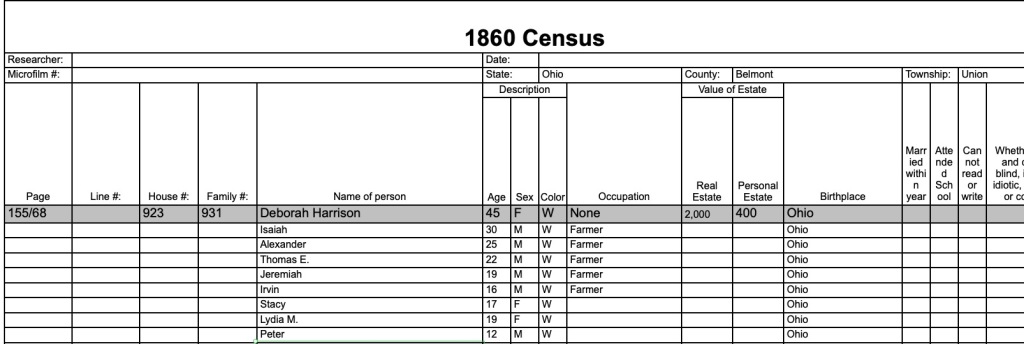
To solve this, I transcribe the census information and print it out, putting it into the other side of the sheet protector so I have the original and the transcription together in one page. I use a set of fillable forms from CensusTools.com. (This is NOT a paid advertisement.) They have created spreadsheets for every federal, state, special, and international census. The cost today is $13.95 for 40 fillable spreadsheets. However, if funds are tight, feel free to make your own, or just transcribe the information into a word processing document. I just appreciate having the form match the original census forms, making it easier to see the data at a glance.

Sample from one transcription of the 1860 census for my Harrison family.

Since this is a spreadsheet, you can add columns or rows, transcribe 10 households up and down the page, or collect all persons in a county of the same surname. Whatever your project needs, you can do. These are nice because they are already formatted matching the original forms.

I add this sheet to every census I have for a family and add it to my binder. It makes reviewing those records much quicker and easier on the eyes.

Revisiting My Roots: Handling Each Document

As we drill down through my system of revisiting old work, I want to share the process I do with each document. I do this with the entire binder before I start with new research because the process I do now is way more detailed than the process I did in 2000. So, some of these things were not done back then and I want to bring my binders up to the same level of “doneness.”

This process includes:

  • Write a full citation for each item. I put that citation in my touch-it-once citation list as well as in my desktop software. I never have to write the same citation more than once. I do have to fiddle with them from time to time based on writing project, audience, and any style changes that invariably happen over time, but the bulk of the citation is done once and forever.
  • Print that document, with the citation affixed to the front of the page in some way. I personally use Snag-it most of the time to add my citations in a text box on the page. You can also use Word or Mac Pages. This fulfills the genealogy standard regarding the separation of document from citation.1
  • I put my documents into sheet protectors and file them in my binders in chronological order, with the children of the couple in their own section. This makes a visual timeline of their lives.
  • I also file that digital document in my electronic filing system that mirrors my binders. The main part of this step is with the file name so that the folder’s contents are in order to match the binder. This is largely done by putting the year first.
  • I make sure that document has been added to my Ancestry tree and my desktop software. I do have trees on other sites, but they are mostly for cousin bait and are not my full tree. My Ancestry tree (which is private) is where my work happens. It contains verified and unverified information, which is why I keep it private. I do have a public tree that I have attached to my DNA but it is a bare-bones tree with only the main details to get DNA matches the information they need. I also do not use a software that would sync with Ancestry (like FamilyTreeMaker). I like to have control over what is uploaded and downloaded. Plus, the act of adding items to trees sometimes reminds me of something else to do or shows me where I’ve made an error.

As I conduct new research to fill in the gaps from by “baby days,” I do the above as well. I don’t get “too crazy” with the children of each couple (except the one I descend from) unless I need to for a particular project. Remember, this is just the basics. I’m finding vital records, census, and newspapers as available. But I didn’t even do the basics when I didn’t know any better, so these binders have a lot of holes.

I’ll share some of the other things I do in my binders to make reviewing my research easier for myself. My future self thanks me when I do them and curses me when I don’t. Until next time…

  1. For more information on Genealogy Standards, visit the Board for Certification of Genealogists.  ↩︎

Revisiting My Roots: My Basic Process

I started (in my spare time) revisiting the work I did on some of my family lines back when I didn’t know any better. I refer to myself as a “baby genealogist” during that time. We all start somewhere and don’t know what we don’t know in the beginning. Well, now with 25 years of experience under my belt, I’m revisiting some of those lines I haven’t touched in almost as many years.

I have a binder and electronic filing system that should mirror each other. If you only do one, good for you! Seriously. I just can’t bring myself to trust one or the other and feel the need for redundancy. And I think if I were to disappear (hit by a bus, win the lottery and just move to a deserted island, whatever) I’m not sure my kids would know where to look on my computer to find the work I did. But I will have the binders. And someday I may have a “Read Me” file prepared directing them to the electronic files. But it is not this day.

First, I have to clean up the mess… ok, it’s not a mess, I just didn’t know any better at the time. So it is filling in blanks with the new knowledge, experience, and changes in the genealogical world that have happened since I began back in 2000.

I’m going to share my basic process and I’ll go into most steps in more detail as the series moves on. To have some background, you might revisit my posts on my organization system. You might also look at my post on “touch-it once citations.” I’ll be referring to items from these posts along the way.

My basic steps:

  1. Review what I have in each binder and digital file. If I don’t have sections for each child in the binder and/or digital folder, add them, even if they have nothing in them yet. This is a stage to help get me ready and stay organized as I conduct new research.
    • I work by couple and their children (except the one I’m descended through because that person will be part of a couple). Each binder represents a couple (unless I have very little then couples might share binders until they get too much stuff).
    • I use those binders that have a plastic envelope on the outside that lets you slip papers in. On the front I have a family group sheet for that couple and on the back I have a pedigree chart showing this couple’s placement in the larger family tree. I print these from my desktop software.
  2. I work on each couple and their children (I don’t go any further unless I need to for a specific project, these are just the basics remember.) I find the basic records that should exist for each such as:
    • Census for each year they should be there.
    • Vital records if available (state, county, or city).
    • Newspaper articles, especially obituaries.
  3. As I work on the basics listed above, invariably something else pops up. I will either capture it right then or put it in a list (with a link and detailed notes) to work on later. It depends on how much of a time crunch I’m working with.

I have a process I do with each document as well. I’ll go over those details in the next post so stay tuned!