Registration for GRIP Genealogy Institute closes on June 18 so if you’ve been waiting to decide if your farming ancestors might be more exciting than “Just Farmers,” now’s your chance!
I’ve been working on making sure all the information I am planning on sharing is up to date with the latest. Our farmers were more than “Just Farmers” and I hope you’ll come and learn about more ways to learn about their lives.
A few weeks ago, I participated in a panel discussion about PERSI (the Periodical Source Index) through the National Genealogical Society’s MemberConnects! event. I invited Dawne Slater, Jeanette Sheliga to join me to discuss PERSI, learn about how to best use it for your research, and how to access the articles it indexes. You can view the video recording on NGS’s YouTube channel here.
I’ve written about PERSI in the past on this blog. The most recent series starts here. But if it has been a while, I hope you’ll watch the video and read the previous blog series. PERSI indexes articles from local genealogical societies’ journals and quarterlies sent in to the Allen County Public Library. In my opinion, PERSI is one of the most underutilized resources available to genealogists. We have become spoiled by the internet and the instant gratification that it often offers. However, IT’S NOT ALL ONLINE, though everyday more and more does become available.
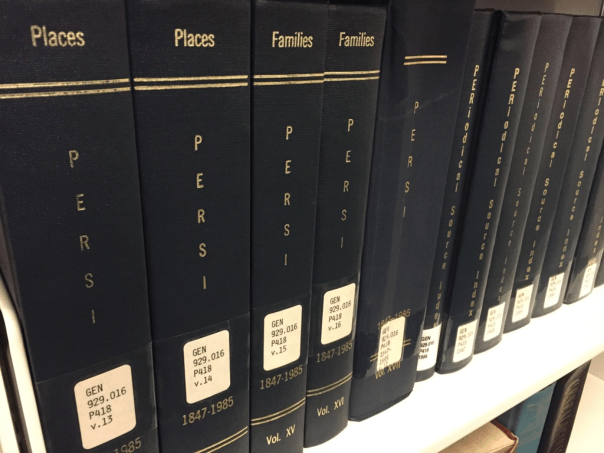
PERSI is an index created by the Allen County Public Library, beginning in the late 1980s. The first versions of PERSI were published volumes. You can still find them in libraries today.
Photo by author
I go into more details about PERSI, how to use it, how to get copies of articles, and so on, in my previous series, so I won’t repeat myself. Those steps are the same today as they were in 2022 when I wrote those posts.
A new article was published in the January-March 2026 issue of the NGS Magazine (available to NGS members or possibly through your local library), written by Adam J. Barrone, current supervisor of PERSI at ACPL. His article has a lot of fun history about PERSI and he offers tips and techniques for using PERSI effectively.
There are to main things I always want to impart about PERSI anytime I talk about it. First, PERSI is NOT an every name index. Do not show up to PERSI, type in your ancestor’s name, find nothing, and then walk away thinking PERSI has nothing for your research. PERSI is primarily a subject/keyword index. When searching PERSI, think about what kinds of things your ancestor may have been involved with or included in. Second, there are multiple ways you can obtain copies of the articles you find in PERSI. Don’t let the extra step of needing to obtain a copy stop you from using PERSI. There are many things you can do to get a copy. I’ve written about them before, but the one that is coming up soon is to travel to the Allen County Public Library yourself. This year, the NGS Conference is being held in Fort Wayne, Indiana, blocks from the library.
PERSI can point you to articles that could be vital to your research. The information that local genealogical and historical societies collected in their journals and quarterlies could be the only place that information can be found because the originals were lost or destroyed or from personal collections. It is worth the effort!
Starting with the Pandemic in 2020, a lot of my record-keeping and lecture maintenance fell by the wayside. For a long time I felt like I was barely keeping it together. Not only were we dealing with a global pandemic, but I got a new full-time job, my son was off to college and needed to move out of the dorms, my daughter started her senior year of high-school online, and we decided to take advantage of the work-from-home/school-from-home time to move back to Colorado from Texas.
Needless to say, things feel by the wayside. Well, I just (finally) took some time and updated my website. My lecture list has been updated. Old lectures that I needed to retire have been removed, new lectures I’ve developed have been added. I spiffed up their descriptions to hopefully be more descriptive for societies looking for presenters. I also updated my terribly out-of-date list of my recent speaking engagements, publications, and so on.
I’m not sure where the first few weeks of the year have gone! I meant to post information about these two institute courses that I am teaching in, sooner than now… I guess I’m better late than never, right?
I’ll be teaching in two courses at IGHR this Spring, registration is open now, so sign up soon if you would like to join us! Both courses are being held once per week for a number of weeks, instead of like a firehose for one full week.
This course is coordinated by Pattie Hobbs and includes myself and Kimberly Powell as instructors. We are teaching the basics, the fundamentals, and the course is set at a beginner DNA level but students should be familiar with genealogical concepts. I will be teaching about the power of pedigrees when analyzing your DNA, DNA clustering, and will provide a hands-on workshop on the Leeds Method.
My colleague, Cyndi Ingle, of Cyndi’s List, put this course together. The way you begin research today is different than when we started before and during the early stages of the Internet. When I began my genealogy journey, I wrote letters, went to libraries and courthouses, and visited cemeteries myself. Today, some 26 years after my beginnings, we start very differently. We should be combing through everything that is available online and from home, before we head to the repositories. That’s what this course is about. How do we begin, now that so much is available online? This course is aimed at new genealogists and those of us who have been doing this a while but may not know what is available online because it grew so quickly! In this course I’ll be teaching on building a locality guide with a focus on repositories, hiring help from afar, and genealogical “grit.”
As 2025 winds down, I want to let you know about some of my plans in 2026.
The study groups that Cyndi Ingle and I lead are planned for 2026 and the schedules are posted on this website here: https://genealogypants.com/studygroups/
The only ones open for registration currently are the NGSQ study groups. These start in January and run for 11 months (we take December off). You can find more details and the registration links here: https://genealogypants.com/studygroups/ngsq-study-groups/ The other study groups open as we get closer to their start dates.
Also, coming up in February 2026, I’ll be presenting an all-day seminar for the lovely folks down at the West Valley Genealogical Society in Sun City West, Arizona. I for one am exciting to visit Arizona in the cold part of the Colorado winter! It is going to be a fun day in case you’d like to get out of the cold and join us. Details on that event can be found here: https://azwvgs.org/education/seminar/
Springtime with IGHR I’ll be teaching in the course “Repository Research: From Website to Doorway” which begins on March 12, 2026. Registration is open! You can find more details about this course or the many others here: https://ighr.gagensociety.org
I’ll be teaching at GRIP Virtual this summer in June with our course on “Not “Just” Farmers: Records, Relationships, and the Reality of Their Lives” with myself, Cyndi Ingle, and Paula Stuart-Warren. This course sold out last time so be ready when registration opens. For those details, see: https://grip.ngsgenealogy.org That week I’ll also be teaching in Paula Stuart-Warren’s course “Digging Deeper.” I hope you’ll join us!
That gets me through the summer… I’ll post more as new opportunities pop up. Consider adding one or more of these to your genealogical education plan for 2026.
I’ll be one of the speakers at this year’s New England Regional Genealogical Consortium (NERGC). The conference is taking place October 29–November 1, 2025 in Manchester, New Hampshire. The pre-registration is closed but they also take walk-ins.
I am excited about the presentations I’ll be giving:
Wednesday, Oct 29, I’ll be providing a workshop on “Using Google’s MyMaps as a Research Tool.” I will show the attendees maps I’ve made for various uses on Google Maps.
Thursday, Oct 30 is “Genealogical Side Quests and Treasures Discovered,” a new lecture I’ve developed that talks about those research tangents we all find ourselves on and when that’s Ok and, when it’s not, tips for dealing with our curiosity to stay on track.
Friday, Oct 31 I’ll be sharing tips for “Utilizing Ancestry’s Databases: Beyond ‘Search’” and showing the audience ways to maximize the records at Ancestry.
Saturday, Nov 1 I start the day with a presentation on “Who Lived Next Door? Using the FAN Club in your Research” which walks the audience through using this strategy to advance our research and break down brick walls.
Another Saturday presentation is “Using Lists to Find Proof” where I discuss the various kinds of lists we encounter as genealogists and how using lists can be used to meet genealogical standards.
Saturday, Nov 1, Dinner Talk features stories of my kids in genealogical pursuits in “How Potty Training Helped My Genealogy.”
After the conference, my husband and I are taking some much needed time off to explore New England and do some genealogical research while we’re at it.
Cyndi and I have finalized our plans for 2024 and wanted to share the schedule with you.
2024 NGSQ with Mastering Genealogical Proof Principles – There are four session times to choose from (limit of 25 per session). This course runs for 11 months (January – November) and we study one National Genealogical Society Quarterly (NGSQ) issue per month. Due to copyright, we cannot provide copies of the articles. You need to be a member of NGS or be able to make copies at a local public library. We read the articles ahead of students and create a list of unique questions for each article to discuss along with some standard questions we ask of all NGSQ articles. We don’t have the article list yet, but will post it as soon as it is available.
Writer’s Workshop Group 2024 – This writing group will work together to improve a piece of your own writing over 8 months (we January through August). The meeting times will be on usually the third Thursday of the month at 7 pm Eastern. Our overall focus will be genealogical writing. We will be mostly focusing on writing aspects but will also touch on genealogical issues such as meeting the Genealogical Proof Standard (GPS), looking at Genealogical Standards that are relevant to writing, and using citations. This is a participation required group. We will work on a piece of writing over the 8 months. You will be paired up each month with a partner to give feedback on that month’s topic. Participation is a must, and if you are looking for a hands-on writing group, this may be the one for you!
Mastering Genealogical Proof (MGP) – a seven-week beginning principles course. There will be two sessions, Wednesday daytime at 3pm Eastern and Saturdays at 1pm Eastern (so adjust for your time zone). This is for those who have never studied this book before. We will be studying this from a beginner or slightly intermediate level. If you’ve done one of these groups before and want a refresher, that’s ok too! We will take 25 students in each class. This year, all classes will be taught by Cyndi Ingle. This is for those who have never studied this book before. We will be studying this from a beginner or slightly intermediate level. If you’ve done one of these groups before and want a refresher, that’s ok too! We will take 25 students in each class.
2024 Dates for MGP:
Wednesdays, February 7 – March 20 – Noon Pacific/3 pm Eastern
Saturdays, February 10 – March 23 – 10 am Pacific/1 pm Eastern
Wednesdays, August 7 – September 18 – Noon Pacific/3 pm Eastern
Saturdays, August 10 – September 21 – 10 am Pacific/1 pm Eastern
Registration will open 4-6 weeks before the class begins.
Mastering Genealogical Documentation (MGD) – a seven-Week beginning principles course – There will be two sessions: Wednesday daytime at 3pm Eastern, and Saturdays at 1pm Eastern (so adjust for your time zone). Each class will be about an hour. This is for those who have never studied this book before. We will be studying this from a beginner or slightly intermediate level. It is recommended that you have studied the book Mastering Genealogical Proof, but not a requirement for taking this class. If you’ve done one of these groups before and want a refresher, that’s ok too! We will take 25 students in each class.
2024 Dates for MGD:
Wednesdays, February 7 – March 20 – Noon Pacific/3 pm Eastern – Coming Soon
Saturdays, February 10 – March 23 – 10 am Pacific/1 pm Eastern – Coming Soon
Wednesdays, August 7 – September 18 – Noon Pacific/3 pm Eastern
Saturdays, August 10 – September 21 – 10 am Pacific/1 pm Eastern
Registration will open 4-6 weeks before the class begins.
Visit the Classes and Study Groups page at any time for most recent information. We hope to see you throughout the year!
Creating a research plan takes a bit of practice. There are differing opinions on just how much planning one should do for a given research question. I have seen long lists of sources one should consult when working on a project. Great, long lists that identify every source you may ever think of (even if it doesn’t apply to a particular ancestor or situation), like this one from the Puget Sound Genealogical Society. Others have taught that the plan should only be a few items, because what you find in those items may dictate where you look next. Some example research checklists, forms, and templates can be found here on Cyndi’s List.
I’ve discussed before that I think (at least in my experience) that are two phases of a genealogists “life.” The collection phase comes first; gathering as much as you can. In this phase you find all of the “low-hanging fruit” such as census records, vital records, newspaper articles, obituaries, and so on. The “easy” to find items for your ancestors. Then there is the phase that you face when the easy-to-find runs out. And not just runs out but when there are conflicts in the records you have found. The second phase I think of as the “brick wall” phase, or maybe just the “it is going to take more concentrated effort to figure out” phase.
I think the long checklist forms you can find are more appropriate for the collection phase. The more thoughtful, intentional, and detailed research plans are what is needed to get through the tougher problems. So, my point in saying all the above is this: What phase are you in? Choose the most appropriate system that works for you. I have two examples one for each “phase” that I will share both over the next few posts and discuss MY thoughts on the benefits of each.
Many, if not all, major genealogical websites have some sort of catalog that allows you to see their holdings. This allows you to drill down to specific databases for a given location or topic. Effective searching when working on a specific research problem will hinge on utilizing the catalog.
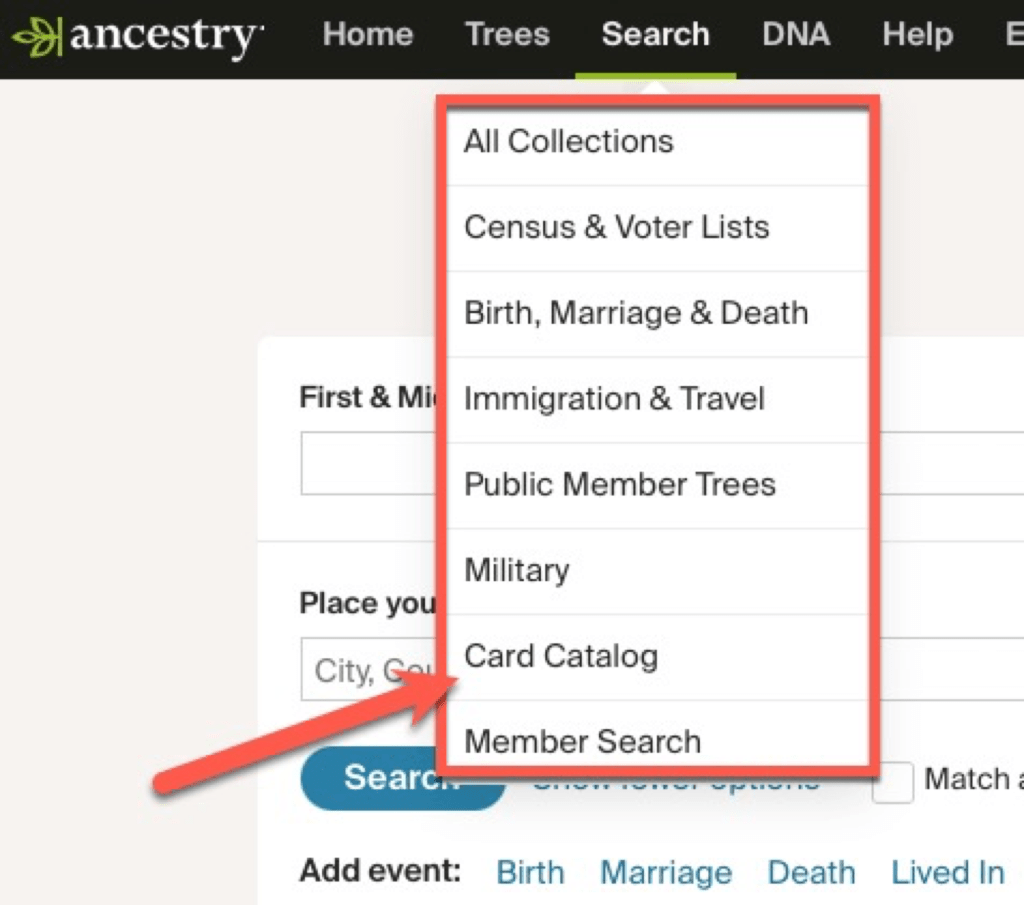
At Ancestry, from the home page, you’ll see some menu items along the top, to the right of the Ancestry logo. One of them is “Search.” When you click on that, a dropdown menu appears. Select “Card Catalog.”
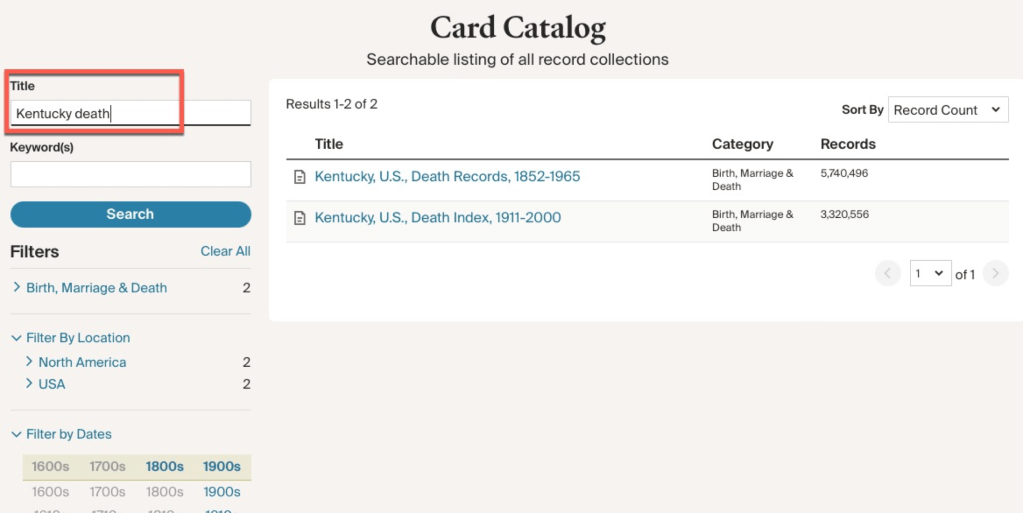
You will then get a full list of every individual database at Ancestry. At the time of writing this post, the total is 33,274 collections.
In the image above, you can see some tools on the left. At the top are title and keyword search boxes. Below that are a series of filters. Usually, I type in a word or two in either the title or keyword box (sometimes I do each separately depending on what kind of results I get). For example, “Kentucky death.”
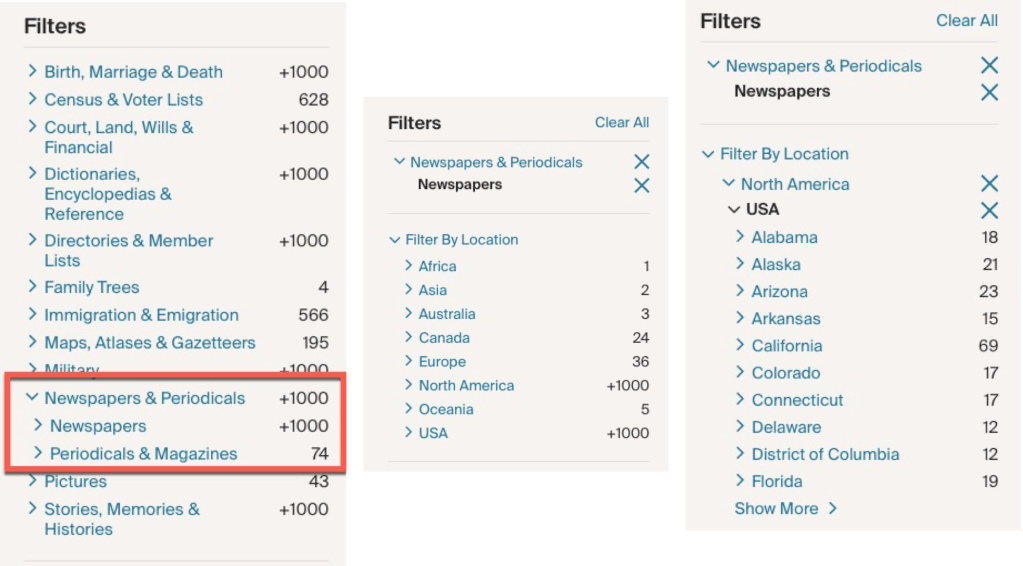
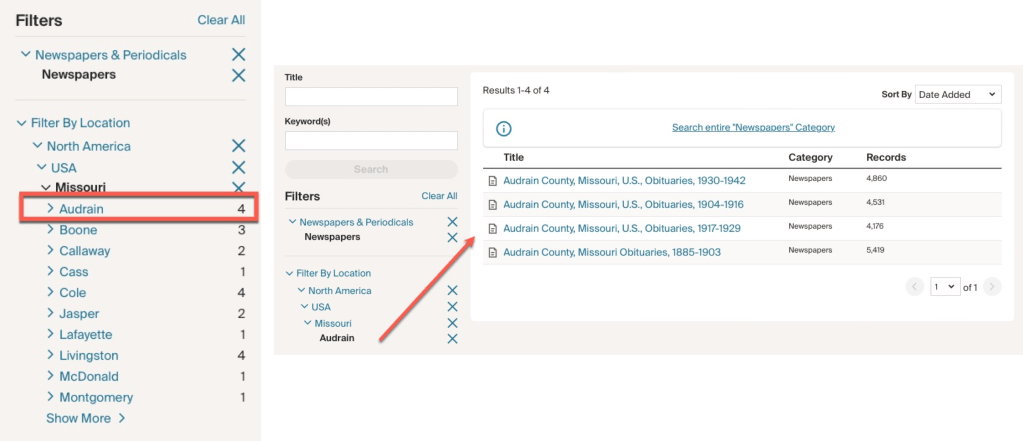
There are two items that come up with Kentucky death in the titles. You can also use the filters below to narrow down the database list. This is especially helpful if you don’t know exactly what you are looking for and you’d like to see what databases a website might have on a location or topic. Let’s say I want to see if there are any newspapers or obituary collections that might apply to Thomas Carroll Mitchell. Click on Newspapers & Periodicals, then Newspapers, then filter by location. In our case, we are looking for Missouri and Audrian County.
There are four databases from Audrain County (the neighboring county to Montgomery) that contain obituaries, one of them covering the year when Thomas C. Mitchell died in 1914. So, I will add this to my research plan. (Or, let’s be realistic, we’ll just jump in and search for Thomas.)
We will look at some more tips for using Ancestry’s catalog next time.
Christmas will have just passed and the New Year is coming up quick!
I have the week off between Christmas and New Years and so does my husband, so I’m going to take some time away from the computer. I know, crazy, right? Ah, but it is a time to recharge, to rest, take a break, and spend time with my nearly grown kids.
I’ll be back next week with the next installment of County Histories. In the meantime, here is what’s on my plate for the first half of 2023:
January 10 – First NGSQ Study groups starting. There are still a couple of seats. Visit this page for more information and to register if you are interested.
June 19-23 – Genealogical Research Institute of Pittsburgh (GRIP) – “The Spirit of the Inland Seas: Research in the Great Lakes Region” with Cyndi Ingle and Paula Stuart-Warren. I will also be teaching a couple of classes in Paula’s course “Digging Deeper.”
You can view my calendar at any time by scrolling down below to the footer of this page.