Category Archives: Certification

Known Information about William Long

Since we work from the known to the unknown, I had already researched the Long family line from myself back to William Long. In William’s records, he overwhelmingly reports that he was born in Ireland in about 1819. (If George Long arrived in Ohio in 1817, then William was born in Ohio, or George did not arrive in 1817 but later, or, William arrived later as a young child and was born in Ireland, but then George would have been married in Ireland, not Ohio… You see how this goes?)

Anyhoo, William married Sarah Metzger on 15 April 1841 in Stark County, Ohio. In 1850, William and his family lived in Allen Township, Hancock County, where he worked as a wagon maker. By 1860, William was farming in Findlay Township to the south of Allen Township. William was killed at Stout’s gristmill at Gilboa, Putnam County, on 13 August 1861, when his clothing got caught up in the belts, and he was dragged into the machinery; his body was horribly mangled.

Knowing the information about William pins him in a time and place. I then looked for George Long in Hancock County, as mentioned in J. W.’s biographical sketch, the family relocated to Hancock County. Two George Longs lived in Hancock County at the right time and were of similar ages.

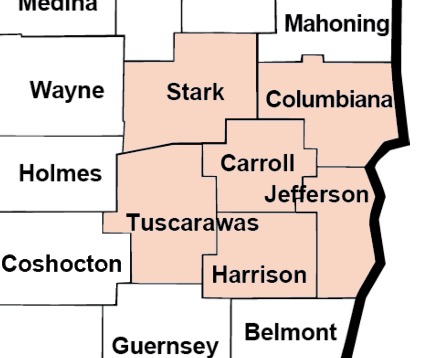
  1. George W. Long lived in Amanda Township in Hancock County in 1840. A land patent refers to him as George Long “of Franklin County.” Franklin County is not one of the five counties that made up Carroll, and it is located in central Ohio, several counties to the south and west of the counties in question. George of Amanda Township was reportedly born in Maryland. He died on 18 August 1880 and was buried in Salem Cemetery in Houcktown, Jackson Township, Hancock County.
  2. George Long lived in Portage Township in Hancock County in 1850. He purchased 40 acres from William R. Alexander in Portage Township, Hancock County, in 1848. He died in Hancock County on 8 October 1855 and is buried next to his wife, “Isabel,” at Thomas Cemetery.
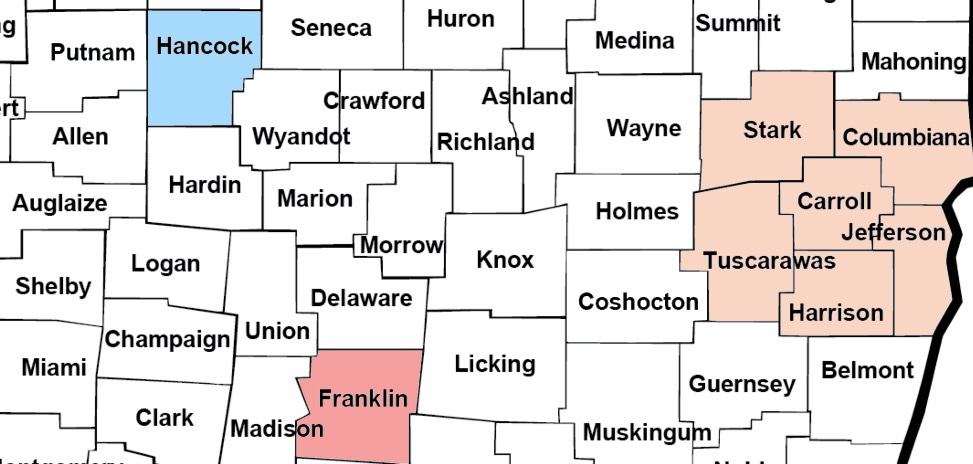
Map expanded to show the Carroll County cluster, Franklin County, and Hancock County.

So, two candidates in Hancock County exist. I need to determine which one is the father of William before I can then identify which George of the twelve is the correct George. The answer next time…

Identifying 12 Candidates

In my recertification project, I examined census, tax, land, and probate records and identified twelve candidates in the right time and place to be George Long, father of William Long. But how did I decide on those twelve?

  1. Census – The biographical sketch of J. W. Long mentioned in the last post stated that William’s father was George Long and he arrived in Ohio in 1817 from “North of Ireland” to Carroll County, Ohio, where he married and had several children. I used that information to look for George Longs in the 1820 and 1830 censuses in the counties that would later make up Carroll County. They also had to have been born in Ireland, and of an approximate age to fit the other criteria such as the approximate age of William. His age was the one I left most wide open in terms of filtering results.
  2. Land – Knowing that many immigrants came to the United States for land opportunities, I identified George Longs in the Bureau of Land Management’s General Land Office (BLM GLO) database as well as in deed books in the five counties.
  3. Tax – Many counties in Ohio have tax records digitized and online for the years in which I was expecting to find George Long. Tax records can act like a yearly census.
  4. Marriage – Also, many counties in Ohio have marriage records available online for the counties in question in the right time frame to match the information from the biographical sketch. If the correct George Long married in one of the counties that made up Carroll County, then I should find a marriage record, ideally. (I never did.) But the marriage records let me sort out the other Georges into separate individuals.

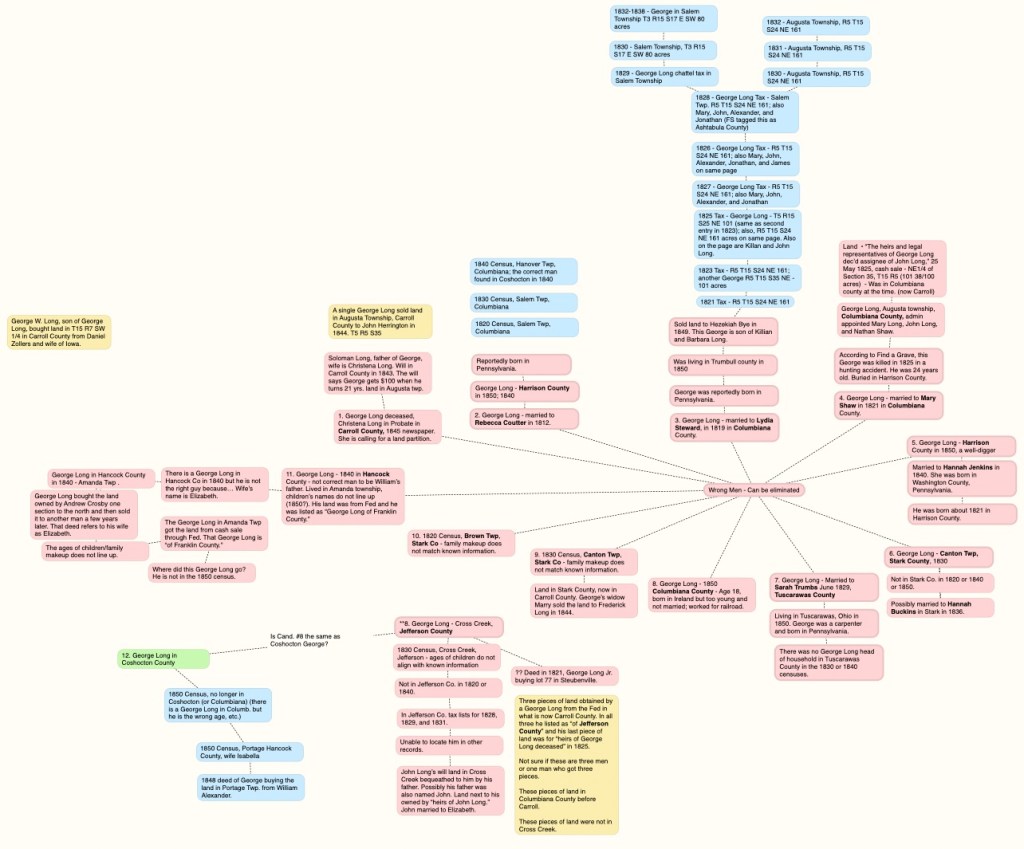
Basically, I collected every George Long I could find in these records, matched them up as the same man, if I could with other context clues (land descriptions mostly), and boiled it down to twelve candidates. How did I keep track of everyone? Besides just textual notes in Scrivener where they were linked to their records, I also used a mind map which I created in Scapple. I am not traditionally a mind-mapper, it’s just not how I think, but it worked beautifully for this project.

A very zoomed out view of my mind map. You’re not necessarily supposed to understand my thoughts, but this is how I organized those candidates and narrowed it down to twelve separate men.

Mind mapping can be used to organize your thoughts. I’ve been to lectures and webinars on the topic. Many times they are used to help with writing in which you can just dump your thoughts into a mind map in no particular order and then later drag the pieces around to become more organized. I personally generally do better with outlines. However, as you can see, I had a lot of little bits of information I was trying to match up to individuals of the same name.

As I am looking at this mind map now, months after its use was finished, I don’t recall the point of the different colors. I believe the red/pink was definitely the wrong man but the blue and yellow I can’t remember why I used them. I’m sure I had a great reason at the time. They all ended up being the wrong man except for the green one and his connected records. And once I got to a certain point of understanding who was who, I stopped using the mind map and started writing. So, it is unfinished as a work product on its own.

Some of the boxes have questions, thoughts, reasoning, and information items. This was very useful when having to set the project aside to say, make dinner, and work, and then come back to it several days later. This allowed me to recall my thinking about a particular man and why I thought he was the wrong one.

Different tools fit different situations and different brains. You might absolutely love mind mapping and use it a lot more than I do. Someone else may prefer to have done all of this in a spreadsheet. Honestly, it doesn’t matter. What matters is that it works for you.

Recertification: What is it? And What Did I Do?

Once you pass your first portfolio with the Board for Certification of Genealogists, you have to submit a project every five years that shows you are not only keeping up with your skills but also improving on any shortfalls they noted in your last portfolio. This time only one project is required at minimum, but it must meet the Genealogical Proof Standard.

My recertification project this time was to identify the father of William Long, my third great grandfather. I had one starting piece of information about William’s father. His William’s son, J. W. Long’s biographical sketch in the Wood County, Ohio, county history. The sketch claims that his grandfather, George Long, came from “North of Ireland” to Carroll County, Ohio, in 1817, married there, and then had several children named in the sketch: George, William, John, Catherine, Ellen, Susan, and Alexander. It does not name his grandmother, George’s wife.

There are some problems with this statement, which I will breakdown over the course of this series. As I was researching this family, several things became clear to me. The first thing was that Carroll County did not exist in 1817. It was not formed until 1833 when it originated from land taken from five counties: Columbiana, Harrison, Jefferson, Stark, and Tuscarawas.1 When George Long arrived in “Carroll County” in 1817, it must have still been one of these other original counties.

This meant that I had to widen my search from one county to five or six, depending on the time frame.

If George arrived in Ohio in 1817, then surely he was enumerated in the 1820 census. Of the nine George Longs in Ohio in 1820, only two lived in one of the target counties: George Long in Salem Township, Columbiana County, and George Long in Brown Township, Stark County. A similar search in the 1830 census shows there were 22 households in Ohio headed by a man named George Long (or similar), four of whom were in a target county. Depending on what record sets I looked at, I found MANY George Longs in and about the correct area in 1820 to 1840.

I identified twelve (12!) candidates that could have fathered William Long. The main purpose of my project was to examine these twelve candidates and eliminate them until only one man made sense. Some were easy to eliminate, others were trickier. I will share some of my information organization tricks in the next post.


1. Acts of A General Nature Passed at the First Session of the Thirty First General Assembly of the State of Ohio (Columbus: State of Ohio, 1832), p. 8; image, Google Books (https://books.google.com/).

I’m Recertified!

I’ve written in the past a little bit about a project I was working on involving George Long, my 4x great grandfather. It was for my recertification project for the Board for Certification of Genealogists. Once you pass your first portfolio, you have to submit a project every five years that shows you are not only keeping up with your skills but also improving on any shortfalls they noted in your last portfolio.

I finished the project in mid-December and shipped it off before the holidays because I did not want to worry about it while trying to relax and enjoy family time. I was told the wait could be up to six months, so imagine my surprise when I got the email informing my my project passed and I am certified for another five years!

Well, when the news came I was sick in be with the worst “stomach flu” I may have ever experienced. We assume it was Norovirus based on the symptoms. My son, who works in hospitals and medical clinics, got it first, and likely brought it home. We immediately started wiping everything down and doing laundry and trying to help him feel better. But I did not escape. I was sick next, and it put me in bed for four solid days, and I honestly didn’t feel like 100% until Sunday, so a full seven days to recover. I got the recertification news on Tuesday (day 3) of being sick. I checked my emails and gave out a very puny “yay.” My husband got a very minor version of whatever our son and I had. Thank goodness, because we needed someone to go get Gatorade and ginger ale and applesauce and otherwise hold down the fort.

I then spent the next week trying to catch up on work. So I’m only now taking a moment to share the news. Over the next few blog posts, I’m going to share some of the problems I solved within that larger project, some of the techniques I used to stay organized, and anything else that jumps out at me about it.

I do want to share this. The anticipation, the worry, the anxiety, and the imposter syndrome I think we all experience (in any field), is real. I definitely worried that some major flaw in my reasoning would be found, that they’d realize they never should have passed me in the first place. Yet, at the same time, I felt more confident on this one than I did on the last recertification. The confidence did nothing to alleviate the anxiety, but, looking back, I think that is a sign of increased skill, knowledge, familiarity with material, and having a good support system, not just with my family but my colleagues as well. It took me one portfolio and two renewals to think, “maybe I DO know what I’m doing.” Ha! If you know me or have been a participant in any of my study groups or courses, I’m sure you’re thinking I’m ridiculous. If you are a certified or accredited colleague of mine, you likely know what I’m talking about. Overall, my point is, don’t let the anxiety hold you back. Do your best and learn from it.

Finding Laws

George Long supposedly came from “North of Ireland” to Carroll County, Ohio, in about 1817.1 The problem is, Carroll County did not exist in 1817; it was formed in 1833 from five counties: Columbiana, Harrison, Jefferson, Stark, and Tuscarawas. My hypothesis is then that he had to have been in one of these counties before coming to Hancock County.

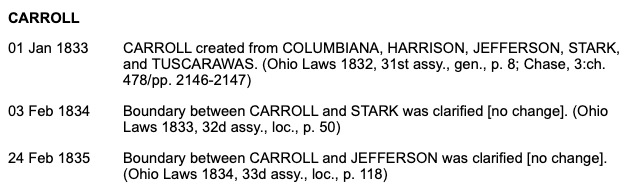
In writing my proof argument, I wanted to cite the exact law that created Carroll County. I have numerous books on Ohio, the county boundary changes, I also utilize the Newberry Library’s Atlas of Historical County Boundaries. The Atlas has a timeline of each county’s boundary changes, as well as a bibliography to help point you to the laws.

Atlas of Historical County Boundaries entry for Carroll County.

As you can see, the entry lists sources for the information. I like to read the laws myself. (I guess I have trust issues. But that all stems from being “burned” in the past.)

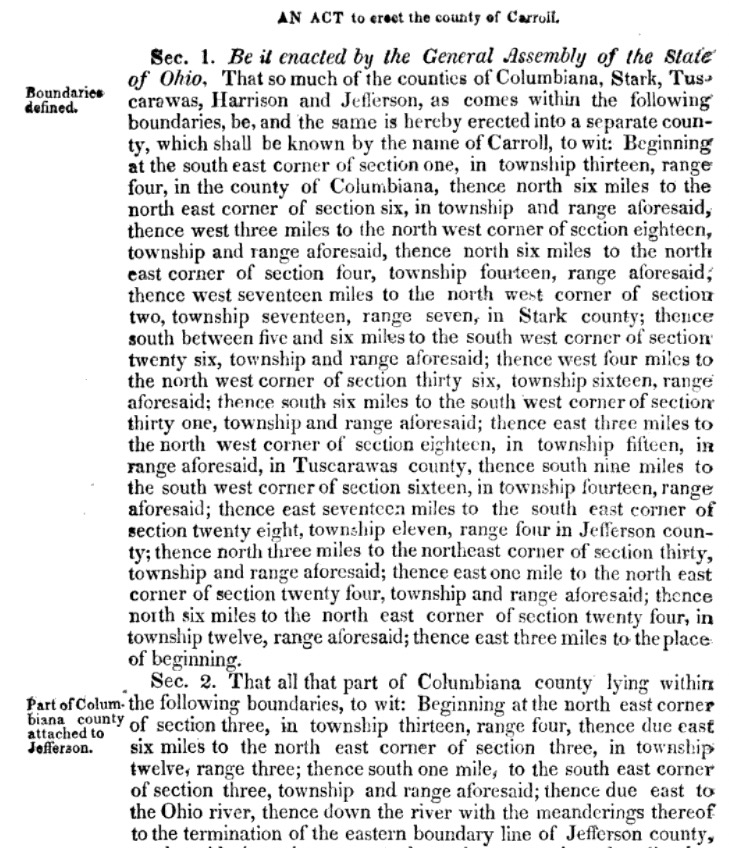
I turned to Debbie Mieszala’s website The Advancing Genealogist. She has been collecting and posting links to historic law books. I found the one referenced in the image above quite easily. She links directly to the book on Google Books.2 Very handy! Thank you to Debbie for this fantastic resource!

The first part of the law that changed the boundaries and added Carroll County.

If you need to find a historic law, try Debbie’s website. It is a great resource that has saved me a bunch of time on this and other projects as well. Check it out!


1. J. H. Beers, Commemorative, Historical and Biographical Record of Wood County, Ohio. (Chicago:  J.H. Beers and Co, 1897), pp. 714-715. Available on Google Books.

2. Acts of A General Nature Passed at the First Session of the Thirty First General Assembly of the State of Ohio (Columbus: State of Ohio, 1832), p. 8; digital image, Google Books (https://books.google.com/ : Viewed 17 July 2024.

A bit of a rest…

Leading up to GRIP (GRIP Genealogy Institute) was a whirlwind. Cyndi Ingle, Paula Stuart-Warren, and I put together a brand new course about researching your farming ancestors. We had so much fun doing the research to put the course together. We ran into so many interesting topics, resources, historical events, inventions, records, repositories, and so on, that the course probably could have been two weeks, easy. But that’s a story for another time. All of that work and then the teaching for the week, while fun, was also exhausting; I took a little rest from the blog.

But I’m back, at least somewhat. I’m now working on a big project that has a due date… my recertification project is in full swing! I cannot believe how fast five years goes. Well, these last five years have been weird anyway, so that didn’t help matters.

I am one of those crazy morning people. Since January and getting ready for GRIP, I have been getting up at 5:30 am and shortly thereafter heading to my office to get a couple of hours of work in before my workday at Ancestry ProGenealogists. It has been going very well. Now that GRIP is over, I’ve been working on this project in the same time slot and have made some great progress.

I’ve written about this project before. The target ancestor is George Long, who died in Hancock County, Ohio, in 1855. Where did he come from before Hancock County? I identified 11 candidate George Longs in the right time and place. So, my project has been first identifying and then eliminating those candidates, and then researching the one left standing to prove he is the right man.

Stay tuned for more fun times.

CG Renewal Time!

I recently received a helpful packet in the mail from the Board of Certification of Genealogists that my renewal application would be coming due soon. Where did five years go? (Well, four and a half, but still.) It seems like just yesterday I was putting the final spit and polish on my first portfolio!

Luckily, the renewal application process is not as rigorous as the initial application. You only have to submit one to three items as long as one meets the Genealogical Proof Standard (GPS). The main goal is to make sure you are continuing to grow in your journey as a Certified Genealogist, that you are keeping up your education, and that you are applying the standards to your work.

I have been working steadily to improve everything from my first portfolio and am not too worried, except for the lack of time I have to work on it! So I’ve been working hard to finish up and clear out some responsibilities I’ve had and to block time out in my schedule to work on it. Time management is such a trick sometimes!

I will keep you posted. In the meantime wish me luck and few interruptions!

Board for Certification of Genealogists Adopts Standards for DNA Evidence

The use of DNA in our genealogical research is becoming more and more prevalent. As the use of DNA has grown, the Board for Certification of Genealogists (BCG) has been assessing how it has affected the field. As a result, BCG has adopted new standards for the use of DNA in genealogical work.

The following news release was received from BCG making the announcement:

For immediate release 27 October 2018
News Release, Board for Certification of Genealogists

Board for Certification of Genealogists Adopts Standards for DNA Evidence

On 21 October 2018, the Board for the Certification of Genealogists (BCG) approved five modified and seven new standards relating to the use of DNA evidence in genealogical work. BCG also updated the Genealogist’s Code to address the protection of people who provide DNA samples.

The new measures are intended to assist the millions of family historians who now turn to genetic sources to establish kinships. The action followed a public comment period on proposed standards released by BCG earlier this year.

“BCG firmly believes the standards must evolve to incorporate this new type of evidence,” according to BCG President Richard G. Sayre. “Associates, applicants, and the public should know BCG respects DNA evidence. It respects the complexity of the evidence and the corresponding need for professional standards. BCG does not expect use of DNA to be demonstrated in every application for certification. However, all genealogists, including applicants, need to make sound decisions about when DNA can or should be used, and any work products that incorporate it should meet the new standards and ethical provisions.”

“Standards for Using DNA Evidence,” a new chapter to be incorporated in Genealogy Standards, introduces the issues this way:

“Meeting the Genealogical Proof Standard requires using all available and relevant types of evidence. DNA evidence both differs from and shares commonalities with documentary evidence. Like other types of evidence, DNA evidence is not always available, relevant, or usable for a specific problem, is not used alone, and involves planning, analyzing, drawing conclusions, and reporting. Unlike other types of evidence, DNA evidence usually comes from people now living.”

In brief1, the new standards address seven areas:

  • Planning DNA tests. The first genetic standard describes the qualities of an effective plan for DNA testing including types of tests, testing companies, and analytical tools. It also calls for selecting the individuals based on their DNA’s potential to answer a research question.
  • Analyzing DNA test results. The second genetic standard covers factors that might impact a genetic relationship conclusion, including analysis of pedigrees, documentary research, chromosomal segments, and mutations, markers or regions; also, composition of selected comparative test takers and genetic groups.
  • Extent of DNA evidence. The third genetic standard describes the qualities needed for sufficiently extensive DNA data.
  • Sufficient verifiable data. The fourth genetic standard addresses the verifiability of data used to support conclusions.
  • Integrating DNA and documentary evidence. The fifth genetic standard calls for a combination of DNA and documentary evidence to support a conclusion about a genetic relationship. It also calls for analysis of all types of evidence.
  • Conclusions about genetic relationships. The sixth genetic standard defines the parameters of a genetic relationship and the need for accurate representation of genealogical conclusions.
  • Respect for privacy rights. The seventh genetic standard describes the parameters of informed consent.
  • The modifications made to several existing standards call for:
  • Documentation of sources for each parent-child link.
  • Where appropriate, distinction among adoptive, foster, genetic, step, and other kinds of familial relationships.
  • Use of graphics as aids, for example: genealogical charts and diagrams to depict proved or hypothesized relationships; or lists and tables to facilitate correlation of data and demonstrate patterns or conflicts in evidence.
  • Explanations of deficiencies when research is insufficient to reach a conclusion.

A new edition of Genealogy Standards is expected to be ready by next March. A new application guide and judging rubrics incorporating the new standards will be released at about the same time. In the interim, portfolios submitted for consideration for certification will be evaluated using the existing Genealogy Standards.

1. The Board for Certification of Genealogists® (BCG) contractually granted the publisher of Genealogy Standards the exclusive right to copy, publish and distribute the standards including amendments. However, BCG-certified associates have the contractual right to include reasonable portions of the standards in presentations, articles, blog posts, social media, and the like. In no case may BCG or its associates allow the standards to be published in their entirety because the publisher deems that competitive to its publication rights.

The words Certified Genealogist and the designation CG are registered certification marks and the designations Certified Genealogical Lecturer and CGL are service marks of the Board for Certification of Genealogists, used under license by board-certified associates after periodic competency evaluations, and the board name is registered in the U.S. Patent & Trademark Office.
Interested in Certification? Try a Discussion Group!

2018-06-12_14-31-22I recently completed my first time as discussion group leader (ring leader?) with Jill Morelli’s “Certification Discussion Groups” (CDG for short). These groups were created to demystify the process of preparing and submitting your portfolio for the Board for Certification of Genealogists (BCG). It was a fun time. I got to meet with old friends and make new ones. And they got to ask questions about the process, be each others’ cheerleaders, and have the opportunity to study and process portfolios and judges’ comments.
The discussion groups are seven weeks and are divided up as follows:

  • Week 1: Intros, Application, Resources & Strategy I
  • Week 2: Ethics, Dev Activities & Strategy II

  • Week 3: Transcriptions

  • Week 4: Research Report (Client Report)

  • Week 5: Case Study

  • Week 6: Kinship Determination Project (KDP)

  • Week 7: Evaluation & Process

We go over each part of the application as well as the rubrics and standards for each piece. We also discuss some of the confusing items such as the differences between a narrative lineage, genealogy, and pedigree, and the differences between a proof statement, proof summary, and proof argument, and more. Questions arise as to what a particular standard or rubric means and this group allows for discussion of those questions.

The groups take place via video conferencing either via GoTo Meeting or Zoom. There are homework assignments that are meant to enhance the discussion, but they are optional. The course is not meant to be intensive, rather to answer specific questions about the process, dispel any myths that are floating around, give participants a chance to hear from people who have been through the process and passed, but aren’t PERFECT! We share our mistakes, the things we learned, and tips for avoiding overwhelm.

If you are interested in the process, are considering becoming certified, are already on the clock, or just wondering if it is even for you, I encourage you to participate in one of the groups. Current discussion group leaders are Jill Morelli, Angela McGhie, and myself. For more information and to be added to the waiting list, contact Jill jkmorellli@gmail.com.

GREAT NEWS: I did it!!!

colorlbcgsealfullLast week I got that email everyone who has submitted a BCG portfolio hopes to get… “Congratulations and welcome! I am delighted to report that your application for BCG’s Certified Genealogist credential has been successful.” Hallelujah!

What a journey! It began 10 years ago when my friend and mentor, Birdie Holsclaw, encouraged me to create a lecture describing all of the obituaries I had collected in my first few years of research. At that time it was somewhere over 100 (today it is closer to 300 but I lost an accurate count). A few years later, she suggested I look into Certification (from the Board for Certification of Genealogists) and think about working toward that goal. My friend Birdie died on 13 May 2010 from cancer.

Birdie_Russ-35thBday
Birdie and Russ Holsclaw at my 35th Birthday celebration, January 2009

After her death, I became sad whenever I tried to work on any of my genealogical research and so I spent some time away from it. But I loved it too much to stay away for long. In 2012 I got some renewed energy and decided to make it my full-time gig. GenealogyPANTS was born in March of 2012.

I decided that instead of being sad that Birdie was gone from our midst, I should do the things she thought I could do. I decided to pursue certification in her honor. If she thought I could do it, then I should do it. I should see if she was right. Along the way I met others who thought I could do it as well. The knowledge that someone is pulling for you, has confidence in you, and will stop what they are doing to send you an encouraging email or answer a question is a powerful thing. This knowledge helped me finish my portfolio. All of the things that these genealogists do for the genealogical community at large to educate us contributed to my success.

I am going to list some people here. So many people have shaped me in some way over the years that I can’t possibly name them all; just please know your contribution to my success did not go unnoticed or was unappreciated. In no particular order:

  • Angela McGhie for ProGen and all of my cohort from ProGen 16! (This amazing study group  helped me tighten up many areas of my portfolio.)
  • Tom Jones for all of the educational materials he has written over the years, classes and lectures he has taught, for answering several emails in super-quick fashion, and for just being one of the most approachable and patient people out there.
  • Judy Russell also for all of the educational materials you provide to us (via The Legal Genealogist blog and all of the lectures and classes) but also for being so clear AND fun in your lecture style. It makes learning about potentially boring topics so much fun and NOT boring. I mean we each have our interests, but Judy has the ability to make you really want to learn about historical laws and their genealogical impact even if you were an art major in college!
  • Elizabeth Shown Mills for all of the work she’s done on making citations understandable through not only her books but also her Evidence Explained website; also for her informative lectures and classes. I’m honored to have been among the last Course 4, Advanced Methods class at IGHR and I’m honored to have gotten the coveted “gold seal” AND the Walter Lee Sheppard Jr. Prize. I have to admit that the thought of “Elizabeth Shown Mills thinks I can do this!” really, REALLY helped me finish and succeed with my portfolio.
  • Dave McDonald also for the Walter Lee Sheppard Jr. Prize. It is people giving back to the genealogical community that really helps others succeed! [And I wanted to say thank you for your lovely tribute to Birdie at the 2012 NGS Birdie Monk Holsclaw Memorial Lecture. I bought the CD to your lecture titled “Maps! White Oaks, Gradients, Google, and more….” and listen to what you had to say from time to time. Very moving.]
  • Mark Lowe for being another one of those educators that just makes learning fun and for telling a great story every time he speaks. Mark can really get into the emotions of why genealogy is important. Also, for being so approachable, supportive and just a great genea-friend!
  • To my genealogy “support group” which consists of Annette Botello, Ruth Ratliff, Deb Skoff and Denise Miller. This group also included Birdie and she was always so encouraging to us when we met and so generous with her time. This group has been such a blessing to me not only genealogically but personally! Thanks you guys!

    PageTwoGroup
    My genealogy “support group,” February 26, 2010, from left to right: Annette Botello, Deb Skoff, Cari Taplin, Birdie Holsclaw, Denise Miller and Ruth Ratliff
  • To the members of the CERTS group I was a part of that included: Beth Benko, Kirk Patton, Deena Coutant, Harry Ross, Karlene Ferguson, Diane Barbour, Margaret Kadziel, and if there are others I’ve missed, please accept my apologies, but this group tended to morph a bit so I hope I didn’t miss anyone.
  • To my genealogy colleagues in Colorado. ALL of you whom I have had the pleasure of learning, interacting, working, and engaging with over the past 14 years. [I am not even going to try naming you all; you know who you are!]
  • Most of all to my husband, Seth, for being encouraging, for listening to rants, for tolerating genealogical tantrums, for bringing me food and coffee to keep me going, to all of the driving to cemeteries and libraries, and for taking care of kids so I could focus. [I love you!]

And so to conclude, I’m grateful. I’m grateful that this part of the process is over, I’m grateful for all of the support I’ve had and I’m grateful that I had the chance to know and work with and be friends with one of the best people on the planet. Plus, I’m so excited to start this next part of the genealogical journey, watch out!