As we look ahead to the new year, we tend to plan for new adventures, things we’d like to improve, goals we’d like to reach and a year better than the last. While we can’t plan for what we can’t control, we can make goals for what we can.
This is my 2014 “wish list” for myself, genealogically speaking:
Get my BCG portfolio turned in (My deadline is December 15, 2014!)
Write at least 3 major articles (These are aside from those that may appear in my home society’s quarterly.)
Gain 1 new client per month
Speak/teach at least 12 times this year
Ok, that list feels short to me. But look at number 1! I’m going to keep the list short because that first one is a doozy! I really should just make that one item the only goal I expect from myself this year, but I am an overachiever so of course I put more items on my list.
Good luck to you and I hope you take some time to make a few goals for yourself this year.
We can plan and plan, but life always has a plan of its own. Sometimes things come up that take you off course of your own goals, and sometimes that is for the better. When you look back at the things you accomplish, you may notice that sometimes things happen that you hadn’t planned on, opportunities “knocked” and you opened the door.
Here are some things that I accomplished this year that I hadn’t planned on:
Continuing Education Program – I had the opportunity to develop and teach a 4-week beginning genealogy class through my local community college.
FGS committee – I was asked to participate on a committee with FGS. It was a lot of fun and great to meet and work with some genealogists that I really admire and respect.
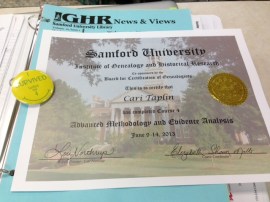
Gold Star – I had the surprise and pleasure of earning a gold star from Elizabeth Shown Mills’ Advanced Methods course at IGHR.
Legacy Quick Guides – I had the opportunity to write five legacy quick guides, which was an amazing experience. They are:
Sometimes the goals you don’t plan turn out to be some of the best accomplishments you didn’t plan for. Take a look back over your year and see what you’ve done you didn’t plan on. You might be pleasantly surprised.
While long-term goals can carry over a period of time, I generally expect my short-term goals to be smaller and easier to accomplish. Let’s see how I did this year. My short-term goals for 2013 were:
Revise and post my mission statement on my website.
Attend GRIP and IGHR provided I get into the desired courses.
Add “Mentoring” to my business plan.
Attend more online webinars, explore and read more blogs, read the books and magazines I’ve gathered.
Create some new programs. I’ve been a little stagnant lately and have not created any new programs to present to local societies.
Do more work for my society’s Quarterly.
Here’s the breakdown:
Put my mission statement on my website – I did this as a part of my ProGen study this year. You can view it here in the intro of my website.
Attend GRIP and IGHR – I did get into the courses I wanted and they were quite exciting courses to take! I was lucky enough to have taken Elizabeth Shown Mills’ last Advanced Methods course at IGHR! And I thoroughly enjoyed Tom Jones’ Mastering Genealogical Proof course at GRIP.
Add “Mentoring” to my business plan – I’ve termed consultation now, instead of mentoring. I wavered back and forth over this and feel like mentoring is a personal relationship that develops and can’t be forced or bought, but I can offer consulting services.
Attend more online webinars… – I’ve been watching a lot more of these while I work on organizing in my office or scan documents. I seem to have hit the limit on the number of blogs I can easily follow. There are a lot of us out there blogging and as much as I’d love to read them all, I just can’t. So I have a few of my favorites and I skim the headlines of the rest. As for my books and magazines, I’ve done some work on this but it is a more time-consuming project.
Create some new programs – I have created a new 4-week beginner course curriculum and I have a new lecture on County Histories. I am in the process of writing another one that will be done in January, an Ohio case study.
Do more work for my society’s Quarterly – I have done some of this. I have been extracting data from a ledger from the Boulder Superintendent’s visits to schools and have turned some of it in to the Quarterly editor.
So all in all I am quite pleased with the outcome of my short-term goals for this year. Invariably, things happen that weren’t planned. Next I will discuss the things I accomplished that weren’t on either of these lists.
When I create goals, I like to create two kinds of goals, long-term and short-term. Generally the short-term goals feed into the long-term goals. Also, short-term goals tend to be smaller, easier, things you can take care of quickly whereas long-term goals take more time, planning, determination, and consistency. The completion of short-term goals gives you the sense of accomplishment and the momentum to keep up with the long-term goals.
Last year I created a list of my Long-Term goals for 2013. There were as follows:
Organize my office (this is more of an ongoing, every day resolution, but still, I need to keep it visually handy).
“Process” my binders. This is in relation to my organization system according to family groups. I recently changed it a little bit and so all of my families need to be caught up.
Finish and submit my BCG application by December. (I went “on the clock” at the end of December 2012.)
Let me break them down by goal:
Organize my office – I’m happy to report that this is possibly the only one that I feel is pretty much done. This summer we finally finished our basement and built a very nice home office (that I’m mentioned before). I have plenty of file cabinets, shelves, and desk space to keep my genealogy organized.
“Process” my binders – I know that most of you don’t even know what this means, but in terms of updating my research organizing system, I’ve only done 2 or 3 of these binders. I have about 20. So, while I’ve done some, it’s not as far along as I’d like. I’ll keep working on it.
Finish and submit my BCG application – Well, some things happened with this that have caused me to get an extension. For one thing, I did a lot more education in preparation for the BCG than I had previously thought I would. This was a good thing. In taking those courses, I realized that I would need some more time to really do it right. My new deadline is December 15, 2014. This will make an appearance on my 2014 goals list.
So even though I did maybe half of my long-term goals, I feel like I made quite a lot of progress. These are LONG-TERM goals after all and it’s ok if they carry over to the next year’s list.
December… this is a month of mixed emotions for me. I love the holiday decorations, the sparkly lights, trees, snowflakes, and especially snowmen (they’re cute). But it also involves a lot of busy-ness, places to go, kids’ programs and parties to navigate, gifts to buy, wrap and deliver. Stores are crowded. It’s not my favorite time to be out and about. And it can be so cold, and it’s always dark, and I really just feel like hibernating until March.
Despite that, I love that a new year is looming, it’s a feeling of a fresh start, a chance to do some things differently and make new goals. It’s an arbitrary date, January 1, you can “turn a new leaf” anytime during the year, but there’s something about the changing of the calendar that just gets me excited for new things. Last year I made public my goals for 2013. I’m going to take some time to review how I did and examine things I did that were not on the list. It is easy to get caught up in day-to-day mini-roadblocks that I forget to look at the bigger picture and see that I actually did get stuff done.
This series of posts will look at my 2013 goals in more detail and will end with my goals for 2014. I encourage everyone to take some time to do this for themselves, several times throughout the year even, in order to gain some perspective. I hope you join me in this activity to see where you stand with your goals.
I wasn’t sure what to expect from IGHR or Elizabeth Shown Mills’ Advanced Methodology Course. I heard a lot of rumors about how hard it was. When people would find out which course I was taking they’d say “Ooooh. Gosh, be ready for a lot of homework.” Of course then I begin to second guess myself. “What if I’m not at the level needed to take this course? What if I’ve overestimated my abilities?” It turned out to be at just the right level and pace for me. I was familiar with almost all of the topics covered, with the exception of the government documents (gov docs for short) section. I’ve listened to lectures about gov docs before but never had the opportunity to use them. Everyone has a unique brain and therefore a different way of doing things and I thoroughly enjoyed learning how someone of Elizabeth Shown Mills’ caliber approaches a problem, what interpretations she makes from any given record and where she goes from there.
I think the biggest lessons I learned from the course are:
There’s always something more.
Citations are an art not a science.
Research the neighbors.
Of course there were many lessons to learn. I definitely have a new way of approaching my research problems! And there was a fair amount of homework. I spent about 4 hours per night, but I found myself going off on tangents. (Anyone else have that problem?) I did not attend any of the evening events except the banquet, because I wanted to do the homework to my satisfaction, and I wanted sleep. Craig R. Scott taught a lecture or two in our course and my favorite thing he said was “A good genealogist needs sleep.” I still didn’t get enough sleep, but an adequate amount. (I hope Elizabeth takes the yawns as a sign of hard work and not as commentary on her lecturing!)
I was surprised when I received a gold star on my certificate. I was doubly surprised when I got home and received an email from Elizabeth letting me know that I had won the Walter Lee Sheppard Jr. Prize. This is from the press release:
Cari Taplin of Longmont, Colorado, has been named the 2013 recipient of the Walter Lee Sheppard Jr. Prize, bestowed annually upon one or more genealogists who demonstrate sound practices and exceptional potential. Candidates for the award are drawn from the Advanced Research Methodology and Evidence Analysis track at Samford University’s Institute of Genealogy and Historical Research. The stipend awarded to each recipient covers the preliminary and final application fees for pursuing certification by the Board for Certification of Genealogists. Past recipients of the prize include Debbie Hooper, CG, of Millsboro, Delaware; Judy Russell, CG, of Avenel, New Jersey; David Ouimette, AG, CG, of Highland Utah; Phil Burnett Adderly, CG, of Shreveport, Louisiana; and Teri Tillman, CG, of Natchez, Mississippi. The Samford University IGHR and the Board for Certification of Genealogists (BCG) were both founded in 1964 by a cadre of genealogical educators seeking to advance quality and professionalism within the field. Across the decades, BCG has co-sponsored the IGHR; and a significant number of Board-certified genealogists have been its course coordinators and instructors. The prize itself memorializes the late Walter Lee Sheppard Jr., one of the twentieth-century’s leading genealogical scholars whose example strongly promoted sound reasoning and careful analysis in all genealogical specialties. As a mentor, his discerning eye could be counted upon to identify a missed source or clue in family reconstructions, thereby strengthening a colleague’s conclusions. A founder and president of BCG, Lee was also a fellow and president of the American Society of Genealogists, the National Genealogical Society, the Genealogical Society of Pennsylvania, and other bodies. In 2007, he was elected to the National Genealogy Hall of Fame. The Sheppard Prize is privately funded by an IGHR Track 4 graduate, for whom Lee acted as mentor and patron. The prize has no affiliation with the Board for Certification of Genealogists itself.
The Walter Lee Sheppard Jr. Prize is funded by a private person who was mentored by Lee. This is serendipitous because having had an awesome mentor is the only reason I am here (in the genealogy world) today. My dear friend and mentor Birdie Holsclaw told me I could be, she told me I could do this, that I had potential, that what I was doing was fun and interesting and that people would want to hear about it. So I began speaking and writing articles. We would sit up until Buffalo Wild Wings kicked us out (around 2am) talking about my work and she’d just impart her wisdom on me, freely and with such patience and grace. Then she and some other friends invited me to a small group of people who were thinking about becoming certified. And I’ve been on that path slowly ever since. Well, now, it’s not going to be slow anymore.
The next 18 months is going to fly by and I hope to do Birdie proud! And I hope to be able to pay forward the mentoring gift someday. All in all, that is not a bad first time at IGHR!
So, I went “on the clock” (for BCG certification) in December 2012. In the meantime a lot of “life” has happened but a lot of “life” is going to happen when you take a step like this. I’m the type of person who needs a deadline, so I went on the clock. Once I sat down and tried to locate a family/problem for my case study, I got concerned. One look at my office, my binders, my computer files, told me that I was horribly unorganized and I needed to do a lot of catching up, fixing, data entry (I have a thumb drive with scans from Salt Lake City from 2009 that I haven’t worked with yet!) and organizing, before I could even make an educated guess on the case study.
Well, in the last week, I went through a very large pile of notes with “to-do” items on them, some dating back to 2003. They said things like “find tombstone for …” or “locate obit for …” or one sticky note “I am not convinced that ––– is really –––’s father.” (Names being left out in case this REALLY is my case study.) That one sticky note sent me on a swirl of reviewing documents, notes, computer files, quick look-ups on Ancestry and FamilySearch. I MAY just have found my case study. I have a few pieces of indirect evidence but nothing conclusive that says who the parents of my subject are.
This project is so counter-intuitive for the genealogist. If you’ve never reviewed the Case Study requirements for the BCG portfolio, it basically requires that you use the genealogical proof standard to solve a problem of conflicting evidence or by using of indirect evidence. I know that I have many of these in my family research, but finding a good one can be challenging. And then, what happens when you start to work hard on it and then find that piece of direct evidence? … ah … back to square one.
I did get through my pile of to-dos and either figured out that they had been done (recycled), or if they were easy to do (just did it), or they went into my Evernote to-do list (then recycled). Now, on to some research! So pray for my project, that I find no direct evidence on this man’s parentage and instead am able to locate a lot of really good indirect evidence!
I turned in my BCG preliminary application for certification at the end of December, so I’m officially “on the clock” as they say here in genealogy land. It is a little stressful to think of all of the work that lies before me, not only for certification but also while pursuing a Master’s Degree. I have this unrealistic personal belief or maybe it’s my personality type, but I think I can get amazing amounts of work done and love to “climb big mountains” of tasks. I inevitably end up stressed out at various times, but usually I get the things done I say I’m going to do.
There are several things in play that I believe will help me be less stressed and get my portfolio finished. First of all, I am in a group of other genealogists from my general area who are also “on the clock” or plan to be soon and we are working together reading the BCG Standards Manual and understanding the requirements. Also, I am a member of a smaller group, what I call my genealogy “support group.” This is a group of 5 women who have been meeting for many years to discuss what’s new in their genealogy journeys, basically a discussion outlet so our families don’t get bored with our ramblings. Third, while I am pursuing a Master’s Degree, the workload has been quite manageable, only overwhelming toward the end of the semester. Fourth, while I do still have kids at home, they are in school all day and I am not working right now, so, while I am poor, I do have uninterrupted time during the week days to work on BCG and homework.
The BCG website gives a proposed timeline for how long certain projects will take. I began working on my portfolio, in a rather unorganized fashion, a few years ago. So I have at least some rough drafts finished on several of the items. So I feel I have a slight head start on some of the tasks. However, if by December of this year, I am not ready yet, they generously allow you to apply for an extension for 1 year for a nominal fee, which has taken some of the pressure off! Wish me luck!
As the new year is progressing, I have taken some time to address what my genealogical goals for 2013 are. I have broken them down into long term and short term goals. Some are things I’ve been meaning to do, just haven’t had time while others are events I plan on attending or studies I hope to pursue.
Long Term Goals:
Organize my office (this is more of an ongoing, every day resolution, but still, I need to keep it visually handy.
“Process” my binders. This is in relation to my organization system according to family groups. I recently changed it a little bit and so all of my families need to be caught up.
Finish and submit my BCG application by December. (I went “on the clock” at the end of December 2012.)
Short Term Goals:
Revise and post my mission statement on my website.
Attend GRIP and IGHR provided I get into the desired courses.
Add “Mentoring” to my business plan.
Attend more online webinars, explore and read more blogs, read the books and magazines I’ve gathered.
Create some new programs. I’ve been a little stagnant lately and have not created any new programs to present to local societies.
Do more work for my society’s Quarterly.
That’s what I’ve got for today. This list always changes throughout the year but this feels like all of the goals I have been thinking about since the New Year began. I hope you all have your lists and are working toward your goals!

 As we look ahead to the new year, we tend to plan for new adventures, things we’d like to improve, goals we’d like to reach and a year better than the last. While we can’t plan for what we can’t control, we can make goals for what we can.










 Genealogy Pants