Category Archives: Research – General

Timeline Analysis

I mentioned my timeline for my ancestor Samuel Cook Dimick a few blog posts ago. Let’s take a look at his story. When I was first researching him, one of my main questions was “why.” Why did he take his family away from New Hampshire (where it is beautiful, I’ve visited) to Wood County, Ohio? Wood County is about as flat as flat can be (well, with the exception of large parts of Kansas and eastern Colorado, but I digress). Why was I from Ohio and not New Hampshire?

I have a fantastic county history entry for Samuel in the Wood County History. It has so many details about him and his family. I started corroborating that biographical sketch with documentary research. I set out to prove (or disprove) each point. (I’m still working on a few points that I need to do onsite research for, but it is mostly finished – and all points proven so far.) I started by making a timeline of the known information I had for him and then started adding those points from the county history as I proved them.

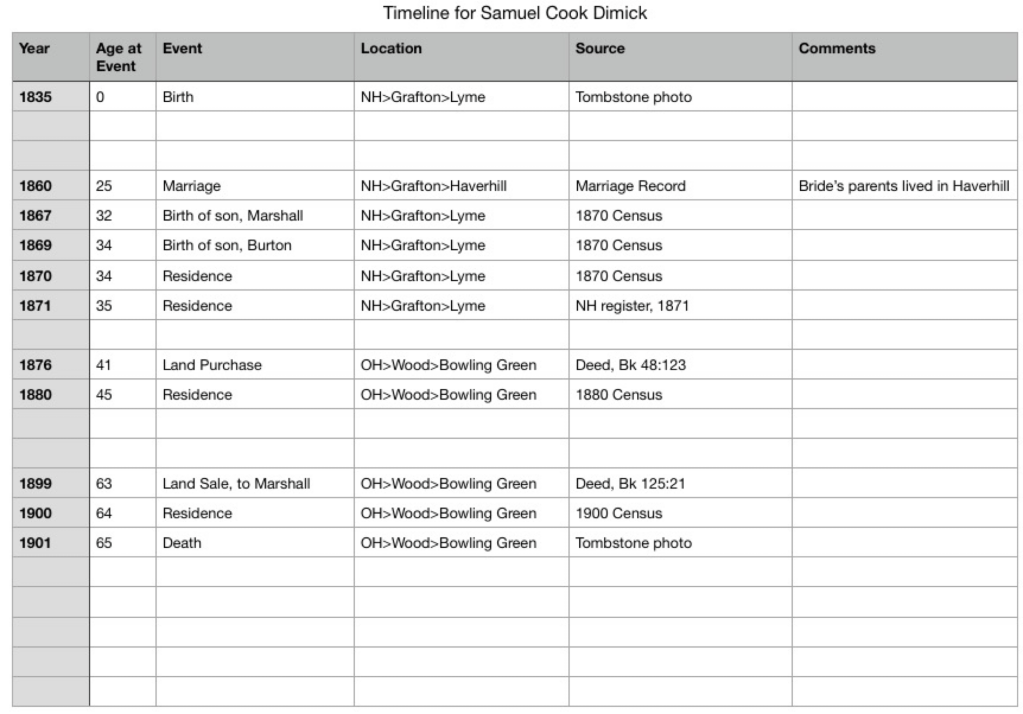
Here is an early version of the timeline. The orange box shows the gap in time between when he lived in New Hampshire and when he moved to Ohio. This is where I started asking some of those questions I mentioned in a previous blog post.
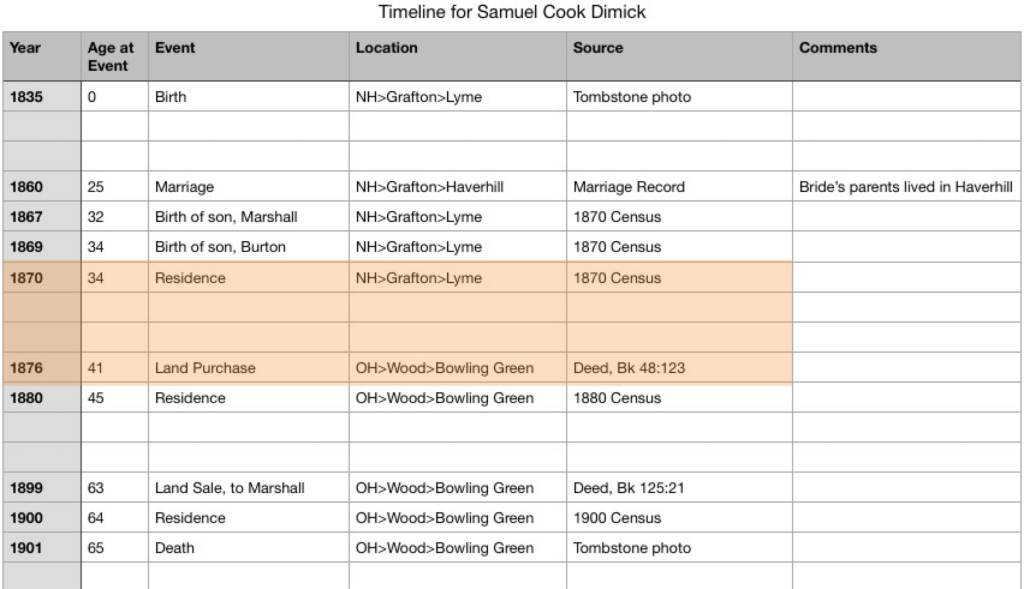
What records could I use to fill in the gaps? To keep a long research story short, I looked at a lot of records, including city directories for Bowling Green, Ohio. They do not have them for these specific years, so I was out of luck in that regard.

I reread the county history.

I’m sure none of you have ever glossed over things you read, have you? This is why it is important to go back and reread things you’ve read before. I had learned a lot since the first time going through the county history. But the answer I needed was right there in front of my face. The family lived in Toledo for a while before he moved the family to the “Old Williams Farm” in Wood County. This allowed me to go back to city directories, but this time to directories for Toledo, which is in Lucas county. Sure enough, I found Samuel live there for the roughly five-year gap.
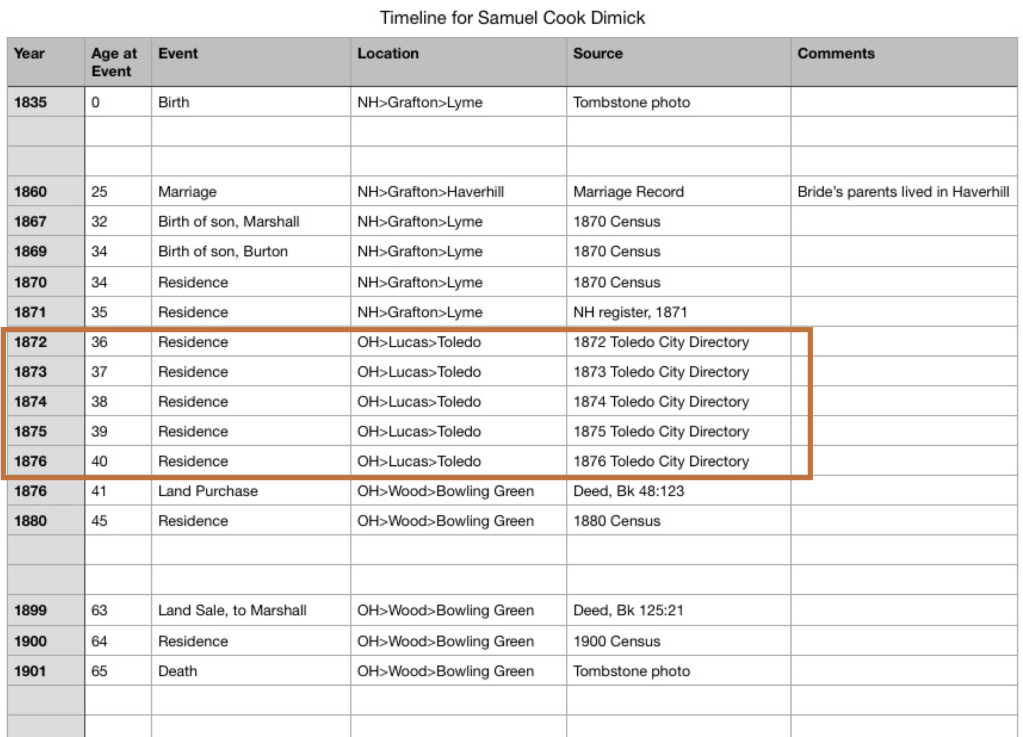
This allowed me to fill in the gap and ultimately answered the question about why the moved from New Hampshire to Ohio. The city directory shows that Samuel worked for “H. M. Clark & Co. Manufacturers of Tin and Japanned Ware.” In the 1870 census, Samuel’s occupation was in “tin.” Turns out, H. M. Clark is roughly the same age as Samuel, also born in Lyme, New Hampshire, and they served on a town council together in Lyme. So, Samuel moved to Ohio for a job opportunity.

Other research has filled in Samuel’s timeline beyond this, but the visualization of your known information allows you to get more detailed and fill in those gaps, thus building a more robust understanding of your ancestors.
Timelines: Special Projects, In and Out Tables

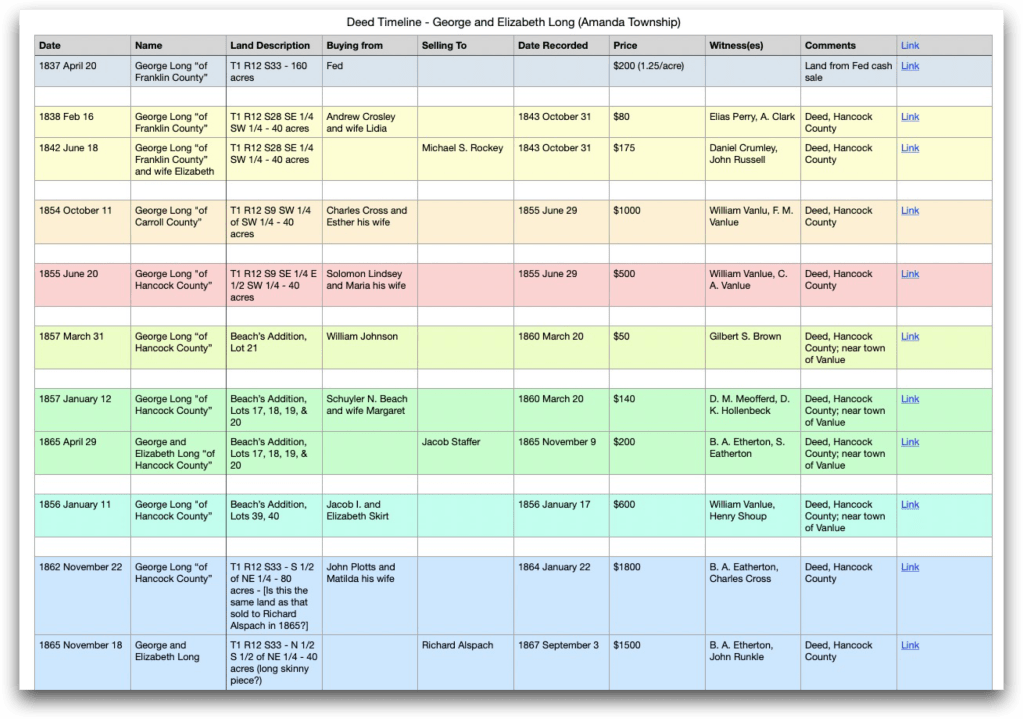
Sometimes in our research, we come across an ancestor who did a lot of land deals. And you may want to understand what he was up to in more detail. Putting those land records into a timeline can really help. These are sometimes called “in and out” tables and may not necessarily be intended as timelines, but if you set up your spreadsheet or table in a way that allows you to sort by date, that’s exactly what you’ve created. You can follow a particular piece of land AND you can follow a person’s land transactions.

While working on my George Long project, I needed to disambiguate two George Longs in Hancock County, Ohio. One bought and sold land frequently in that county, the other owned one piece of land. (Can you guess which one mine was?)

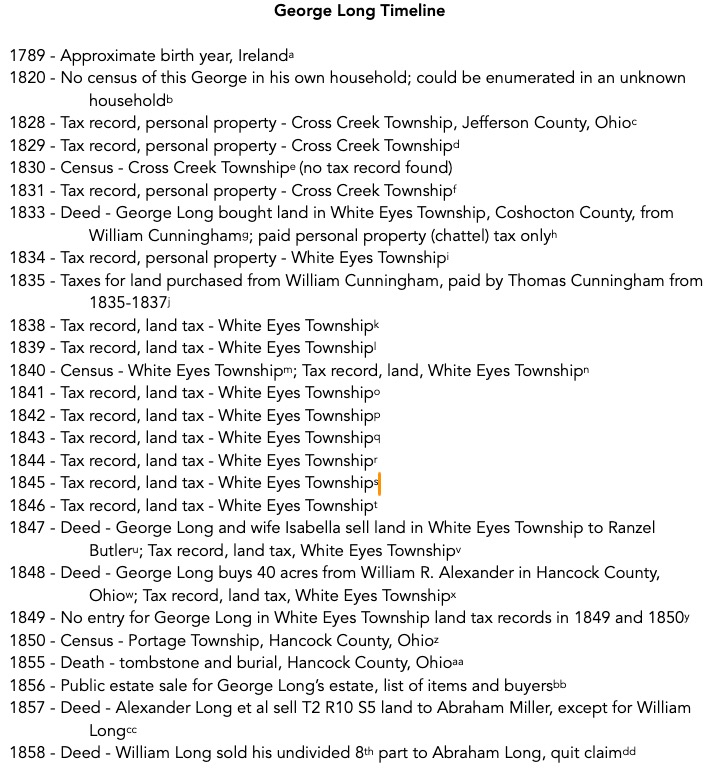
Here is the table. The first image shows each piece of land next to each other, color coded to match. You’ll notice that in some cases, there’s only one entry. That means I did not find the “in” or “out” deed for that land in the timeframe I was working in. The land could have been inherited or disposed by will rather than in the deed books I was looking through. More research could be done to find those. (However, this is NOT my George Long, so I don’t think I’ll be doing that research.)

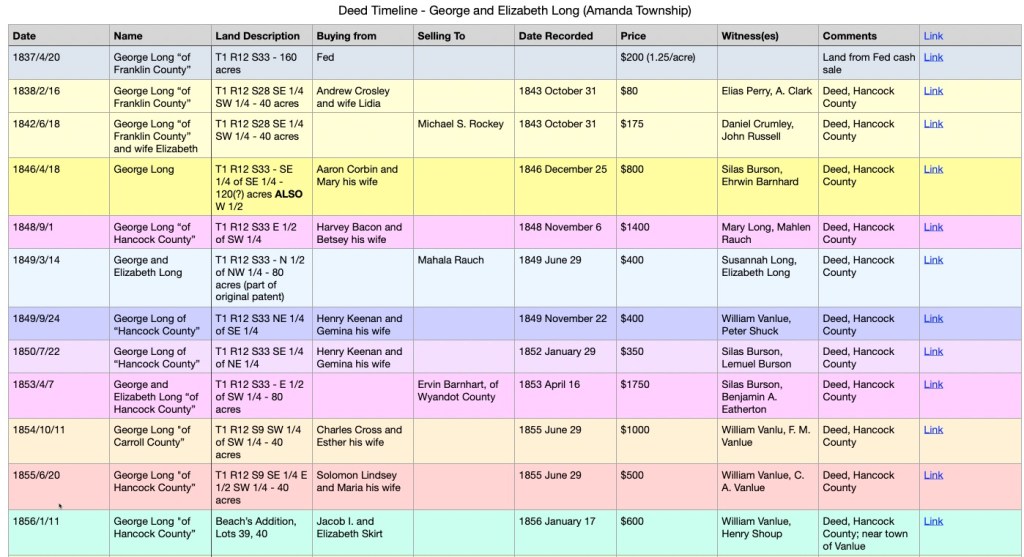
The above table is organized by piece of land. However, because of how I captured the data, one click turns this into a timeline.

Timeline sorted by date.

If you are paying attention, and have read this far, you may have noticed that the first table is in fact NOT entered such that it will sort properly on the date. And if so, you get a gold star for the day. I had to go fix that for this blog post. It sorts alphabetically, essentially, so if you type of the names of the months, they will not be in proper month order. I had to go back and put the dates in by number instead of name so it would sort properly.

Couldn’t “they” have named the months in some kind of alphabetical order? I prefer the names over the numbers, myself, but that doesn’t sort right, so humbug.

Timelines: Special Projects

Timelines can also be use to visualize other types of projects or research goals. Probably the best two examples I can share from my own research are when trying to disambiguate two people of the same name (do we have one person or two?) and when trying to compare deeds for someone who did a lot of buying and selling of land (often called an “in and out” table, but they can also be timelines if you set them up in your spreadsheet to be able to sort them chronologically).

“One person or two of the same name?” is a common genealogical problem, especially in an area where a family lived for several generations. All the brothers named sons after grandpa and pretty soon, no matter how unique a name may be, suddenly there are multiple men with the same name in the same county at approximately the same time. How do you differentiate them? One tool is a comparative timeline or a “side-by-side” timeline.

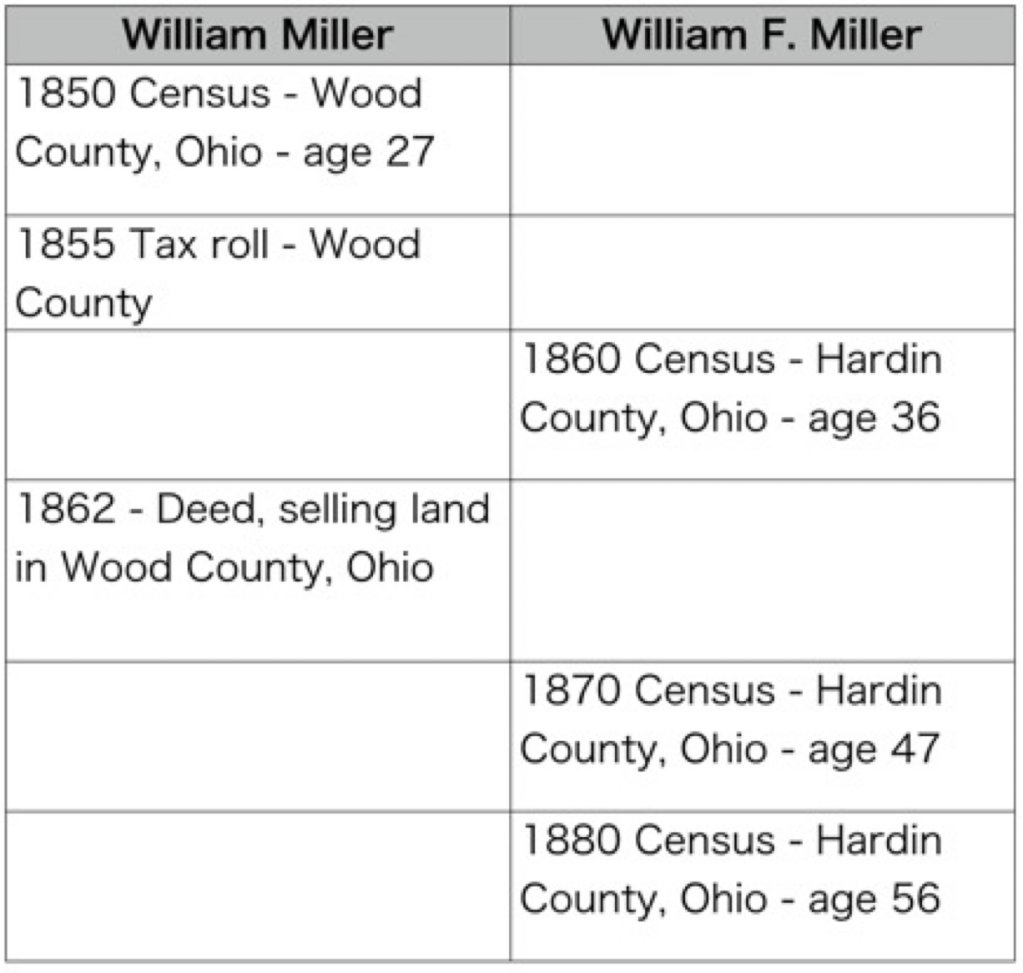
Make columns for the same-named people. In my example below, we’ll just look at two to keep it simple. I then put abbreviated information in each box/cell for that person. Enough to put it in chronological order, see a location, an age, and the source. In the case below, you can see a census, tax, or deed year, a location, and an age for William Miller and William F. Miller.

An example of a comparative or “side-by-side” timeline.

In this simple example, the two men do not overlap in records or location, at least as presented in this timeline. You need to ask yourself questions to fill in any gaps and to try to prove or disprove that this is one man or two men. Some general questions I ask myself:

  • What time gaps are there that I can fill?
  • What records might fill those gaps?
  • What historical events were happening that might explain those gaps?

Some questions specific to this project I ask:

  • Can I find William F. Miller in Hardin County in the 1850 census?
  • Are tax rolls available for Hardin County where I could look for William F. Miller?
  • Can I find William Miller in Wood County in 1860 or 1870?
  • How far away are Wood and Hardin counties from each other?

Of course there are more questions and more research that could be done on the above. It is just meant to be an example. (I have my Miller ancestors squared away during this time period.)

The first set of questions work for a single timeline as well. One of my favorite examples of this has to do with my ancestor Samuel Cook Dimick. We will look at his specific timeline in a later post. By looking at data in a different way, we can see patterns or gaps that may have missed before.

Timelines: Tips for Analysis

There are some things you will want to consider when setting up a timeline for your ancestor or project.

First, how are you going to make it (special software, spreadsheet, word processor, paper and pencil)? What tools you use to create your timeline might dictate some of the next items. I like to use digital means, usually a spreadsheet or a word processor, because they are easy to add to, rearrange, sort automatically, etc. However, as a pre-computer native, I like paper and pencil. If I were going to create a timeline for a project on paper, I would suggest using notecards or sticky notes, one for each event, that you can add to and rearrange as needed.

Second, what kind of information do you want to capture. You’ll need to decide on a format so your timeline is consistent. When I am using a spreadsheet, I will tailor the columns to fit my needs for that particular project. For a general timeline for an ancestor’s life, I use these column headings:

  • Year – I usually only use the year unless I need to get more granular, then I’ll change this to a numerical sortable date system such as Year/Month/Day. You may have to work with your spreadsheet’s formatting for numbers so it appears correctly. I usually set them to “text” rather than it trying to interpret a date.
  • Age at the time of the event – I like to capture this because it often tells me something about the person or the event. If someone is paying taxes or getting married, but their age is too young or too old, then it might indicate that I’ve made a mistake somewhere.
  • Name of the event – I keep it simple when possible so “Birth” or “Marriage” usually suffices.
  • Location – Depending on what you are looking for, you might put in the place from largest to smallest or smallest to largest. For example: Lyme, Grafton, New Hampshire vs. New Hampshire, Grafton, Lyme. If I want to see all of the New Hampshire items together, I might opt for the large-to-small option.
  • Citation/source – this does not have to be a full-on polished Evidence Explained citation, but don’t skip this step. I am always second-guessing myself. I do not know how many times I’ve had to recreate my research because I forgot to note where I got a piece of information. Timelines are no different. When you find something that conflicts, you’re going to want to know where you got that information. Do something that works for you, if that’s a link to a document or database, a full citation, or simply “Samuel’s death certificate.” As long as your note tells you enough to go re-examine the record, you’re good.
  • Misc. Notes – When I am creating these timelines, questions invariably come up, or I might want to make a note about a particular event. Put in a misc. notes column to capture those ideas and thoughts.
A work-in-progress timeline for Samuel Cook Dimick.

Next we will look at some more specialized timeline set ups for various projects.

Timelines: Why?

As genealogists, we gather a lot of data. We find our ancestors in many records such as obituaries, death and birth certificates, deeds, wills, church records, tax records, military records, and so on. The list is endless. How do you analyze, process, or understand the information you’ve gathered? And if you’re working on a trickier project, say figuring out which of the 12 George Longs is your ancestor, how do you keep it all straight?

One of my absolute favorite strategies is timelines. Creating a timeline for your ancestor puts his or her life into context and perspective. Obviously (or maybe not), a timeline is a list of events in chronological order. They show the “lifespan” of an individual, a place, or an historical event. Depending on what your goals are, you can create timelines with different focuses. The two main focuses I use are event-focused or document/source-focused.

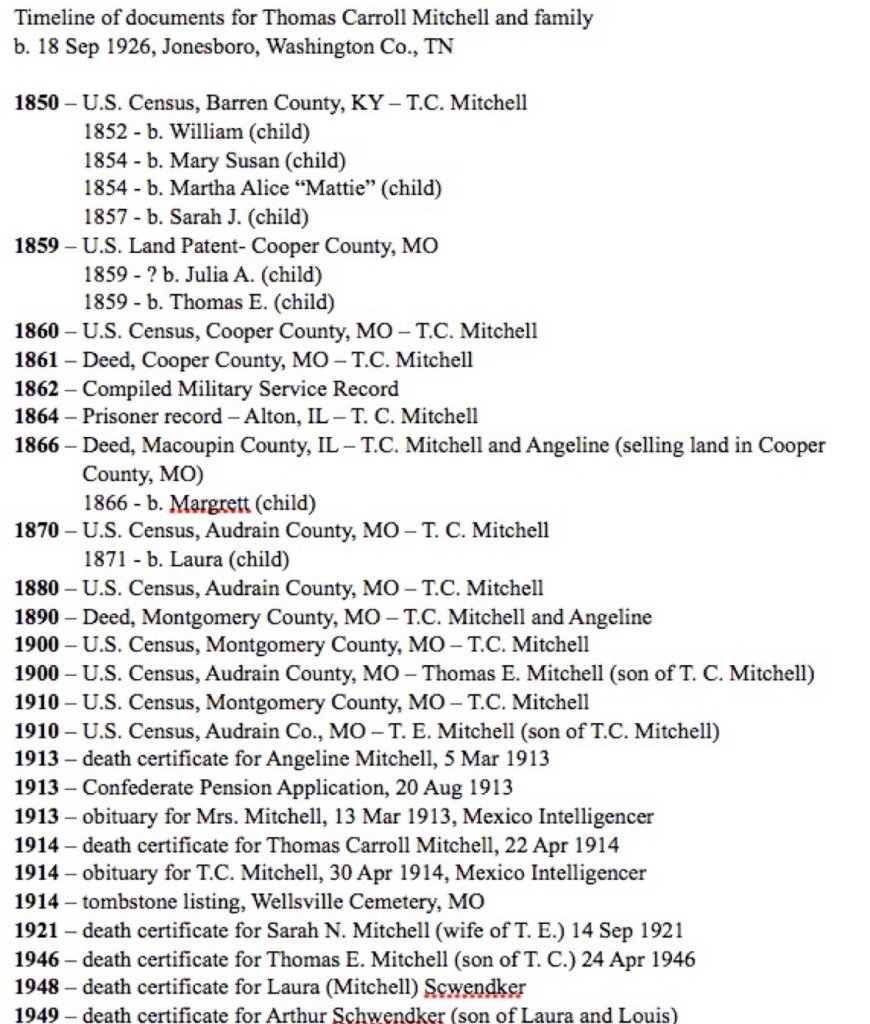
Each document was created on a date (sometimes you know that date because it is written on the document, sometimes you might have to make an educated guess based on context). By putting together a document-focused timeline you can assess your research and make a plan for any research holes you find.

Document-focused timeline

Documents or sources may list multiple events. A death certificate, for example, will list a date of death, but also may list the birth date, the burial date, the onset of an illness, the date of a coroner’s inquest, etc. An event-focused timeline pulls all those dates out.

Event-focused timeline

As you enter your data into your genealogical software or online tree, if you use them, they may automatically put the events in chronological order, helping you to visualize your ancestor’s life. When I get deep into a project, however, I tend to work in a spreadsheet or word processor so I can reorder things, put in items that may I may not want in my software, add historical context items, and link citations.

Next, we will look at using timelines to compare and analyze your research.

Research Plogs: Final Thoughts

When you are starting to work on a more difficult research problem, beyond the collection phase, you’ll want to make more directed, pointed, plans for your research. Here are the steps I take to plan research:

  1. Think about your research question. Clear it up if it isn’t already clear. Who exactly are you trying to identify? Have you singled out a unique person in time and place? Don’t make it too complicated or to simple. There is a Goldilocks effect when it comes to a research question, one that is “just right.”
  2. I catalog my starting point information. During this process, I reevaluate what I have. Many times this is research I haven’t looked at for a long time. Are the assumptions I’ve made sound and based on documents? Is my starting point information actually correct and known to be for the right individual? Are there any conflicts in the starting information? I write all of this down, usually in bullet points. If there are a lot of conflicts, they may get their own section. Sometimes (often?) I find some kind of mistake I made in my reasoning, often because I didn’t know then what I know now. I have more experience and knowledge now and sometimes that breaks through a brick wall all by itself.
  3. I make a list of what I need to do to resolve anything from step 2. If there are conflicts, can I give sound reasoning as to why they may exist? If not, what additional research do I need to do to resolve them? If I made an incorrect assumption, what do I need to do to correct it?

    You’ll notice that everything above is not even planning the RESEARCH yet!
  4. I survey the records that are available (both online and off) that may answer my research question. I utilize the catalogs available on websites such as Ancestry, FamilySearch, and local public libraries, archives, universities, and etc. as it applies to the topic or the location I’m working in. From that research, I may make a larger list, but I truly start with a top 3-5 items. Invariably, you’re going to find something that changes the course of your research. Spending too much time creating an extensive and detailed plan will likely be a waste of time.
  5. Conduct the research! This is the fun part. Look at what you planned on looking at. Note why you are looking at it (purpose of search) and what you found. Collect any URLs, waypoints, download images, note any conflicts, note any negative findings, and note any changes in your plan or direction of your research.

Whether you are in collection mode or brick-wall mode, planning your research is an important part of being efficient with your research time. Hopefully you found some trips or tricks you can use from this series on how I do it. Everyone thinks and plans and organizes differently. So take what you think will work for you and go make it happen!

Happy plogging!

Research “Plogs” – the Planning Part – part 4

We looked at a blank example of my research PLOG template that I use in Evernote last time. You do not have to use Evernote to make something like this. You could use Word, Mac Pages, Google Docs, a spreadsheet, or any other note-taking tool of your choice. This is simply how I do it. Please adapt to find something that works for you and your way of thinking.

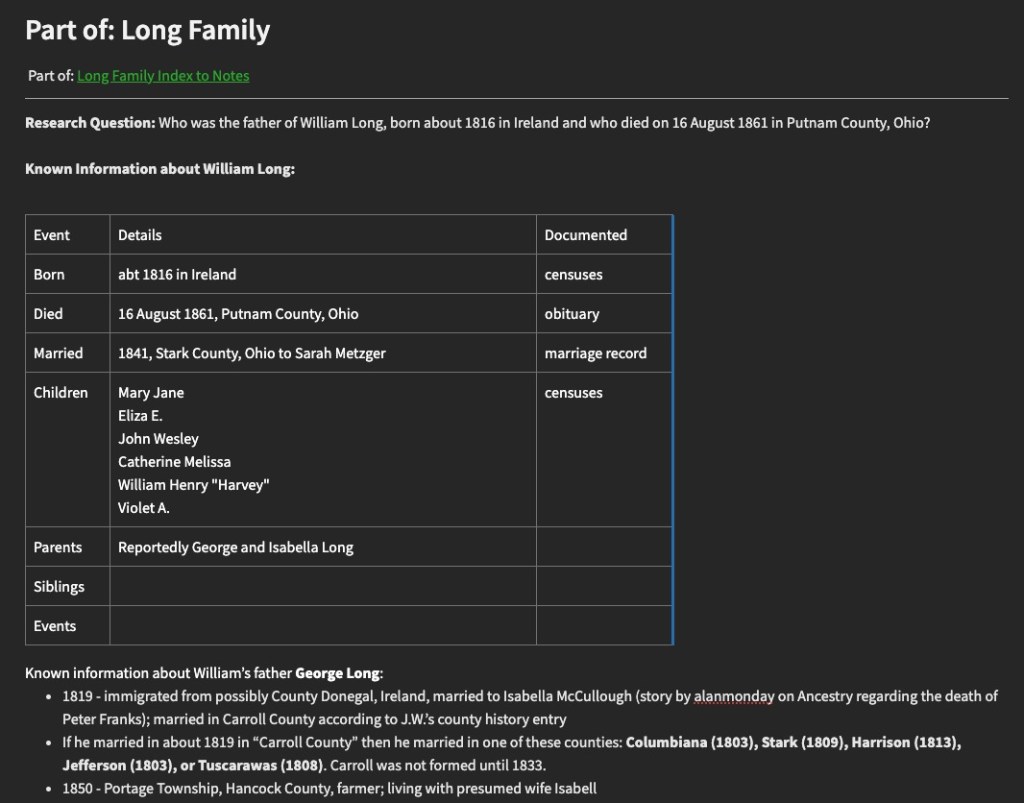
I am currently working on a project to identify the father of William Long who was born in about 1819 in Ireland and who married Sarah Metzger in Stark County, Ohio, in 1841, and died in Putnam County, Ohio, in 1861. I have only a name for his father “George Long.” The problem is, there are a lot of George Longs that could be the father of William. The son of William, John W. Long, has a biographical sketch in the Wood County, Ohio, county history that states that his grandfather was “George Long” and he “emigrated to the United States in 1817, locating in Carroll County, Ohio, where he was married and became the father of seven children: George, William, John, Catherine, Ellen, Susan, and Alexander.” There are a few problems with this, one of which is that Carroll County was not formed until 1833 from Columbiana (1803), Stark (1809), Harrison (1813), Jefferson (1803), or Tuscarawas (1808).

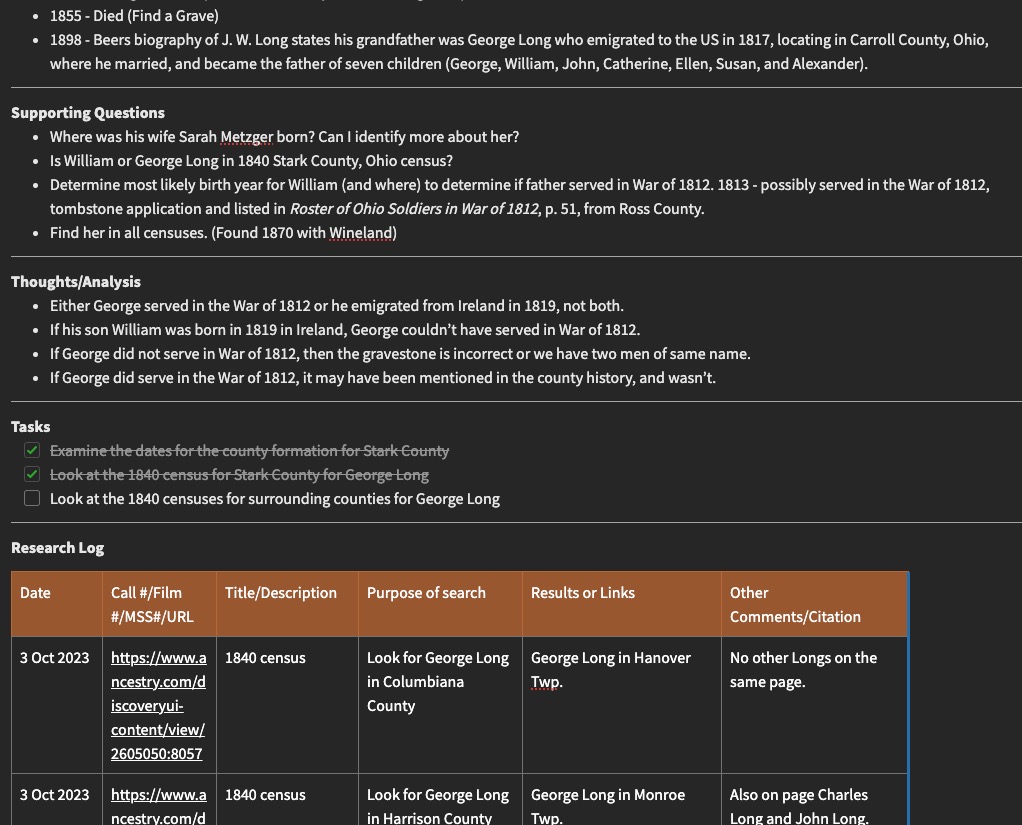
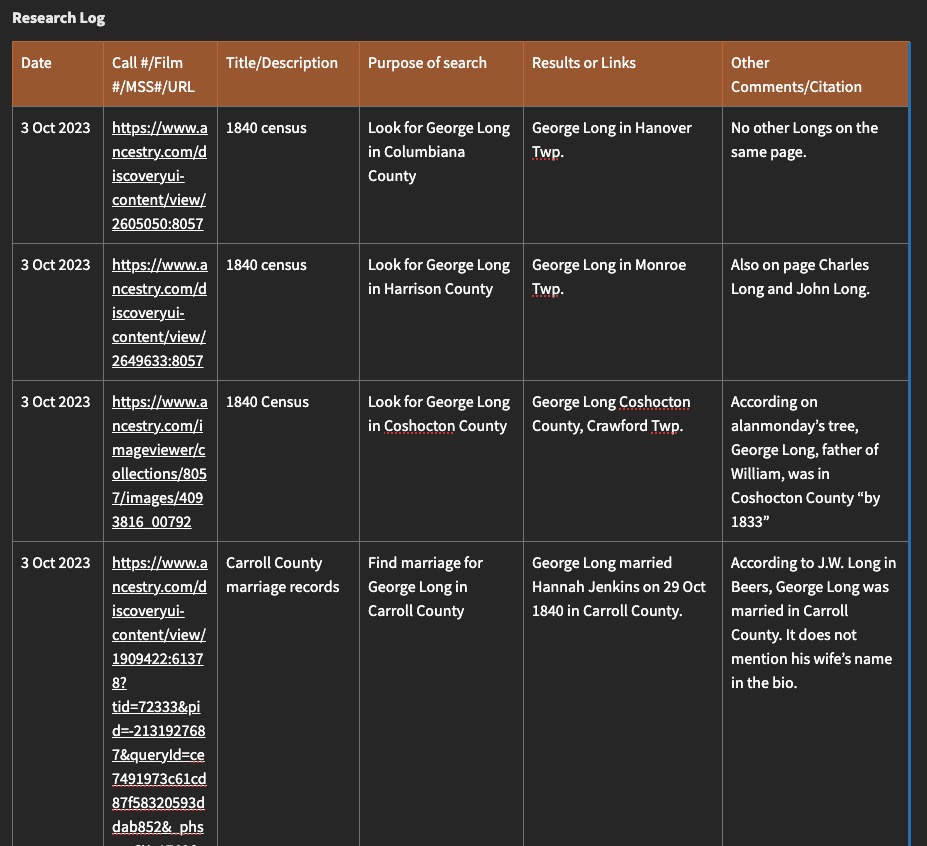
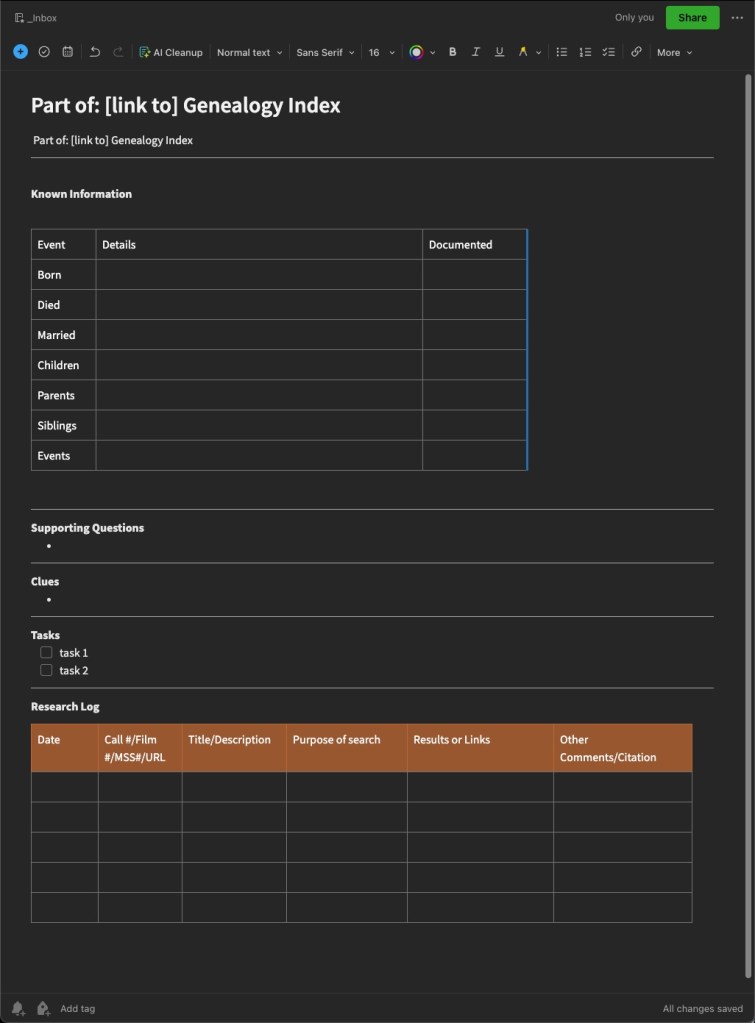
So, my research question is listed at the top of my “plog” template, followed by a cataloging of known information, supporting questions to answer, thoughts and analysis of the problem, some tasks, and then the research log portion of the template, which will get filled in as I complete the tasks.

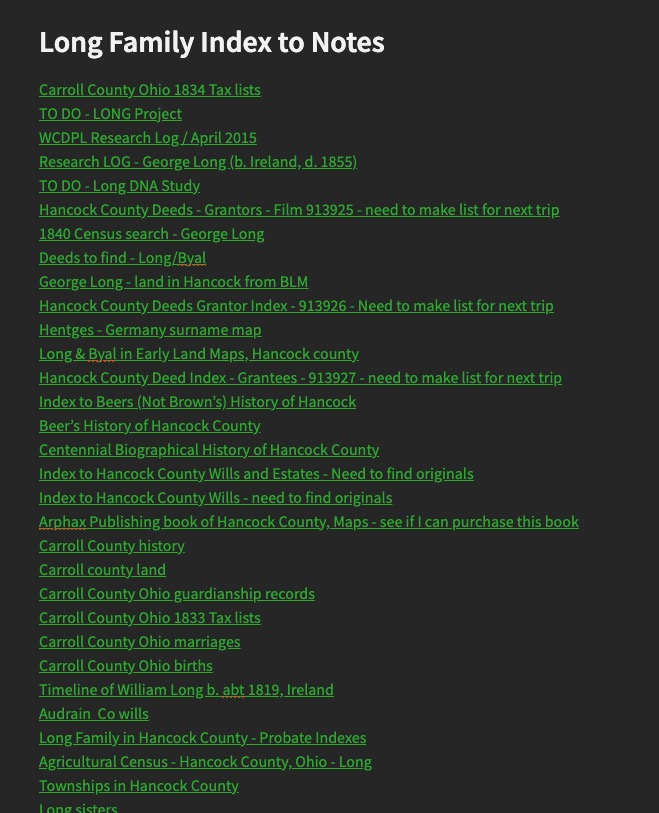
As you complete tasks, they often create more questions than they do answers. I document these in the last column and add things to the task list. Sometimes the template gets too long and too much scrolling needs to be done. One cool feature of Evernote is that you can link the notes together and essentially create an index where you can see all of your notes for one particular project in a list. Provided you titled your notes in a meaningful way, this will be great to get to notes quickly rather than scrolling through long notes. There are likely ways to do something similar in other programs.

So, that’s the mechanics of research “Plogs” and how I use them. The next post will have some final thoughts on research planning and logging in general, tips and tricks, etc.

Research “Plogs” – the Planning Part – part 3

Last time we looked at research planning for when you’re in the “collection” phase. Usually the collection phase happens when we are just starting out and gathering as much as we can on our ancestors, or it may happen when you are starting a new client project or a new project for yourself that you haven’t researched before. The collection phase is when you are gathering as much of the “low-hanging fruit” as you can, the easy to find documents and sources to advance your family trees.

What do you do when you get to a point of resistance, commonly called a “brick wall” in our field. We invariably get to a point where the low-hanging fruit doesn’t identify that next generation, for example, and we have to do some extra work to determine who the parents are. This is where we can really put our skills to the test, or learn new skills and methods if that is the case. Part of this is effective research planning.

I have an Evernote template that I use for more directed research. This same sort of “set up” will work in Word or Excel or your note-keeping tools of choice. The most important thing is that you figure out what works best for you, for your way of thinking, and how you view your findings.

My Evernote Research Plan/Log template.

I fashioned this template after one I found online, probably from Cyndi of Cyndi’s List (click here to see all her Evernote templates.) I almost always end up changing or adapting them to fit the needs of whatever I am working on. Do not try to shoehorn yourself into something that someone else created. If that doesn’t work for you, change it until it does. You can recreate something similar to mine, find one that works from Cyndi’s list, or create your own in Word, Excel, or the program of your choice.

When I set out to work on a “brick wall” in earnest, I will start one of these “plogs” to help me get myself and my thoughts organized, and ready for research. Next time, we will look at this template filled in for a project I am currently working on so you can see how I use it in actual practice.

Research “Plogs” – the Planning Part – part 2

In the previous post, I discussed two “phases” that I saw in myself in terms of my genealogical development. There is the “collection” phase where you are gathering the information for your family tree, perhaps regardless of a family line or specific problem. When I started out, I spent hours and hours at libraries and on websites gathering what I call the “low-hanging fruit” or the easier to find records for family groups and my direct line ancestors. Those records often include censuses, death certificates, obituaries, tombstone photos, etc. Depending on the area where your research is located, some of these may be easier than others.

In terms of research planning when working in the “collection” phase, when I was in this phase, things were a little bit different than they are now, but the planning portion is pretty much the same. The difference is in how we might access those records and collect them. I started research in 2000. Ancestry as a research website was in its early stages so a large portion of my early collecting was done at local public libraries, local cemeteries, the Family History Library, the local branch of the National Archives (where you could view the census on microfilm before it was digitized and available online).

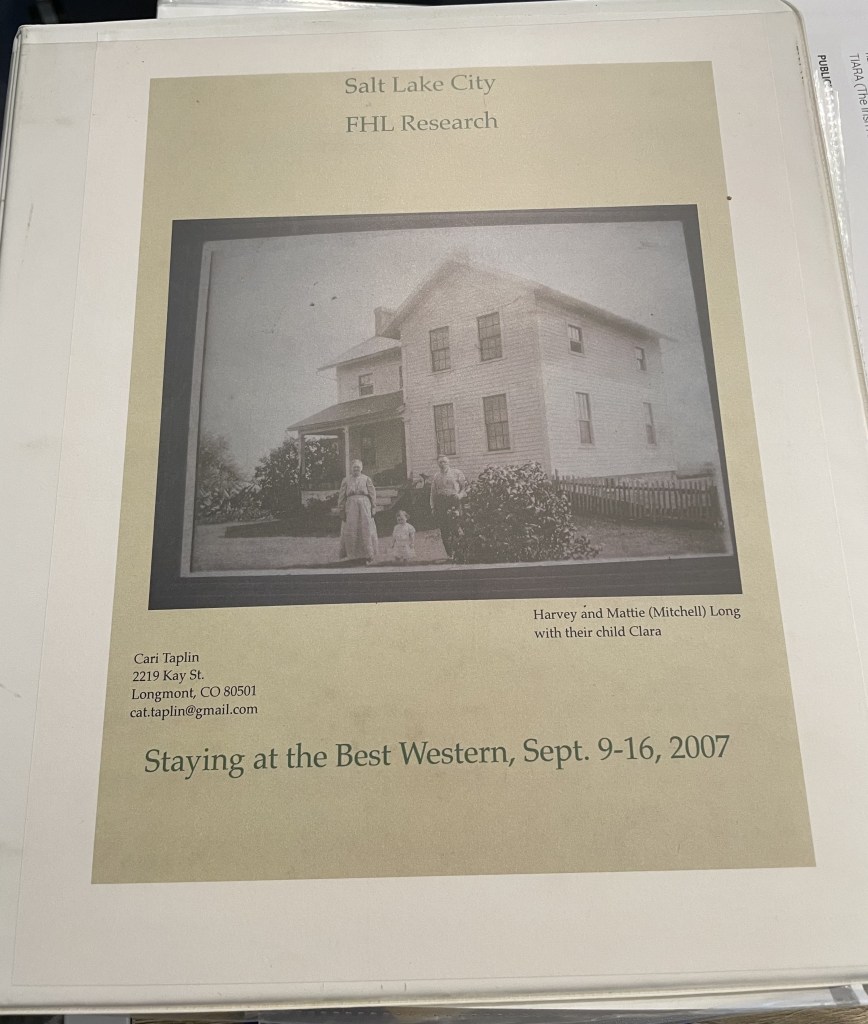
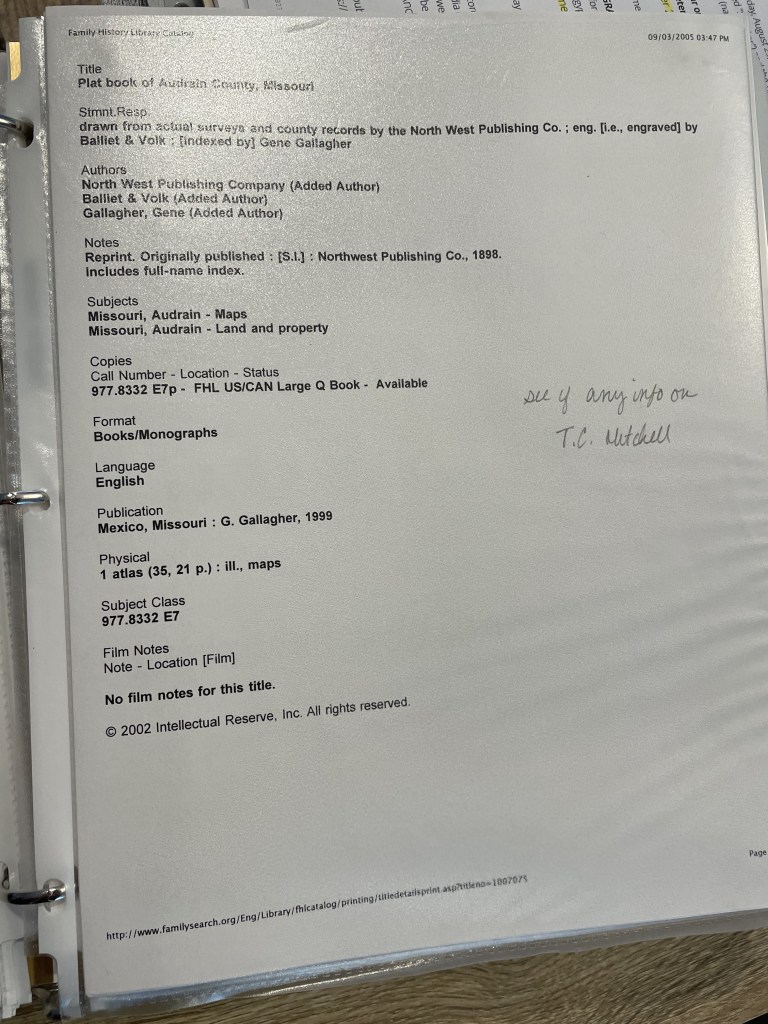
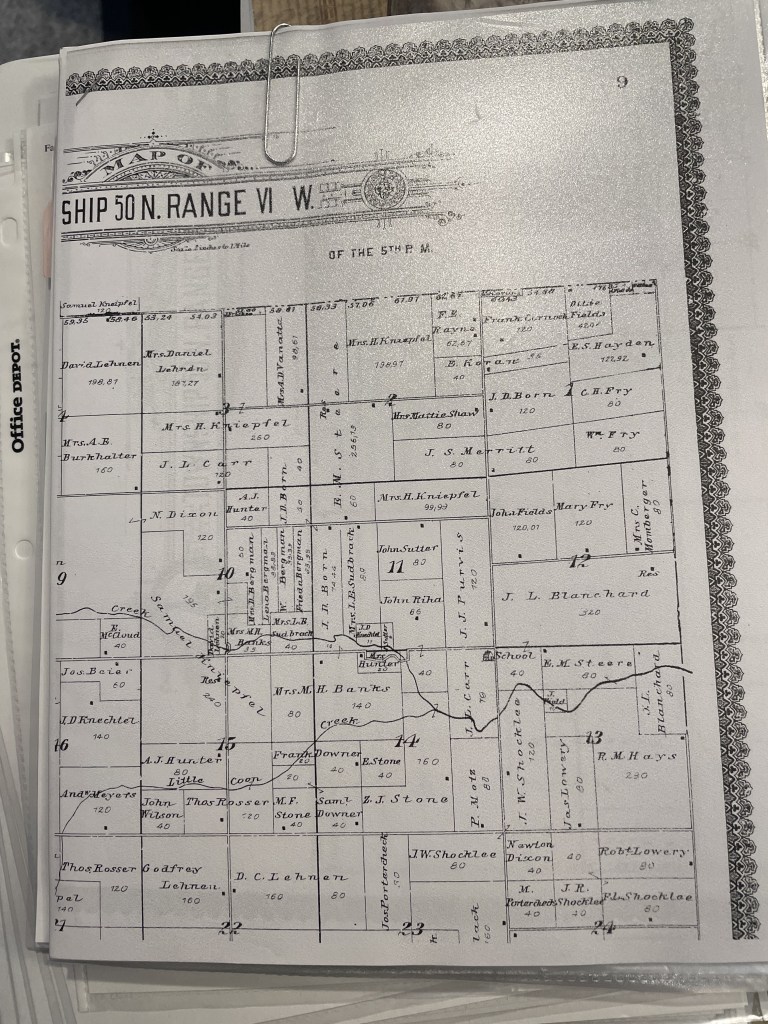
When preparing to visit any library, I visit that library’s catalog to determine what sources I plan to use to find records for my family tree. Remember, I’m in the “collection” phase here, so these will be a lot more broad-purpose searches. My tasks might be something like “find the obituary for Thomas Mitchell” or “Find Thomas Mitchell in the 1900 census.” When I started, I would print out that catalog item and put it in a sheet protector in a binder specific to that repository. Then, when I visited the repository, I used my binder as a guide or a to-do list and would complete each item. Back then, you made photo copies. We didn’t have scanning or photography (well not conveniently), when I started. I would tuck the photocopies into the sheet protector that contained the original catalog entry. Keeping the photocopy and the catalog entry together allowed me to go back later and create the citations for the items found.

My binder from a 2007 trip to the Family History Library. I do not live at that address any longer.
Print out of catalog page from the FamilySearch Catalog
Printouts of Items Found from the FamilySearch Catalog Entry Above, tucked into the sheet protector.

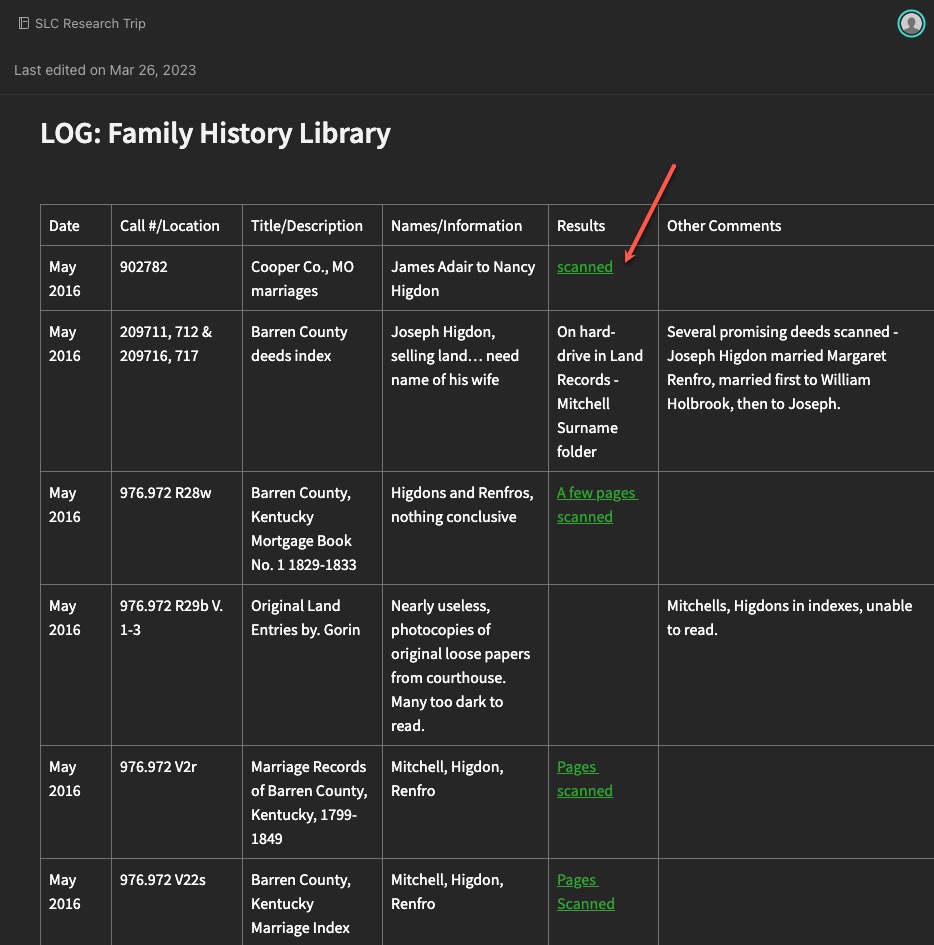
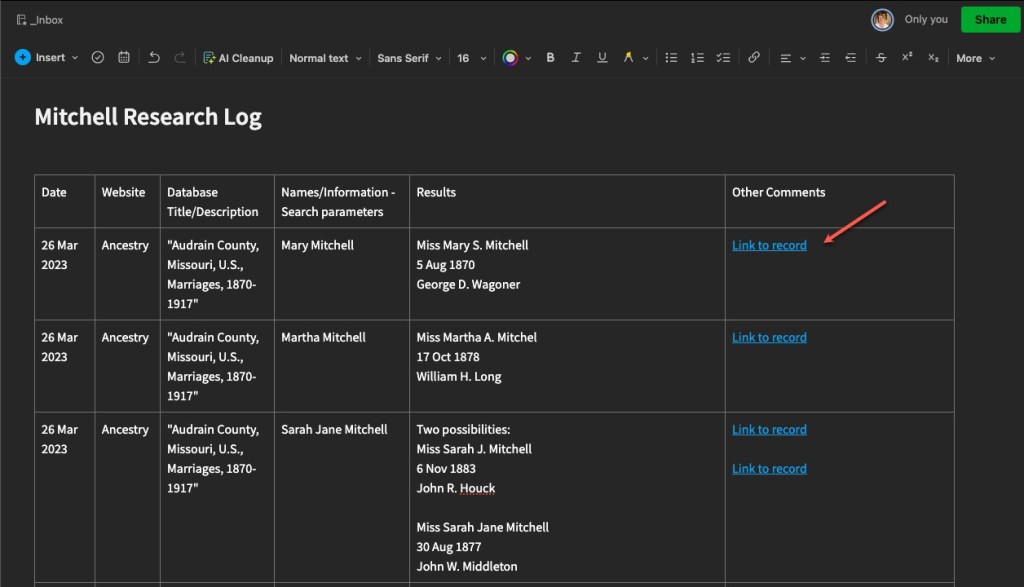
Ok, so that isn’t exactly the same system I used today when I’m “collecting.” I still visit the catalogs, but many items (not ALL) I’m looking for are now digitized and available online from home. So, my plan consists of a spreadsheet or Evernote note with links to databases, and the tasks, rather than a printout. If items are only available at the repository, I still copy the link into my plog, and then retrieve it next time I’m at that repository. I then collect my “copies” (scans or phone photos these days) and add them to Evernote where I can link them to the “plog.”

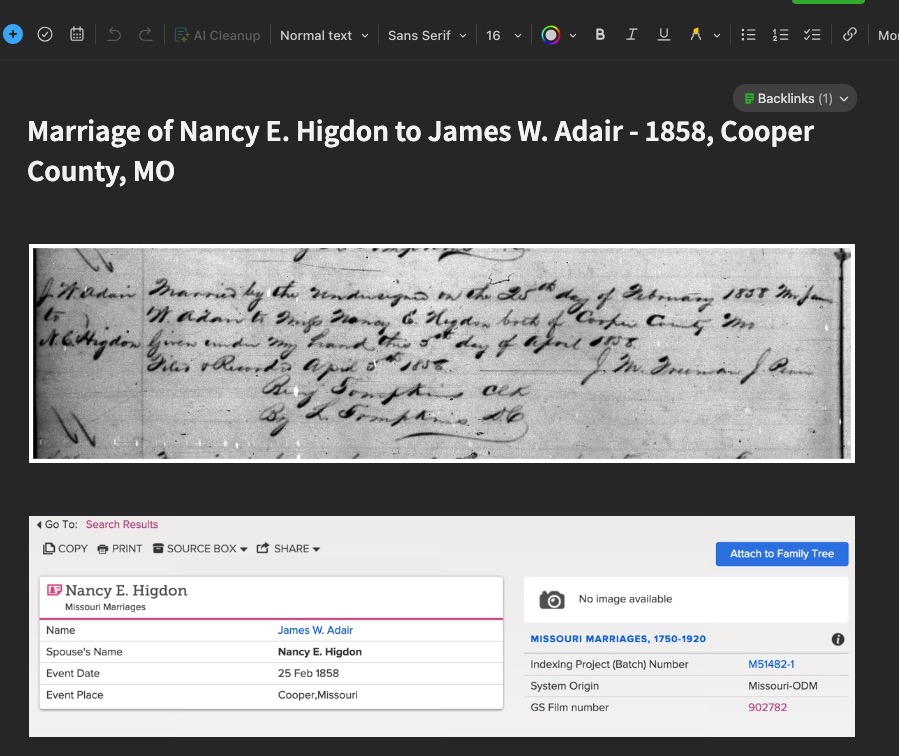
Evernote note showing a “collection” example with links to scanned items (red arrow).
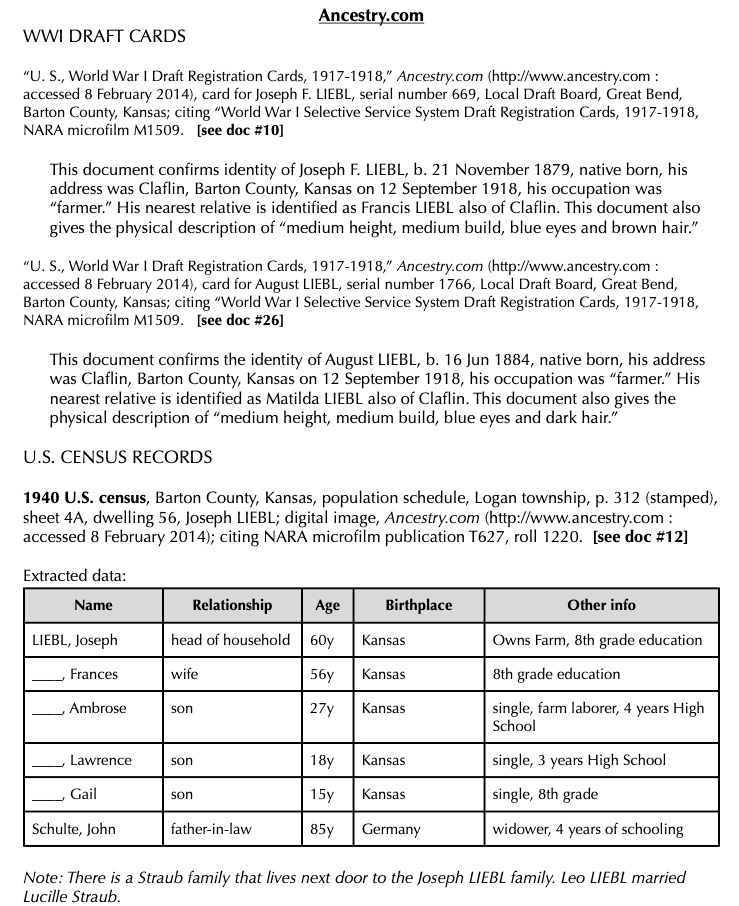
The scanned item from the “scanned” link above.

You might still like to have printouts. You might also prefer to only work in digital. And you might be a combination of both like I am. That doesn’t matter. What matters is that you have a system for keeping track of what you want to research, what you expect to (hope to) find in a particular source, and then what you found.

Next time, we will look at some examples of more directed research plogs based on specific research questions and projects.

Research “Plogs” – Different Styles

As I have evolved as a genealogist, so has my working style, and specifically how I use research “plogs.” I’m going to share some of my earlier plogs… no judgement. I mainly want to demonstrate how I used to do it, and how I’ve improved, at least in terms of keeping track of my thoughts and research.

My earliest logs were on printed paper. I’m sure I have copies of them, but I’m having some remodeling done in my office and my “stuff” is in piles under drop cloths and I can’t get to them right now. If I can before this series is over, I’ll snap a few photos. For now, let’s look at some of my earliest digital versions.

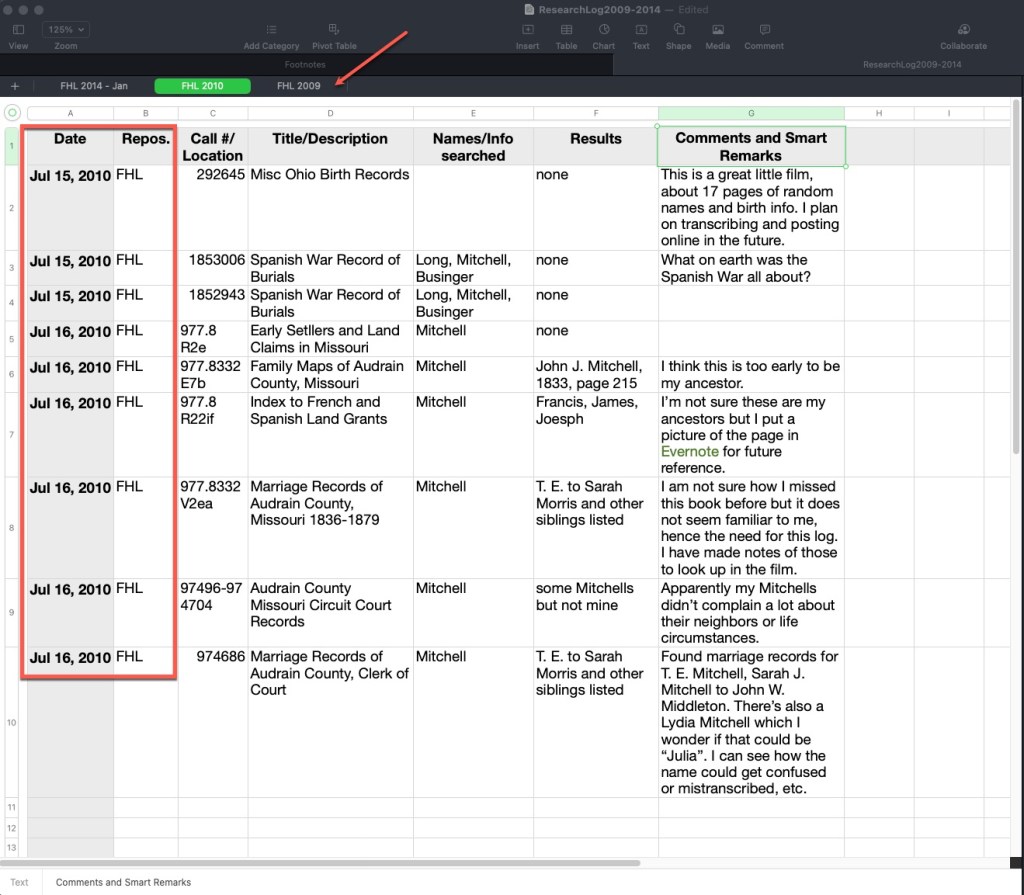
The following plog was done on a spreadsheet. I use a Mac and the Numbers spreadsheet program. It works very nearly like Excel. Across the top you can see tabs indicating the repository and the year. The column headers have not changed a lot over the years. I usually indicate a date, the repository, the call number/film number/manuscript number if it is in an onsite location, or a link and database title if it is an online source, the title or description of that item, the names and parameters used to search, the results, and then any comments, ideas, analysis, etc.

Example Research Plog by Author, using Mac Numbers Spreadsheet

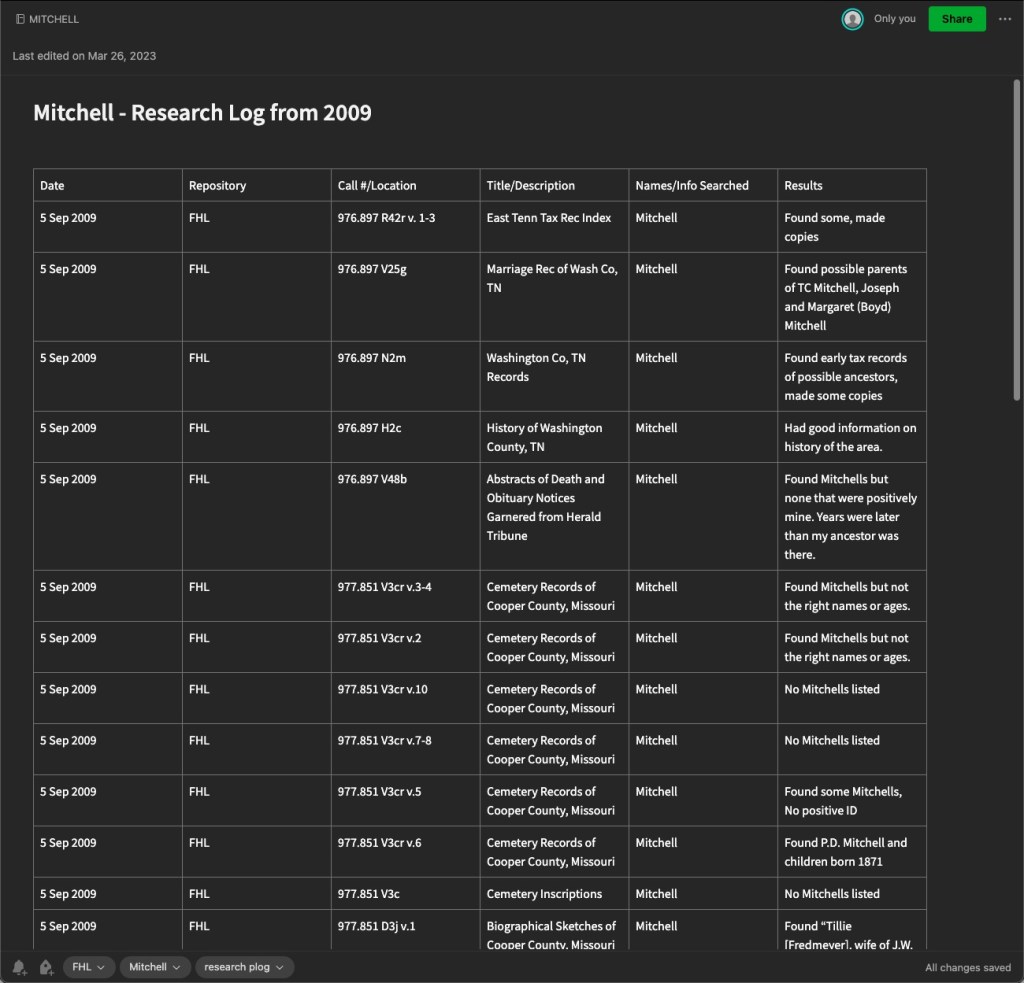
Here is another plog I’ve created, this time in Evernote. Other note programs exist and you may prefer. This is an example of one from 2009, you’ll note very similar column headings. You’ll also note that I didn’t do as much thought-process writing in the results column. I mostly noted what I found. In newer plogs in Evernote, I generally take photos of the pages in books and store them right in Evernote and then link the results in this log to those separate notes so that this log would be much more useful. Stating “Found some, made copies” doesn’t really help if I have to track down those copies. Earlier in genealogy time, we made a lot of paper copies. Now we can take digital photos and link them to these logs.

Example Research Plog by Author, using Evernote

The advantage to a note-taking software like this is that they often are shared to the cloud and you can access them on mobile devices as well as your computer. Of course, a spreadsheet can do this as well if you store in Dropbox or other file sharing service. Note-taking apps generally work more seamlessly, in my opinion. On these things, my advice is to always do what works best for you. It makes no sense to spend valuable research time trying to use someone else’s system if it isn’t working for you. If you have a favorite system, keep using it! Just adapt and evolve.

Here is another, more recent plog, showing linked records. These are links directly to the item in online databases, in this case Ancestry. With Evernote, and other note-taking options, you can link to other notes within the software.

Example Research Plog by Author, using Evernote, demonstrating links

You can, of course, use a word processor to keep a plog as well. Below is an example of one I did back in 2014 as I was experimenting and evolving.

Example Research Plog by Author, using Word Processor

The above example of a word processor plog, I tend to use for client work, but also in my own personal research when I’m trying to “round up” all of the research I’ve done and write more analysis from the findings I collected in the plogs I have made in Evernote or a spreadsheet.

Most recently, I’ve begun doing this “round up” more frequently, writing a kind of informal client report for myself. I think of it as writing notes to my future self telling me what I was thinking at the time, what I thought then that the next steps might be, and future tasks for myself. This has really helped me because my memory is getting worse as I get older (and busier) and I always think I’ll remember what I was doing, but then months go by and I’ve completely forgotten what I was doing.

Next we will talk in more detail about the plan part of the “plog.”