Do you have photos like these?


When I was young, my family was very fond of having large get-togethers where we all shared potluck meals and grilled hotdogs and hamburgers. I love a good potluck and I blame it on my upbringing. Where else will you get sweet and sour baked beans, onion casserole, and Jell-o salad on the same plate?
Invariably, at these parties, we would have a very large group picture. And just as invariably, those pictures ended up in an envelope full of all of the developed photos from that film roll (remember those?) and be stored in a box. That box would later be discovered by me and not know who most of the people are in the pictures!
It’s sad on some levels. Who are these people? What role did they play in the lives of my family? Who were they that they got invited to the party? I can identify the major players, me and my parents, my aunt, and her family, my grandparents, some of the really close friends of the family. But then there are the others. The fringe folk as it were. Those who came and went. They were in our lives for a short time. Who were they? I may never find out. My aunt may know some of them. But some of their identities are lost to the ages.
If you have living family members that can identify those in the photos, be asking them now. Make notes on the back or in some way that they don’t get lost from the photo. But for many of these people, it’s too late. For those, I look at these party photos and remember when we were all together. I don’t just mean prior to COVID-19, but also because many of the people in the photos have died. And miss many of them terribly.
When you are a kid you don’t appreciate what you have in your family and family friends. Then when you get old enough to appreciate them, they are gone or going. As I get older and as more of my older family members pass on, I deeply wish that I had paid more attention, that I appreciated more. Mostly, I wish I could turn back the clock and chat with my grandparents again. Ask them the really important questions. (I always think “what would grandma or grandpa think about this?”) Be at one of those potlucks again.
I hope you can answer “who are these people?” with your photos.



 dinner out with her family. She lived a long and happy life and I was so fortunate to have had her as part of our family. Her kindness, pleasantness, and cheerful personality will always be the thing I remember most about her.
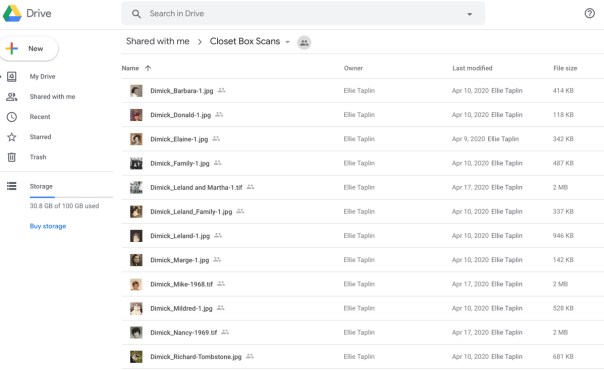
 We unpacked the box and sorted it into types of items. I then hired my daughter to do the scanning for me. We discovered my old scanner was just not working fast enough. A job that should take a small amount of time was taking forever. Since I’m paying her by the hour, and she was getting completely bored waiting for the scanner to do its thing, I decided to upgrade my scanner. My old scanner was a built-in scanner, copier, printer. In computer years, it was old. It still works, mind you, but it is slow. So, the need for speed got me shopping.
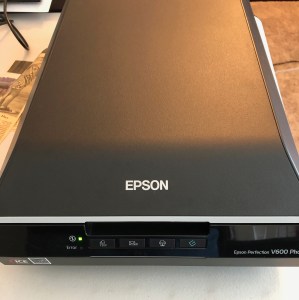 I opted for an Epson Perfection V600 photo scanner. It has some features I need for a price I was willing to pay. You can find it on Amazon


 When getting started on the writing, you might feel overwhelmed. Where do I begin? What should come first? How do I build this story so that it is clear, concise, easy to understand, and makes the case?
 I like to write in “bits.” By ‘bits’ I mean short thoughts, a couple of paragraphs on one idea, or a page at a time. My ‘bits’ can be found everywhere: notebooks, margins, on my phone in the notes app, in emails or texts to myself, slips of paper on my desk, sticky notes sticking to all kinds of things, in Evernote, and in other places. This is not very organized! Unfortunately, many writers that I’ve talked to are like this. When an idea hits you, you have to take a moment to write it down wherever you can.