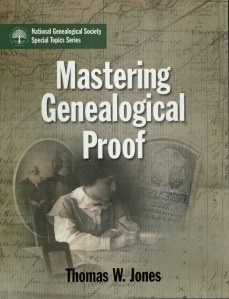
If you are a burgeoning genealogist, you might consider taking our study group based on the book Mastering Genealogical Proof (MGP) by Tom Jones. And if you are an established genealogist, you might consider a refresher on the topic. MGP covers the five elements of the Genealogical Proof Standard (GPS):
Reasonably exhaustive research
Full and complete citations
Analysis and correlation of evidence
Resolution of conflicts
A written conclusion
The MGP book by Tom Jones was designed as a study guide with questions at the end of each chapter. This has been a fantastic way to study the topics of the GPS. He has them broken down into tangible parts, with examples from his own work. The GPS allows genealogists to be confident in their findings, especially as it pertains to tough problems. This book breaks all of that down into easy-to-understand concepts.
Our study groups work through his book, studying his examples, but we also add our own examples to those in the book. We have time for discussion of the book’s questions and of anything from it that is confusing or unclear, and we share our own experiences with those topics.
This year, we are only doing one session of MGP (to make way in our class schedule for a new exciting opportunity; stay tuned). This session will be led by Cyndi Ingle (of Cyndi’s List) and starts on 15 February 2025 and runs on Saturdays at 5pm Eastern for seven weeks.
In my last post, I said I was going to go over some of the basic how-tos and some tips I’ve learned. However, I have another example of how amazing this tool is.
Working on my client’s Gallimore family from the last post, I needed to try to prove a father-son connection. One great place to look for that kind of link is in probates, wills, and estate files. Using Full-Text Search, I found the Gallimore will quickly and easily. However, when I went to formulate my citation, I realized that I likely wouldn’t have found this estate packet if it weren’t for the Full-Text Search!
The estate states that the heirs of Isom Gallimore, deceased, are to receive his portion of William Gallimore’s estate. That is not the important part of this story, just a little bit of background. It turns out that these estate papers were filed in the middle of another probate packet!
Here is the file folder of Michael Garoutte, image 411 of 625:
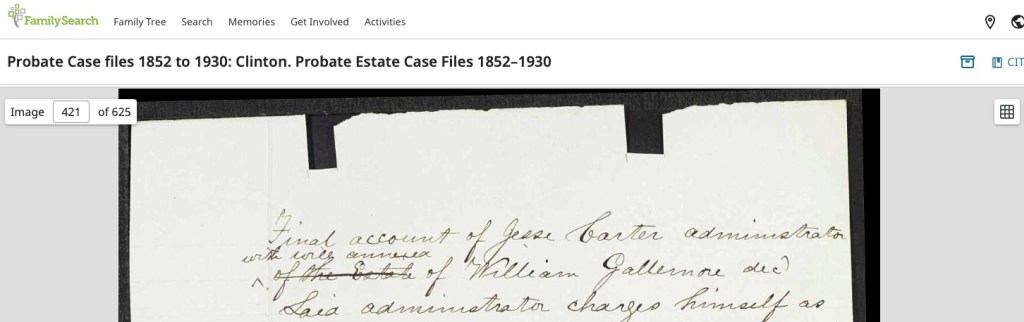
On image 421, we find the first of several pages of the Gallimore file:
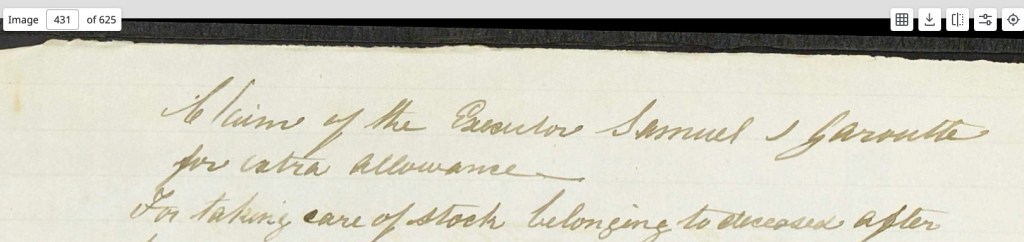
Then, on image 431, we are back to the Garoutte file:
Are there more Gallimore papers elsewhere in this film roll? Possibly. I found what I needed for the purposes of my original search. However, again, it was when I went to begin crafting my citation for the one piece of paper I wanted to reference that I discovered that I had found something that is probably lost. Maybe these missing documents are part of why my clients’ family have had so many brick walls with this family.
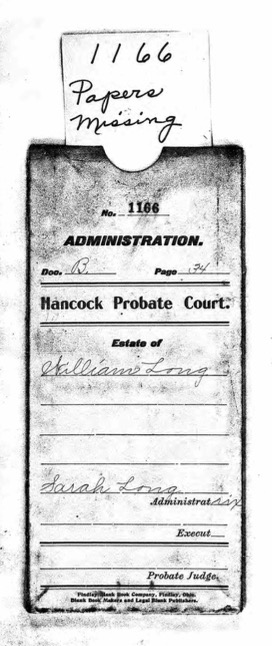
It makes me think of this image I found for my own ancestors:
I’m going to have to go back and use the Full-Text Search to see if I can find William Long’s file stuffed into someone else’s packet!
This summer, I have the pleasure of coordinating the course “The Spirit of the Inland Seas: Research in the Great Lakes Region.” Three other outstanding instructors—Cyndi Ingle, Paula Stuart-Warren, and Judy Russell—will share their expertise with us. They are all amazingly talented and knowledgeable women.
We will discuss topics such as the area’s historical significance, especially in the growth and development of the U.S. and Canada. The resources in the Great Lakes area were major attractors for mining, timber, farming, etc. The lakes acted like highways, moving people and goods from one place to another with more speed and ease than previous modes of transportation.
Not only will you hear from some spectacular instructors, but we all put a lot of time and energy into creating an extensive syllabus that contains not only what we discuss during the presentations but also extra information we don’t have time to cover. Also, it never fails that as we are preparing for the institutes, we find more information that we couldn’t fit into the syllabus before the deadline, so we make addendums that we share during the week. We are committed to providing a high-quality experience and an in-depth dive into the subjects.
The course will be held VIRTUALLY, so you can attend from home, 22-27 June 2025, through GRIP Genealogy Institute. Details about the institute can be found here: https://grip.ngsgenealogy.org/#1#schedule
Registration opens on 4 February 2025 at the link above. Be sure to put that on your calendar! We have a lot of fun in our courses and hope to see you there!
You may have heard about the FamilySearch Labs “Full-Text Search” already. If not, I’m shocked. It has rocked the genealogical community’s discussions in online forums for months and months now, and it is growing by the hour. The Full-Text Search “for historical records uses artificial intelligence (AI) to transcribe images into text so they can be fully searched. This feature is meant to save hours previously spent manually reviewing thousands of images for an important piece of information—that can be found almost instantly with an automated search.” This new technology takes handwritten documents and scans them, creating fully-searchable text transcriptions. Searching is no longer limited to just an index, but the entire document!
Because your search is not limited to indexes any longer, names found in the middle of another document can now be found. You may find your ancestor listed in someone else’s deed, will, court record, or other document, possibly in a document you would have never thought to examine! But there is it. From time to time I plan to share documents I’ve found, that I wouldn’t have found otherwise, to showcase the power of this new technology.
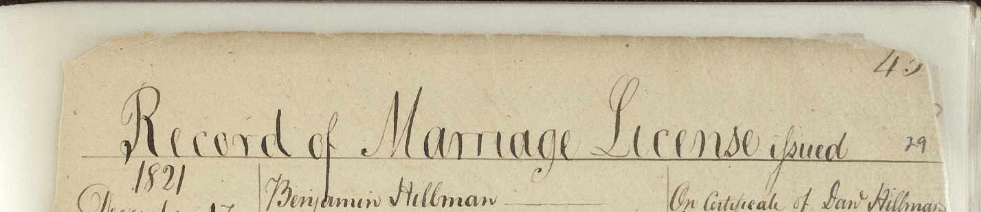
Here is an example of what I mean. I was looking for a marriage record in Clinton County, Ohio, for Isom Gallimore. I knew he should have been married in about 1821 from other research. However, my examinations of the books covering that year did not turn up a record. Using the Full-Text Search, I found the record quickly! Amazing. But why? What is going on that stopped me from finding it where it should have been?
The following page is roughly in the middle of the book and clearly shows that these marriage licenses are from 1821 according to the top of the first column.
Looking forward and backward in the book, I noticed something. This is the last license in the book. It was recorded in 1817.
I also noted that the FamilySearch label for the book states the book covers 1810-1817.
What is going on here? Looking closely at the pages, you can see that they have been put into an archival sleeve or a lamination-type of preservation material (likely using the processes called “encapsulation” and re-set into a book cover.
Using Full-Text Search, I was able to find this record which is obviously in the wrong book based on the dates and labels. Some of the page numbers have been lost to the torn and worn edges. Someone wrote in new page numbers in pencil on most corners. It looks to me like someone did their best putting a book back together that may have fallen from a shelf and the pages spilled all over.
Without Full-Text Search, I may have never found this record. I may have if it were important enough for me to go through every book and read every page. This was for a client project and they rarely want to pay us for the time it takes to do that level of searching. However, with Full-Text Search, we are far more likely to be able to find documents that are hiding from us or that we may not even know exist in the first place.
As I find examples of this, I plan on sharing them in this blog. My next blog will walk through some of the steps and tips I’ve learned along the way. The new technology is amazing. I can remember thinking, after OCR technology became readily available, that it would not likely happen to be able to train a computer how to read handwriting. I’m so glad I was wrong!
We still have some seats remaining in some of the NGSQ sessions. The registration will open soon for the MGP session starting in February.
We also have a new study group coming soon… more details as the group is finalized, so stay tuned for that!
A few thoughts on the NGSQ study groups
I will be heading into my sixth year running these groups. I have learned so much just by being the discussion moderator, but also, I am a student along with everyone else. We all read an article that none of us have (likely) read before. A few things I’ve learned by being a student:
I learn about how other people think. Others’ approaches to similar problems of my own give me new insights on how to tackle those problems. What sources are they consulting? How much research are they doing to solve their problem?
I learn how other people present evidence. Studying the charts and tables alone gives me ideas on how to visually present the evidence I have found in a way to enhance my narrative.
I learn how other people cite their sources. Of course, each journal has an in-house citation style, but beyond that, I learn about which sources authors use and how they cite them, specifically, what is important to include in that citation.
I learn how other people resolve conflicting evidence. When you come across sources that are not in agreement, how do you write about that? How to you explain the conflict or present evidence that shows why one side of the conflict is the most likely or “right” side? Reading how others do that helps me learn how to do that for myself.
I learn how other people write about certain topics or methodologies. When I read articles that are about disambiguating men of the same name, for example, or how authors write about DNA evidence, I learn about how I can write about similar situations in my own work.
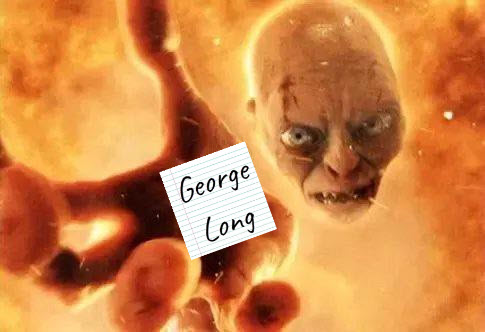
(The title is a Lord of the Rings/Hobbit reference in case you missed it. It made sense to me.)
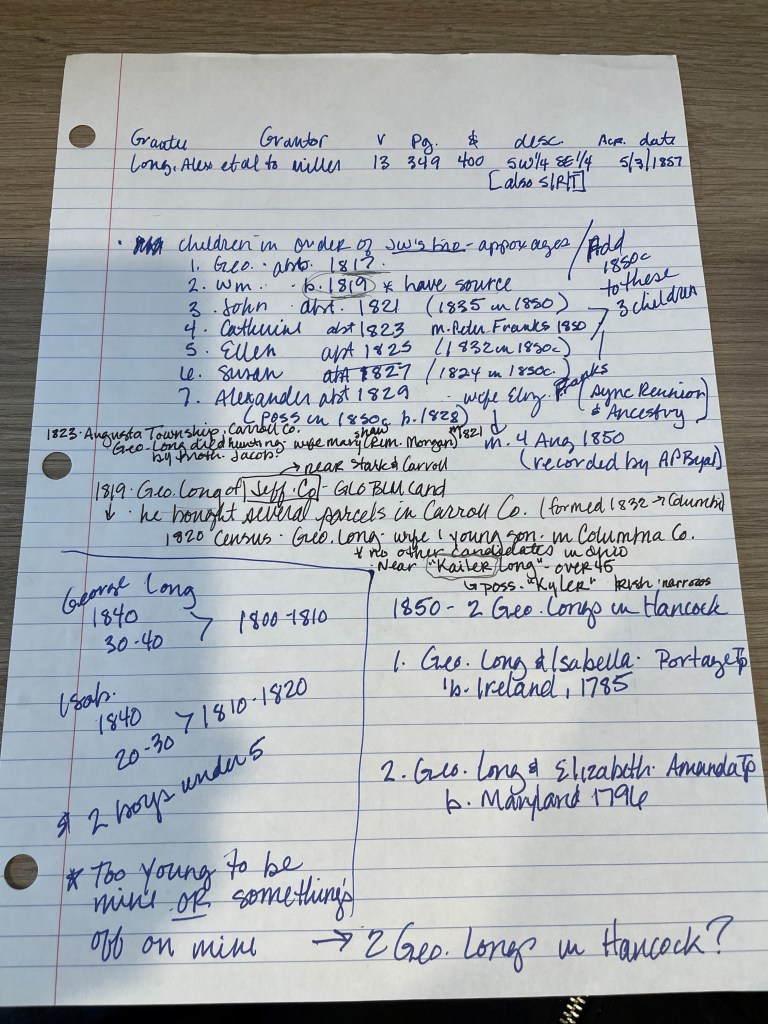
I’ve mentioned a few times in past blog posts a project I’m working on to determine which George Long of the seemingly thousands in Ohio in the 1820s to 1830s is the George Long who died in Hancock County in 1855. I started working on this project as preparation for taking one of the Irish courses I’ve taken over the years… thinking I’d figure out how to get my George into Ireland. However, once I really got started, I realized I’d need to figure out WHICH George Long was even mine to begin with. And once I started analyzing things, I identified 12 George Longs who had even the slightest potential to be the right man. You have to eliminate those to be sure. The final element of the Genealogical Proof Standard is that you have to present your findings in writing, especially in tough cases that aren’t self-explanatory. If it isn’t in writing and accessible somewhere, it does no good to other researchers anyway.
[Unless you are one of those people who love to find the answer and then hoard it for yourself (like Gollum). Don’t be Gollum. He nearly destroyed all of Middle Earth.]
I am finishing up this project but ran across my early beginning notes, which are funny but also have part of the resolution I came to on them!
It was fun to look back at these scribbles once I’ve nearly finished and am confident in my findings. And it is good to know, even after this journey of identifying the correct George Long, that I was on the right track in the beginning.
This has been consuming my time over the past few months (along with my day job and my family), but I’ll be back to blogging more regularly (I hope) once I finalize this project and get it off my desk. In the meantime, happy scribbling!
I wanted to share a tip that recently worked out nicely for me. It has to do with the previous topic of “genealogical persistence.” I’ve been working on disambiguating two men of the same name of about the same age in the same county in Ohio. Last post I talked a bit about some military records. The “other” George Long obtained a War of 1812 pension and in those records, it noted that he also obtained 120 acres of land through a military warrant.
The land for a military warrant could have been located just about anywhere in the U.S. And George Long is a pretty common name. The Bureau of Land Management’s General Land Office (BLM GLO) database and online images is a fantastic resource for people researching ancestors in the Federal Land States (Public Land States). This database holds land records of many types, among them are military warrants.
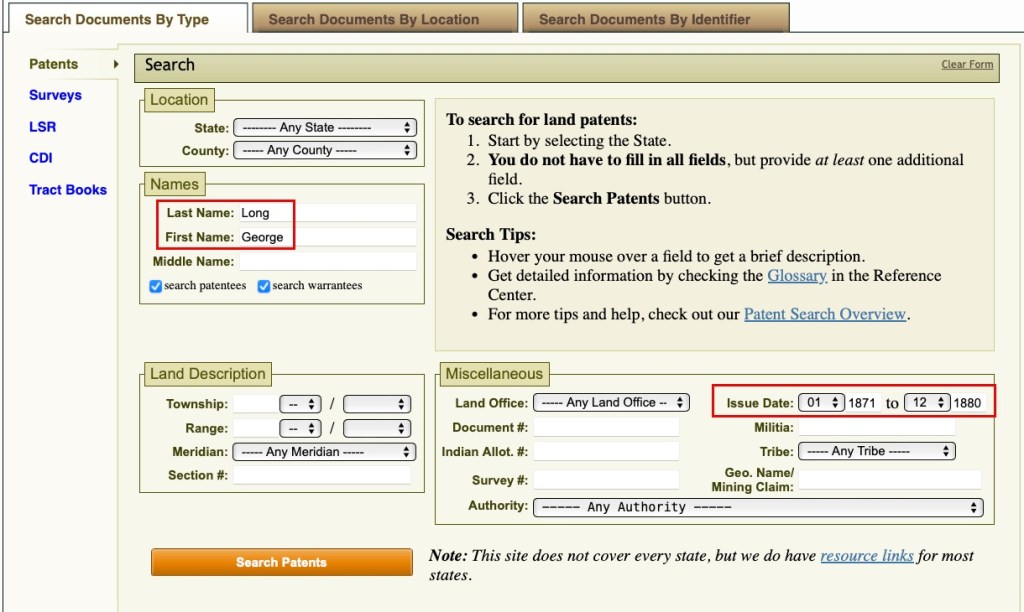
A wide-open search for “George Long” in any state returns way too many results to find the record efficiently. George’s pension packet shows that he obtained this land after 1871. I know from other research that he died in 1880.
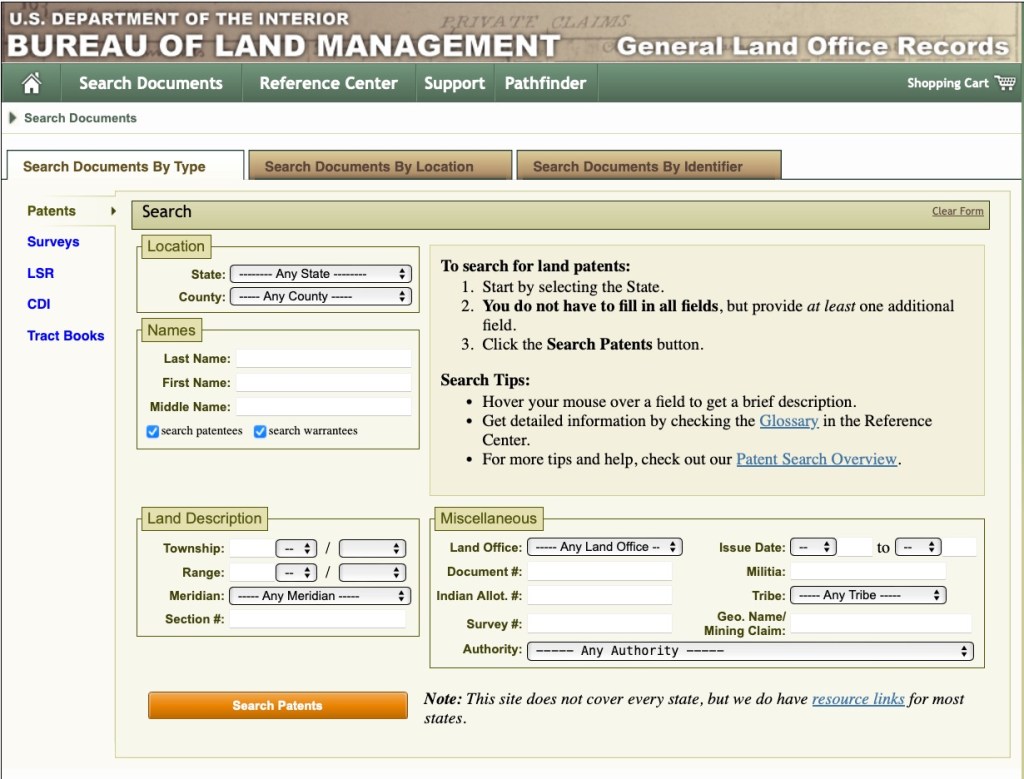
In the “Search Documents By Type” tab, there are a lot of options for narrowing down your search. I tried several. Again, I didn’t know where the land might be located so narrowing down by location wouldn’t work. There is the option to narrow your search down by “Authority,” or by the law/program that the land was disposed under. It is a very long list, and I didn’t see one for “military warrant” or something similar. There are several “Scrip Warrant Act” authorities, but offhand, I didn’t know which one might have applied. (And if it should have been obvious, well, what can I say…sometimes the obvious eludes us.)
My tip is that I used the information I found from his pension packet to narrow down the search by what I know.
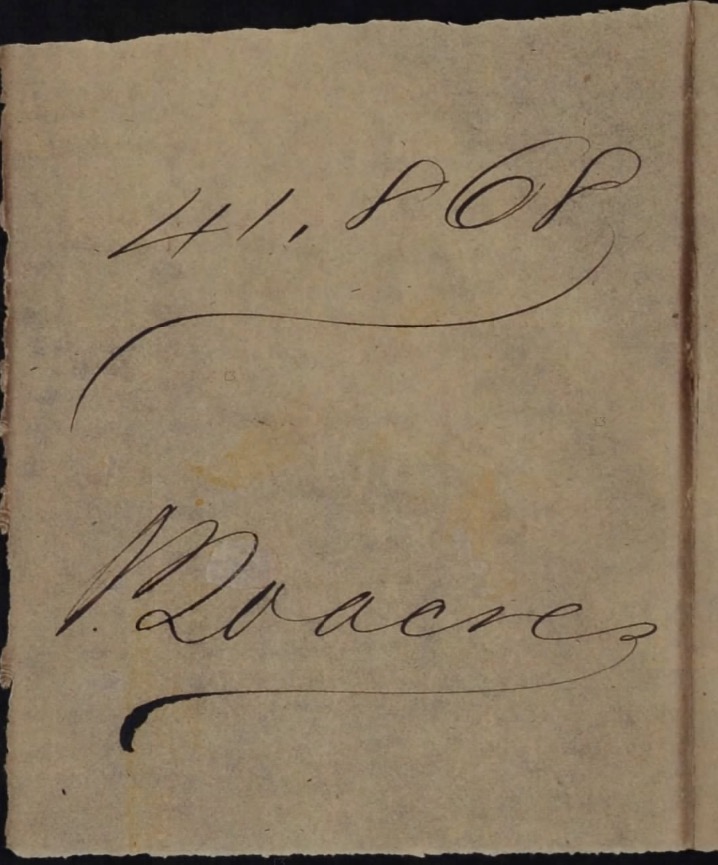
First, I tried looking by warrant number. In his pension packet, there is this note:
George Long’s War of 1812 Pension, 120 Acres, Patent #41868
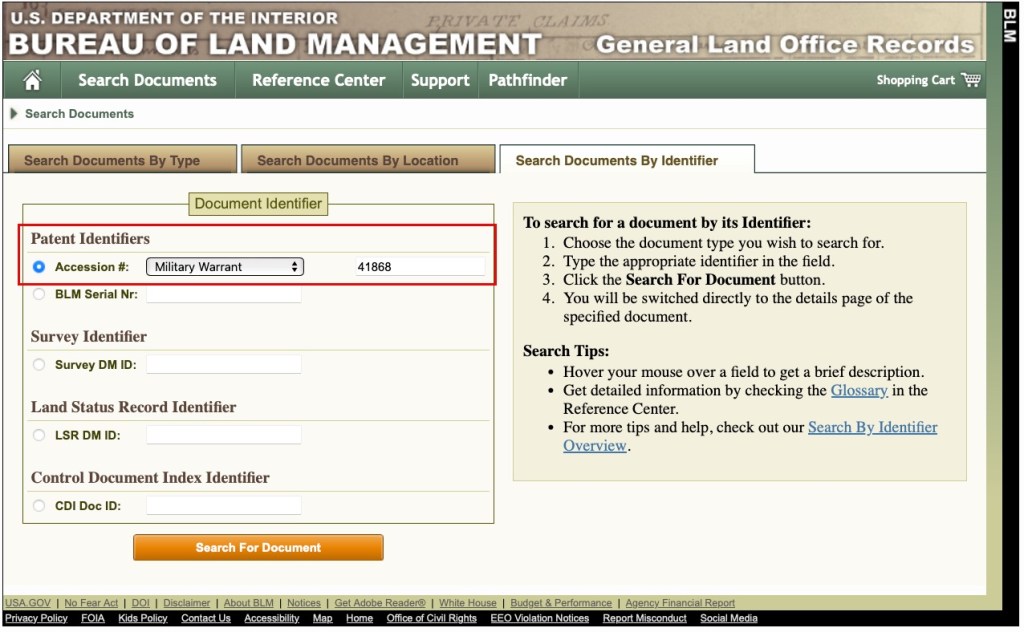
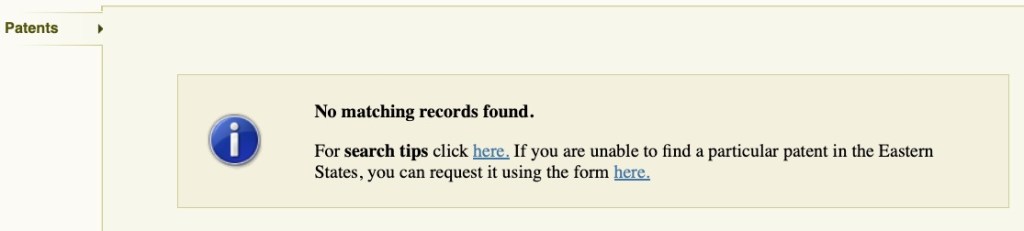
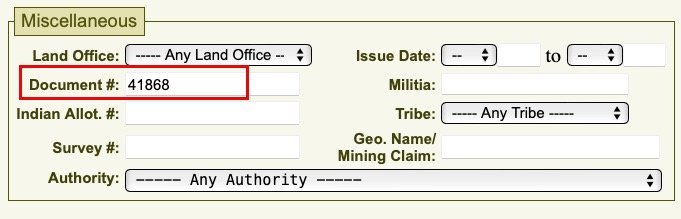
Searching by that number in the “Search Documents By Identifier” tab did not return any results:
I tried that number in a couple of different fields, on the “Search Documents By Identifier” tab, and could not locate the correct entry.
I ultimately found it by narrowing my search down by date. From the pension I know he obtained the warrant in 1871, and he died in 1880, so I narrowed by search by those dates.
I then also noticed the “Document #” field in that same “Miscellaneous” section (see, the obvious doesn’t always jump out at you).
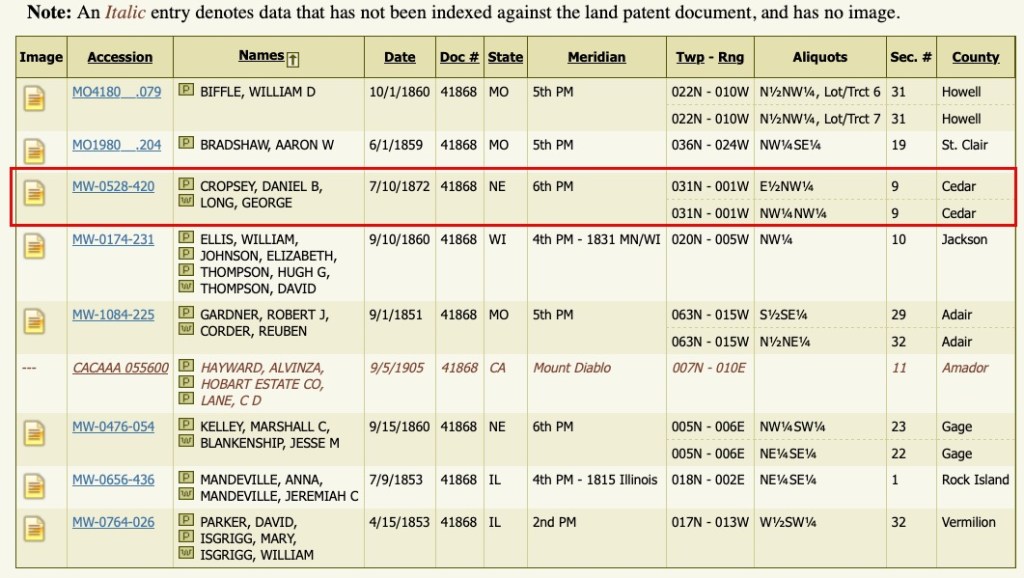
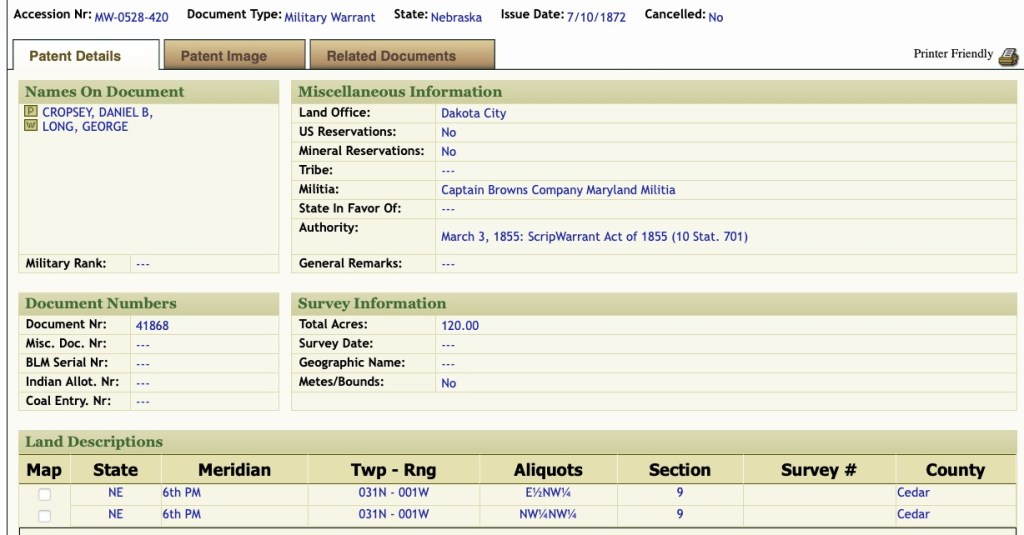
Here is “other” George Long’s entry:
The entry shows the correct militia: Captain Brown’s Company Maryland Militia. The document number and the number of acres match. I would never have known to look in Nebraska.
If I had to try every option on this database, I was going to, because I knew this record had to be in there. I have the feeling that some people are going to write me and say something like “I knew that” or give me some kind of tip for using the site… and if you do (or are tempted to), you are missing my point.
My point is,we don’t know everything … not about every website and how they work and how the data was cataloged. And if you ever encounter a site that’s not as familiar to you, you have to figure out how to work it to your advantage. This is an example of taking known information and narrowing down results to find what you need… It’s not about using the BLM website per se. This is an example of genealogical persistence.
Long story and many screenshots to say keep looking, trying, clicking, and searching! Something will eventually work, I’m certain of it.
I have been working on a project to identify the correct George Long to be my ancestor. There are about a hundred to choose from in Ohio (ok, it is a slight exaggeration, I have identified 12 candidates in the right time and places).
I was working on one particular candidate who was living in the right county at the same time as my George Long. So in this case, I am proving that there are indeed two George Longs in Hancock County, Ohio at the same time. Two important record types I’m using to prove this are land and military records. I have gone through the deeds for the county and pulled out those that belong to “my” George and those that belong to “that other” George. Turns out the “other” George has a LOT of deeds in the county. He was buying and selling and making a profit. “My” George Long, bought one piece of land and lived there until his death in 1855.
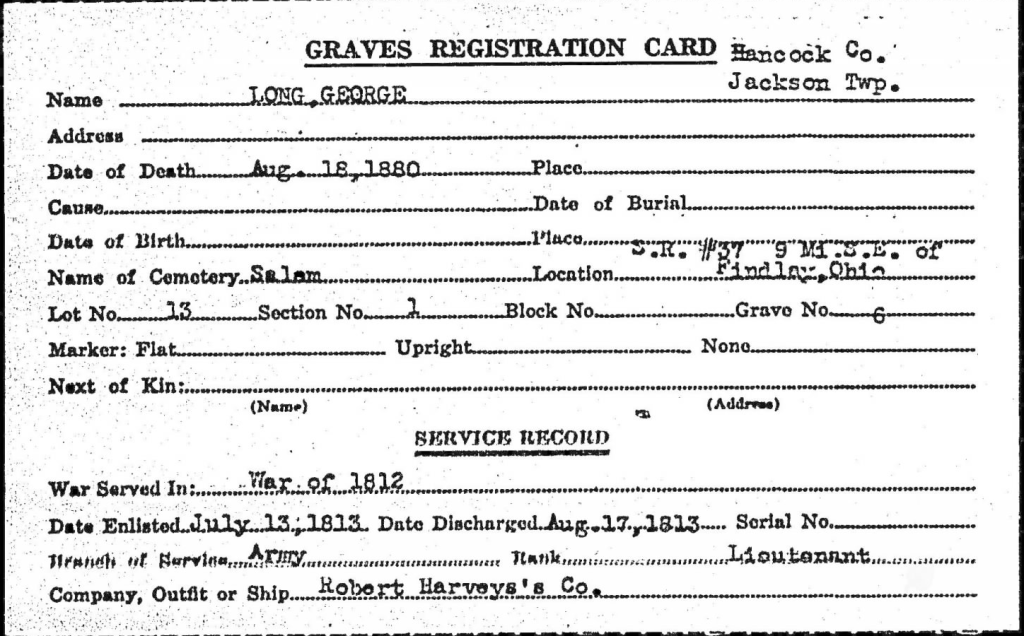
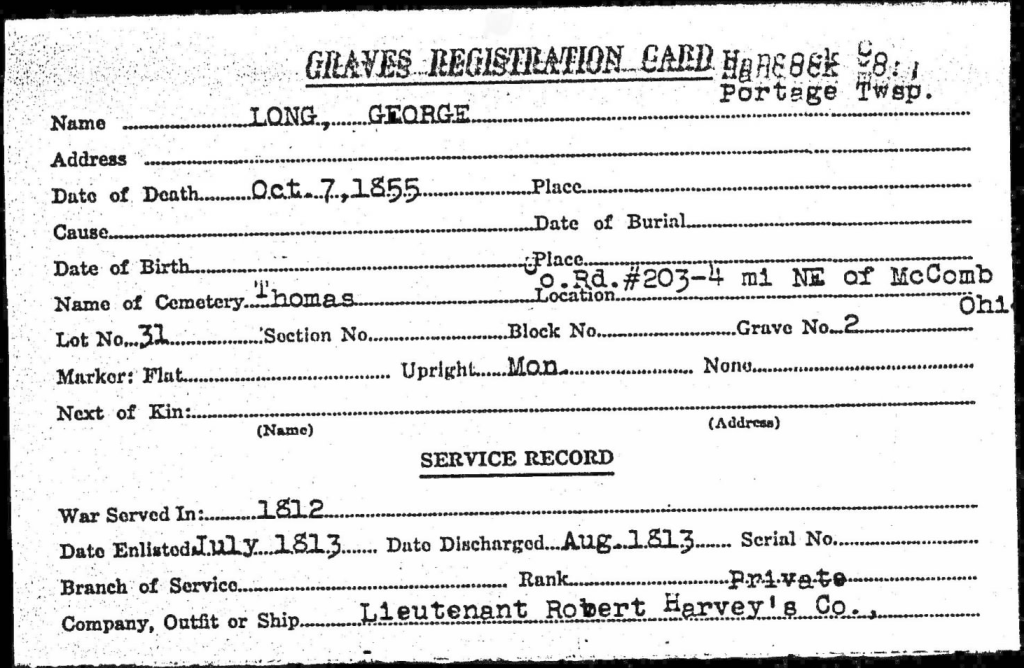
While work on this project, I have found TWO “Graves Registration Cards” created as a project by the Works Progress Administration (WPA), one of each of these Georges, but attributing the same service to BOTH men!
They are both attributed to Lieutenant Robert Harvey’s Company during the War of 1812, same enlistment and discharge dates. Examining the book Roster of Ohio soldiers in the War of 1812, there is only one George Long in this particular company. They are from “probably Ross County.”
Digging a bit more about the Graves Registration Cards, I asked an archivist at the Ohio History Connection about the cards. She replied that there is no way to know where exactly they obtained the information on the cards. As I imagine it, now that I’ve done more research, they possibly went through the cemeteries, found tombstones or cemetery records of men of about the right age, looked for them in the Adjutant General’s list, and made them a card. (I could be wrong but that is my best guess.)
Anyhow, looking for other proof to determine if either George Long served in the War of 1812, I did the obituary for the “other” George which stated he was in that war. I also found a pension for him. I know it is the “other” George because it names his wife which I had already identified in other records as being the wife of the “other” George. It also shows that his service was in Captain John Brown’s Company of the Maryland Militia. (Also, record for “my” George never mention War of 1812 service, not his obituary, nor an entry in a county history.)
So, both Graves Registration Cards are incorrect, but one is more correct than the other. You might ask why I put so much effort into researching a man who is not “my” George Long. Well, to meet the Genealogical Proof Standard, you have to resolve conflicts, you can’t ignore them. So, in this case, I have to identify and disambiguate two men of the same name (not just the same, but a common name at that), of about the same age, in the same county.
I’ve said it before, and I’ll say it again I’m sure… but don’t stop looking, asking, and clicking. There’s always more to find!
George Long supposedly came from “North of Ireland” to Carroll County, Ohio, in about 1817.1 The problem is, Carroll County did not exist in 1817; it was formed in 1833 from five counties: Columbiana, Harrison, Jefferson, Stark, and Tuscarawas. My hypothesis is then that he had to have been in one of these counties before coming to Hancock County.
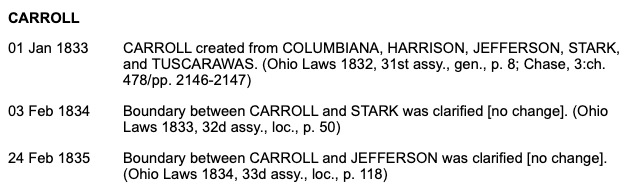
In writing my proof argument, I wanted to cite the exact law that created Carroll County. I have numerous books on Ohio, the county boundary changes, I also utilize the Newberry Library’s Atlas of Historical County Boundaries. The Atlas has a timeline of each county’s boundary changes, as well as a bibliography to help point you to the laws.
Atlas of Historical County Boundaries entry for Carroll County.
As you can see, the entry lists sources for the information. I like to read the laws myself. (I guess I have trust issues. But that all stems from being “burned” in the past.)
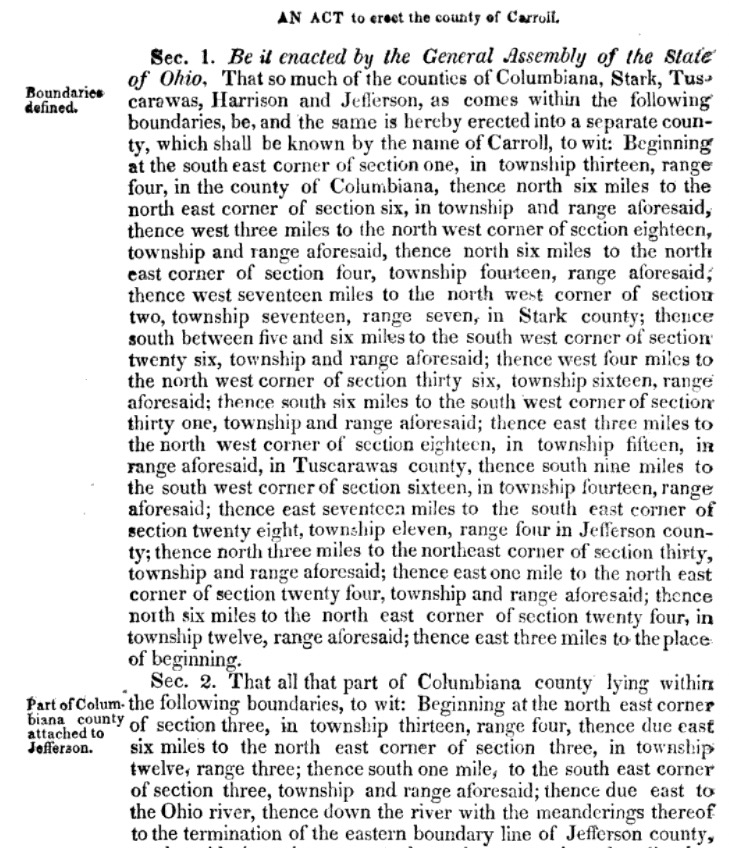
I turned to Debbie Mieszala’s website The Advancing Genealogist. She has been collecting and posting links to historic law books. I found the one referenced in the image above quite easily. She links directly to the book on Google Books.2 Very handy! Thank you to Debbie for this fantastic resource!
The first part of the law that changed the boundaries and added Carroll County.
If you need to find a historic law, try Debbie’s website. It is a great resource that has saved me a bunch of time on this and other projects as well. Check it out!
1. J. H. Beers, Commemorative, Historical and Biographical Record of Wood County, Ohio. (Chicago: J.H. Beers and Co, 1897), pp. 714-715. Available on Google Books.↩
2. Acts of A General Nature Passed at the First Session of the Thirty First General Assembly of the State of Ohio (Columbus: State of Ohio, 1832), p. 8; digital image, Google Books (https://books.google.com/ : Viewed 17 July 2024.↩
Leading up to GRIP (GRIP Genealogy Institute) was a whirlwind. Cyndi Ingle, Paula Stuart-Warren, and I put together a brand new course about researching your farming ancestors. We had so much fun doing the research to put the course together. We ran into so many interesting topics, resources, historical events, inventions, records, repositories, and so on, that the course probably could have been two weeks, easy. But that’s a story for another time. All of that work and then the teaching for the week, while fun, was also exhausting; I took a little rest from the blog.
But I’m back, at least somewhat. I’m now working on a big project that has a due date… my recertification project is in full swing! I cannot believe how fast five years goes. Well, these last five years have been weird anyway, so that didn’t help matters.
I am one of those crazy morning people. Since January and getting ready for GRIP, I have been getting up at 5:30 am and shortly thereafter heading to my office to get a couple of hours of work in before my workday at Ancestry ProGenealogists. It has been going very well. Now that GRIP is over, I’ve been working on this project in the same time slot and have made some great progress.
I’ve written about this project before. The target ancestor is George Long, who died in Hancock County, Ohio, in 1855. Where did he come from before Hancock County? I identified 11 candidate George Longs in the right time and place. So, my project has been first identifying and then eliminating those candidates, and then researching the one left standing to prove he is the right man.




 Genealogy Pants