Tag Archives: Education

Revisiting My Roots: Another Case in Point

I’ve been working through my prior research on my Avery family from Wood County, Ohio. I’ve been going through my old research and mostly filling in blanks with the now low-hanging fruit of “easy” records hinted to me from Ancestry. Things such as census records, vital records, obituaries, and so on. I found another example of “trusting” old research in my binders.

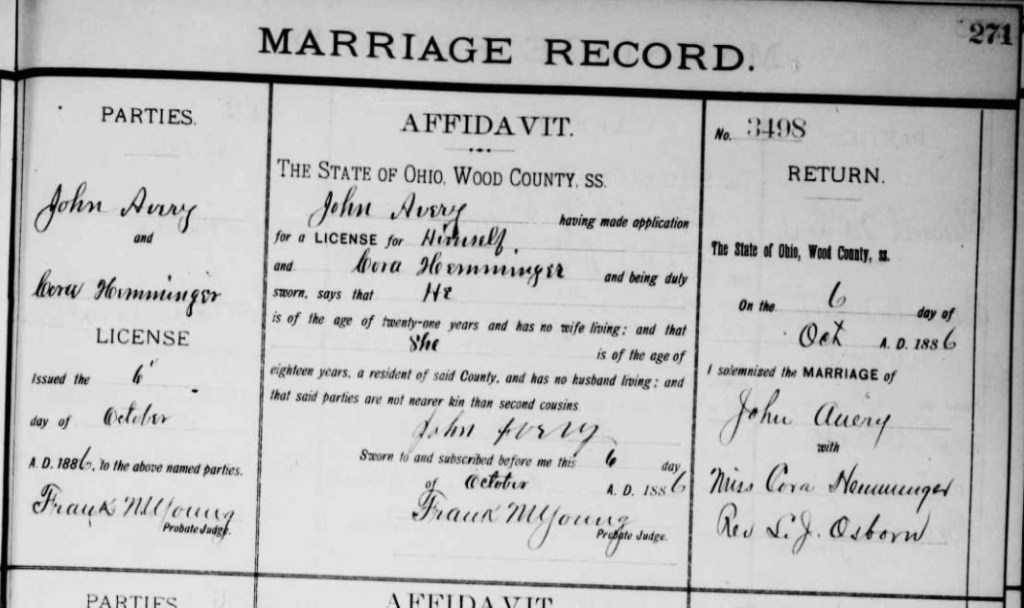
I’m working through the children of Gilbert Z. Avery, just grabbing their basics: birth, death, census, marriage, and obits, generally. According to my previous “research,” Gilbert’s son John B. Avery was married to Cora May Hemminger. I have their marriage record. They married in Wood County on 6 October 1886.1 However, as I’m working through the records this time, starting with Gilbert’s obituary and working through finding his children in the census records as adults, I found John B. Avery, in Arkansas where his father’s obituary said he would be. His wife was not Cora; it was Josephine.

Not to worry. He may have married twice. When did Cora die? Hmmm, not until 1939. John is in the census with his wife Josephine for most of his adult life. He and Josephine married in about 1878, a full ten years earlier than the marriage record for John and Cora. John and Josephine are together in the census from 1880-1930. John died in 1932 in Pine Bluff, Arkansas. So, John could not have been married to Cora. I set out to figure out where I went wrong.

It was another case of believing research done before me. This time from a genealogist cousin who had done a lot of the Avery research and who was kind enough to share it with me to get me started. I was looking back over her original family group sheet she shared, and there it says that John B. Avery was married to Cora Hemminger. There is a note that he “resided in Pine Bluff, Arkansas?” So, she wasn’t sure about that, but there is no mention of Josephine.

I found the marriage record back in my early days and didn’t question it. And I didn’t go looking for him in the census. I DID put him in one of my early public trees. I did some searching in online trees for him, and I’m happy to say that most trees did not make the same mistake I did. Phew. Most of them have Josephine or no wife at all. Thank goodness.

I also did some searching on Cora Hemminger. I wanted to make sure she was a real person and who she was married to if not John B. Avery. In my Ancestry tree, she has a lot of hints. And she is married to John Avery, of course. But she’s married to John Orlando Avery. They also lived in Bowling Green, Ohio. John Orlando Avery’s parents are Joshua Orlando Avery and Harriet J. Manley, of Groton, Connecticut. My Averys were from New York state. So, I’m not sure they are related.

Let’s be fair. The internet, digitized images, and revolutionary tools like full-text did not exist when my cousins began their research. This has definitely made it easy for me to figure out the mistake in a matter of minutes. This is all at my fingertips now, whereas it wasn’t “back in the day.” The moral of the story? It’s a good idea to check your old research and reevaluate some of the early work you trusted.


1. The marriage record is at FamilySearch: https://www.familysearch.org/ark:/61903/3:1:939K-BP64-D

Educational Opportunities in 2026

As 2025 winds down, I want to let you know about some of my plans in 2026.

The study groups that Cyndi Ingle and I lead are planned for 2026 and the schedules are posted on this website here: https://genealogypants.com/studygroups/

The only ones open for registration currently are the NGSQ study groups. These start in January and run for 11 months (we take December off). You can find more details and the registration links here: https://genealogypants.com/studygroups/ngsq-study-groups/ The other study groups open as we get closer to their start dates.

Also, coming up in February 2026, I’ll be presenting an all-day seminar for the lovely folks down at the West Valley Genealogical Society in Sun City West, Arizona. I for one am exciting to visit Arizona in the cold part of the Colorado winter! It is going to be a fun day in case you’d like to get out of the cold and join us. Details on that event can be found here: https://azwvgs.org/education/seminar/

Springtime with IGHR I’ll be teaching in the course “Repository Research: From Website to Doorway” which begins on March 12, 2026. Registration is open! You can find more details about this course or the many others here: https://ighr.gagensociety.org

I’ll be teaching at GRIP Virtual this summer in June with our course on “Not “Just” Farmers: Records, Relationships, and the Reality of Their Lives” with myself, Cyndi Ingle, and Paula Stuart-Warren. This course sold out last time so be ready when registration opens. For those details, see: https://grip.ngsgenealogy.org That week I’ll also be teaching in Paula Stuart-Warren’s course “Digging Deeper.” I hope you’ll join us!

That gets me through the summer… I’ll post more as new opportunities pop up. Consider adding one or more of these to your genealogical education plan for 2026.

A Great Lakes Interlude

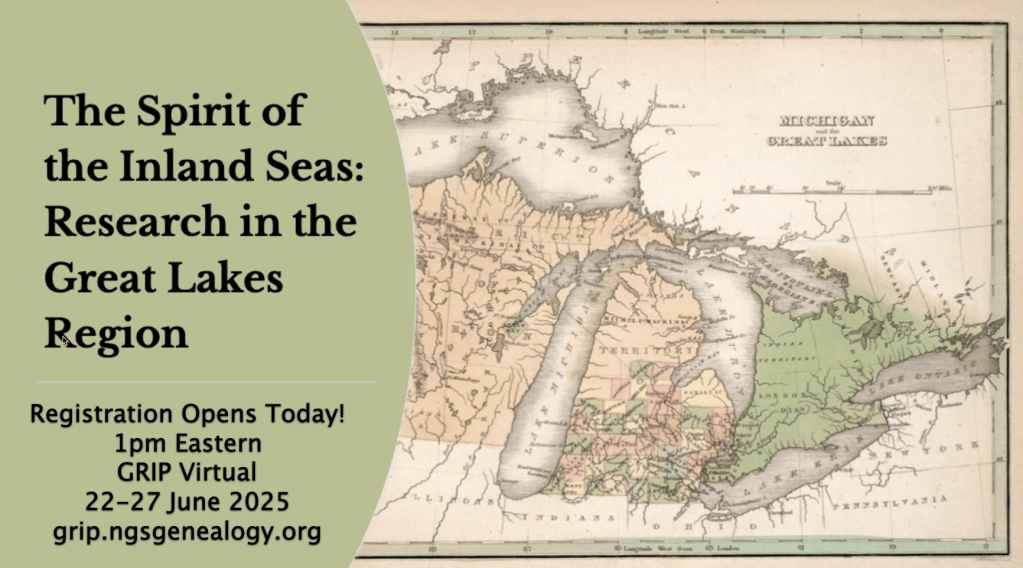
Before I continue on with the George Long discussion, I wanted to take a moment to share some details about something that is coming up. Registration is open for GRIP Genealogy Institute.

I have the great pleasure to coordinate a course on the Great Lakes, and I wanted to share some information about the course’s contents and why it is an important region for genealogical research. I grew up near Lake Erie and enjoyed learning about the history of the area when I was a kid (well, to be honest, I didn’t retain a lot, what child really does?) but I appreciate it more now as an adult learning about my ancestors and how the region affected them and their livelihoods.

The lakes served as a vital transportation route that contributed to the westward expansion of the U.S. and Canada. If you had ancestors that lived around the lakes, they were likely impacted by the lakes’ usefulness in some way. Shipping routes and advancements in shipping technology, both for resources and people, contributed to the growth of the region. The fluidity of the border between the U.S. and Canada allowed border-dwellers to cross often for commerce, trade, occupations, shopping, attending church, and so on. Border crossing requirements were not put into place until the mid-1890s. The course will walk attendees through not only the history of the area but also has a deep focus on records in terms of what is available and how to access them.

I have a fantastic team of women teaching in the course with me: Cyndi Ingle, Paula Stuart-Warren, and Judy Russell. We will join forces to bring this important area to life through the following topics:

The sessions, and a bit about each:

  • Early to 1850s Geography, History, and Migration – Cyndi Ingle, in which she starts the day off with the early Mesozoic Period and brings us into the 1850s.
  • 1850s to Modern Geography, History & Migration – Cari Taplin, in which I get the better deal and only have to cover about a century of history.
  • Cash, Bounty, Homestead, and Timber: Land in the Great Lakes Region – Cari Taplin. I will discuss the ways in which settlers obtained land, the resources they discovered, and records for both the U.S. and Ontario.
  • Census Records in the Great Lakes Region – Cari Taplin. We all probably know all about census records, but this presentation will dig deeper into the censuses and census issues particular to this region, examining both countries’ records, and we will discuss some helpful methodologies for using censuses in this region.
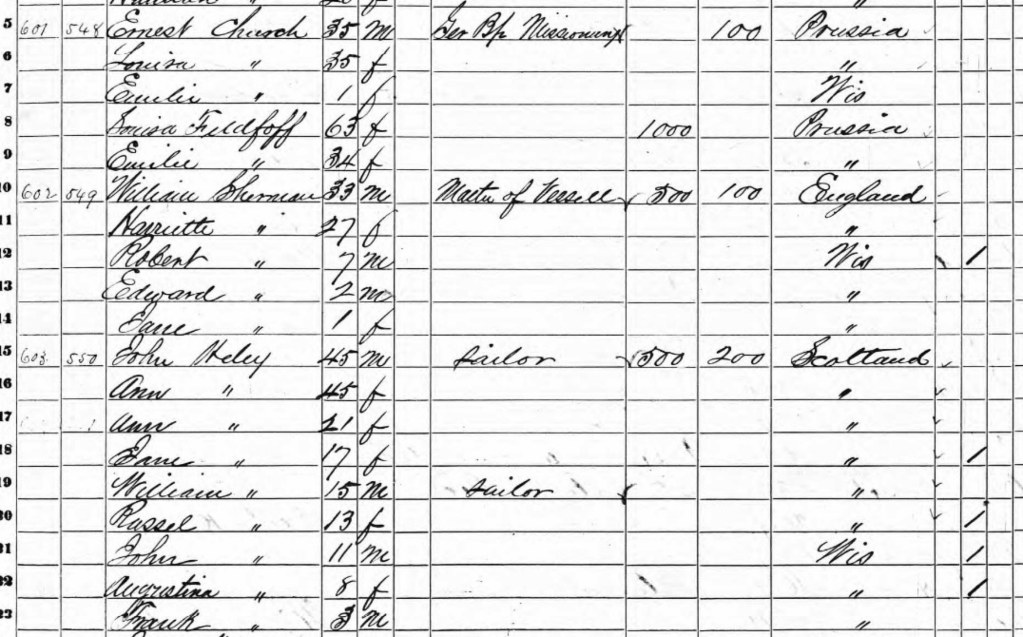
1860 Racine, Wisconsin, Ward 1
  • Finding Birth, Marriage and Death Records in the Great Lakes Region – Cyndi will take a deep dive into vital records and alternative records for the times before vital registration was required. She will help students find challenging records for births, marriages, and deaths in both the U.S. and Ontario.
  • Crossing the Border Between the United States and Canada – Cyndi walks the class through the many records that are available regarding border crossings, including the St. Albans List.
  • Steamers, Tugs, and Schooners: Shipping and Commerce on the Great Lakes – Cari Taplin. This is quite possibly my favorite topic in the Great Lakes course. The Great Lakes waterways were instrumental in the growth of the region, for both Canada and the United States. In this class, we will examine the major shipping routes and ports, discuss passenger lists, shipwrecks, military defense, and transportation, and how that led to population growth. We will also talk about the major businesses that boomed with the expansion of shipping on the lakes.
  • Military Records on Both Sides of the Conflict – Cari Taplin. From the Revolutionary War to the War of 1812, and on to present day, we will discuss the Great Lakes region in terms of defensive strategies for military conflicts, but also about the records that exists for soldiers who moved to the area and left records.
  • Paupers, Pews & Planks: The Law of the Great Lakes – Judy Russell is as entertaining and educational as ever as she walks us through the laws in the Great Lakes region. She will discuss law issues from its origins in the Northwest Territory through individual territorial legislatures and on through statehood. The law of the Great Lakes Region has reflected the particular needs and concerns of its people and its economies. Most importantly, Judy will guide students to resources where they will be able to find the law applicable to genealogical questions at various times in the region’s history, with examples of how knowing the law can help explain records and solve genealogical problems.
  • On a Mission: Religion in the Great Lakes Region – Cari Taplin. Some of the earliest settlers and explorers in the Great Lakes were missionaries of various faiths, looking to convert the native tribes and indigenous peoples living in the area. This class will focus on major religions in the Great Lakes region, a history and timeline of their arrival and expansion in specific areas, and will include a discussion on the main denominational repositories for research.
  • Tracing French Canadian Ancestors – Paula Stuart-Warren will cover the important topic of the French Canadians in the Great Lakes region. If you have an ancestor from a Great Lakes state or province, it’s likely you have found a French Canadian connection. Your German or British Isles ancestor or their sibling may have married into a French Canadian family. Whichever is the case, the records are amazing; the names of parents are generally found. Learn about the general history of the people, the fantastic records created, the books and online resources, the repositories, and meet some new cousins. 
  • Researching in Ontario – Paula Stuart-Warren. Ontario is the only Canadian province to border the Great Lakes. Paula will walk students through researching in this important province. She will talk about the major resources that are available to researchers with connections to Ontario.
  • Great Lakes Newspapers: Defy the Borders – Cari Taplin. We will discuss the importance of newspapers in the Great Lakes region and how the news did not pay attention to the borders. We will discuss the importance of newspapers in the daily lives of our Great Lakes ancestors, and what riches can be unearthed between the sheets of newsprint. The availability of U.S and Canadian newspapers in the Great Lakes Region repositories will be shared.
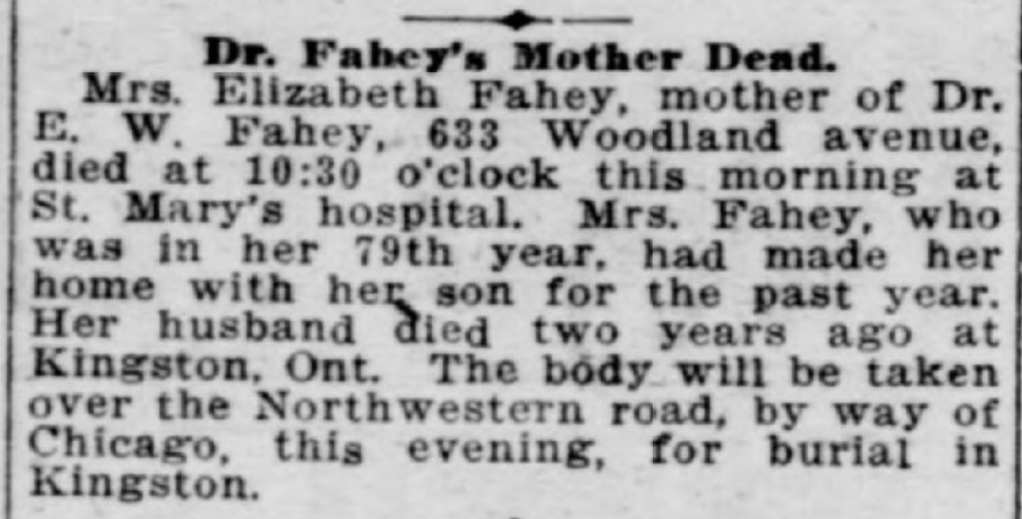
Duluth Herald, 29 July 1918, p 2.
  • Naturalization and Citizenship in the U.S. & Canada – Paula will share information about migration between Canada and the United States, and as it progressed, new residents may have become citizens. This process was important to immigrants in order to assimilate into their new home, obtain land, vote, and take part in other government programs. This class will discuss important aspects of the naturalization process focusing on the Great Lakes region. First papers, declarations, final papers, passports, and other records useful for tracking down immigrant ancestors will be examined and methods for locating those records will be discussed.
  • Beyond Shipping: Making a Living in the Great Lakes Region – Cyndi will discuss the unique occupations in the Great Lakes region. Occupations went far beyond shipping and fishing. Farming, trapping, mining, timber, and railroads drew our ancestors to live and work in this area too. She will discuss the history of various industries that helped grow the area.
  • Major Archives and Libraries in the Great Lakes Region and their Fantastic Records – Cyndi will focus solely on repositories in this session. The research repositories in the area offer extensive in-house and online material for family historians. We’ll cover some at local, provincial, state, and country level. Overlooked treasures offer information that just might fill in those missing family details.
  • Mapping the Great Lakes using Google Earth – Cyndi will dazzle and amaze us with the capabilities of Google Earth and demonstrate how to create migration maps, plot out land owned by our ancestors, and make historical map overlays to show the changes in the Great Lakes region over time.
  • Bringing it all together: Two Case Studies – Captain Stephen Meeker, Sailor on the Great Lakes, and Those Loyalist Taplins – Cari A. Taplin. I finish out the week by sharing two Great Lakes families I continue to research. First, we will examine sailor, Captain Stephen Meeker, descendant of sailors and shipbuilders, who successfully brought the Percival Roberts through a storm. Second, follow the migration of the Taplin family around the Great Lakes as they arrived in the U.S., moved to Canada to avoid the Revolutionary War and ended up in Minnesota and Wisconsin around the time of the Civil War.

We do hope you will join us for a week full of fun and genealogy!

Visit this website for more information and to register: https://grip.ngsgenealogy.org

NEW! Study Group Based on Evidence Explained 4th Ed.

We (Cyndi Ingle and I) have developed a five-week study group based on Elizabeth Shown Mills’s book Evidence Explained 4th Edition. This will be a nice companion to our study group based on Tom Jones’s book Mastering Genealogical Documentation. While it is not a requirement to have taken the MGD study group first, we will discuss some of the similarities and differences in their approach to documenting your genealogical research.

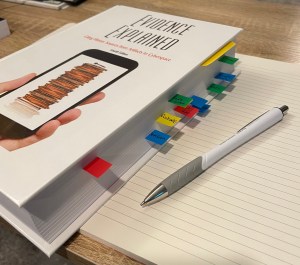
Image of the book Evidence Explained 4th Edition by Elizabeth Shown Mills.

Basically, outside of some standard conventions, there are also a lot of options when it comes to creating your citations. Mills’s book offers some differing options, provides ample explanation of the “why” behind her suggestions, and provides us with this fantastic tome to help everyone through their citation anxiety.

The five-week group will cover the first three chapters of the book. We will have a reading assignment along with guided homework questions to be completed before the discussion sessions. We will have a private Facebook group for discussion between sessions. Each session will be about an hour. You must own a copy of the book which can be purchased at Genealogical Publishing Company or on Amazon.

The cost for the 5-week course is $75. Click the links below to register. Please pay attention to the days, dates, and times when making your selection since they vary.

There will be three sessions (limited to 25 students):

If you can’t make it this time around, sign up on our Waitlist to be notified of the next session when it is scheduled.

We hope you will joint us as we continue to try to demystify the practice of creating citations for your genealogical research.

Why You Should Consisder an MGP study group

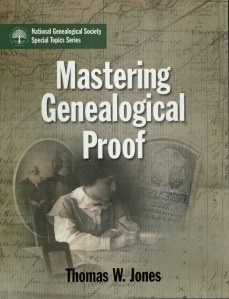
If you are a burgeoning genealogist, you might consider taking our study group based on the book Mastering Genealogical Proof (MGP) by Tom Jones. And if you are an established genealogist, you might consider a refresher on the topic. MGP covers the five elements of the Genealogical Proof Standard (GPS):

  1. Reasonably exhaustive research
  2. Full and complete citations
  3. Analysis and correlation of evidence
  4. Resolution of conflicts
  5. A written conclusion

The MGP book by Tom Jones was designed as a study guide with questions at the end of each chapter. This has been a fantastic way to study the topics of the GPS. He has them broken down into tangible parts, with examples from his own work. The GPS allows genealogists to be confident in their findings, especially as it pertains to tough problems. This book breaks all of that down into easy-to-understand concepts.

Our study groups work through his book, studying his examples, but we also add our own examples to those in the book. We have time for discussion of the book’s questions and of anything from it that is confusing or unclear, and we share our own experiences with those topics.

This year, we are only doing one session of MGP (to make way in our class schedule for a new exciting opportunity; stay tuned). This session will be led by Cyndi Ingle (of Cyndi’s List) and starts on 15 February 2025 and runs on Saturdays at 5pm Eastern for seven weeks.

Please visit this link for the full details.

To register, click here.

We hope you will join us! This opportunity won’t be available again until 2026!

Upcoming Institute Course: Research in the Great Lakes

This summer, I have the pleasure of coordinating the course “The Spirit of the Inland Seas: Research in the Great Lakes Region.” Three other outstanding instructors—Cyndi Ingle, Paula Stuart-Warren, and Judy Russell—will share their expertise with us. They are all amazingly talented and knowledgeable women.

We will discuss topics such as the area’s historical significance, especially in the growth and development of the U.S. and Canada. The resources in the Great Lakes area were major attractors for mining, timber, farming, etc. The lakes acted like highways, moving people and goods from one place to another with more speed and ease than previous modes of transportation.

Not only will you hear from some spectacular instructors, but we all put a lot of time and energy into creating an extensive syllabus that contains not only what we discuss during the presentations but also extra information we don’t have time to cover. Also, it never fails that as we are preparing for the institutes, we find more information that we couldn’t fit into the syllabus before the deadline, so we make addendums that we share during the week. We are committed to providing a high-quality experience and an in-depth dive into the subjects.

The course will be held VIRTUALLY, so you can attend from home, 22-27 June 2025, through GRIP Genealogy Institute. Details about the institute can be found here: https://grip.ngsgenealogy.org/#1#schedule

Registration opens on 4 February 2025 at the link above. Be sure to put that on your calendar! We have a lot of fun in our courses and hope to see you there!

Upcoming Study Groups

We have added our 2025 schedule for the NGSQ, Mastering Genealogical Proof, and Mastering Genealogical Documentation study groups.

We still have some seats remaining in some of the NGSQ sessions. The registration will open soon for the MGP session starting in February.

We also have a new study group coming soon… more details as the group is finalized, so stay tuned for that!

A few thoughts on the NGSQ study groups

I will be heading into my sixth year running these groups. I have learned so much just by being the discussion moderator, but also, I am a student along with everyone else. We all read an article that none of us have (likely) read before. A few things I’ve learned by being a student:

  • I learn about how other people think. Others’ approaches to similar problems of my own give me new insights on how to tackle those problems. What sources are they consulting? How much research are they doing to solve their problem?
  • I learn how other people present evidence. Studying the charts and tables alone gives me ideas on how to visually present the evidence I have found in a way to enhance my narrative.
  • I learn how other people cite their sources. Of course, each journal has an in-house citation style, but beyond that, I learn about which sources authors use and how they cite them, specifically, what is important to include in that citation.
  • I learn how other people resolve conflicting evidence. When you come across sources that are not in agreement, how do you write about that? How to you explain the conflict or present evidence that shows why one side of the conflict is the most likely or “right” side? Reading how others do that helps me learn how to do that for myself.
  • I learn how other people write about certain topics or methodologies. When I read articles that are about disambiguating men of the same name, for example, or how authors write about DNA evidence, I learn about how I can write about similar situations in my own work.

Basically, you learn how to “do” the Genealogical Proof Standard by studying NGSQ articles.

  1. Reasonably Exhaustive Research
  2. Analysis and Correlation of Evidence
  3. Full Source Citations
  4. Resolution of Conflicts
  5. Written Conclusion

We hope you will join us for the learning that doesn’t end, is varied, and new each month!

Full details about our NGSQ study groups can be found here.

Grist Mills

My ancestor, William Long, was killed in a terrible grist mill accident at Gilboa, Putnam County, Ohio in 1861. The newspaper reported that his clothing got tangled in the belts and he was drug into the machinery, breaking every bone in his body.1

I will be talking about grist mills and this incident in my lecture on “Historical Side Hustles” in the “Not Just Farmers” course that this taking place at GRIP (virtual) in June. As part of the lecture, we are going to watch this video I found on how grist mills worked and thought I’d share it.

This video makes the grist mill look quite slow. However, grist mills were not just used for making flour. They also utilized the water-powered shafts to spin grinding wheels designed to sharpen tools. That’s what William was up to when he got caught in the machinery. He had gone to the mill “for the purpose of grinding his scythe; and while arranging the belt to the grindstone, his clothing was caught by another belt, and he was whirled around the shaft, which was making about ninety revolutions a minute…”

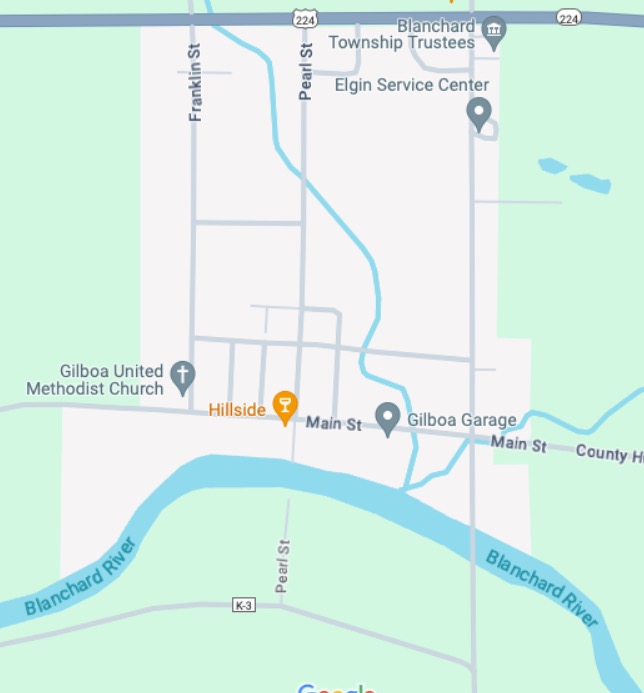
I then started looking at who owned the grist mill in Gilboa, where it was located, whether it was operated by water or not, and I came across an entry in the Putnam county history that stated that the first gristmill in Gilboa was opened by Elisha Stout in 1837.2 Gilboa is located on the Blanchard River, which also runs into Findlay, Hancock County, Ohio, where William Long lived.

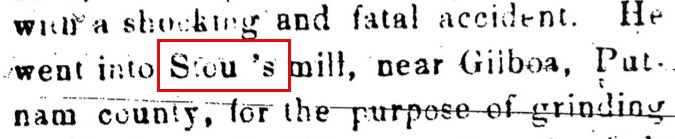
Rereading the news article about William’s death, there is a section of the print that is hard to read, but now makes sense… “He went into Stout’s mill…” The news article print is faded:

Two lessons here… First, check YouTube for short videos on how things worked to better understand what our ancestors were doing and seeing everyday. Second, as you learn more, go back an reread the materials you’ve already collected. New information will pop out at you, and old information will make sense that didn’t before.

And a third, don’t wear loose-fitting clothing when working around fast-spinning belts. It can result in a “sad accident.”


1. “Sad Accidents” William Long obituary, Hancock (Findlay, Ohio) Courier, 23 August 1861, p. 3, col. 1.

2. George D. Kinder, History of Putnam County,Ohio: Its Peoples, Industries, and Institutions, (Indianapolis, Indiana: B. F. Bowen, 1915), p. 116; available on Internet Archive at https://archive.org/details/historyofputnamc01kind.

One Tough Lady – Carry Nation

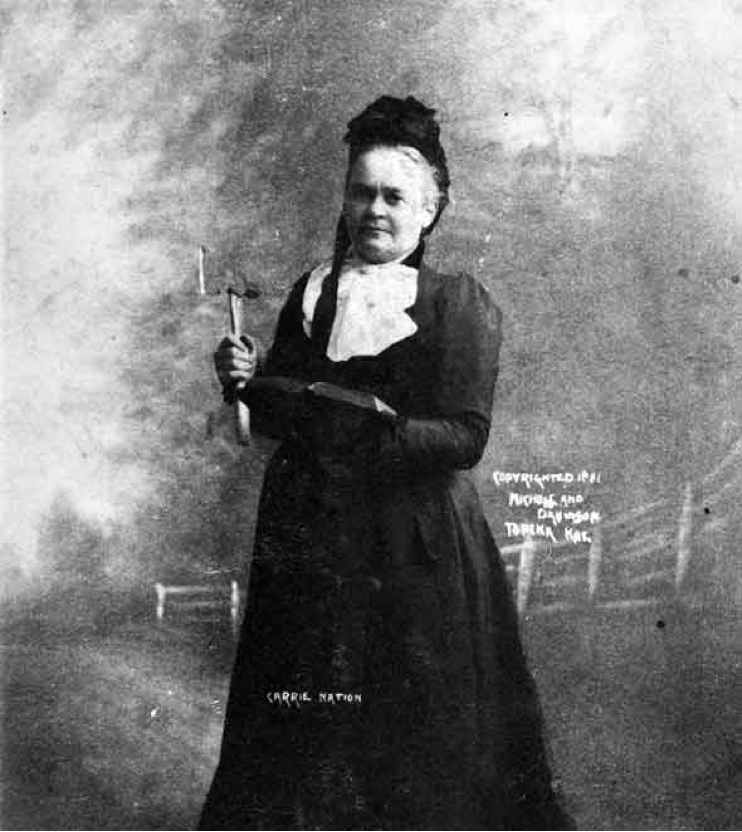
As I was reading about Prohibition and the Temperance Movement and it’s impact on agriculture, I came across a tough-looking woman, Carry Nation. She was a fighter for the cause, gaining a reputation for entering saloons and bars and breaking the liquor bottles with a stick or an axe. The axe then became her signature weapon and she posed in photos with the axe although it is claimed she more often used a lead pipe.

Carry Nation, photo from the Library of Congress.

Carry Nation grew up with an alcoholic father and a mother who suffered from mental illness. She felt that alcohol and drunkenness were a scourge and she wanted to save people from its effects.

You can read more details about her life all over the internet, but the account from History.com is one I recommend. Interestingly, a YouTube channel I follow for quilting this week added a tutorial on how to make a “Carrie Nation Quilt.” You can watch that video here if you are a quilter.

This will be part of a lecture I’m giving during our “Not Just Farmers” course through GRIP in June 2024. I hear that the course is sold out! (Thanks to those who have signed up!)

GRIP: Digging Deeper

Another course offered at GRIP Genealogy Institute this summer is coordinated by Paula Stuart-Warren, CG, FMGS, FUGA. It is called “Digging Deeper: Records, Tools, and Skills.” I am one of the instructors for this course and am looking forward to it!

For the complete details and to register, visit this link.

Paula is a fantastic instructor. She does an excellent job with hands-on experiences in addition to the lectures. This course is great for anyone wanting to expand or polish their genealogical skills.

I’ll be teaching two classes, one on PERSI (Periodical Source Index) and one on Probate Records.

Paula is also teaching in the “Not Just Farmers” course I am coordinating and in “Midwest Family History Research: Migrations and Sources” coordinated by Jay Fonkert. She wrote a blog post about this here.

There are a lot of educational opportunities coming up this summer. This class is one you should consider if you haven’t taken it already!

For the complete details and to register, visit this link.