Tag Archives: Genealogy

Genealogy Institutes – Part Three

This time in my series on genealogy institutes, I’m going to describe IGHR and GRIP. These are the two institutes I have actually attended so I have my firsthand experiences to also share. Both of these institutes take place on a college campus and come with all of the perks (or not, depending on your perspective) of campus life, dorm packages and meal plans.

2013-08-08 01.32.06 pmThe Institute of Genealogy and Historical Research, also commonly referred to as “IGHR” (pronounced eye-jer) or “Samford,” takes place annually in June at Samford University in Birmingham, Alabama. There are typically ten courses offered for beginners to advanced researchers. The Samford campus is quite lovely with a lot of shade when walking from building to building. This year the temperatures were quite bearable and we experienced a few days of rain, not unpleasant for someone from Colorado where the days are mostly dry. You may choose to stay in the dorms (beware of the snakes) but there are also hotels nearby and the institute coordinates a shuttle service between the hotels and the campus. If you happen to drive, there is free parking on campus. They also have meal plans in their cafeteria or a student center with fast food, a carryout and a coffee bar.

At IGHR the courses being offered for 2014 and 2015 are posted on their website. Here is a quick look at 2014’s lineup by course number:

  1. Techniques & Technology
  2. Intermediate Genealogy & Historical Studies
  3. To Be Determined
  4. Advanced Methodology & Evidence Analysis
  5. Writing & Publishing for Genealogists
  6. Advanced Library Research: Law Libraries & Government Documents
  7. Virginia: Her Records & Her Laws
  8. Researching African American Ancestors
  9. U.S. Military Records
  10. Irish Genealogical Research

There are a lot of topics to choose from and for complete course descriptions you will want to check their website.

Also, if you are interested in attending IGHR, there is a scholarship available to pay for your tuition. It is the Birdie Monk Holsclaw Memorial Scholarship. According to the Colorado Council of Genealogical Societies website, “Distributions are awarded to those who have an interest in genealogy and wish to pursue genealogical related education at the Samford University Institute of Genealogy and Historical Research (IGHR). Application is open to all genealogists and consists of a short resume listing genealogical experience and a 150-200 word essay describing how IGHR will help advance their genealogical research skills. Deadline for Applications is October 1 each year.” There is a downloadable application on the site. Don’t miss this amazing opportunity!

-4The Genealogical Research Institute of Pittsburgh (or “GRIP”) takes place annually in July at La Roche College, located a few mile north of downtown Pittsburgh. La Roche College is a small college, easy to locate, with amenities near by. They too offer a dorm and cafeteria package. There are hotels nearby but they do not have a shuttle service yet. If you rent a car or drive to the conference there is also free parking available. This institute offers courses for varying levels of experience. The line-up and course descriptions for 2014 is posted on their website but here are the titles and instructors:

  • “Intermediate Genealogy: Tools for Digging Deeper” with Paula Stuart-Warren, CG, FMGS, FUGA
  • “Determining Kinship Reliably with the Genealogical Proof Standard” with Thomas W. Jones, PhD., CG, CGL
  • “Becoming an Online Expert: Mastering Search Engines and Digital Archives” with D. Joshua Taylor, MA, MLS
  • “Finding and Documenting African-American Families” with J. Mark Lowe, CG, and Deborah Abbott, PhD.
  • “Practical Genetic Genealogy” with Debbie Parker Wayne, CG, CGL, CeCe Moore and Blaine Bettinger, Ph.D., J.D.
  • “Law School for Genealogists” with Judy G. Russell, J.D., CG, CGL and Richard G. “Rick” Sayre, CG, CGL

These institutes are very similar in structure. The classes run from about 8:30am-4:30pm. There are set break times with free snacks provided and a great time to get up and stretch your legs and network with your classmates. Both of these institutes offered optional evening sessions on various topics. At GRIP this year we got to watch the first episode of Who Do You Think You Are? (full episodes available on tlc.com) which is a lot of fun when you do it with a huge room of genealogists!

Both of these institutes are top notch, offer a wide variety of topics and activities. They are both located in some very scenic locations with a lot of history to explore. Be sure to plan time for site-seeing and fun!

Genealogy Institutes – Part Two

There are what I would consider five major genealogy institutes: British, IGHR, GRIP, NIGR, and SLIG. Readers, if there are others that I’m missing, please don’t hesitate to let me know. I may want to attend! By institute, I mean the week-long, in-depth course you take on one topic with one or two instructors for the entire week. You can read the previous post to read my description of an institute. This post will begin the tour of those five and give some insights into what I know about each of them. They are being presented here in random order, and just to remind you, I have only been to GRIP and IGHR personally although I will be attending SLIG in January. So while some of this is firsthand knowledge, other bits are what I have read, heard or found on their websites, which I will also be linking to for easy access.

I find institutes to be invaluable learning opportunities for genealogists wanting to know more and go deeper into a topic. There are many choices within these five institutes. They all seem to have a core of classes that are taught annually and some that rotate. Check their websites for each year’s lineup.

2013-08-08 12.49.06 pmThe first institute that I will be covering is the International Society for British Genealogy and Family History Institute (or “British Institute” for short). As the title would suggest, this institute focuses mainly on British Isles research, including Irish research. It is held annually in October at the Radisson in downtown Salt Lake City which is located within walking distance of the Family History Library. Classes are designed so that you have class/lecture time in the morning with time at the library in the afternoon and individual instruction time with your instructor. For current pricing, visit their website.

This year the institute is offering four tracks:

  • “Sources For Tracing Pre-mid-nineteenth Century English Ancestors” with Maggie Loughran and Paul Blake
  • “From Simple to Complex: Applying Genealogy’s Standard of Acceptability to British Research” with Tom Jones
  • “Irish Land Records and Fragmentary Evidence Correlation” with David Rencher
  • “Using the Cloud for British Family History Research” with Graham Walter

The website currently only lists David Rencher’s course as being sold out, so there may still be time to register and go if you are interested. I have not attended this institute yet, but it is in my future plan to do so. If any of you have input on your experiences with British Institute and would like to share them, please do so in the comments.

Next up, IGHR and GRIP.


My First IGHR Experience

My Gold-Star Certificate

I wasn’t sure what to expect from IGHR or Elizabeth Shown Mills’ Advanced Methodology Course. I heard a lot of rumors about how hard it was. When people would find out which course I was taking they’d say “Ooooh. Gosh, be ready for a lot of homework.”  Of course then I begin to second guess myself. “What if I’m not at the level needed to take this course? What if I’ve overestimated my abilities?” It turned out to be at just the right level and pace for me. I was familiar with almost all of the topics covered, with the exception of the government documents (gov docs for short) section. I’ve listened to lectures about gov docs before but never had the opportunity to use them. Everyone has a unique brain and therefore a different way of doing things and I thoroughly enjoyed learning how someone of Elizabeth Shown Mills’ caliber approaches a problem, what interpretations she makes from any given record and where she goes from there.

I think the biggest lessons I learned from the course are:

  • There’s always something more.
  • Citations are an art not a science.
  • Research the neighbors.

Of course there were many lessons to learn. I definitely have a new way of approaching my research problems! And there was a fair amount of homework. I spent about 4 hours per night, but I found myself going off on tangents. (Anyone else have that problem?) I did not attend any of the evening events except the banquet, because I wanted to do the homework to my satisfaction, and I wanted sleep. Craig R. Scott taught a lecture or two in our course and my favorite thing he said was “A good genealogist needs sleep.” I still didn’t get enough sleep, but an adequate amount. (I hope Elizabeth takes the yawns as a sign of hard work and not as commentary on her lecturing!)

I was surprised when I received a gold star on my certificate. I was doubly surprised when I got home and received an email from Elizabeth letting me know that I had won the Walter Lee Sheppard Jr. Prize. This is from the press release:

Cari Taplin of Longmont, Colorado, has been named the 2013 recipient of the Walter Lee Sheppard Jr. Prize, bestowed annually upon one or more genealogists who demonstrate sound practices and exceptional potential. Candidates for the award are drawn from the Advanced Research Methodology and Evidence Analysis track at Samford University’s Institute of Genealogy and Historical Research. The stipend awarded to each recipient covers the preliminary and final application fees for pursuing certification by the Board for Certification of Genealogists.
 
Past recipients of the prize include Debbie Hooper, CG, of Millsboro, Delaware; Judy Russell, CG, of Avenel, New Jersey; David Ouimette, AG, CG, of Highland Utah; Phil Burnett Adderly, CG, of Shreveport, Louisiana; and Teri Tillman, CG, of Natchez, Mississippi.
 
The Samford University IGHR and the Board for Certification of Genealogists (BCG) were both founded in 1964 by a cadre of genealogical educators seeking to advance quality and professionalism within the field. Across the decades, BCG has co-sponsored the IGHR; and a significant number of Board-certified genealogists have been its course coordinators and instructors.
 
The prize itself memorializes the late Walter Lee Sheppard Jr., one of the twentieth-century’s leading genealogical scholars whose example strongly promoted sound reasoning and careful analysis in all genealogical specialties. As a mentor, his discerning eye could be counted upon to identify a missed source or clue in family reconstructions, thereby strengthening a colleague’s conclusions. A founder and president of BCG, Lee was also a fellow and president of the American Society of Genealogists, the National Genealogical Society, the Genealogical Society of Pennsylvania, and other bodies. In 2007, he was elected to the National Genealogy Hall of Fame.
 
The Sheppard Prize is privately funded by an IGHR Track 4 graduate, for whom Lee acted as mentor and patron. The prize has no affiliation with the Board for Certification of Genealogists itself.

The Walter Lee Sheppard Jr. Prize is funded by a private person who was mentored by Lee. This is serendipitous because having had an awesome mentor is the only reason I am here (in the genealogy world) today. My dear friend and mentor Birdie Holsclaw told me I could be, she told me I could do this, that I had potential, that what I was doing was fun and interesting and that people would want to hear about it. So I began speaking and writing articles. We would sit up until Buffalo Wild Wings kicked us out (around 2am) talking about my work and she’d just impart her wisdom on me, freely and with such patience and grace. Then she and some other friends invited me to a small group of people who were thinking about becoming certified. And I’ve been on that path slowly ever since. Well, now, it’s not going to be slow anymore.

The next 18 months is going to fly by and I hope to do Birdie proud! And I hope to be able to pay forward the mentoring gift someday. All in all, that is not a bad first time at IGHR!

IGHR Starts Tomorrow!

SamfordTrees
One of the beautiful wooded areas on the campus of Samford University. Photo taken by the author.

Samford University in Birmin’ham, Alabama is a gorgeous campus teeming with beautiful architecture, wonderful magnolia trees and apparently snakes. It is in its 174th year as a private university. I have lived in Wyoming and Colorado since 1988 and having been in a dry climate for that long I had nearly forgotten about lush, green vegetation, rolling hills, rivers, lightning bugs and all other things that come along with just a little bit more precipitation.

I am here attending my first ever IGHR (Institute of Genealogy & Historical Research). Tomorrow I will have the pleasure of learning from Elizabeth Shown Mills for an entire week! I am excited (and truth be told, a little bit nervous) to be here. There are many rumors that the nightly homework can be quite involved!

Today was the welcome dinner where I got to meet and visit with some of my colleagues and fellow classmates. I especially enjoyed the time getting together with the ProGen Study Group, past and present. What an amazing group of people. The mentors and coordinators are truly interested in promoting genealogy as a profession and in giving each individual participant their attention when needed. Many of my fellow students I have never met in person, so have a chance to put a face with the name is really fun.

Since sleep might be scarce for the rest of the week, I think I will turn in early tonight!

My FGS Conference Plans

View of the downtown Fort Wayne skyline, looki...I recently decided to attend the FGS (Federation of Genealogical Societies) annual conference this year which is being held in Fort Wayne, Indiana, home of the Allen County Public Library, August 21-24, 2013. When I made my genealogy plans for the year, I hadn’t included FGS. I just had so many trips I wanted to take and I had to limit myself. However, several things lined up that allowed me to go. First of all, I have a travel companion that will help cut down expenses (you know who you are). Second, I have never been to the Allen County Public Library. Third, I really have a hard time resisting the chance to listen to wonderful speakers such as D. Joshua Taylor, John Colletta, Elizabeth Shown Mills, Tom Jones, Mark Lowe, Curt Witcher, George Morgan, and that’s just the beginning; there are dozens of great speakers on the schedule. Forth, did I mention the Allen County Public Library?

In addition to attending lectures that are sure to increase my knowledge and skills, I am planning on doing a bit of research at the Allen County Public Library. From their 16-minute Orientation Video I learned that the Genealogy Center in the ACPL has over 340,000 printed volumes including published family histories, county histories, directories and local records from across the United States and Canada as well as holdings for the British Isles, Ireland and Western Europe. Also, they have over 550,000 pieces of microfilm and microfiche. This video also walks you through each of their five genealogy rooms. ACPL is also the creator of PERSI (the Periodical Source Index) which indexes surnames and topics from periodicals.

I had some collateral ancestors in one of my brick walls that lived in Allen County. Carrill Long married Harry Rudd in Michigan. She was born in Missouri abt. 1892 and died in Fort Wayne, 12 July 1967. She is buried in Wood County, where the rest of her family lived. However, I don’t know a thing about her husband, Harry. I will be looking into Harry Rudd and why they moved to Fort Wayne. The couple are not buried together, she died before he did and I speculate that he remarried and is buried with his second wife. But I need to find the proof!

I am also very interested in learning about what other great treasures can be found at ACPL. Much of my ancestry is based in Wood County, Ohio, which is in the northwestern part of the state. Being that close to Allen County, I hope I might find other resources I had not discovered before. Family histories, county histories, periodicals, maps, microfilms, and more!

With all of the time I will be spending at the conference and then at the library, with their extended hours for conference attendees, I wonder if I will get any sleep! But who needs sleep with all of the great genealogy happening?

Attempting to be Organized

English: Mount Everest North Face as seen from...Being an “organized genealogist” is like trying to reach enlightenment. It seems like such an unattainable goal, like me climbing Mount Everest. (I’m lucky if I can climb the stairs sometimes!) However, there are many tips and tricks, blogs, books, magazines and people (they call them “professional organizers”) to help you get and stay organized.

A new Facebook community got me thinking about this topic. Susan Peterson started the community “The Organized Genealogist” which allows genealogists the chance to swap ideas, photos, ask/answer questions and get some great tips on organization geared directly at genealogists. People have been sharing their personal systems for organizing everything from their photos, to their files and research to their entire office. You should go and visit. It is a great group to be a part of.

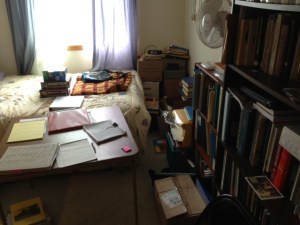
Currently my office is crammed into our guest bedroom. I mean crammed. I have boxes of books stacked in the corner, bins of office supplies stacked up, two bookshelves over-flowing, a card table, a few piles on the floor, two small filing cabinets, a hutch, on top of the hutch… well you can see for yourself:

image-1  imageThere is no way for anyone to use this room! When we have visitors, I have to “clean up” which means put everything into a pile on top of my desk while they are visiting. I’m not saying I mind having visitors, I am saying I mind not having a REAL office.

We have lived in this house for 10 years now, and for the entire time, my dear husband has been “finishing” the basement. Granted, he works a full time job to put food on the table and the roof over our head that houses said basement, however, this summer is the summer of completion! I can count the projects left to complete on one hand: finish the mudding/sanding in one section of the basement (the rest is done), prime that section, paint, carpet, floor/window trim. We did a lot of prep work over the last few weeks to get this ready to finish. We moved a lot of stuff upstaphotoirs (the upstairs is a series of piles right now), we stapled and taped plastic to various sections of the basement where we’d like to keep the dust to a minimum, we bought primer and paint, we have some cash set aside for carpet (I hope it’s enough) and we moved as much out of those two rooms as possible to give clear working space for sanding/painting and carpet.

There are basically two large sections to our basement, one will be family/TV/video-game play area and the other, larger section will be our offices. My husband and I will be getting two of those U-Shaped desks to put together, his and her offices. There will be plenty of room for shelves, I have two large filing cabinets already that were given to me (I love free!) and the basement has really nice large windows that let a surprising amount of light in.

So, this fall look for the “grand opening” of GenealogyPants, LLC home offices! I will keep you updated!


Pray for NO DIRECT EVIDENCE!

image from wikimedia commons

So, I went “on the clock” (for BCG certification) in December 2012. In the meantime a lot of “life” has happened but a lot of “life” is going to happen when you take a step like this. I’m the type of person who needs a deadline, so I went on the clock. Once I sat down and tried to locate a family/problem for my case study, I got concerned. One look at my office, my binders, my computer files, told me that I was horribly unorganized and I needed to do a lot of catching up, fixing, data entry (I have a thumb drive with scans from Salt Lake City from 2009 that I haven’t worked with yet!) and organizing, before I could even make an educated guess on the case study.

Well, in the last week, I went through a very large pile of notes with “to-do” items on them, some dating back to 2003. They said things like “find tombstone for …” or “locate obit for …” or one sticky note “I am not convinced that ––– is really –––’s father.” (Names being left out in case this REALLY is my case study.) That one sticky note sent me on a swirl of reviewing documents, notes, computer files, quick look-ups on Ancestry and FamilySearch. I MAY just have found my case study. I have a few pieces of indirect evidence but nothing conclusive that says who the parents of my subject are.

This project is so counter-intuitive for the genealogist. If you’ve never reviewed the Case Study requirements for the BCG portfolio, it basically requires that you use the genealogical proof standard to solve a problem of conflicting evidence or by using of indirect evidence. I know that I have many of these in my family research, but finding a good one can be challenging. And then, what happens when you start to work hard on it and then find that piece of direct evidence? … ah … back to square one.

I did get through my pile of to-dos and either figured out that they had been done (recycled), or if they were easy to do (just did it), or they went into my Evernote to-do list (then recycled). Now, on to some research! So pray for my project, that I find no direct evidence on this man’s parentage and instead am able to locate a lot of really good indirect evidence!


Upcoming Event Schedule (May 2, 2013)

bigstock_calendar_54869811I just wanted to share the events I will be attending as well as the programs I will be giving for the rest of the year. I have a busy few months ahead!

  • May 4: “Evernote” Presentation – Colorado Chapter APG
  • May 23-June 2: Road trip to visit family and do a little research in Ohio
  • June 8-14: I will be attending Elizabeth Shown Mills’ course on methodology at IGHR (Birmingham, AL)
  • June 21-July 5: Family vacation to Minnesota (I don’t have any ancestors up there, so I will probably do a lot of reading and/or writing when we aren’t fishing and canoeing.)
  • July 10: “A Nose for the News” presentation – Adams County Genealogical Society
  • July 20-27: I will be attending Tom Jones’ course at GRIP (Pittsburgh, PA)
  • August 6: “Genealogical Education – Institutes and Home Study Options” – Boulder Genealogical Society‘s “You Asked For It” series
  • August 21-24: I will be attending the FGS Conference in Fort Wayne, IN
  • September 10-13: I MAY be attending a research trip to Salt Lake City with the Castle Rock Genealogical Society
  • September 21: “The Power of the Family Legend: How I am Related to Roy Rogers” presentation at Castle Rock Genealogical Society
  • October 1: “Evernote & Evidentia” – Boulder Genealogical Society’s “You Asked For It” series
  • October 5: I will be attending the first annual Rocky Mountain Genealogical Seminar featuring D. Joshua Taylor
  • November 21: “Evernote” Presentation – Larimer County Genealogical Society
  • December 3: Title still to be determined, topic is county histories and mug books – Boulder Genealogical Society
     

RootsTech 2013

2013-04-15 12.10.40 pmIt has been about a month since I attended RootsTech. I wanted to let the dust settle a bit before I wrote about it. It was an enjoyable trip. As a mom of two kids, ages 10 and 12, it was a nice break from reality. Grandpa came and took care of the kids so my husband and I could attend. The best part was not having to worry if everyone had eaten or had their homework done.

The second best part was when we checked in at the conference hotel, we were told that the organizers of RootsTech had arranged for free self-parking and a free breakfast buffet every morning! That alone saved my husband and I around $200. What a deal! We also frequented a  restaurant that was new to us, the Blue Lemon. It had healthy food with gluten-free options that were reasonably priced and not at all far away from the conference center and library.

The conference itself was full of energy. If you’ve read anything about RootsTech (everyone else has already blogged about it by now) I’m sure you know that it was the biggest one yet with over 6,700 attendees! There were people I knew there that I never saw! It was very exciting and full of great ideas, forward thinkers and new products. I am going to highlight a few of my favorite programs or products beyond the big sponsors and obvious happenings of the conference, which have already been written about:

  • D. Joshua Taylor gave a very interesting program on “Gaming and Virtual Realities: Attracting the Next Generation of Genealogists” which highlighted some very intriguing comparisons between gamers and genealogists, probably most profound is that each group can sit at a screen and “waste” hours of time every day, yet neither feels like it is a waste of time. Also, each group, when they get really into it, keep amazing records. I know gamers who will keep detailed notes about how to solve the games or strategies that have worked, etc. Doesn’t that sound like a genealogist’s research log?
  • Evidentia was there showcasing their exciting new software that guides your research through the genealogical proof standard. You can download a free 30-day trial (for MAC or PC) at: http://ed4becky.com/products/evidentia/
  • Kin2 is still in Beta but it has some great potential to be a fun website. It uses Facebook connections and a large celebrity database to find out who you are related to and how. Currently there’s no gedcom upload possibilities yet, but when I spoke with the representative at the booth, he said that was one of the first things they would be implementing. Also, this site has some very cool pedigree charts, very modern looking and not at all like your basic pedigree chart.
  • Another new product that is “coming summer 2013” is HalfTale.com. It is sort of a collaborative blogging, family history, oral history tool. It is hard to describe, however the tour I was given had me very excited. Often I will email a relative and ask them a simple question “Do you know what happened to grandpa’s military uniform and medals?” to which I will get a several paragraph reply with all kinds of memories about that question and others. This site will be a way to collaboratively answer those questions and create “walls” or “pages” on various ancestors that many family members can contribute to. It’s not available yet, but you can sign up for a beta test account.

The worst part: the internet was either incredibly slow or at capacity and you couldn’t get on at all. For being a “tech” conference, you’d think they would plan on a lot of internet-ready gadgets. I like to look at the websites the speakers are showing, while they are talking, and was completely unable to. In addition, the hotel internet was very, very slow. So connectivity was limited for the week. Another aspect that was something of a let down for us, most of the sessions we attended seemed to be a bit basic for the level we are at. My husband, who is a developer, felt like many of the sessions he attended did not go into the depth he expected or would have liked to have attended. Personally, I attended several that were marked with “I” for intermediate in the program and felt that they were more like beginner level sessions. I struggled to find sessions that challenged me and brought me completely new ideas.

Overall, it was a very enjoyable experience. I enjoyed the exhibit hall the most, learning about new products, services, and learning opportunities as well as talking to other genealogists, developers, speakers and other collaborators. Next year, Rootstech will take place on February 6-8, 2014 again in the Salt Palace. I am looking forward to hopefully attending again with my hubby! We had a great time.

On the Clock

clockI turned in my BCG preliminary application for certification at the end of December, so I’m officially “on the clock” as they say here in genealogy land. It is a little stressful to think of all of the work that lies before me, not only for certification but also while pursuing a Master’s Degree. I have this unrealistic personal belief or maybe it’s my personality type, but I think I can get amazing amounts of work done and love to “climb big mountains” of tasks. I inevitably end up stressed out at various times, but usually I get the things done I say I’m going to do.

There are several things in play that I believe will help me be less stressed and get my portfolio finished. First of all, I am in a group of other genealogists from my general area who are also “on the clock” or plan to be soon and we are working together reading the BCG Standards Manual and understanding the requirements. Also, I am a member of a smaller group, what I call my genealogy “support group.” This is a group of 5 women who have been meeting for many years to discuss what’s new in their genealogy journeys, basically a discussion outlet so our families don’t get bored with our ramblings. Third, while I am pursuing a Master’s Degree, the workload has been quite manageable, only overwhelming toward the end of the semester. Fourth, while I do still have kids at home, they are in school all day and I am not working right now, so, while I am poor, I do have uninterrupted time during the week days to work on BCG and homework.

The BCG website gives a proposed timeline for how long certain projects will take. I began working on my portfolio, in a rather unorganized fashion, a few years ago. So I have at least some rough drafts finished on several of the items. So I feel I have a slight head start on some of the tasks. However, if by December of this year, I am not ready yet, they generously allow you to apply for an extension for 1 year for a nominal fee, which has taken some of the pressure off! Wish me luck!