Tag Archives: GRIP

A Great Lakes Interlude

Before I continue on with the George Long discussion, I wanted to take a moment to share some details about something that is coming up. Registration is open for GRIP Genealogy Institute.

I have the great pleasure to coordinate a course on the Great Lakes, and I wanted to share some information about the course’s contents and why it is an important region for genealogical research. I grew up near Lake Erie and enjoyed learning about the history of the area when I was a kid (well, to be honest, I didn’t retain a lot, what child really does?) but I appreciate it more now as an adult learning about my ancestors and how the region affected them and their livelihoods.
The lakes served as a vital transportation route that contributed to the westward expansion of the U.S. and Canada. If you had ancestors that lived around the lakes, they were likely impacted by the lakes’ usefulness in some way. Shipping routes and advancements in shipping technology, both for resources and people, contributed to the growth of the region. The fluidity of the border between the U.S. and Canada allowed border-dwellers to cross often for commerce, trade, occupations, shopping, attending church, and so on. Border crossing requirements were not put into place until the mid-1890s. The course will walk attendees through not only the history of the area but also has a deep focus on records in terms of what is available and how to access them.

I have a fantastic team of women teaching in the course with me: Cyndi Ingle, Paula Stuart-Warren, and Judy Russell. We will join forces to bring this important area to life through the following topics:

The sessions, and a bit about each:

  • Early to 1850s Geography, History, and Migration – Cyndi Ingle, in which she starts the day off with the early Mesozoic Period and brings us into the 1850s.
  • 1850s to Modern Geography, History & Migration – Cari Taplin, in which I get the better deal and only have to cover about a century of history.
  • Cash, Bounty, Homestead, and Timber: Land in the Great Lakes Region – Cari Taplin. I will discuss the ways in which settlers obtained land, the resources they discovered, and records for both the U.S. and Ontario.
  • Census Records in the Great Lakes Region – Cari Taplin. We all probably know all about census records, but this presentation will dig deeper into the censuses and census issues particular to this region, examining both countries’ records, and we will discuss some helpful methodologies for using censuses in this region.
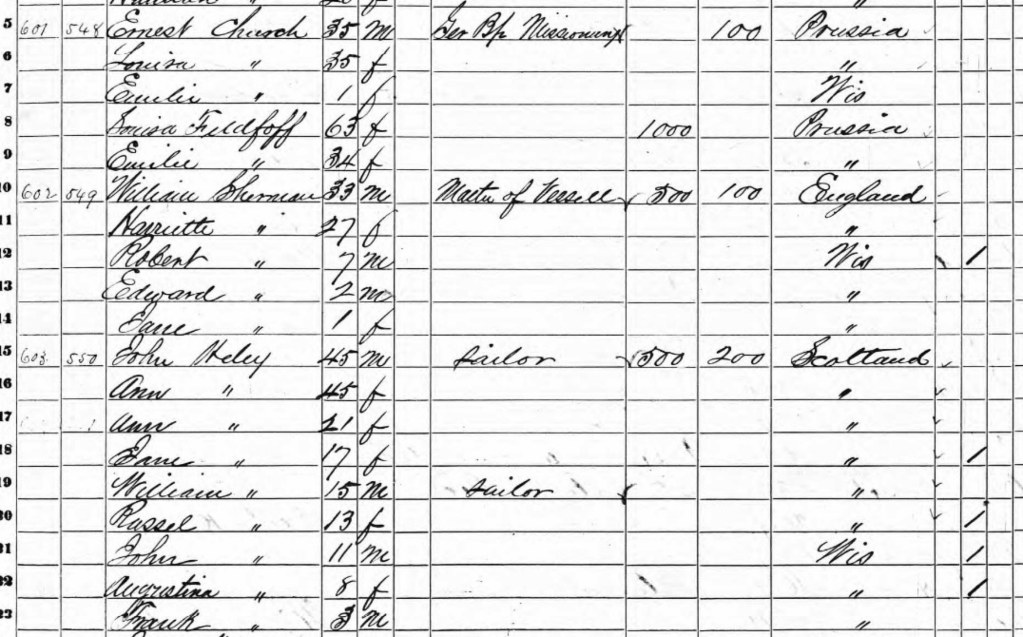
1860 Racine, Wisconsin, Ward 1
  • Finding Birth, Marriage and Death Records in the Great Lakes Region – Cyndi will take a deep dive into vital records and alternative records for the times before vital registration was required. She will help students find challenging records for births, marriages, and deaths in both the U.S. and Ontario.
  • Crossing the Border Between the United States and Canada – Cyndi walks the class through the many records that are available regarding border crossings, including the St. Albans List.
  • Steamers, Tugs, and Schooners: Shipping and Commerce on the Great Lakes – Cari Taplin. This is quite possibly my favorite topic in the Great Lakes course. The Great Lakes waterways were instrumental in the growth of the region, for both Canada and the United States. In this class, we will examine the major shipping routes and ports, discuss passenger lists, shipwrecks, military defense, and transportation, and how that led to population growth. We will also talk about the major businesses that boomed with the expansion of shipping on the lakes.
  • Military Records on Both Sides of the Conflict – Cari Taplin. From the Revolutionary War to the War of 1812, and on to present day, we will discuss the Great Lakes region in terms of defensive strategies for military conflicts, but also about the records that exists for soldiers who moved to the area and left records.
  • Paupers, Pews & Planks: The Law of the Great Lakes – Judy Russell is as entertaining and educational as ever as she walks us through the laws in the Great Lakes region. She will discuss law issues from its origins in the Northwest Territory through individual territorial legislatures and on through statehood. The law of the Great Lakes Region has reflected the particular needs and concerns of its people and its economies. Most importantly, Judy will guide students to resources where they will be able to find the law applicable to genealogical questions at various times in the region’s history, with examples of how knowing the law can help explain records and solve genealogical problems.
  • On a Mission: Religion in the Great Lakes Region – Cari Taplin. Some of the earliest settlers and explorers in the Great Lakes were missionaries of various faiths, looking to convert the native tribes and indigenous peoples living in the area. This class will focus on major religions in the Great Lakes region, a history and timeline of their arrival and expansion in specific areas, and will include a discussion on the main denominational repositories for research.
  • Tracing French Canadian Ancestors – Paula Stuart-Warren will cover the important topic of the French Canadians in the Great Lakes region. If you have an ancestor from a Great Lakes state or province, it’s likely you have found a French Canadian connection. Your German or British Isles ancestor or their sibling may have married into a French Canadian family. Whichever is the case, the records are amazing; the names of parents are generally found. Learn about the general history of the people, the fantastic records created, the books and online resources, the repositories, and meet some new cousins. 
  • Researching in Ontario – Paula Stuart-Warren. Ontario is the only Canadian province to border the Great Lakes. Paula will walk students through researching in this important province. She will talk about the major resources that are available to researchers with connections to Ontario.
  • Great Lakes Newspapers: Defy the Borders – Cari Taplin. We will discuss the importance of newspapers in the Great Lakes region and how the news did not pay attention to the borders. We will discuss the importance of newspapers in the daily lives of our Great Lakes ancestors, and what riches can be unearthed between the sheets of newsprint. The availability of U.S and Canadian newspapers in the Great Lakes Region repositories will be shared.
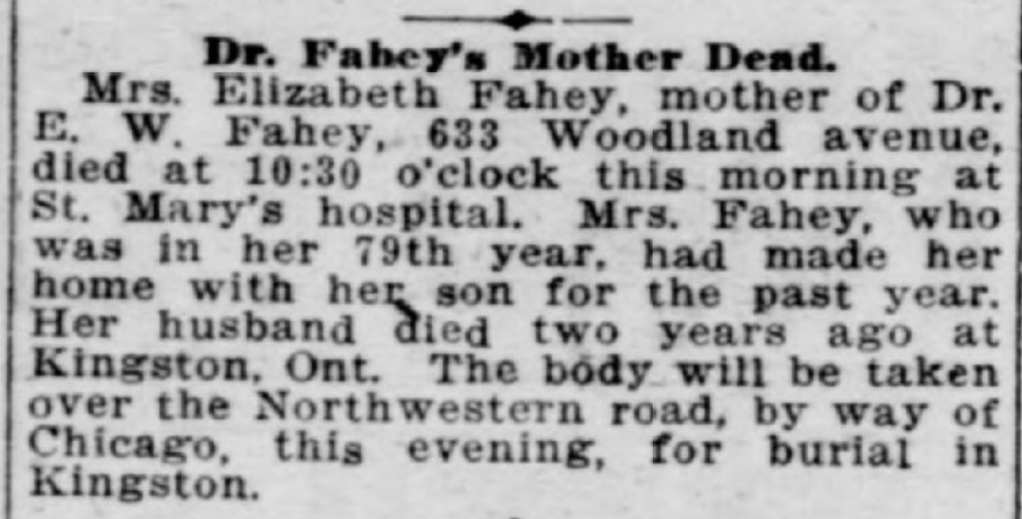
Duluth Herald, 29 July 1918, p 2.
  • Naturalization and Citizenship in the U.S. & Canada – Paula will share information about migration between Canada and the United States, and as it progressed, new residents may have become citizens. This process was important to immigrants in order to assimilate into their new home, obtain land, vote, and take part in other government programs. This class will discuss important aspects of the naturalization process focusing on the Great Lakes region. First papers, declarations, final papers, passports, and other records useful for tracking down immigrant ancestors will be examined and methods for locating those records will be discussed.
  • Beyond Shipping: Making a Living in the Great Lakes Region – Cyndi will discuss the unique occupations in the Great Lakes region. Occupations went far beyond shipping and fishing. Farming, trapping, mining, timber, and railroads drew our ancestors to live and work in this area too. She will discuss the history of various industries that helped grow the area.
  • Major Archives and Libraries in the Great Lakes Region and their Fantastic Records – Cyndi will focus solely on repositories in this session. The research repositories in the area offer extensive in-house and online material for family historians. We’ll cover some at local, provincial, state, and country level. Overlooked treasures offer information that just might fill in those missing family details.
  • Mapping the Great Lakes using Google Earth – Cyndi will dazzle and amaze us with the capabilities of Google Earth and demonstrate how to create migration maps, plot out land owned by our ancestors, and make historical map overlays to show the changes in the Great Lakes region over time.
  • Bringing it all together: Two Case Studies – Captain Stephen Meeker, Sailor on the Great Lakes, and Those Loyalist Taplins – Cari A. Taplin. I finish out the week by sharing two Great Lakes families I continue to research. First, we will examine sailor, Captain Stephen Meeker, descendant of sailors and shipbuilders, who successfully brought the Percival Roberts through a storm. Second, follow the migration of the Taplin family around the Great Lakes as they arrived in the U.S., moved to Canada to avoid the Revolutionary War and ended up in Minnesota and Wisconsin around the time of the Civil War.

We do hope you will join us for a week full of fun and genealogy!

Visit this website for more information and to register: https://grip.ngsgenealogy.org
Upcoming Institute Course: Research in the Great Lakes

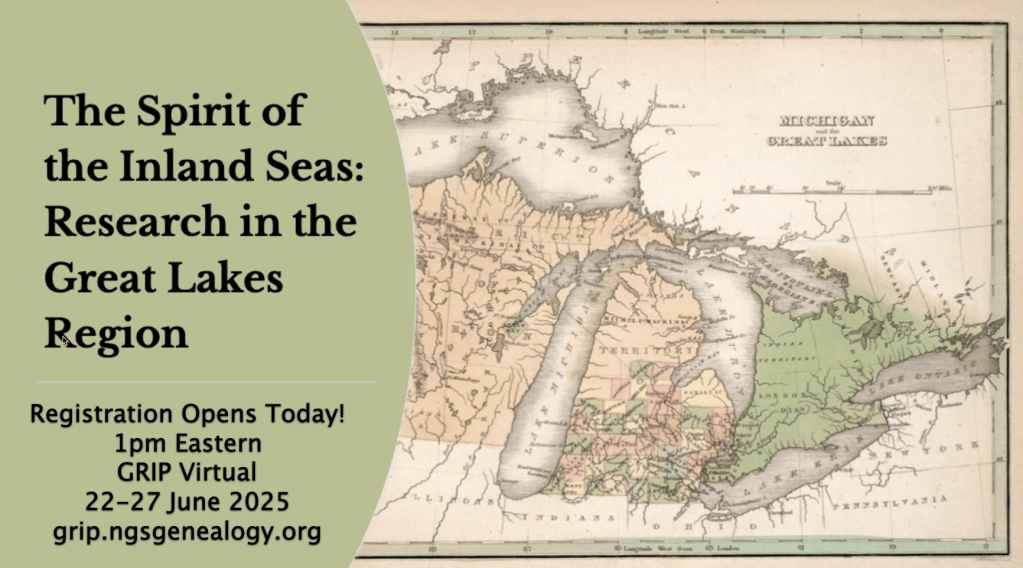
This summer, I have the pleasure of coordinating the course “The Spirit of the Inland Seas: Research in the Great Lakes Region.” Three other outstanding instructors—Cyndi Ingle, Paula Stuart-Warren, and Judy Russell—will share their expertise with us. They are all amazingly talented and knowledgeable women.

We will discuss topics such as the area’s historical significance, especially in the growth and development of the U.S. and Canada. The resources in the Great Lakes area were major attractors for mining, timber, farming, etc. The lakes acted like highways, moving people and goods from one place to another with more speed and ease than previous modes of transportation.

Not only will you hear from some spectacular instructors, but we all put a lot of time and energy into creating an extensive syllabus that contains not only what we discuss during the presentations but also extra information we don’t have time to cover. Also, it never fails that as we are preparing for the institutes, we find more information that we couldn’t fit into the syllabus before the deadline, so we make addendums that we share during the week. We are committed to providing a high-quality experience and an in-depth dive into the subjects.

The course will be held VIRTUALLY, so you can attend from home, 22-27 June 2025, through GRIP Genealogy Institute. Details about the institute can be found here: https://grip.ngsgenealogy.org/#1#schedule

Registration opens on 4 February 2025 at the link above. Be sure to put that on your calendar! We have a lot of fun in our courses and hope to see you there!

The Nigerian Prince: Swindlers and Vigilantes in Agriculture

Scammers are nothing new. They have probably existed as long as people have. And you only have to look so far as the newspapers to see them in the 1800s in the U.S. In our GRIP course, “Not Just Farmers,” I will be talking about “Farming Outside the Law.”

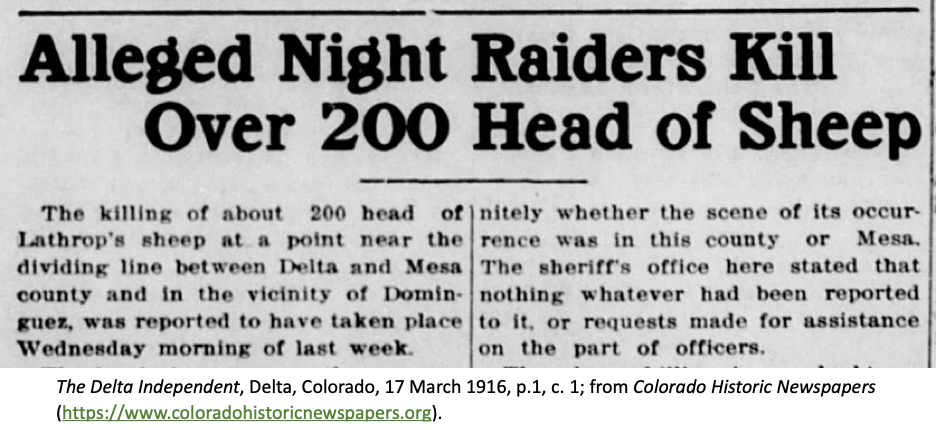
One topic I’ll be covering are vigilante groups who were not happy with the speed that law-makers moved. If they saw an injustice, they just took it upon themselves to right the wrongs. A premise I can get behind in general, but you know these groups always take things too far. One group’s goal was to intimidate sheepmen from grazing on public lands. There was a belief that sheep were inferior to cattle (longer story that I have time to go into here) and therefore groups formed to run off the sheepherders. Well, intimidation turned to violence and killing of sheep.

Another topic I’ll be touching on are the scammers, conmen, swindlers, and thieves that used an agricultural front to make their fortune. Many news articles can be found warning communities of a conman working in an area. For example…

Swindlers and people taking the law into their own hands… it’s a tale as old as time. And we’ll be talking more about it in our course. I hope you can join us!

GRIP: Digging Deeper

Another course offered at GRIP Genealogy Institute this summer is coordinated by Paula Stuart-Warren, CG, FMGS, FUGA. It is called “Digging Deeper: Records, Tools, and Skills.” I am one of the instructors for this course and am looking forward to it!

For the complete details and to register, visit this link.

Paula is a fantastic instructor. She does an excellent job with hands-on experiences in addition to the lectures. This course is great for anyone wanting to expand or polish their genealogical skills.

I’ll be teaching two classes, one on PERSI (Periodical Source Index) and one on Probate Records.

Paula is also teaching in the “Not Just Farmers” course I am coordinating and in “Midwest Family History Research: Migrations and Sources” coordinated by Jay Fonkert. She wrote a blog post about this here.

There are a lot of educational opportunities coming up this summer. This class is one you should consider if you haven’t taken it already!

For the complete details and to register, visit this link.

Blogging has Taken a Backseat to Farming

Hello friends. You may have noticed (or maybe not) that my blog went a bit silent there for a bit. That’s because I’ve been in writing overdrive preparing for my newest course “Not Just Farmers: Records, Relationships, and the Reality of Their Lives” that will occur at the NGS GRIP Genealogy Institute (formerly the Genealogical Institute of Pittsburgh), virtually, June 23-28., 2024. Registration is now open. Of course, I’m not the only instructor. I am being joined by Cyndi Ingle and Paula Stuart-Warren as well.

I get tired of hearing genealogists of all kinds say “oh my ancestors weren’t that _____ (interesting, important, etc.) because they were ‘just farmers.'” There is a commonly held belief that they did not lead interesting or important lives, and that they just didn’t leave many records. So, this course is designed to defy all of those misconceptions. There is nothing more important than providing food and other necessary supplies to your family and community.

The focus of our course is on North American farming and agricultural ancestors and their families. The course will dispel the myth that our ancestors are “just farmers” without a rich and documented life. Farmers have often been dismissed by the assumption that there is not much to find or to learn about their lives and the issues they faced. The variety of records–often underused or undiscovered–give depth and breadth to the lives of our ancestors. Understanding the history of farming and learning about the unique records of the people, products, and land, will give a deeper picture of what hearty families we descend from. Students will build an “agricultural profile” for their farming ancestors by the end of the week. This profile can help to craft a robust background of their “just farmer” ancestors.

My Grandpa Karl Miller on His Tractor

The full breakdown of the courses and who will be teaching those can be seen on the GRIP website. My topics include:

  • Inventions and Ingenuity: Advancement in Farming Over Time
  • Get Along, Little Doggy! The Agricultural Contributions of Ranches
  • Historical Side-Hustles: Other Income Streams of Our Farming Ancestors
  • Farming Outside the Law: Squatters, Tax-Evaders, and Bootleggers
  • Female Farmers: Women’s Issues in Agricultural Families
  • Taking Care of the Farmers: Social Programs Benefitting Our Farming Ancestors
  • A Case Study – Building Your Ancestor’s Agricultural Profile

I am going to share tidbits that I’ve been writing and collecting for this course on my blog over the next several months. So, break out your bibbed-overalls and work boots, and hang on to the tractor’s steering wheel and let’s go for a hay ride through farming lives and their records. (Did I get enough farming metaphors in there?)

Plans for the rest of the year and some for next…

Before I start the next series of my blog, I just wanted to give a quick update for me and the rest of the year and some exciting things starting next year.

First, the last Mastering Genealogical Proof study group for 2022 is starting next week. You only have a few days left to register if you are interested. (The 2023 schedule is still being formed for both MGP and MGD so stay tuned.) You can check the webpage for all class schedules or follow my Facebook page or subscribe to this blog to be kept up to date. (At the bottom of each page is a place to enter your email address to get updates to my blog.)

Scroll to the bottom of this page to find the location for getting emails when a new blog post is published.

Second, I am starting a new group focused on WRITING in 2023. It is called the “Writer’s Workshop Group 2023” and will be held once per month to allow for attendees to work on various aspects of their writing. More information and registration can be found here. The class size is limited so do not wait to sign up!

Third, Cyndi Ingle (of Cyndi’s List) and I will be holding our NGSQ study groups again next year. If you have not participated, but would like to be notified when registration happens, please sign up on the waitlist here.

Fourth, I will be participating in the Ohio Genealogical Society Conference in April 2023. I am going to present the keynote on Thursday titled “The Virtue of the Great Lakes: Contributions to Westward Expansion,” as well as several other lectures.

Fifth, I am excited to be coordinating our Great Lakes course again at GRIP in June 2023. The instructors are myself, Cyndi Ingle, Paula Stuart-Warren, and Judy Russell. We had a blast last time and many good comments so we are excited to do it again. It is one of my favorite topics.

I am always providing webinars throughout the year. Between living through the pandemic and now having a full-time job, I have decided to limit my in-person speaking. So, I will mostly be found at online events. (No gas money, driving through stressful traffic, not to mention the time commitment for travel. Not only is that easier for me and less expense for the societies I’m speaking to, it is better for the environment.) My speaking calendar can be found at the bottom of my webpages or click here. I hope to see you at any of the events above.

GRIP 2022

I just wanted to share a quick update about the course I am coordinating this summer at the Genealogical Research Institute of Pittsburgh. The course is called “Following Ancestors in Time and Place” and is being taught by myself and four top instructors in the field. The theme is to sort of take a journey with your ancestors, from the time they move into the country, through their earliest connections with religion, through examination of their migration and transportation through the U.S, important methodologies researchers need to follow those ancestors, finalized by getting yourself and your research organized.

Besides myself you will learn from:

  • Cyndi Ingle
  • Rev. David McDonald, DMin
  • Paula Stuart-Warren, CG, FMGS, FUGA
  • Rich Venezia

The course is being held virtually June 19 -24, 2022. For the full course description and schedule, and to register for one of the few remaining seats, click here.

I will also be teaching two sessions in Paula Stuart-Warren’s course “Digging Deeper” which will be held 10-15 July 2022, also virtually. Course instructors include myself and:

  • Cyndi Ingle
  • Debbie Mieszala, CG
  • Paula Stuart-Warren, CG

For the full course description and schedule, and to register for this course, click here.

I hope to see you this summer! These two course are fun and I’m looking forward to another fantastic time at GRIP!

Any plans for 2021?

2020 is in the rearview window. But what does 2021 look like? For me, it is still too full of unknowns. So I am only planning what I can reasonably expect to do from home until more is known and settled.

In the meantime, we’ve made the move back to Colorado and are in the process of buying a new home….so we will be moving again. But for the last time for a long time I hope.

I have some speaking plans for 2021, all virtual at this point. Click here to go to my speaking calendar.

The biggest project I have on my plate is teaching a newly revised and restructured course at GRIP this summer on the Great Lakes Region. I will also be teaching in Paula Stuart Warren’s course as well. All of the information on GRIP courses can be found on the GRIP website.

If you have “tackle writing citations” on your genealogical resolutions list, you might consider taking my study group based on Tom Jones’s book Mastering Genealogical Documentation. This is a seven-week study group that goes through the book together and discusses some of the exercises in the book. We have two sessions, daytime with Cyndi Ingle (of Cyndi’s List) or evening with me. More information on that course can be found here. Or click on “Services” at the top of this page, then “Classes and Study Groups” and then after browsing all of the study groups we are offering, find Mastering Genealogical Documentation toward the bottom of that page.

I hope we all find 2021 a better year!

Mid-Summer Catch-Up

I returned from a fantastic week at the Genealogical Research Institute of Pittsburgh (GRIP) where I had the pleasure of taking “Advanced DNA” from Blaine Bettinger, Angie Bush, and Karen Stanbury, CG. I learned a lot and I learned I already knew a lot which is almost just as important when you are trying to build your confidence in your DNA analysis skills! GRIP has a fantastic line-up for July as well as their 2020 courses published. It’s one of my favorite institutes!

I have some exciting things planned for the rest of my year that I wanted to share:

Phew! I’m tired just thinking about it. I hope to see you at at least one of these events. Be sure to say hi if you see me about.

GRIP 2019 Courses Announced

-4

It is hard to believe that the year is half over and I’m already looking ahead to my continuing education plans for 2019. In a little over a month, I will be attending the July week of the Genealogical Research Institute of Pittsburgh (GRIP) in Pittsburgh (as opposed to the July week in Amherst, NY) coming up soon, taking the course “Women and Children First” with Judy Russell.

Looking ahead to future educational opportunities, I want to point out that GRIP’s 2019 courses have been announced and you can read about them on their blog.

Two weeks will be held in Pittsburgh at La Roche College, which is a lovely and inviting setting for a week of study. The weeks are June 23-28 and July 14-19, 2019. Mark your calendars!

GRIP is one of my favorites. I hope to see you there!