Monthly Archives: May 2018

Digital Collection Feature: Buffalo & Erie County Public Library

I have been working on a client project this week that took me into Buffalo, Erie County, New York, one of my favorite areas to research because of its vital role in the westward movement of the United States. Buffalo was in a prime location between the time of the Erie Canal and Lake Erie, shipping and passenger travel could occur from the east coast in New York all the way inland to the frontier via the Great Lakes, and even down the Mississippi River to areas to the south and west. The growth, opportunities, and migration through that location is amazing from an ancestral and historical point of view.
a795f06d1b6363c80fe67c7c01d6ff88One of my favorite things to do when researching at a local public library is to examine pages named “digital collections” or something similar. Today, I happened upon a new collection at the Buffalo and Erie County Public Library: ERIE COUNTY POOR HOUSE LEDGERS. This is a wonderful collection! The poor house books cover a range of years from 1851 to 1952. The pages have been beautifully digitized and the on-screen viewer is very easy to use. Zoom in to see very high-quality images.

ErieCountyPoorhouse
Screenshot of the page view of one of the ledger books. Erie County Home and Infirmary (Alden, N.Y.), “Erie County Poor House Ledgers, Volume 8. Register of Deaths, Erie County Home & Infirmary, August 16, 1926-December 30, 1941,” B&ECPL Digital Collections, accessed May 30, 2018, http://digital.buffalolib.org/document/93.

I am always so excited when I find digitized records such as these. To be able to access high-quality digitized records from Buffalo, NY while sitting in my office in Austin, TX is truly a blessing.

There are other items in their digitized collections and if you have Erie County, NY ancestors, I hope you’ll be heading over to their website! The URL is: http://www.buffalolib.org/content/digital-collections for the entire Digital Collections page.

I hope you are examining local public library websites when you are researching your ancestors, and I especially hope you like to poke around in their “digital collections.” You just never know what treasures you might find!

FGS Conference Registration is Open

Web

Another great conference opened registration this week. This time it is the Federation of Genealogical Societies’ annual conference, that will be held in Fort Wayne, Indiana, home of the Allen County Public Library! This conference is taking place August 22-25, 2018. You can read more about it at the conference website. The full program has also been released and can be viewed here.

APG PMC Registration Open

banner_left

The Association of Professional Genealogists opened registration for the Professional Management Conference taking place in Kansas City, Missouri from  October 4-6, 2018. You can register and reserve a hotel room by visiting the APG conference website.

APG also announced the dates and locations for the 2019 PMC which will be held in Salt Lake City at the Hotel RL from September 19-21, 2019. This is also APG’s 40th Anniversary and there’s sure to be plenty of celebrating so mark your calendars!

BCG Seeks Public Comment on Genetic Genealogy Standards

Exciting news!

This was just sent out by the Board for Certification of Genealogists:

[At the annual meeting at NGS] … “the trustees debated a proposal to update genealogy standards to incorporate standards related to genetic genealogy. As a result of this discussion BCG intends to move forward with the integration of genetic genealogy into Genealogy Standards. The board directed that the committee’s proposal be published for public comment. The proposed standards can be viewed at https://bcgcertification.org/DNA/Proposed_Standards.pdf.

The public comment period ends on 23 July 2018. Fill out the survey at this link (https://goo.gl/forms/57ahXLqkAYOBWDop2) by 23 July 2018. Due to the expected volume of comments, we will not be able to acknowledge or respond to individual comments.”

Often, when I am discussing the certification process with interested genealogists, I am asked about using DNA in portfolios. They want to know about the specific requirements for including genetic genealogy in their portfolios, and as of yet, there are not really any specifics. There are now many NGSQ articles I can point people to, webinars that can be watched for DNA methodology, and guides and articles on citing DNA in your reports. However, there are not currently any DNA-specific standards, rubrics, or instructions for portfolio preparation. I hope this is a step in that direction, so that those working on certification can have specific and solid guidelines for DNA requirements.

If you are interested in reviewing the proposed standards for genetic genealogy, I encourage you to view and comment using the links above.

Audio Recordings from NGS 2018

Audio recordings of many of the NGS lectures are available for sale and download at PlaybackNGS. There were many fantastic sessions, some I made it to, some I missed due to speaking or other obligations, and so I’m compiling my list right now.

7780-banner2If you couldn’t make it to NGS (or even if you did) this is a great way to hear some fantastic lectures.
I do have three lectures available if you are interested:

  • The Third Coast: How the Great Lakes Shaped America (W144)
  • Casting the Net: Denominational, Ethnic, and Specialized Newspapers (S443)
  • Using PERSI Like a Pro (S451)

I thought Grand Rapids, Michigan and this NGS conference was one of the best I’ve been to. The level of education, the exhibit hall, and the city offerings were fantastic.

Next year’s NGS is 8-11 May 2019 in St. Charles, Missouri. And 2020 will be 20-23 May in Salt Lake City, Utah. Mark your calendars!

Great Lakes States – State and Territorial Censuses

I spoke on Wednesday at the National Genealogical Society Conference on “The Third Coast: How the Great Lakes Shaped America.” This lecture really just skims the surface of  topics one would need to know to do effective research in the Great Lakes States. (I put together this lecture and realized I had a lot to say on the subject and gave me the idea to develop an entire course on the subject.)

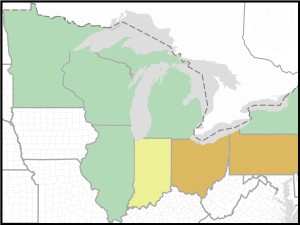
One thing I wish I had more time to discuss is the use of State and Territorial censuses in Great Lakes research. The following map I colorized to demonstrate the Great Lakes states that held state-level censuses, typically on “the fives” (e.g. 1855, 1865, and so on).

StateCensusMap

The states in green held state censuses, those in orange did not. Indiana (in yellow) did, but they are scattered or no longer exist. So, of the eight Great Lakes States, five of them offer this extra set of records that other states do not.

I share with you two resources for further study on this topic:

To make things a little easier, I have collated the information from both of these sources, as well as that from the appropriate state archives, to create a useful table regarding only the Great Lakes States. (Click here to download a PDF.)

So, if you had not considered whether or not your Great Lakes ancestors had been captured on a state or territorial census, I hope the above resources help you figure that out. Happy searching!

BCG Putting Skills to Work 2018

I’ve been in Grand Rapids, Michigan since Tuesday when I attended the Board for Certification of Genealogists (BCG) Education Fund’s “Putting Skills to Work” class. What an excellent day! The time was split between two classes.

Connie Lenzen’s class “Planning and Executing Reasonably Exhaustive Research: Or How to Ensure a Successful Hunt” discussed research questions and plans. I have to say that I was quickly reminded of what I should be doing everyday. I get so excited for the research that I forget to focus, slow down, and set forth a path for my search.

Tom Jones made us think about “Citing All Kinds of Online Sources.” This class focused only on sources you find online and really made us look at all of the layers that an online source might have. The original source, the microfilmed version, the scan of the microfilm, an original digitization in color, previously published or not, and so on. We worked through many example citations as a class and discussed each of the parts.

The level of interactive instruction that one gets at a BCG “Putting Skills to Work” class is incredible. If you are interested in certification, are already on the clock, or are already certified, it doesn’t matter. These classes are wonderful examples of hands-on, lecture with discussion with exercises, types of classes many of us enjoy and will benefit for our own continuing education.

The BCG Education Fund’s “Putting Skills to Work” occurs on the Tuesday before the National Genealogical Society Conference every year, so you will want to adjust your schedule accordingly. Next year’s schedule was announced at this years’ class, and will take place in St. Charles, Missouri on Tuesday May 7, 2019:

  • “Meeting Standards with Twenty-First Century Research Reports” with Melissa Johnson, CG
  • “Evidence Analysis: Theory, Practice, and the Real World” with Nancy A. Peters, CG, CGL

For more information on the BCG Education Fund, visit bcgedfund.org.