I started (in my spare time) revisiting the work I did on some of my family lines back when I didn’t know any better. I refer to myself as a “baby genealogist” during that time. We all start somewhere and don’t know what we don’t know in the beginning. Well, now with 25 years of experience under my belt, I’m revisiting some of those lines I haven’t touched in almost as many years.
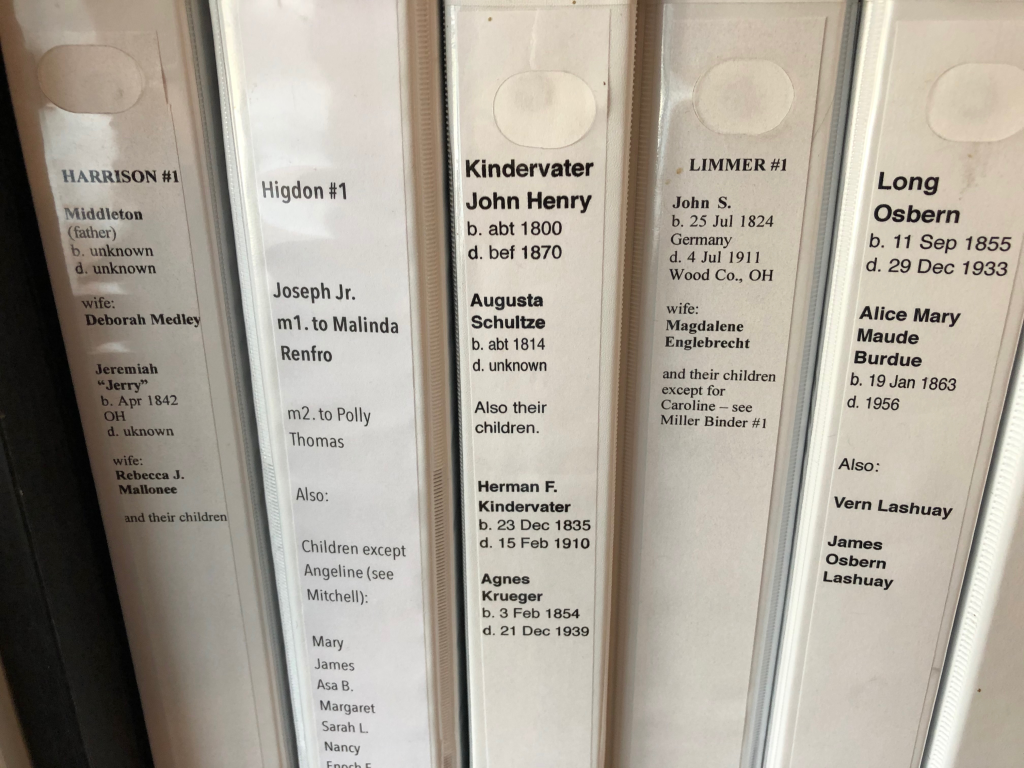
I have a binder and electronic filing system that should mirror each other. If you only do one, good for you! Seriously. I just can’t bring myself to trust one or the other and feel the need for redundancy. And I think if I were to disappear (hit by a bus, win the lottery and just move to a deserted island, whatever) I’m not sure my kids would know where to look on my computer to find the work I did. But I will have the binders. And someday I may have a “Read Me” file prepared directing them to the electronic files. But it is not this day.
First, I have to clean up the mess… ok, it’s not a mess, I just didn’t know any better at the time. So it is filling in blanks with the new knowledge, experience, and changes in the genealogical world that have happened since I began back in 2000.
I’m going to share my basic process and I’ll go into most steps in more detail as the series moves on. To have some background, you might revisit my posts on my organization system. You might also look at my post on “touch-it once citations.” I’ll be referring to items from these posts along the way.
My basic steps:
Review what I have in each binder and digital file. If I don’t have sections for each child in the binder and/or digital folder, add them, even if they have nothing in them yet. This is a stage to help get me ready and stay organized as I conduct new research.
I work by couple and their children (except the one I’m descended through because that person will be part of a couple). Each binder represents a couple (unless I have very little then couples might share binders until they get too much stuff).
I use those binders that have a plastic envelope on the outside that lets you slip papers in. On the front I have a family group sheet for that couple and on the back I have a pedigree chart showing this couple’s placement in the larger family tree. I print these from my desktop software.
I work on each couple and their children (I don’t go any further unless I need to for a specific project, these are just the basics remember.) I find the basic records that should exist for each such as:
Census for each year they should be there.
Vital records if available (state, county, or city).
Newspaper articles, especially obituaries.
As I work on the basics listed above, invariably something else pops up. I will either capture it right then or put it in a list (with a link and detailed notes) to work on later. It depends on how much of a time crunch I’m working with.
I have a process I do with each document as well. I’ll go over those details in the next post so stay tuned!
When I started this journey in genealogy in 2000, I had set out to find my family’s connection to Roy Rogers. We just always knew that he was our “cousin.” I wanted to figure out the connection and in the process disproved a dearly-held family myth. (If you want to know more, you should tune in to my presentation for IGHR on 28 July 2025.) Since then, I have been on a 25+ year journey educating myself, building my skills, and gaining the Certified Genealogist credential. In that time, I have developed skills, processes, and strategies that I have honed into a workflow that works for me.
However, as I look back at some of my early work, I see a lot of flaws. Of course, I do. As we gain knowledge and skills, those things we did before did not benefit from that knowledge and skill. I have been revisiting my old work, families I have not given attention to since I started. It has been eye-opening to see how far I’ve come. Working the daily grind, I find it hard to notice that my skills have gotten better over time. But when I look back at some of my earliest work, the contrast is stark. And it fills me with a bit of pride, but also some anxiety. If I died today, what would other researchers think of this low-quality (i.e. early) work?
It is from this anxiety that I have started on a journey to bring my older work up to standards. I’ve said in lectures that I feel like there are at least two phases in a genealogist’s life: the collection phase and the project (or brick wall) phase. The first is when you are just collecting all of the easy, low-hanging fruit for your ancestors and climbing your family tree as fast as you can. I believe this is where we all begin. In my beginning, since no one had built my tree, I started out with very little, so finding records and climbing branches is relatively easy. The second occurs when things get tougher. You run into research in that pre-1850 time when censuses did not name everyone in the household, for example.
As I’m revisiting my older research, I’m discovering that I didn’t even get all of the low-hanging fruit. When I started, genealogy on the internet was in its infancy. I had email. But digitized censuses did not exist yet. Or the 1880 census CD boxed set had just been published by FamilySearch (but I couldn’t afford it). I did most of my beginning research at the library (Denver Public Library, the Family History Library, or a local Family History Center) or via email or mailed letters. As I am going back through my work, so many things are online now, it is incredible to think about!
My current process includes:
Finding all of the census records each individual/family group should be in. Extracting that information into a spreadsheet. (I use premade forms from CensusTools.com.)
Find any vital records that are available online for the individuals.
Find online obituaries or news articles about the individuals.
Find probate, land, military, or any other records for the individuals.
I add the information from these records into my Reunion database.
I write the source citation for each document and add it to my master list and copy/paste to Reunion. (See my post on my “Touch it Once” Citations.)
As I’m doing the above, I often think of other records to look for. Especially after 25 years of education and practice, I have knowledge of other records that I didn’t know about in my early days. This is allowing me to fill in gaps and build better profiles for my ancestors.
I am doing this through all of my family groups. I keep a binder system, because that is just how I like to do it. I get tired of reading on a computer after doing that all day for my day job. Also, if all of my “stuff” is in a computer file, will anyone ever find it once I’m gone? My binders and my digital system match, more or less. The binders make an easier to see representation of my work and our family history. Of course, they could be tossed out, along with all of my unfinished craft projects. But I digress…
My next post will share some of my future plans for this revisiting old research and how I plan on improving what I’ve got.
When conflicting evidence rears its ugly head in our research, we have to confront it. We can’t ignore it. If we ignore it, other researchers will find it and then that puts our other conclusions into question. Many times, conflicting evidence can be easily explained and you can set aside the “wrong answer” and focus on the right one. Let’s look at this in practice with my George Long project.
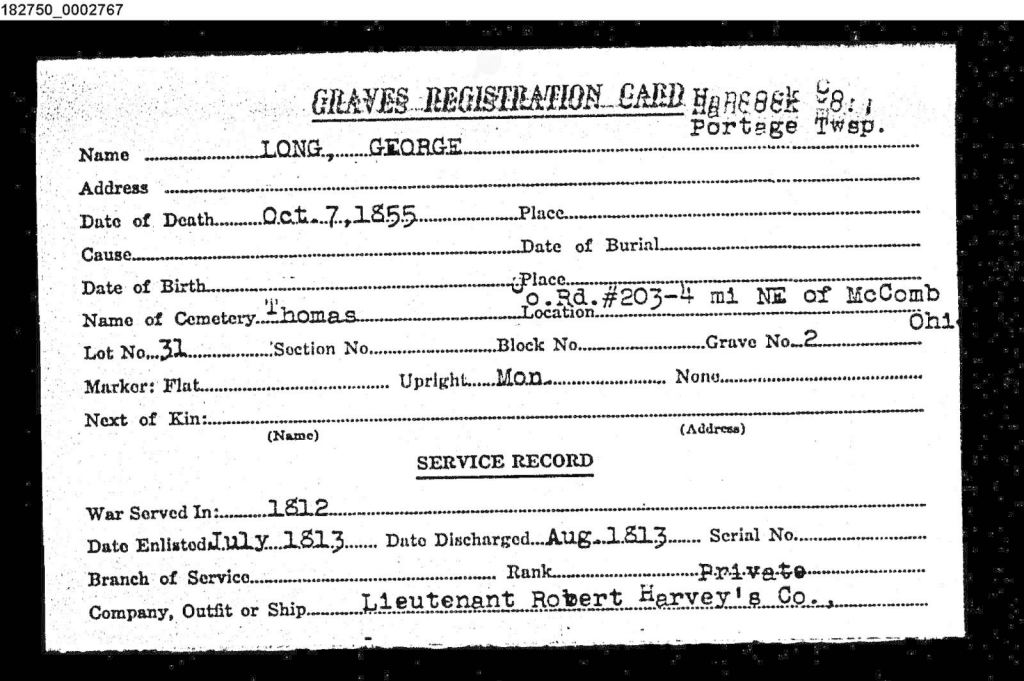
“My” George Long has been attributed as having served during the War of 1812. However, my research has indicated that he arrived in 1817 at the earliest. A “Graves Registration Card” for “my” George Long, who died in Hancock County in 1855, indicates that he was a soldier during the War of 1812 and served as a Private in Lieutenant Robert Harvey’s Company.1
I investigated the origin of this card. As a New Deal program under the Works Progress Administration, workers attempted to identify all of the veterans who were buried in the State of Ohio. The veterans were indexed as part of the “Grave registration cards A–Z, soldiers buried in Ohio from the Revolutionary War to World War II” collection at the Ohio History Connection.2 This project was undertaken in the late 1930s under the Historical Records Survey, sponsored by the Ohio Adjutant General’s Department.
“The project was ambitious, trying to record the grave of every veteran buried in Ohio, but the record is far from comprehensive and the information not always accurate. The information on the cards was taken from burial or cemetery records or from information on the headstones. Information about military service may have come from the county recorder’s office or military rosters or the local GAR. It is hard to say with any certainty where the information on an individual card came from.”3
Indeed, a George Long did serve in the War of 1812 for Ohio in Robert Harvey’s Company. That company’s service was from 13 July until 17 August 1813. The roster indicates the company was “probably from Ross County.”4 There is another George Long who served in Captain Isaac Pancake’s Company, also “probably from Ross County.”5 Ross County is in the south central portion of Ohio, not near the northeastern counties that would later make up Carroll County. There are no George Longs living in Ross County during the 1820 census enumeration.6 Only one George Long has been located in Ross County; a man who was about 30–40 years old was enumerated there in 1840.7 If he were born in about 1800, he would have only been 12 years old at the start of the war, too young to have served.
There are seventeen cards for men named George Long in the War of 1812 Service Record Index, two for service in Ohio.8 One served in the 1st Regiment (McDonald’s) Ohio Militia as a private.9 The other served in the 2nd Regiment (Willett’s) Ohio Militia as a private.10
If George Long arrived in 1817, he likely did not serve during the War of 1812. It is possible that he could have served, returned home to Ireland, and then returned to the U.S. with his family by daughter Catherine’s reported birth in 1820 in Ohio. However, it would have been a long and difficult voyage across the Atlantic during the 1810s and 1820s, which usually took about six weeks before the use of steam power in the 1830s. However, if George was a soldier in the War of 1812, it seems likely that his grandson’s biographical sketch would have mentioned him as one of the heroes of that war, as many biographical sketches did. Furthermore, no soldier’s pension for any George Long of Ohio, including the two Privates in the 1st and 2nd Regiments, has been located.11 Beyond the connection made in the WPA Soldiers’ Grave Registration Project, there is no indication that George Long, the father of William, served during the War of 1812. The more likely scenario is that he did not serve, and the service of another George Long has been attributed to him.
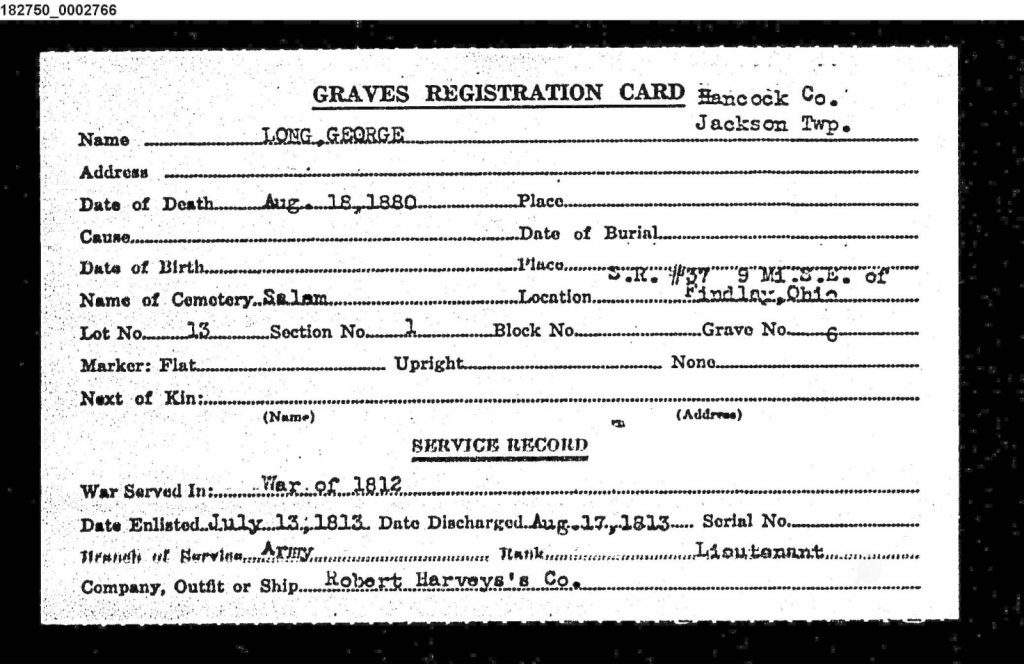
In fact, the other George Long (whom I call “Candidate 11”) that lived in Hancock County has an obituary that mentions his service during the War of 1812. It seems they both were attributed with the service of the other George Long.
This is an example of resolving conflict in my George Long project. I found a conflict that I couldn’t ignore and had to explain. This caused me to conduct research that ultimately did not apply to “my” George Long but had to be done to prove that he, in fact, did not serve during the War of 1812. Address the conflicts you find so they are explained and not left hanging.
1. Ohio, Adjutant General’s Department, “Grave Registration Cards A–Z, soldiers buried in Ohio from the Revolutionary War to World War II, circa 1810–1967,” Works Progress Administration Project, Historical Records Survey, card for George Long, died 7 Oct 1855, Thomas Cemetery; image, “US, Ohio, Soldiers Grave Registration Cards, 1804–1958,” Fold3 (https://www.fold3.com/)↩
2. “Grave Registration Cards A–Z, soldiers buried in Ohio from the Revolutionary War to World War II, circa 1810–1967,” Ohio History Connection (https://ohiohistory.on.worldcat.org/), catalog entry.↩
3. Tutti Jackson, Library Services, Ohio History Connection (reference@ohiohistory.org) email to author on 29 Dec 2023.↩
4. Roster of Ohio Soldiers in the War of 1812 (Columbus, Ohio: Adjutant General of Ohio, 1916), p. 51. Neither a War of 1812 pension or service card have been located for George Long of Robert Harvey’s Company.↩
5. Roster of Ohio Soldiers in the War of 1812, p. 113.↩
6. “1820 United States Federal Census,” Ancestry (https://www.ancestry.com/search/collections/7734/). Search for George Long in Ross County, Ohio. The 1810 Federal census for Ohio is not extant. See Kip Sperry, Genealogical Research in Ohio, 3rd ed. (Baltimore, Maryland: Genealogical Publishing Co., 2023), p. 79.↩
7. See 1840 U.S. census, Ross County, Ohio, population schedule, Concord Twp., p. 292, George Long household; image, “1840 United States Federal Census,” Ancestry (https://www.ancestry.com/).↩
9. General Index Card, George Long, Private, 1st Regiment (McDonald’s), Ohio Militia, War of 1812; Indexes to the Carded Records of Soldiers Who Served in Volunteer Organizations During the War of 1812, compiled 1899 – 1927, documenting the period 1812 – 1815; Record Group 94: Records of the Adjutant General’s Office, 1780s–1917; image, “US, War of 1812 Service Record Index, 1812–1815,” Fold3 (https://www.fold3.com/). McDonald’s regiment was not included in the Ohio Adjutant General’s 1812 Roster. See Roster of Ohio Soldiers in the War of 1812 (Columbus, Ohio: Adjutant General of Ohio, 1916).↩
10. General Index Card, George Long, Private, 2nd Regiment (Willett’s), Ohio Militia, War of 1812; Indexes to the Carded Records of Soldiers Who Served in Volunteer Organizations During the War of 1812, compiled 1899 – 1927, documenting the period 1812 – 1815; Record Group 94: Records of the Adjutant General’s Office, 1780s–1917; image, “US, War of 1812 Service Record Index, 1812–1815,” Fold3 (https://www.fold3.com/). Willett’s regiment was not included in the Ohio Adjutant General’s 1812 Roster. See Roster of Ohio Soldiers in the War of 1812 (Columbus, Ohio: Adjutant General of Ohio, 1916).↩
11. “US, War of 1812 Pension Files, 1812–1815,” Fold3 (https://www.fold3.com/publication/761/us-war-of-1812-pension-files-1812-1815/description). Searched for George Long in Ohio. There are four pensions for men named George Long, in South Carolina, Virginia, and two in Maryland. One George Long who served in Captain Brown’s Company in Maryland, lived in Hancock County at the time of his pension application. That man’s wife was Elizabeth Rockey and they lived in Amanda Township, not Portage Township. That man has been identified as “Candidate 11.” See previous posts.↩
I’m going to go back to my George Long project for two more posts, then I’m going to let it lie for a bit. I was thinking about “reasonably exhaustive research” and I wholeheartedly believe I did meet “reasonably exhaustive research” for this project, at least in terms of answering the original research question, which in its abbreviated form was “Which George Long was the father of William Long?” I had clues about where they originated, I thought I had the right George Long in the right counties in Ohio, but I had to prove the right one and explain away the literal eleven other George Longs I found in the right time and place. Two instances of military records causing confusion were discovered during this project and I thought they would make great examples of the necessity and value of looking at original records, and the need to resolve conflicts you find in the records.
[If you do not know what I mean by “reasonably exhaustive research,” it is one of the tenets of the Genealogical Proof Standard. Click here to learn more.]
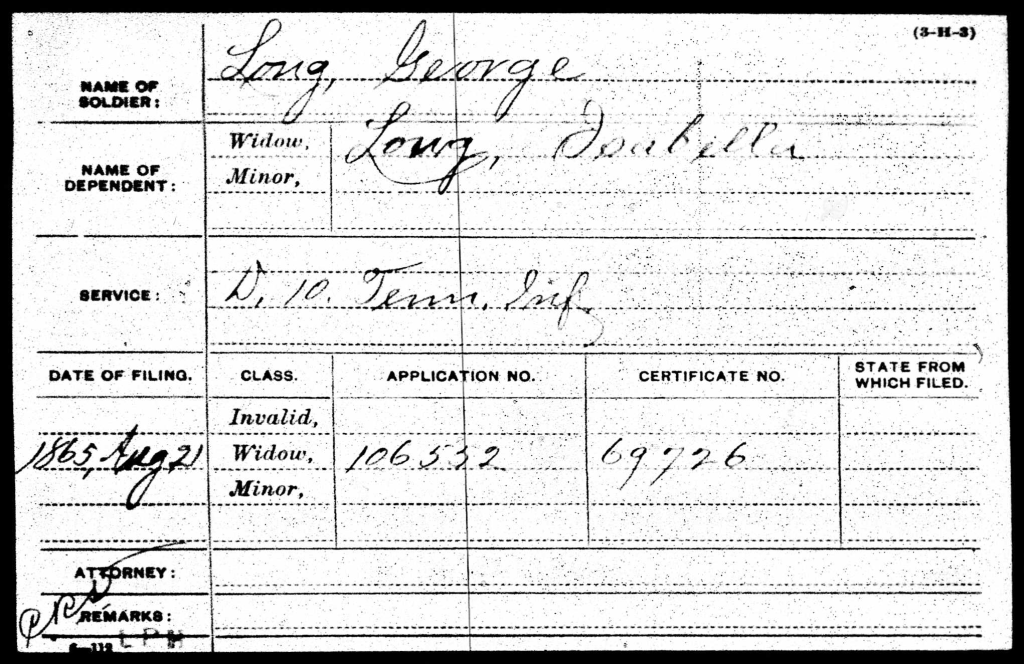
One of the records I found and saw attached in many online trees was a pension card for George Long and his wife Isabella. I have learned the hard way not to ask myself “how many George Longs could there possibly be that have a wife named Isabella in Ohio” because the answer is never “just one.” (In the case of THIS George Long project, there are at least two in the counties in Ohio I was focused on, but that’s a story for another time.) The pension card I kept seeing was indeed for George Long and his wife Isabella:
I have looked at every Ancestry tree (I think) that has what appears to be the same George Long I’ve been researching, and many of them have this card attached. My George Long lived in Ohio, but I suppose he could have gone to Tennessee to serve, though I’m not sure why he would have since there were plenty of units being raised in Ohio. However, a genealogist who aspires to conduct “reasonably exhaustive research” cannot ignore evidence items. I mean many online trees have this record attached to the same George Long I was looking at, so it should be examined.
We have all found errors, mistakes, and conflicts in online trees. But we have all also found gems, clues, and keys to solving our puzzles as well. Remember not to engage in “source snobbery.” We can’t learn much from this pension card alone. We have his name, his wife’s name, and his unit (Company D of the 10th Tennessee Infantry). We have the date his widow filed (21 August 1865). We have her application number and certificate number.
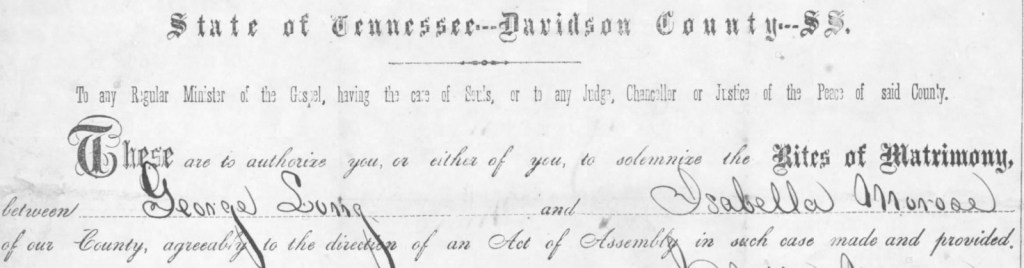
With that information, I found his pension file, this one in particular is available on Fold3. From that, I learned that Isabella’s maiden name was Morose. At the time of filing for a Widow’s Pension, Isabella (Morose) Long was a resident of Walker County, Georgia. Her husband George died on 15 April 1865 of small pox in a hospital in Nashville, Tennessee. They married on 25 July 1864 and had no children.1
However, the most obvious fact that is overlooked is that if the George Long I’ve researched died in 1855, he could not be the George Long that served during the Civil War (1861-1865).
Other datapoints do not line up either: he did not live in Tennessee or Georgia, he definitely had children, and his wife was Isabella McCullough, not Morose.
I write this post, not to cast dispersions upon other genealogists who have attached the wrong document to George Long. We have all done it. I don’t believe there is one genealogist who hasn’t made a similar mistake. I am writing this post to share my process of correcting my previous work and looking beyond an index, index card, or any other derivative (second-hand) source and examine the original. Then, pull every bit of information out of that original and compare it to the known information you are working with. Plus, understanding the chronology (see my previous posts about timelines) helps you make determinations about the records you are looking at.
We will address the issue of resolving conflict in the next post. Stay tuned!
1. Claim for Widow’s Pension, 4 Apr 1866, Isabella Long, widow’s pension W.C. 69726, service of George Long (Pvt., Co. D, 10th Tenn. Inf., Civil War); Case Files of Approved Pension Applications of Widows and Other Veterans of the Army and Navy Who Served Mainly in the Civil War and the War With Spain, compiled 1861–1934; Civil War and Later Pension Files; Record Group 15: Records of the Department of Veterans Affairs; image, “US, Civil War ‘Widows’ Pensions,’ 1861–1910,” Fold3 (https://www.fold3.com/file/288364023).↩
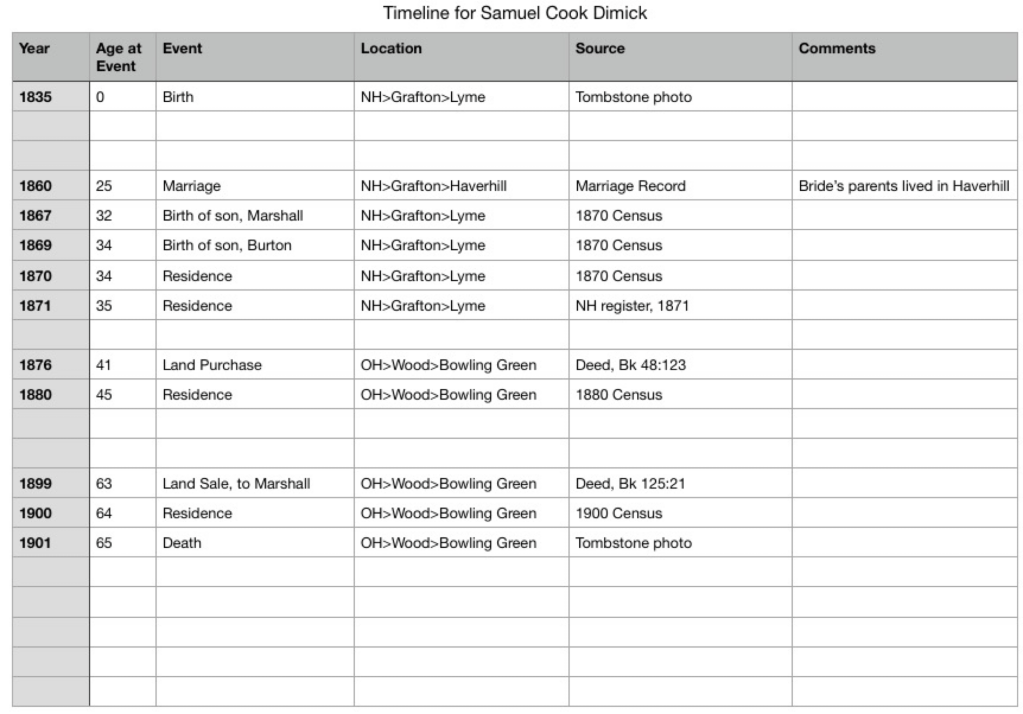
I mentioned my timeline for my ancestor Samuel Cook Dimick a few blog posts ago. Let’s take a look at his story. When I was first researching him, one of my main questions was “why.” Why did he take his family away from New Hampshire (where it is beautiful, I’ve visited) to Wood County, Ohio? Wood County is about as flat as flat can be (well, with the exception of large parts of Kansas and eastern Colorado, but I digress). Why was I from Ohio and not New Hampshire?
I have a fantastic county history entry for Samuel in the Wood County History. It has so many details about him and his family. I started corroborating that biographical sketch with documentary research. I set out to prove (or disprove) each point. (I’m still working on a few points that I need to do onsite research for, but it is mostly finished – and all points proven so far.) I started by making a timeline of the known information I had for him and then started adding those points from the county history as I proved them.
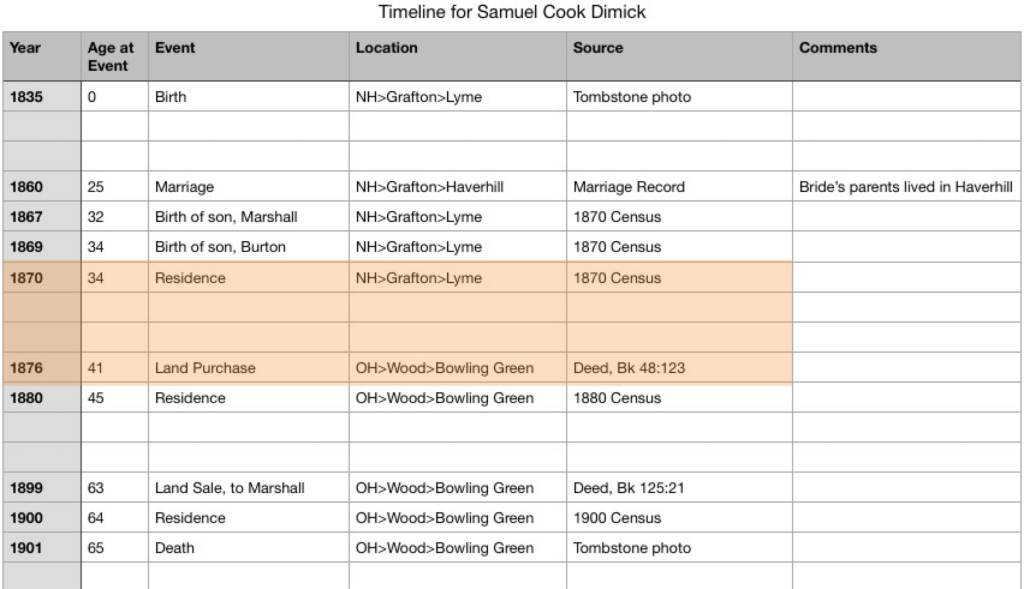
Here is an early version of the timeline. The orange box shows the gap in time between when he lived in New Hampshire and when he moved to Ohio. This is where I started asking some of those questions I mentioned in a previous blog post.
What records could I use to fill in the gaps? To keep a long research story short, I looked at a lot of records, including city directories for Bowling Green, Ohio. They do not have them for these specific years, so I was out of luck in that regard.
I reread the county history.
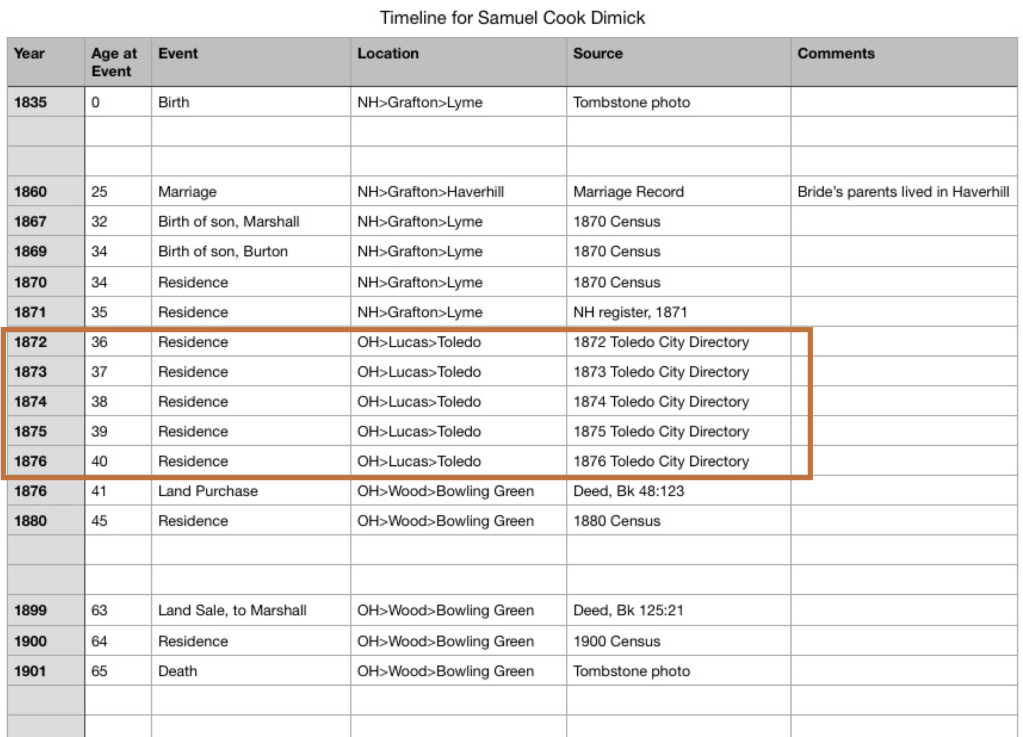
I’m sure none of you have ever glossed over things you read, have you? This is why it is important to go back and reread things you’ve read before. I had learned a lot since the first time going through the county history. But the answer I needed was right there in front of my face. The family lived in Toledo for a while before he moved the family to the “Old Williams Farm” in Wood County. This allowed me to go back to city directories, but this time to directories for Toledo, which is in Lucas county. Sure enough, I found Samuel live there for the roughly five-year gap.
This allowed me to fill in the gap and ultimately answered the question about why the moved from New Hampshire to Ohio. The city directory shows that Samuel worked for “H. M. Clark & Co. Manufacturers of Tin and Japanned Ware.” In the 1870 census, Samuel’s occupation was in “tin.” Turns out, H. M. Clark is roughly the same age as Samuel, also born in Lyme, New Hampshire, and they served on a town council together in Lyme. So, Samuel moved to Ohio for a job opportunity.
Other research has filled in Samuel’s timeline beyond this, but the visualization of your known information allows you to get more detailed and fill in those gaps, thus building a more robust understanding of your ancestors.
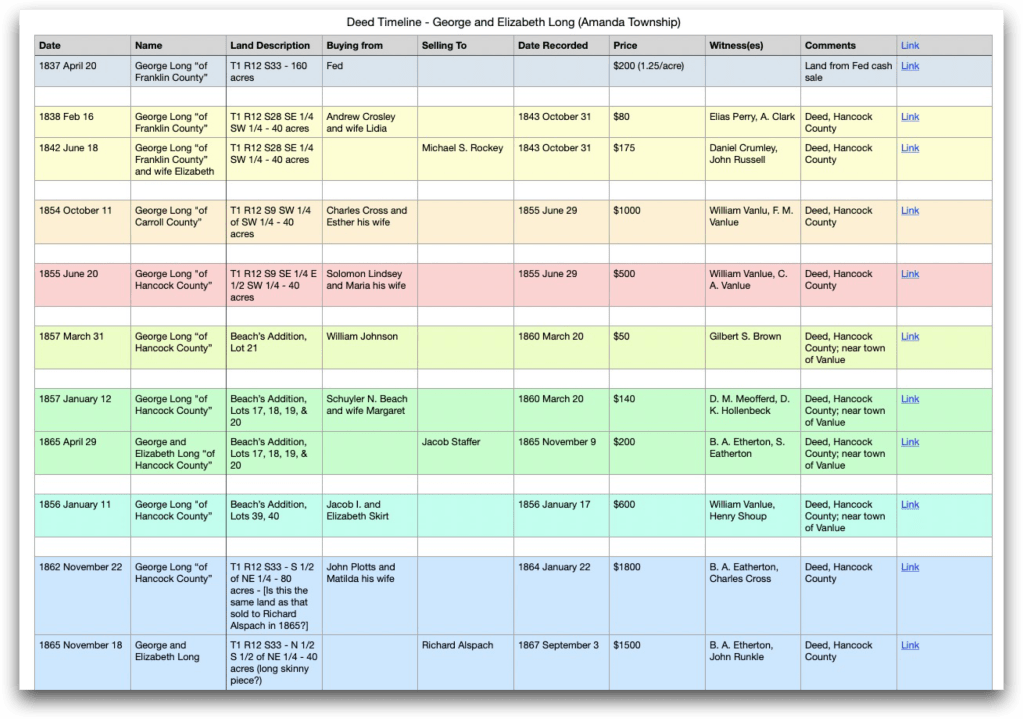
Sometimes in our research, we come across an ancestor who did a lot of land deals. And you may want to understand what he was up to in more detail. Putting those land records into a timeline can really help. These are sometimes called “in and out” tables and may not necessarily be intended as timelines, but if you set up your spreadsheet or table in a way that allows you to sort by date, that’s exactly what you’ve created. You can follow a particular piece of land AND you can follow a person’s land transactions.
While working on my George Long project, I needed to disambiguate two George Longs in Hancock County, Ohio. One bought and sold land frequently in that county, the other owned one piece of land. (Can you guess which one mine was?)
Here is the table. The first image shows each piece of land next to each other, color coded to match. You’ll notice that in some cases, there’s only one entry. That means I did not find the “in” or “out” deed for that land in the timeframe I was working in. The land could have been inherited or disposed by will rather than in the deed books I was looking through. More research could be done to find those. (However, this is NOT my George Long, so I don’t think I’ll be doing that research.)
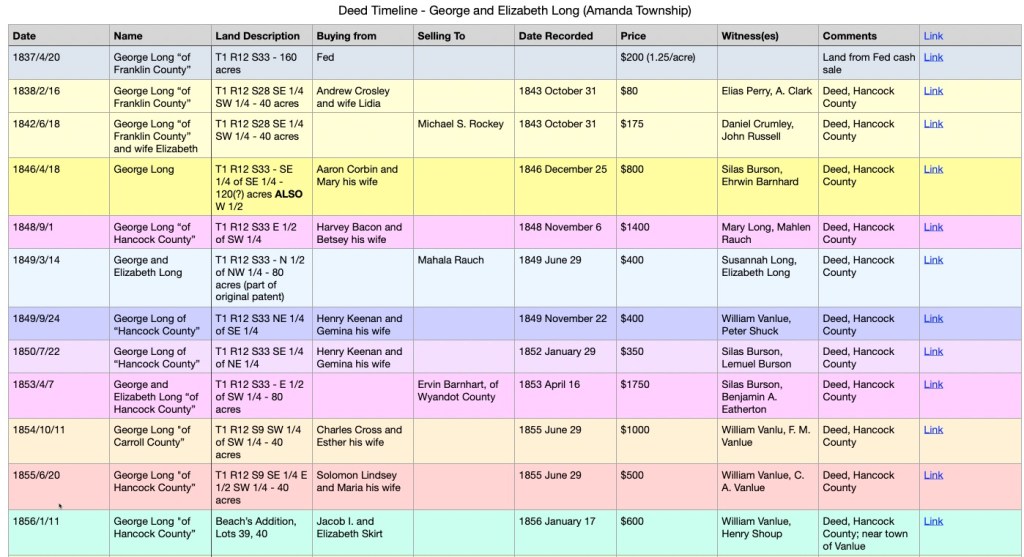
The above table is organized by piece of land. However, because of how I captured the data, one click turns this into a timeline.
Timeline sorted by date.
If you are paying attention, and have read this far, you may have noticed that the first table is in fact NOT entered such that it will sort properly on the date. And if so, you get a gold star for the day. I had to go fix that for this blog post. It sorts alphabetically, essentially, so if you type of the names of the months, they will not be in proper month order. I had to go back and put the dates in by number instead of name so it would sort properly.
Couldn’t “they” have named the months in some kind of alphabetical order? I prefer the names over the numbers, myself, but that doesn’t sort right, so humbug.
Timelines can also be use to visualize other types of projects or research goals. Probably the best two examples I can share from my own research are when trying to disambiguate two people of the same name (do we have one person or two?) and when trying to compare deeds for someone who did a lot of buying and selling of land (often called an “in and out” table, but they can also be timelines if you set them up in your spreadsheet to be able to sort them chronologically).
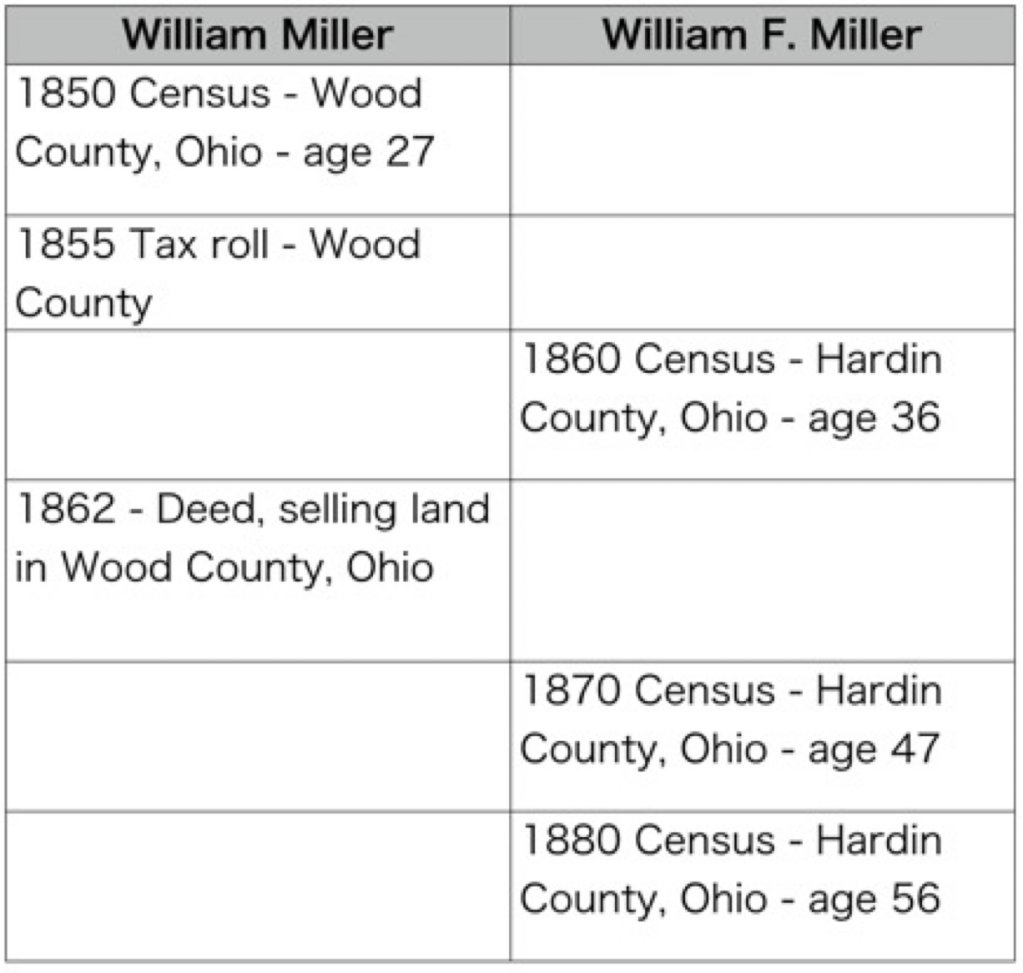
“One person or two of the same name?” is a common genealogical problem, especially in an area where a family lived for several generations. All the brothers named sons after grandpa and pretty soon, no matter how unique a name may be, suddenly there are multiple men with the same name in the same county at approximately the same time. How do you differentiate them? One tool is a comparative timeline or a “side-by-side” timeline.
Make columns for the same-named people. In my example below, we’ll just look at two to keep it simple. I then put abbreviated information in each box/cell for that person. Enough to put it in chronological order, see a location, an age, and the source. In the case below, you can see a census, tax, or deed year, a location, and an age for William Miller and William F. Miller.
An example of a comparative or “side-by-side” timeline.
In this simple example, the two men do not overlap in records or location, at least as presented in this timeline. You need to ask yourself questions to fill in any gaps and to try to prove or disprove that this is one man or two men. Some general questions I ask myself:
What time gaps are there that I can fill?
What records might fill those gaps?
What historical events were happening that might explain those gaps?
Some questions specific to this project I ask:
Can I find William F. Miller in Hardin County in the 1850 census?
Are tax rolls available for Hardin County where I could look for William F. Miller?
Can I find William Miller in Wood County in 1860 or 1870?
How far away are Wood and Hardin counties from each other?
Of course there are more questions and more research that could be done on the above. It is just meant to be an example. (I have my Miller ancestors squared away during this time period.)
The first set of questions work for a single timeline as well. One of my favorite examples of this has to do with my ancestor Samuel Cook Dimick. We will look at his specific timeline in a later post. By looking at data in a different way, we can see patterns or gaps that may have missed before.
There are some things you will want to consider when setting up a timeline for your ancestor or project.
First, how are you going to make it (special software, spreadsheet, word processor, paper and pencil)? What tools you use to create your timeline might dictate some of the next items. I like to use digital means, usually a spreadsheet or a word processor, because they are easy to add to, rearrange, sort automatically, etc. However, as a pre-computer native, I like paper and pencil. If I were going to create a timeline for a project on paper, I would suggest using notecards or sticky notes, one for each event, that you can add to and rearrange as needed.
Second, what kind of information do you want to capture. You’ll need to decide on a format so your timeline is consistent. When I am using a spreadsheet, I will tailor the columns to fit my needs for that particular project. For a general timeline for an ancestor’s life, I use these column headings:
Year – I usually only use the year unless I need to get more granular, then I’ll change this to a numerical sortable date system such as Year/Month/Day. You may have to work with your spreadsheet’s formatting for numbers so it appears correctly. I usually set them to “text” rather than it trying to interpret a date.
Age at the time of the event – I like to capture this because it often tells me something about the person or the event. If someone is paying taxes or getting married, but their age is too young or too old, then it might indicate that I’ve made a mistake somewhere.
Name of the event – I keep it simple when possible so “Birth” or “Marriage” usually suffices.
Location – Depending on what you are looking for, you might put in the place from largest to smallest or smallest to largest. For example: Lyme, Grafton, New Hampshire vs. New Hampshire, Grafton, Lyme. If I want to see all of the New Hampshire items together, I might opt for the large-to-small option.
Citation/source – this does not have to be a full-on polished Evidence Explained citation, but don’t skip this step. I am always second-guessing myself. I do not know how many times I’ve had to recreate my research because I forgot to note where I got a piece of information. Timelines are no different. When you find something that conflicts, you’re going to want to know where you got that information. Do something that works for you, if that’s a link to a document or database, a full citation, or simply “Samuel’s death certificate.” As long as your note tells you enough to go re-examine the record, you’re good.
Misc. Notes – When I am creating these timelines, questions invariably come up, or I might want to make a note about a particular event. Put in a misc. notes column to capture those ideas and thoughts.
A work-in-progress timeline for Samuel Cook Dimick.
Next we will look at some more specialized timeline set ups for various projects.
As genealogists, we gather a lot of data. We find our ancestors in many records such as obituaries, death and birth certificates, deeds, wills, church records, tax records, military records, and so on. The list is endless. How do you analyze, process, or understand the information you’ve gathered? And if you’re working on a trickier project, say figuring out which of the 12 George Longs is your ancestor, how do you keep it all straight?
One of my absolute favorite strategies is timelines. Creating a timeline for your ancestor puts his or her life into context and perspective. Obviously (or maybe not), a timeline is a list of events in chronological order. They show the “lifespan” of an individual, a place, or an historical event. Depending on what your goals are, you can create timelines with different focuses. The two main focuses I use are event-focused or document/source-focused.
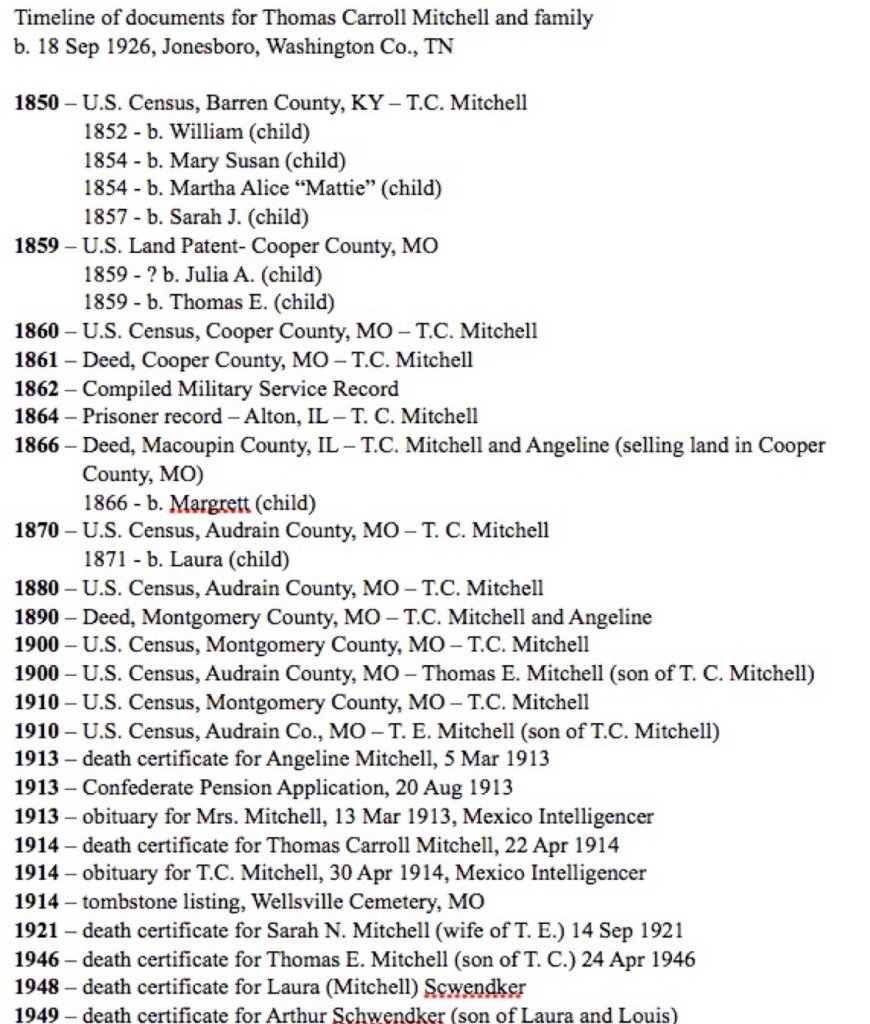
Each document was created on a date (sometimes you know that date because it is written on the document, sometimes you might have to make an educated guess based on context). By putting together a document-focused timeline you can assess your research and make a plan for any research holes you find.
Document-focused timeline
Documents or sources may list multiple events. A death certificate, for example, will list a date of death, but also may list the birth date, the burial date, the onset of an illness, the date of a coroner’s inquest, etc. An event-focused timeline pulls all those dates out.
Event-focused timeline
As you enter your data into your genealogical software or online tree, if you use them, they may automatically put the events in chronological order, helping you to visualize your ancestor’s life. When I get deep into a project, however, I tend to work in a spreadsheet or word processor so I can reorder things, put in items that may I may not want in my software, add historical context items, and link citations.
Next, we will look at using timelines to compare and analyze your research.
I love timelines. They have so many benefits when it comes to genealogical research. It helps you see an ancestor’s life in order. We get so many records, bits of information, and other clues, that putting them in time order helps me to see their life. It also helps to solve some genealogical problems such as if you’re working with one man or more of the same name, like my 12 George Longs.
The main thing I use them for is to help me find holes in my research. When I find gaps in time especially if they also changed location, I start asking questions, the main one being “what records can I find that will help fill in this gap?”
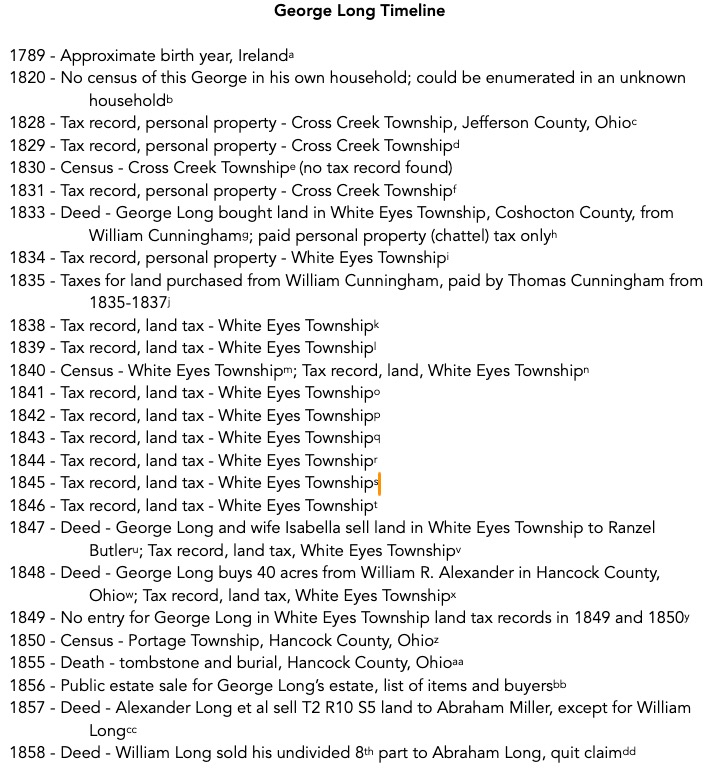
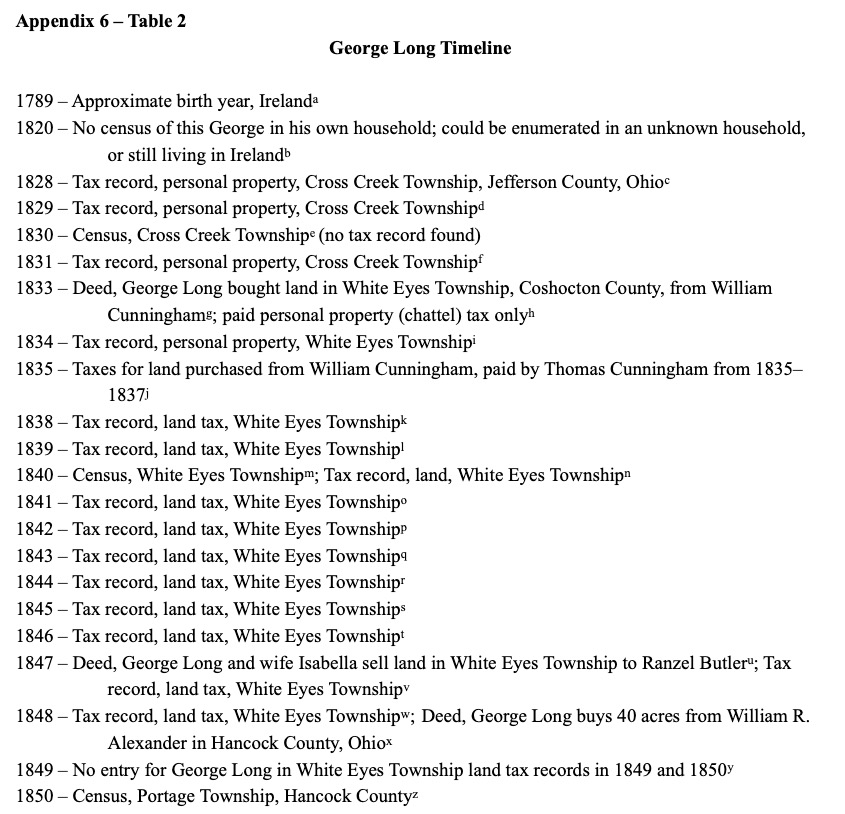
For George Long, I had twelve candidates. Many of them I could easily eliminate, usually because they didn’t end up in Hancock County, Ohio. Some of them died too early, or married women not named Isabella. But when I narrowed in on the “correct” George Long, I found him in a couple of locations before he made it to Hancock County. I had to be sure his time in those locations made sense. A timeline did this for me.
I’m just showing you part of the timeline, and I’m not showing the footnotes, but rest assured, there are citations for each fact. I needed to show that the George Long in Cross Creek Township of Jefferson County, stopped showing up in the tax lists just as the George Long of White Eyes Township in Coshocton County buys land and starts paying tax in that county. Later, I show the sale of his Coshocton County land (an him no longer on tax lists) just before his purchase of land in Hancock County.
The timeline helped me demonstrate that this was indeed one man and his life events lined up with those of the Hancock County George.
Of course, other records were used, there is a DNA portion to my case, and I had a series of conflicts I needed to resolve, but these last several blog posts have hit the highlights of my George Long project. I hope it gave you a bit of insight into my recertification process.

 Genealogy Pants