Category Archives: Genealogy Program

“Crossing the Pond” An upcoming course at the British Institute

britishI will have the pleasure and honor of teaching at the “British Institute” hosted by the International Society of British Genealogy and Family History (ISBGFH). I will be teaching three classes in the course titled “Crossing the Pond: Finding Your Immigrant Ancestor in Their Homeland” coordinated by Eric Stroschein, along with Luana Darby and David Ouimette, CG. The following is an excellent description of the course:

Are you stuck? Have you hit the European immigration research brick wall called the Atlantic Ocean? Want to learn how to resolve your own research problem? Whether your immigrant ancestor came directly to America or through the British Isles this class is for you. For this class, it does not matter where your immigrant came from.

Crossing the Pond teaches proven beginning to advanced methods, instructing students how to resolve their own research problems. Students in this course will bring up to 5 of their own European research problems to work on throughout the week. Crossing the Pond demonstrates sound methodology translates to all countries.

This workshop style course has the look and feel of private consultations centered around morning classroom instruction on methodology and followed by problem solving with guided research by your instructors in the Family History Library while using your own research problems.

The three classes I will be teaching are:

  • Using Lists to Find Proof
    • Genealogists examine lists every time they conduct research, whether it be in the form of censuses, tax lists, directories, petitions, or others. This class will demonstrate methods of examining lists as a research tool for proving the identity of our ancestors.

  • Using Church Records to Find Ancestral Origins
    • Use maps, directories, county histories and other clues from family lore and tradition to determine the religious affiliations of your ancestors. Locating, examining, and analyzing the records for a given church, might be the key to identifying an ancestor’s place of origin.

  • Canadian Migration and Immigration
    • When we think about our immigrant ancestors, we often visualize them coming directly to a United States seaport such as New York or Philadelphia. However, many of our forebears entered through Canadian ports before migrating south overland to become U.S. citizens; some may have crossed back and forth several times creating many records for genealogists. This class examines some of the common migration patterns and the documents they created.

I know I wish I had this course when I was beginning my genealogical research. There is still time to register! If you sign up by September 15 you will save $65 on the registration fees! The classes take place at the Plaza right next door to the Family History Library in Salt Lake City. There is no better format than a half day learning and a half day researching, if you ask me. I am sure this course will be of use to anyone who is looking for their ancestors’ origins “across the pond.”

More information on the other instructors:

Course Coordinator:

Eric Stroschein, is a professional genealogist located in Mount Vernon, Washington. He owns Generations Detective, a genealogical research firm that offers a wide variety of services. Eric has roots in the British Isles and has had great success finding ancestors in their native countries for his clients and his own family. He lectures nationally at various genealogy conferences. To contact Generations Detective please visit: http://generationsdetective.org/contact/

Course Instructors:

Luana Darby, MLIS, is a professional genealogist and lecturer, based in Salt Lake City. She is the owner of Lineages by Luana, a genealogical research company which focuses on US/Canada and Western European research. She has served as president, vice president, and treasurer of the Utah Genealogical Association and currently serves on the Association of Professional Genealogist’s board. She also is employed as an adjunct faculty member at BYU-Idaho in the family history department. 

David Ouimette, CG, CGL, manages Content Strategy at FamilySearch, prioritizing historical records worldwide for digitization and online publication. He has conducted archival research in dozens of countries across the Americas, Europe, Africa, and Asia. David lectures at national genealogical conferences and institutes and authored Finding Your Irish Ancestors: A Beginner’s Guide.

My lecture at the APG PMC is all about the “PERSIbilities”

In just two short weeks I will be attending and presenting a lecture at the Association for Professional Genealogists Professional Management Conference in Fort Wayne, Indiana. (My how time flies!) I will be presenting a lecture on a resource that is one of my favorites: the Periodical Source Index, or PERSI.

“PERSI Possibilities: Better Research with ACPL’s Periodical Source Index” will take place on Thursday 22 September 2016 at 1:15. So right after lunch… I do hope the great examples I will share and the stories I plan on telling will keep everyone awake!

A colleague and genea-pal Darcie Posz suggested I start a hashtag for my program #PERSIbilities. I love that and wish I had thought of it myself… I may have to retitle my lecture! In this program I will give the audience a look into the Periodical Source Index (PERSI), its new partnership with Find My Past, and tips and techniques for getting the most out of this valuable genealogical resource.

There is still time to register for the conference. Click here to go to the APG conference page. The entire conference runs from 22-24 of September at the Allen County Public Library. There are some fantastic presentations in the line-up that I am truly looking forward to attending. There are twenty-five different lectures and five workshops to choose from high-caliber genealogists working in the field today.

Besides the opportunity for learning, the conference is being held in one of the best genealogical repositories, the one that started PERSI, the Allen County Public Library. Who could ask for anything better? So, consider adding the PMC to your genealogical education plan. I hope to see you there!

Genealogical Preparedness – Part 5 – Conference Planning and Participation

Photo taken by my friend Deena Coutant, November 2015.
This year I have had the opportunity to speak at several state and regional conferences. Up until this point I had only spoken at smaller venues, mostly local societies with audiences of 100 or less, in my local area. This year I also had the opportunity to witness a little bit on the conference planning side. This by no means makes me an expert on either of these sides at any level. I have the utmost respect for those who have the ability to plan conferences, to delegate, to deal with stressful situations, and to keep on smiling throughout! But I did learn a few things along the way that I will use to better prepare for next time I am invited to speak at a conference.

The first thing I learned outside of the general nuts and bolts of being a speaker (you learn these things by speaking to the local societies near you, they are often looking for speakers), is to be sure I understand the contract. When speaking at my local societies I have yet to sign a contract and most of the business has been done over email, so the contract was new for me. I made some assumptions I shouldn’t have. Had I asked questions when things weren’t clear instead of thinking “well, it will be fine” or “I’ll just figure that out when I get there” some confusion and awkward conversations wouldn’t have happened.

From that came the need to have flexibility. This applies to conference planners and speakers alike. When you get to a venue and things aren’t what you had in mind, it really does no good to have a major hissy fit (or even a minor one). All that does is get people upset. Everyone should breathe just a little more deeply, take a few minutes to calm down, and then problem-solve. Usually there is a solution to just about anything if you can keep calm.

Be prepared for strange situations. Rooms get changed, times get changed, projectors stop working, power goes out, people fall down stairs, the lunches aren’t lined up in an efficient way, the fire alarms go off, speakers get sick or injured or miss flights, weather happens, microphones have feedback or their batteries stop working… This list could go on and on and on. For every speaker out there, there is probably at least one story of strangeness happening during conferences. Flexibility helps with strangeness. There are a lot of things out of our control and being rigid only helps in raising blood pressure. Laughter is the best medicine. Make light of strange situations, make jokes, be witty, and in general “roll with it.”


Love and Marriage and Death – Dying together

I don’t know about you, but it seems like there are a lot of couples who die very closely together. It could be coincidence, it could be they were both equally unhealthy at the end, it could be just my romantic notion that sometimes people are just so in love that they can’t live without each other. Who knows, but here is another example:

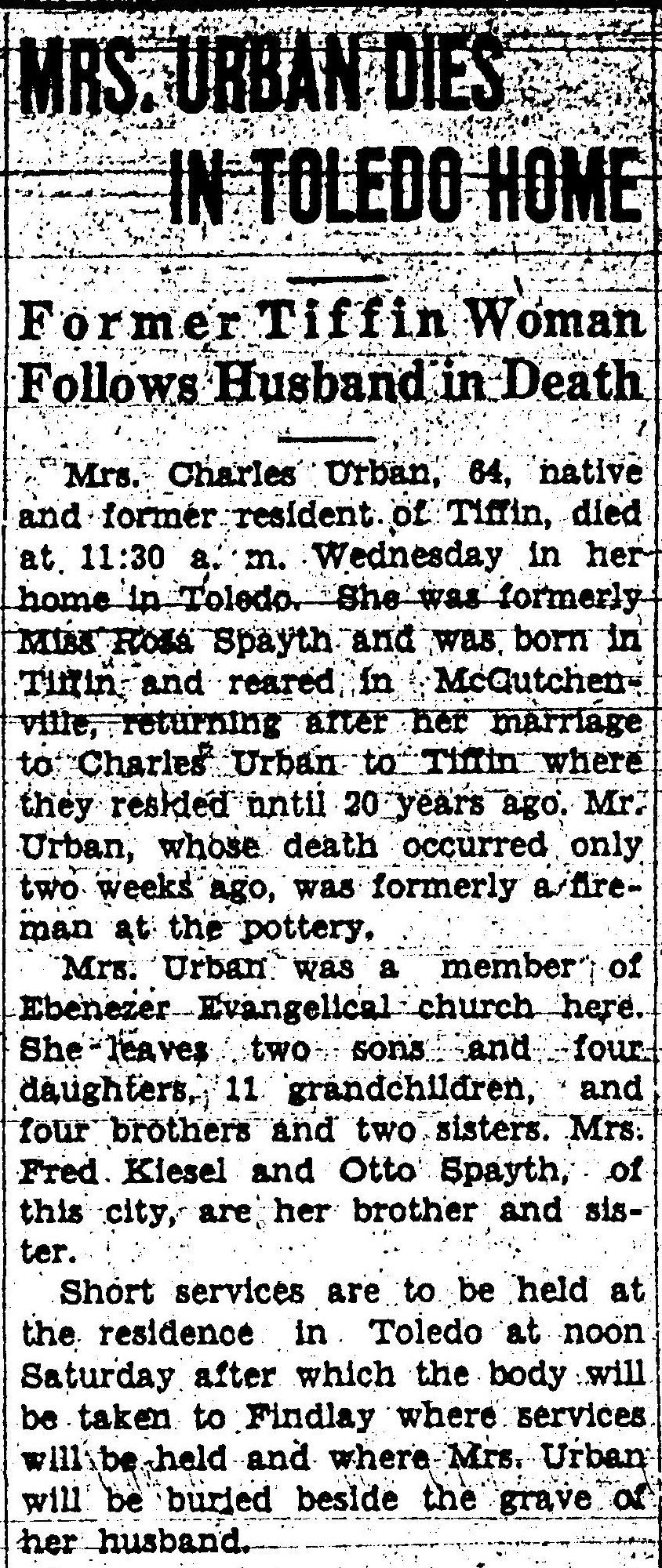
Charles Urban died just two weeks before his wife of 30 years:

Urban_Rosa-obit
Mrs. Charles Urban obituary, Advertiser-Tribune, Tiffin, Ohio, 3 Aug 1933, p5 c7.

Love and Marriage – Getting a Good Wife

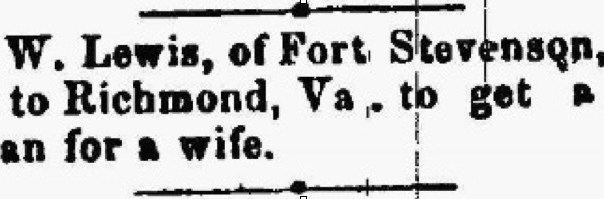
The Bismarck (North Dakota) Tri-Weekly Tribune, 2 April 1878
“Marriage is not about age; it’s about finding the right person.” Sophia Bush
(Read more at BrainyQuote.)
There’s nothing that says “love” like going to look for a good wife. There must have been a shortage of “good women” in North Dakota in 1878. Well, it wasn’t a state yet, but part of the Dakota Territory in 1878. Statehood for North Dakota occurred in 1889. The population was sparse (and continues to be) for the area. And I imagine there really was a lack of “good women.”
1880 Census, Dakota Territory
In the 1880 Dakota Territory census, Phillip W. Lewis is listed with his wife, Mary, and their son, John (age 1). And where are Phillip and Mary from? Virginia. I think Phillip found his good woman.

Angeline’s Maiden Name Confirmed!

I feel as though I have confirmed Angeline Mitchell’s maiden name as “Higdon/Higden.” I have been trying to identify the children of Thomas C. and Angeline Mitchell for some time, with not much to go on. I had previously found a website that has transcriptions or extractions of Audrain County marriage books with citations and have extracted some Mitchell brides who I am hoping are the daughters of T.C. and Angeline. However, looking for them in the census has turned up very little so far, at least in Missouri.

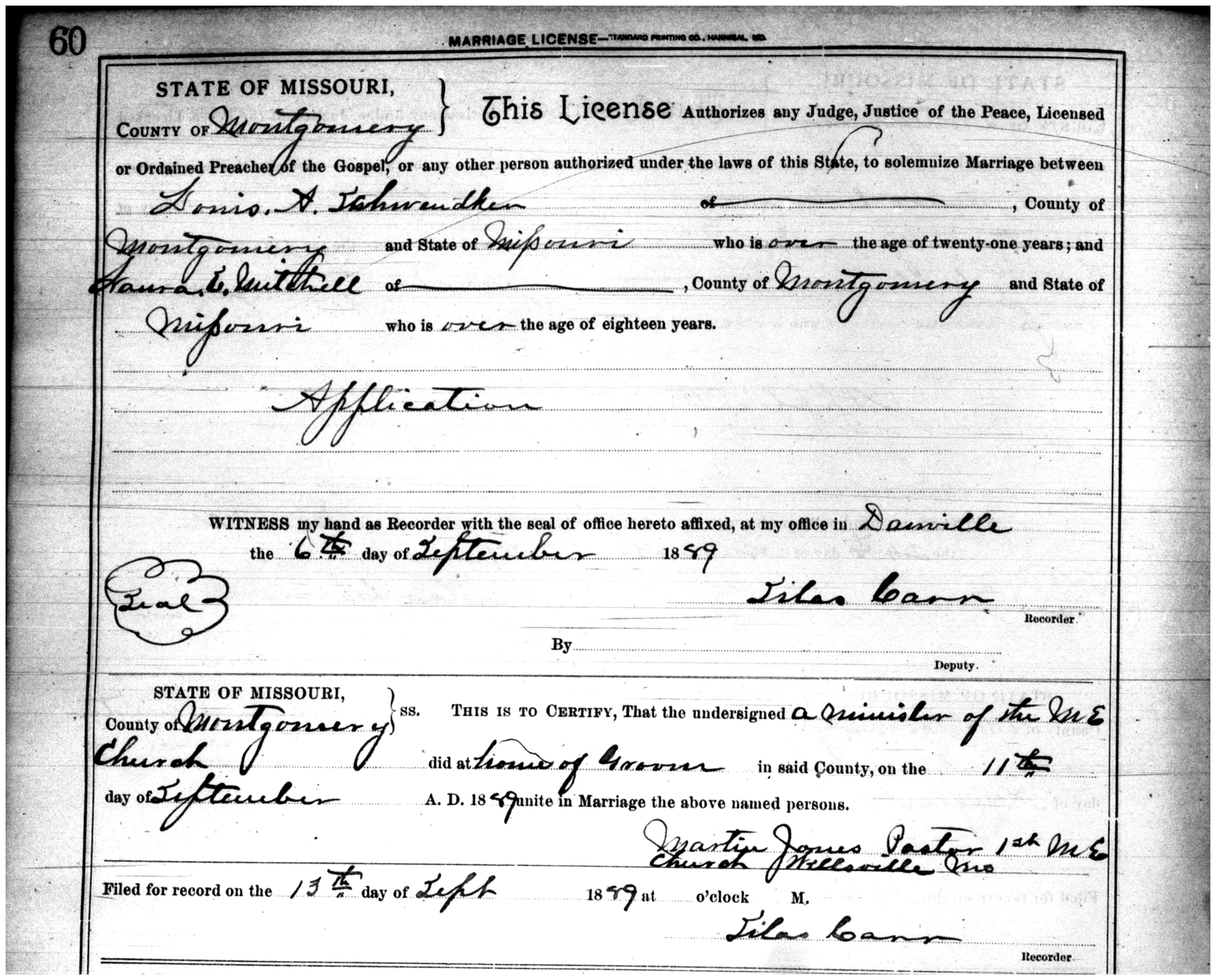
Lately, I have been using the Missouri State Archives‘ wonderful index and many images of death certificates. I have been searching that for what has seemed like days looking for these few married names to no avail. As a last ditch effort to uncover something, I decided to try searching for the informant on T. C. Mitchell’s death certificate. It was a name I had never heard of before, “Schwendker,” and thought maybe I could learn who this person was and how they knew Thomas.

Using the MO State Archives, I searched for “Schwendker” in the death certificate database for all counties in Missouri, and lo and behold, only 4 came up, in the county that T. C. was living in when he died. The informants name was “L. A. Schwendker” and there were two “L” names in the index. One of them, Lewis A., does not yet have an image you can download, so I picked the other, Laura. Well, Laura’s death certificate says she is the daughter of Thomas Mitchell and Angeline Higden!

I had long suspected that Higdon was Angeline’s maiden name but this has clenched it for me! I felt so proud of myself for using those genealogical “skills” I have been learning about for so long and had them pay off!

Prisoner of War Record Found

Civil War Prisoner of War Record [Ancestry.com link] for Thomas C. Mitchell located at Ancestry.com. This bit of information confirms that he indeed was a prisoner of war as he stated in his pension application and not a deserter as his Compiled Military Service Records state. He was a prisoner at Alton, Illinois. I have not been able to determine his length of stay from these records yet, however.

Joseph Higdon 1840 Census

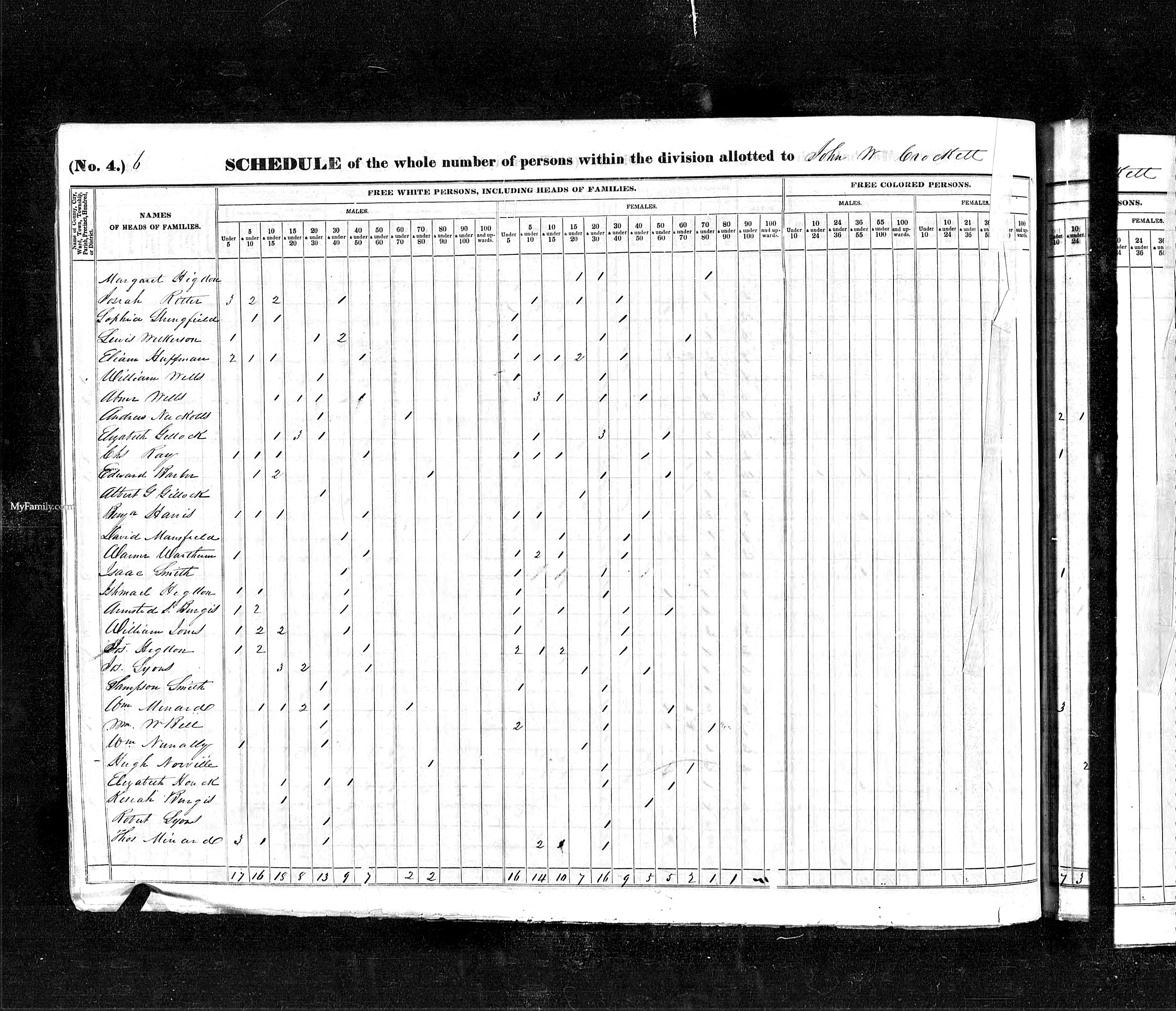
I have located Joseph Higdon in the 1840 Census for Barren County, Kentucky [Ancestry Link]. Also on the same page are a Margaret Higdon with 3 females in the household, one of them being 70-80 years old and an Ishmael Higdon with what looks like a small family. Could be a brother to Joseph, I’ll have to check further.

Attempting to be Organized

English: Mount Everest North Face as seen from...Being an “organized genealogist” is like trying to reach enlightenment. It seems like such an unattainable goal, like me climbing Mount Everest. (I’m lucky if I can climb the stairs sometimes!) However, there are many tips and tricks, blogs, books, magazines and people (they call them “professional organizers”) to help you get and stay organized.

A new Facebook community got me thinking about this topic. Susan Peterson started the community “The Organized Genealogist” which allows genealogists the chance to swap ideas, photos, ask/answer questions and get some great tips on organization geared directly at genealogists. People have been sharing their personal systems for organizing everything from their photos, to their files and research to their entire office. You should go and visit. It is a great group to be a part of.

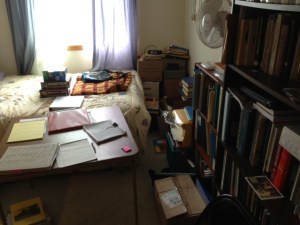
Currently my office is crammed into our guest bedroom. I mean crammed. I have boxes of books stacked in the corner, bins of office supplies stacked up, two bookshelves over-flowing, a card table, a few piles on the floor, two small filing cabinets, a hutch, on top of the hutch… well you can see for yourself:

image-1  imageThere is no way for anyone to use this room! When we have visitors, I have to “clean up” which means put everything into a pile on top of my desk while they are visiting. I’m not saying I mind having visitors, I am saying I mind not having a REAL office.

We have lived in this house for 10 years now, and for the entire time, my dear husband has been “finishing” the basement. Granted, he works a full time job to put food on the table and the roof over our head that houses said basement, however, this summer is the summer of completion! I can count the projects left to complete on one hand: finish the mudding/sanding in one section of the basement (the rest is done), prime that section, paint, carpet, floor/window trim. We did a lot of prep work over the last few weeks to get this ready to finish. We moved a lot of stuff upstaphotoirs (the upstairs is a series of piles right now), we stapled and taped plastic to various sections of the basement where we’d like to keep the dust to a minimum, we bought primer and paint, we have some cash set aside for carpet (I hope it’s enough) and we moved as much out of those two rooms as possible to give clear working space for sanding/painting and carpet.

There are basically two large sections to our basement, one will be family/TV/video-game play area and the other, larger section will be our offices. My husband and I will be getting two of those U-Shaped desks to put together, his and her offices. There will be plenty of room for shelves, I have two large filing cabinets already that were given to me (I love free!) and the basement has really nice large windows that let a surprising amount of light in.

So, this fall look for the “grand opening” of GenealogyPants, LLC home offices! I will keep you updated!


RootsTech 2013

2013-04-15 12.10.40 pmIt has been about a month since I attended RootsTech. I wanted to let the dust settle a bit before I wrote about it. It was an enjoyable trip. As a mom of two kids, ages 10 and 12, it was a nice break from reality. Grandpa came and took care of the kids so my husband and I could attend. The best part was not having to worry if everyone had eaten or had their homework done.

The second best part was when we checked in at the conference hotel, we were told that the organizers of RootsTech had arranged for free self-parking and a free breakfast buffet every morning! That alone saved my husband and I around $200. What a deal! We also frequented a  restaurant that was new to us, the Blue Lemon. It had healthy food with gluten-free options that were reasonably priced and not at all far away from the conference center and library.

The conference itself was full of energy. If you’ve read anything about RootsTech (everyone else has already blogged about it by now) I’m sure you know that it was the biggest one yet with over 6,700 attendees! There were people I knew there that I never saw! It was very exciting and full of great ideas, forward thinkers and new products. I am going to highlight a few of my favorite programs or products beyond the big sponsors and obvious happenings of the conference, which have already been written about:

  • D. Joshua Taylor gave a very interesting program on “Gaming and Virtual Realities: Attracting the Next Generation of Genealogists” which highlighted some very intriguing comparisons between gamers and genealogists, probably most profound is that each group can sit at a screen and “waste” hours of time every day, yet neither feels like it is a waste of time. Also, each group, when they get really into it, keep amazing records. I know gamers who will keep detailed notes about how to solve the games or strategies that have worked, etc. Doesn’t that sound like a genealogist’s research log?
  • Evidentia was there showcasing their exciting new software that guides your research through the genealogical proof standard. You can download a free 30-day trial (for MAC or PC) at: http://ed4becky.com/products/evidentia/
  • Kin2 is still in Beta but it has some great potential to be a fun website. It uses Facebook connections and a large celebrity database to find out who you are related to and how. Currently there’s no gedcom upload possibilities yet, but when I spoke with the representative at the booth, he said that was one of the first things they would be implementing. Also, this site has some very cool pedigree charts, very modern looking and not at all like your basic pedigree chart.
  • Another new product that is “coming summer 2013” is HalfTale.com. It is sort of a collaborative blogging, family history, oral history tool. It is hard to describe, however the tour I was given had me very excited. Often I will email a relative and ask them a simple question “Do you know what happened to grandpa’s military uniform and medals?” to which I will get a several paragraph reply with all kinds of memories about that question and others. This site will be a way to collaboratively answer those questions and create “walls” or “pages” on various ancestors that many family members can contribute to. It’s not available yet, but you can sign up for a beta test account.

The worst part: the internet was either incredibly slow or at capacity and you couldn’t get on at all. For being a “tech” conference, you’d think they would plan on a lot of internet-ready gadgets. I like to look at the websites the speakers are showing, while they are talking, and was completely unable to. In addition, the hotel internet was very, very slow. So connectivity was limited for the week. Another aspect that was something of a let down for us, most of the sessions we attended seemed to be a bit basic for the level we are at. My husband, who is a developer, felt like many of the sessions he attended did not go into the depth he expected or would have liked to have attended. Personally, I attended several that were marked with “I” for intermediate in the program and felt that they were more like beginner level sessions. I struggled to find sessions that challenged me and brought me completely new ideas.

Overall, it was a very enjoyable experience. I enjoyed the exhibit hall the most, learning about new products, services, and learning opportunities as well as talking to other genealogists, developers, speakers and other collaborators. Next year, Rootstech will take place on February 6-8, 2014 again in the Salt Palace. I am looking forward to hopefully attending again with my hubby! We had a great time.