Category Archives: Research – General

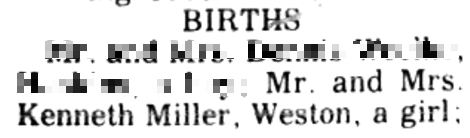
Using Newspapers: Birth Announcements

Depending on the time and place, you might get lucky and find birth announcements in the newspaper. It has been my experience that the earlier in time I’ve been looking, the less likely I was to find those birth announcements. I suspect it was because of high infant mortality and perhaps not wanting to announce the birth if the child was not going to live. However, I have found some early birth announcements, long before vital registration was required by state laws.

This example is one that was published probably because of its newsworthiness, having had triplets! But the genealogical information in this little announcement is both sad and helpful at the same time.

Boston Intelligencer, published as Boston Intelligencer & Evening Gazette, Boston, Massachusetts, 13 Mar 1819, p. 3. 

Keep in mind, the children may not have been named at the time of the announcement, so you may see announcements such as “a son born to Mr. and Mrs. Aaron Businger.” But based on your other research, you should be able to identify that child based on dates or birth orders.

Have you looked for your own birth announcement? Here’s mine:

“Wood County Hospital News,” Daily Sentinel Tribune, Bowling Green, Ohio, 1974.

Using Newspapers: Crime Reports

Often there are “splashy” front page articles about criminal happenings in town or nationwide. Those headlines sell papers, even today. Beyond the front page, there might be information in the crime reports that is important to your research.

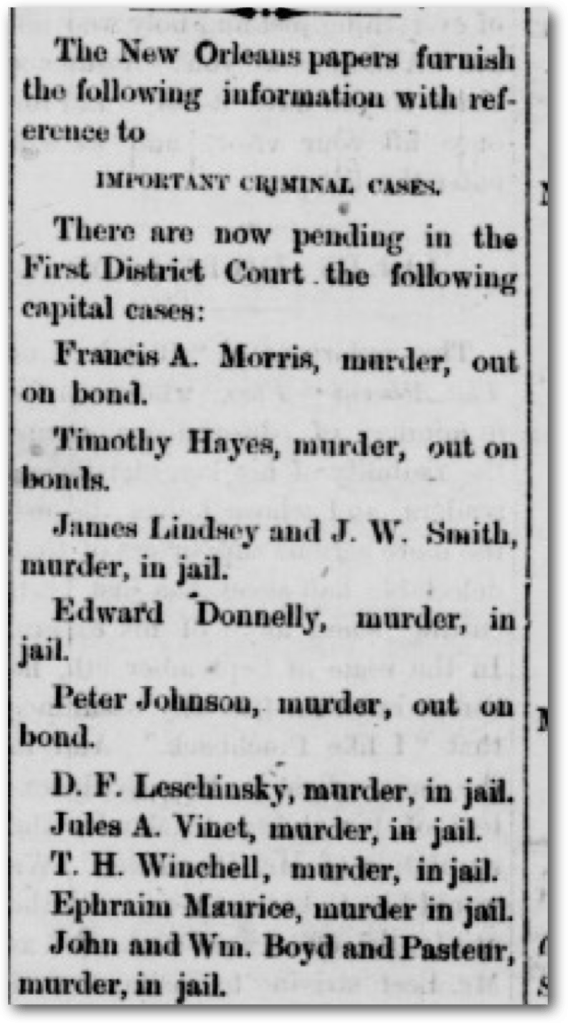
“Important Criminal Cases,” Semi-Weekly Louisianan, 17 September 1871, p. 1, col. 6. 

If your ancestor was in trouble with the law, they might show up in news articles such as the one above. If your ancestor was a lawyer, or judge, or worked in the jail, or was a policeman. What if your ancestor was murdered? These articles might be of interest.

Granted, there’s not a lot of information provided, mostly names and what they were charged with. However, it also states that these cases are pending in the First District Court in Louisiana. Most of the time, you will not find court records such as these digitized and available online. From home, how would you know where to look for the court records if it weren’t for news articles such as these? These can work like a substitute index when trying to locate court records.

You may be able to locate finding aids online, such as these from the City Archives New Orleans Public Library. They cover Suit and Case Records, 1846-1880 which are manuscript records of the proceedings in the civil suits and criminal cases filed before the First District Court. Their description states that…

“Individual criminal case records will contain some, but probably not all, of these documents (some cases, however, can contain little other than the indictment and final verdict):

  • indictment or affidavit–the criminal equivalent of the initial petition in a civil suit. It will set forth the specifics of the criminal conduct that caused the matter to be brought before the Court. On the reverse there will usually be recorded information on arraignment, final verdict or other disposition, and sentencing. 
  • Police reports 
  • Copy of Cornoner’s inquest 
  • Testimony and/or statements of witnesses, the accused, and police officers 
  • Bonds (bail and/or appeal) 
  • Documents from lower courts 
  • Motions, exceptions, and other pleadings filed by the attorney representing the accouses and/or by the District Attorney 
  • Orders, jury charges, and other rulings by the judge 
  • Jury lists 
  • Witness lists 
  • Arrest warrants 
  • Subpoenas 
  • Appeals and related documents 
  • Other documents may also be included.”

There are so many records not available online. I look forward to the days when I can visit the repositories again. Until then, I’m keeping up on my “pre-research” and making lists of the repositories to visit and what to look for when I’m there.

Using Newspapers: The Gossip Column

This may be referred to as the “Social News” section or “Local Items,” something along those lines. But really, it’s the gossip column. Back before there were privacy issues and concerns, you could find out just about anything about anyone in the newspaper. If something really scandalous happened, it may have made front page news. But those more mundane items that all nosy busy-bodies wanted to know, could be found in the newspaper. Who went where for dinner. Who went into town or the big city for shopping. Who was going out of state for vacation or to visit relatives. Who bought what on their shopping trip. Who attended a party and for who or what.

You get the idea. It was Facebook of the day. If photography existed or was easier to print, we may have even seen photos of what someone had for dinner. Let’s look at some examples.

Morning Oregonian, Portland, Oregon, 12 September 1886, pg. 3.

I mentioned it before and I’ll mention it again now. Newspapers are a fantastic way of locating an ancestor’s friends, associates, and neighbors (FAN Club). These people can often be clues to solving mysteries such as making sure you are looking at the right individual and not someone of the same name. The article above is a fun description of a birthday party, but also lists everyone who attended.

Buckeye Valley News, Buckeye, Arizona, 18 April 1935, n.p.

Here is another example of “Local News.” There is news of folks down with the flu, of new employees at the City Cleaners, an new Avon sales agent in town, and more. My great-grandfather, Sanford Sly, the Clerk at the 3-H Mercantile, spent the weekend with his family at Tucson and “they will join him here when school closes at Tucson.” I’m still not sure what the school is. But I do know that his (adopted) daughter, Alice Sly, was being treated for tuberculosis at St. Mary’s Hospital in Tucson. She was a young adult when they moved to Buckeye, Arizona from the Buckeye State (Ohio). So, I’m not sure if she was attending a school of higher learning there or if they were keeping her illness somewhat of a secret. I’m not sure.

But this local news item gives me some clues to look into. I love the gossip column and can get stuck there reading up on everyone’s mundane business. It takes me back in time to kind of see and understand what everyday life was like.

Using Newspapers: Letters Lists

Back before we had postal carriers and post boxes, mail boxes at our driveway or in a large repository at the end of a block, our ancestors had to go in to the post office to pick up their mail. If they didn’t do that often enough, they would publish a list of letters to be picked up at the post office. Let’s look at this list below published in the Guthrie Daily Leader, Oklahoma, 2 May 1900:

Lists such as these can be very helpful in pinpointing your ancestor in a time and place, and produce a FAN Club (list of friends, associates, and neighbors) of sorts for your ancestor. This list is interesting because it separates items for men and woman. I did not know why until an audience participant told me about “Ladies’ Delivery Windows” at the post office. “In an attempt to prevent “timid females” from encountering “detention, rudeness and a thousand vexations” while picking up their mail, Post Offices in some cities had a special ladies delivery window dedicated to their use.” (See “Ladies Delivery Windows” below.)

Next time you pick up your mail from your porch or driveway, think of your ancestors having drive their wagons into town to pick up their mail.

Further Reading

Using Newspapers: Advertisements

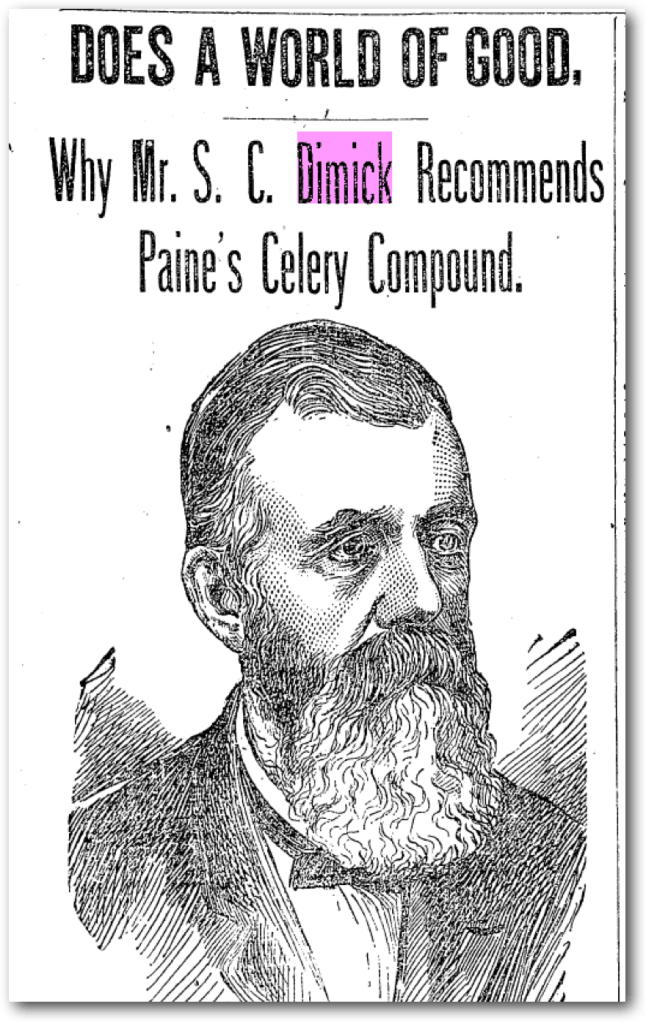
We often think to look for the obituaries, birth announcements, legal notices, and general articles to add to our genealogical research and family stories. Did you ever consider advertisements for products? I hadn’t until I came across this advertisement for Paine’s Celery Compound with a testimonial by my 3rd great grandfather, Samuel Cook Dimick:

St. Paul Daily Globe, Minnesota, February 18, 1893, p. 5.

What is great about this article is the picture of my ancestor, S.C. Dimick. Up until this article was located, I did not have any photographs of him. I had never considered an advertisement could be so useful. Who does not like finding an image of a long-gone ancestor?

Samuel Cook Dimick is one of my favorite ancestors to research because he seemed to live a very full life, and all the time I am finding new bits of information about him. For example, I learned that he worked for one year as the farm superintendent on an Indian reservation in Minnesota from his biography in the county history for Wood County, Ohio. That led me to looking at records in Minnesota. I discovered that his father, Chester Dimick, purchased 15 different sections of land in Minnesota from the Federal Government that encompassed over 1600 acres! I have not done the follow-up to find the deeds indicating where he sold the land. As far as I knew, they never actually lived in Minnesota.

I’d read the text of the advertisement before, but to be honest, was hyper-focused on the image. Rereading it today, I did not remember that it states that to help his health condition he “…decided to try a change of climate, and spent nearly three months in Minnesota.” This leaves me with several questions. Did the family keep that Minnesota land for a longer time than I previously thought? I had assumed this was a money-making plan and they bought the land cheap from the government and then likely sold it for more later, but had not done the research to confirm it. Did they keep a home in Minnesota, like a vacation home? I really need to get into those deeds!

Two points here. First, don’t overlook the advertisements section. They can have clues and sometimes pictures of ancestors. And second, you have to go back and reread your documents from time to time. Most likely, when I first read this advertisement, the Minnesota piece didn’t stick out to me because I had not learned about all the land they owned there. Rereading documents with new things you’ve learned in mind will shine a spotlight on previously overlooked clues.

And a third point: Newspapers are more than the obituaries!

Using Newspapers: More Than Obituaries

“Aaron Businger is Called by Death,” obituary, The Daily Sentinel-Tribune, Bowling Green, Ohio, 22 March 1939, p1, col 3. 

Newspaper items can enhance your family history research by adding social context and local history. The stories captured by newspapers give glimpses into our ancestors’ lives like few other sources do. When I got started doing genealogical research, I began by researching obituaries. I was self-taught, as many of us are, and I thought about what kinds of sources I could access. When I began researching my family history, Ancestry was just barely coming online, census records were barely digitized and they most certainly were not indexed when I started. And MOST definitely, there were no digitized newspapers available when I got started. I spent a lot of time visiting the library back in Wood County, Ohio where my ancestors are from and cranked my fair share of microfilm!

My research began primarily with obituaries. I collected those of my grandparents and great-grandparents. Then I used the clues in their obits to identify their family groups, siblings, aunts and uncles, cousins, and so on. Then I looked up those folks’ obituaries… and on and on. Pretty soon, I had over 500 obituaries in my research collection!

When scrolling through those newspapers, I was often distracted by other headlines, a name would catch my eye, a picture, diagram, advertisement, and so on. I learned so much about the location, events that were happening, issues affecting the community, the weather, and so on. Stories found in newspaper articles can give clues for further research paths and strategies.

In this next series I’m going to highlight some of the newspaper items other than obituaries that I have found and have helped me with my research. I have come across some very interesting tidbits and hope you will have fun seeing some of these items.

Accessing Archives from a Distance

I’ve tantalized you with what you might find in an archive in previous posts here and here. And I’ve given you some tips on how to find a collection that might apply to your personal research through the use of ArchiveGrid. Now, what happens if you find a collection in a repository that is far, far away?

You have three options:

  1. Create a research plan or list, saving all of the information you need to access that collection someday when you are nearby. I do this quite a bit for areas I think I might be visiting in the next 1-3 years and if it is on a personal project that is not time-sensitive. Save the URL to the collection, repository name, address, hours, and so on. I use Evernote for such a task. I have notebooks for various locations or repositories titled “Family History Library,” “Ohio Research Trip,” or “Washington DC.” And I just drop notes in there to access later. A word processing document, spreadsheet, or even a spiral notebook would work as well.
  2. Hire an on-site researcher. Many repositories have lists of proxy researchers because they do not have the staff or resources to do research for individuals. If a repository does not have such a list, check the directories for the Association of Professional Genealogists (APG), the Board for Certification of Genealogists (BCG), or International Commission for the Accreditation of Professional Genealogists (ICAPGEN). These directories allow you to search by location or by specialty. You might also consult with the state or county genealogical society for the area of interest as well. You might also find a cousin, hobbyist genealogist, poor college student, or some other person who would be willing to go to the repository for you.
  3. Ignore it. Now, I don’t recommend this one, especially if you are interested in not only the coolest possible finds out there, but also in conducting “reasonably exhaustive research.” I would at the very least put items in a list and get to them eventually.

I hope this series has convinced you to visit archives and manuscript collections. And if you weren’t sure about how to even go about it, I hope I gave you some helpful tips to quell your anxieties. Where else would you find a petticoat worn by Lizzie Johnson from 1865-1870? (The answer, of course: at the Southwestern University Special Collection in Georgetown, Texas.)

Use ArchiveGrid to Assist Your Search

One of my absolute favorite websites for helping with the task of locating items of interest to MY research project is ArchiveGrid.

archivegridlogo

You can read in detail about how ArchiveGrid works, its history, and so on, on the website. The summary from the website: “ArchiveGrid includes over 5 million records describing archival materials, bringing together information about historical documents, personal papers, family histories, and more. With over 1,000 different archival institutions represented, ArchiveGrid helps researchers looking for primary source materials held in archives, libraries, museums and historical societies.”

It is like WorldCat is to libraries. It is an online catalog of holdings from libraries, manuscript collections, and archives from across the globe. Of course, they have to be participating with the OCLC system to be included, but so many are! And some of the participating collections are not your typical collection you might think about in terms of genealogy. Just reading through the “recent additions” I see Indiana University’s Latin American Music Center, United States Marine Band Library and Archives, the American Bookbinders Museum, the Boston Symphony Orchestra, and the Museum of Flight Archives.

ArchiveGrid is very easy to use. It employs a simple keyword search and then a filter system is available when you click on “Summary View.” There are also more advanced ways to search. As always, read the help pages and “how to search” instructions for better results. For example, if you remember the leather pocketbook from the last post, it belonged to Thomas Jefferson Johnson. If you search ArchiveGrid for Thomas Jefferson Johnson you will get all kinds of hits for the president Thomas Jefferson. However, ArchiveGrid, like many databases, allows you to put the name in quotes. When I did that search, I found a collection of papers down at the Austin History Center that includes family correspondence dating back to 1853. It is very likely that some of those family papers complement the collection I viewed at Southwestern University’s Special Collection.

Access ArchiveGrid, enter some family names or topics relating to your research, and see what you find. You might be pleasantly surprised!

How to Visit an Archive

Some of you might be intimidated by the thought of visiting an archive or manuscript collection. I mean, they aren’t like a regular library usually. They tend to have a lot of rules and they will get after you if you don’t follow them. You can’t always bring in items you want to bring in. Why would you want to subject yourself to all of that hassle? I did feel this way in the beginning…when I was a “baby” genealogist. But I hope the last couple of posts (here and here) have convinced you to get over it and get in there!

Most (if not all) will have a website (such as that for the Briscoe Center for American History on the University of Texas Campus). Be sure to read it! It will prepare you for what to expect, the rules in terms of what you can bring in, copy policies, photography fees, parking, hours, closings, and so on. They will often have a catalog or finding aids on that website. Some archives have a system with which you can make an account and order your items ahead of time so they are ready for you when you show up. Often you will have to register as a researcher, showing your ID, filling our a form, or some other way for them to identity you. Also, do not be afraid to email the archivist with any questions. Sometimes a repository is behind in cataloging and not everything is listed. The archivist will know more about what is in the collection, or if you are having trouble locating something, they can help you find it.
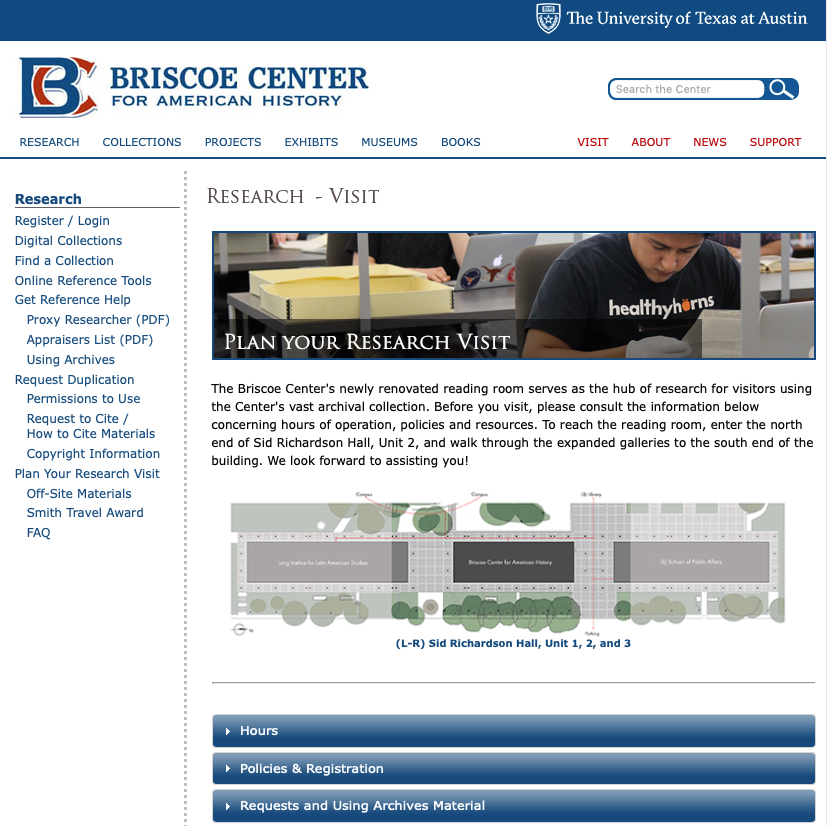
Briscoe Center Website

Most often the rules are: no loose papers unless they look at them and stamp them with a stamp indicating it was something brought in or they provide you with a colored sheet of paper for notes; no pens, pencils only; laptops are usually ok but they will want to look inside it before you leave; usually photos are ok, some repositories have a photography fee; no drinks. I might have forgotten some, but those are the main rules I’ve experienced.

All of those rules are in place to protect the collection. No one is accusing you of anything when they ask to see inside your laptop or at your papers. Over the years, as you might imagine, items have been stolen, ripped, marked on with pen, had coffee spilled on them, and so on. These items are unique, one-of-a-kind, priceless, historical items. We don’t want to lose them and therefore they are in “protective custody” and you are required to follow these rules so they can survive for many generations to come.

The best advice I have is to read ahead to understand the rules then follow them without complaint, and you will have a great time at the archive. You never know what you will find but you will definitely have a great time in these original records!

Archival Finds

I wanted to share a few more finds from my visit to the Southwestern University’s Special Collection from last week’s blog post. I had so much fun and got to see and hold so many cool things!

IMG_3509
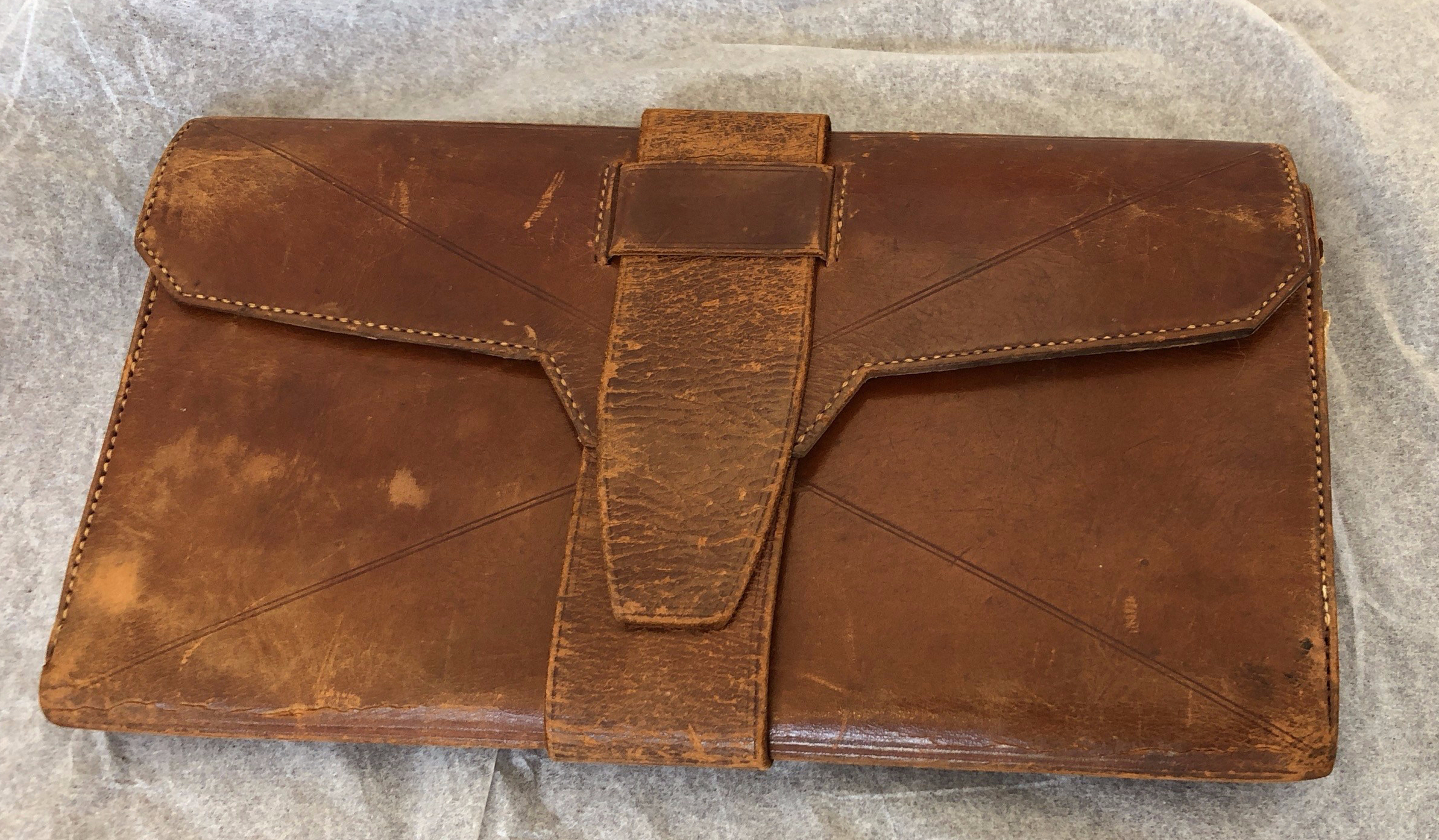
Leather pocketbook belonging to Thomas Jefferson Johnson

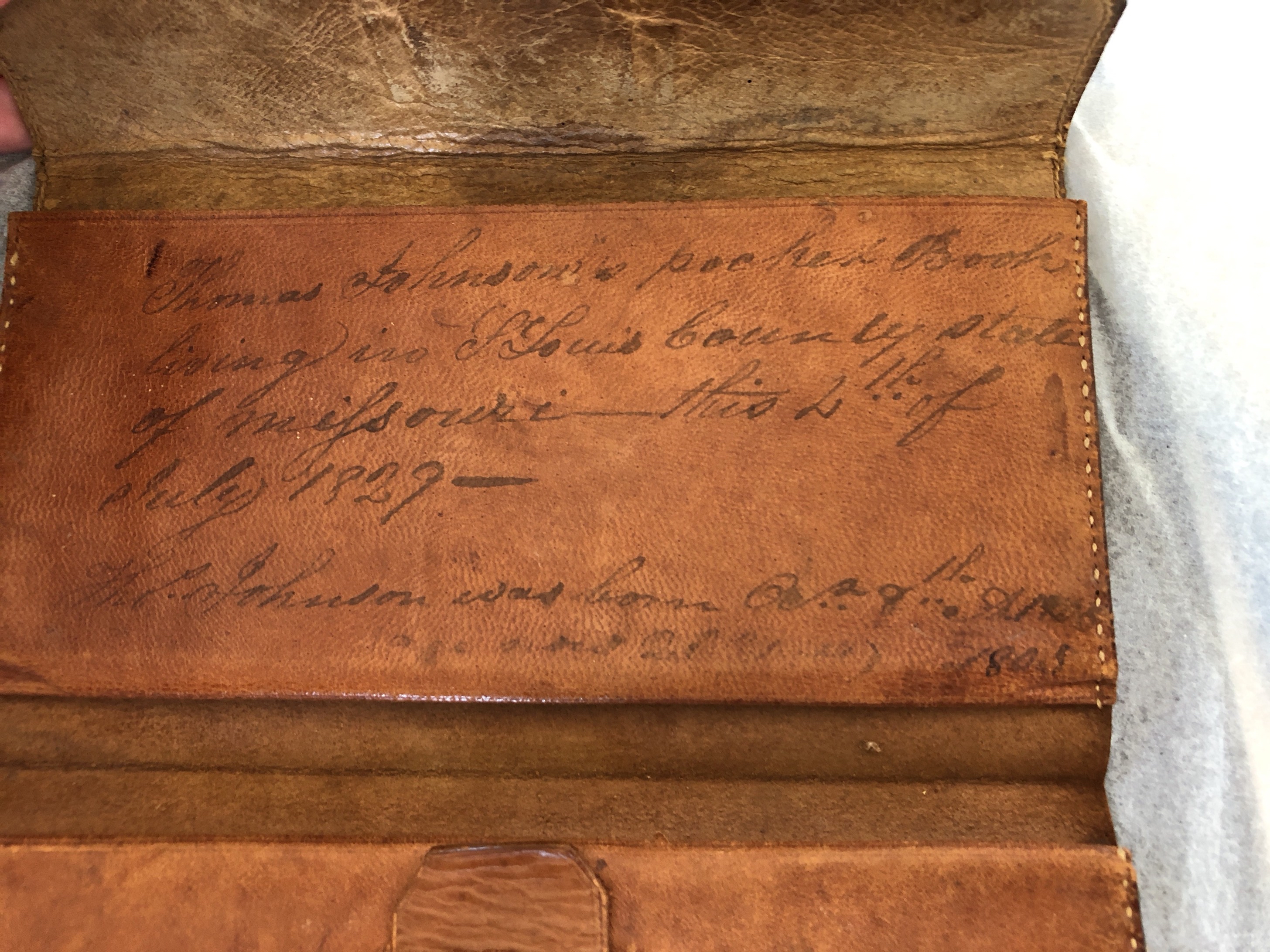
This is probably one of the best examples for visiting the archives…you truly never know what you are going to find! This leather pocketbook belonged to Thomas Jefferson Johnson. On the inside:

IMG_3508
The inside of Thomas Jefferson Johnson’s leather pocketbook.

The transcription: “Thomas Johnson’s pocket book living in St. Louis County state of Missouri this 4th of July 1829 –– Thos. Johnson was born Oct. 8th 1805.”

Ok… when you are looking for those vital records for your ancestors, did you ever think to look in their leather pocketbooks? I didn’t.

Now, will you find your ancestors’ birth information in a leather wallet? Probably not. Will you find some other cool items in an archive near you? Most definitely!