Category Archives: Research – General

Beginning Concepts: Interviewing Relatives, Do It Now

After you’ve collected everything you know, it is time to reach out to your living relatives. Every day that passes by, is one day closer to death, unfortunately. Not to be grim (though we did just pass Halloween), but this is a sincere fact of life. And I’m not necessarily talking about YOUR death; that’s another discussion about YOU getting YOUR genealogical records in order. I’m talking about our older relatives and even those our own age. The time is now to talk to them, to interview them regarding their memories of the family history. Each person will have their own side to every story, their own memories about family events, and so it is so important to ask as many relatives as possible about family events.

There are some great online resources to help you with questions that can prompt family members to talk.

Books:

  • Linda Spence, Legacy: A Step-by-step Guide to Writing Personal History
  • Kirk Polking, Writing Family Histories and Memoirs

Websites:

I have found that paper forms are very handy to use when interviewing relatives when you can sit down with them face-to-face. They can help prompt them to talk about things that they had forgotten. If they see a blank on your form and they know that information, they are often willing to share. Currently, I recommend phone calls or Zoom meetings for you family history interviews. And during this time when we are all so isolated, some of those older relatives would probably really appreciate the call.

It seems that sometimes cousins know more about my direct line than I do because they were more willing to gossip about something not affecting their nuclear family units. Ask cousins what they know about a particular family event and see what kinds of stories you hear.

My grandma on the right, her long-time best friend, Wilma on the left. During a visit where I interviewed them both.

If they are comfortable being recorded, do that so you don’t have to be a furious note-taker while they are talking. If you are using Zoom, that is quite easy. You can also set up your phone to record voices or go old-school and use a tape recorder if you still have one. Come prepared with charts and questions. Share with them pictures, documents, and information you’ve already collected. This often jogs their memory.

Here are some topics:

  • School days
  • Important life events
  • Residences
  • Migrations
  • Land ownership
  • Occupations
  • Best friends
  • Military service

Most of all, this is supposed to be fun and engaging. So, make some time to make some calls either by phone or zoom. As the holidays approach in this weird year, reach out and have some family history conversations with your family members.

Beginning Concepts: Data Collection Tips

If you are brand new to genealogy or if you want to do a refresh here are some solid starting points.

  • Start with yourself and work back in time.
  • Begin with what you know and work toward the unknown.
  • Start with the basics: birth, marriage, death
  • Add more details: military, education, residences, employment

Utilize common family history forms or genealogical software to help you build your family tree. Start with yourself and record everything about you, your spouse, kids, etc. Then work on your siblings and parents. Don’t stop with your direct line. Write down everything you know about your aunts, uncles, cousins, expanding out from your direct line.

Start in your own home. Look through your old papers for:

  • birth and death certificates
  • marriage records
  • diplomas
  • newspaper clippings
  • letters or diaries
  • photographs
  • funeral programs
  • yearbooks

I’m not going to tell you that one way is better than another. The best way to do anything is the way that works for you. I will tell you that I started with paper forms. Then I used an old Mac program that no longer exists. I’ve used a Mac since the beginning of time and so I have been a Reunion user almost since their beginning. I also use online family trees, but I treat those more like a holding place while I’m using their website. All of my research is housed in Reunion. I also print everything and organize it in my binder system.

Once you’ve exhausted everything in your own home, you’ll want to start talking to your relatives. We will discuss that next time. That’s where the fun begins!

Beginning Concepts: Why do we do genealogy?

I’m starting a new series that will focus on some “beginning” or basic concepts of genealogical research. A bit of a reset, perhaps. This year has been one giant [insert your favorite expletive-driven description here.] I’m feeling the need to get back to some of the basics before we head into the holidays and 2021. I’m hoping for a refocus and a shift in my thinking after the utter [again, insert your favorite descriptor here… “crapfest” comes to my mind] this year has been.

So this new series will look at some of the basics, starting with, why do we even do this at all? There are spiritual, religious, emotional, and psychological reasons we might be engaged in this pastime:

  • Greater understanding of family stories brings empathy to living family members, perhaps emotional healing
  • Helps with loneliness and depression by filling you with a feeling of knowing your family members and ancestors loved you (even if indirectly)
  • It may help with that muddling-through-life feeling by understanding that our ancestors went through tough times too and survived. “I can DO this! It’s in my DNA!”
  • Provides us with wisdom and a broader perspective when we understand our ancestors in historical and social contexts
  • May experience “spiritual power” and serendipity while engaged in genealogy

“If you were to gather fifty genealogists in a room, chances are that forty-five of them would readily admit to having experienced a few unexplainable incidents in their search for roots.”

Megan Smolenyak, In Search of Our Ancestors

One of my favorite book series is Psychic Roots by Henry Z. Jones, Jr. which explores some of the anecdotal, serendipitous moments genealogists have experienced.

Has the genealogy “bug” bitten you? Have you thought about why? What benefits you may be getting from researching your ancestors? You might take a few moments to consider the WHY of your love/obsession with family history research. For some it may be as simple as finding the next piece of the puzzle. For others, it may take on a whole new dimension.

Using Newspapers: When They Aren’t Online, What Do I Do?!?

What do you do when the newspapers you need are not online? Normally, I’d encourage you to take a trip to the local public library or archive that holds microfilm of those newspapers. However, there are other ways to get access to far-off newspapers.

  1. Ask a librarian. Often, local public libraries will do quick look-ups for you. So if you know the date that an event occurred, reach out to the public library and ask if they can send you a scan or copy of the page.
  2. Ask a local genealogical society. Some libraries are too busy or don’t offer look-up services. If that is the case, see if there is a local genealogical or historical society that does.
  3. Ask a volunteer. There are sites to find genealogical volunteers such as Random Acts of Genealogical Kindness (raogk.org)
  4. Message Boards. These still exist! At Ancestry, look under the “Help” tab at the top and you will find Message Boards. (www.ancestry.com/boards/)
  5. Inter-library loan. Some repositories allow their microfilmed newspapers to be used via interlibrary loan. See if that option is available for your project.
  6. Hire a researcher. If you need someone to skim several weeks or months for a particular article, hiring a professional is worth it. And it will be cheaper than traveling. Use a directory such as that from BCG (bcgcertification.org) or APG (www.apgen.org) to find a qualified researcher.
  7. Take a trip. Of course, when we can travel and visit repositories again, this is the most fun option. But even then, it is not always the most efficient or cost-effective.
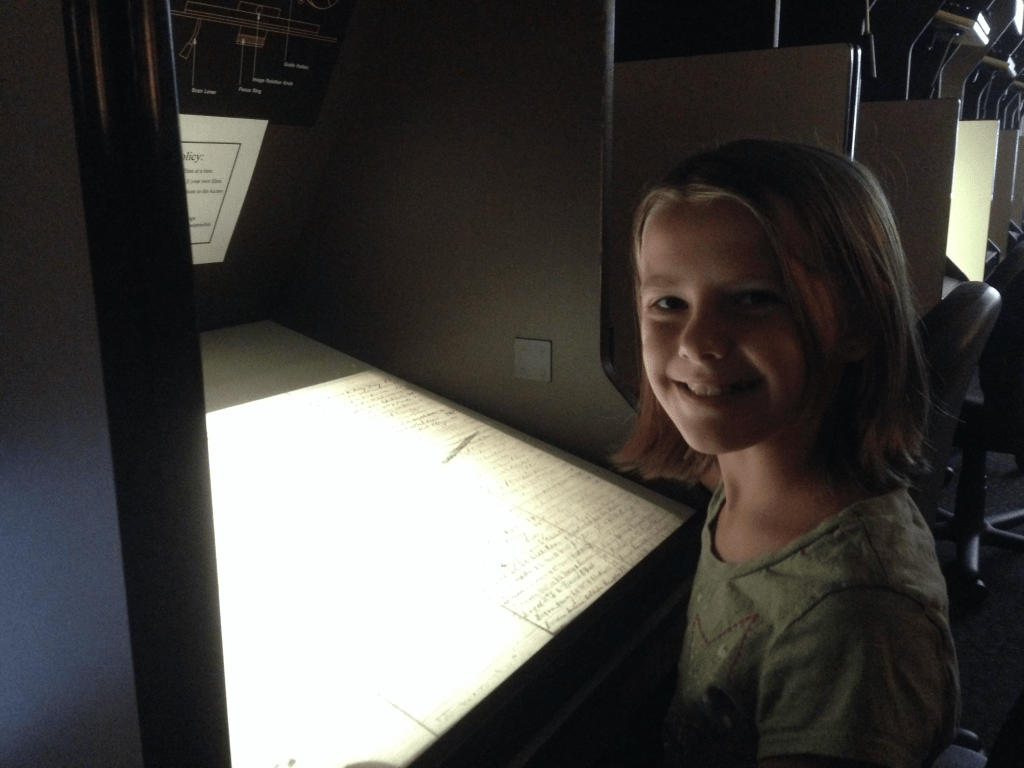
My daughter on a research trip with me a million years ago.

Do not think that just because the newspaper you need is not digitized and available online, that it is not accessible. It just takes more work. The above methods generally get me what I need. The biggest problem is that I have to practice patience!

Using Newspapers: My Favorite Newspaper Sites, FREE

While I am not opposed to paying for a service that gets me the records I need, I am also all for saving some bucks when I can. And the good news is, there are a whole host of free newspaper sites available for genealogists. Most of the free sites tend to be state-based newspaper projects hosted by a state archive, library, historical society, university, or some other interested state entity. There is also the Library of Congress’s Chronicling America which holds digitized newspapers and a directory of newspapers from all over the United States. So here is a list of some of my favorite, free, sites for finding or accessing newspapers online.

Directories and Lists of Newspapers:

My Favorite Digitized Newspaper Sites (this is by no means an exhaustive list, it’s just a few of the sites I’ve used frequently and have found quite useful):

And I recently had the chance to do some research in New Zealand (online of course) and found this fantastic digitized newspaper site, Papers Past, that helped me find many answers and clues for the project I was working on.

Like I said, this is not an exhaustive list. When I find myself in a new area, I usually head over to one or more of the list sites mentioned first to find out what is available for that place in what time frames. There are so many small projects out there, small public libraries, universities small and large, museums, genealogical and historical societies, and so on that are digitizing their own collections as well. Be sure to do some looking around. You will be surprised by what you find!

Using Newspapers: My Favorite Newspaper Sites, Commercial

This week, I’m going to share with you some of my favorite newspaper resources and websites. There are free and commercial sites. I’m not going to say I prefer one commercial site over another, because the truth is, the one YOU should subscribe to is the one that has newspapers that cover areas you are researching. If you do a lot of research, you might need more than one subscription. Check with your local public library to see if you can access any newspaper sites using your library card.

Commercial sites:

  • Newspapers.com, with Publishers Extra. I see a lot of people complain about getting a hint from Ancestry that there is an obituary but when they click on it, “they” just want you to buy another subscription. Well, yes, Ancestry and Newspapers.com are businesses, so of course they are marketing and trying to find ways to get more subscriptions. That’s the nature of business. BUT, the Publishers Extra subscription is full of newspapers that are still under copyright, so they have had to pay for extra licensing to be able to put those digitized newspapers online. So, yes, there is more cost involved. Let me tell you, I use it ALL THE TIME. If you don’t use it because you are not researching in more modern newspapers, then you don’t need to subscribe, but I love it.
  • GenealogyBank. There is not a lot of overlap between GenealogyBank and Newspapers.com. Often if I can’t find it on one site, I can find it on the other.
  • NewspaperArchive. Same as above. I don’t find a lot of overlap between the sites.

Each of the “big three” commercial sites for newspapers have their pros and cons. I find some of their filters, search functions, and image viewers to be better than others. But for the value of being able to view so many newspapers from the comfort of my own home, I am more than willing to put up with a little bit of frustration. Each of these sites allow you to view their titles and year ranges before you subscribe, so be sure to do that. Do not subscribe and then complain that they don’t have what you need. Be sure to check first.

Next week I will share my favorite non-commercial FREE websites for finding newspapers. There are some great resources out there!

Using Newspapers: Corroboration is Key (Part 2)

Last time we examined the obituary, death certificate, and birth record for Martha Meeker. Her obituary and death certificate both provided her parents’ names as Mahlon Meeker and Mary Baughman. However, further searches could not locate that couple. After accessing her birth record, we discovered her parents were actually Lafayette Meeker and Phylinda Baughman.

So, who is at fault for this error that sent me down the wrong research path for quite some time back in 2001 when I worked this project? Look no further than the informant on the death certificate:

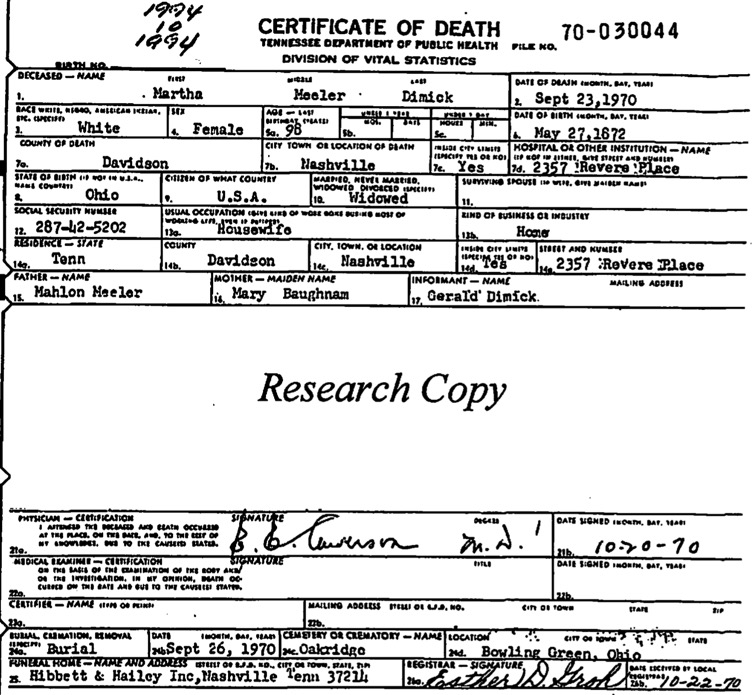
Martha Meeler Dimick, death certificate, number 030044 (1970), State of Tennessee, Department of Public Health, Division of Vital Statistics, Nashville.

Who was Gerald Dimick? He was Martha’s third child. He was only two months old when his grandfather Lafayette Meeker died. AND his grandmother Phylinda Baughman died 22 years before he was born! Did Gerald have good first-hand knowledge of who his mother’s parents were? No. He only had second-hand information. He was dependent on what he had heard as a child growing up. Not to mention the stress a family is under when a loved one dies and a funeral has to be arranged. That can mess with anyone’s memory.

This is why corroboration is key to genealogical research. You can’t just get one document, one vital record (and in this case two) and call it a day. Genealogists should strive to find a record that is A) independently created and B) as close to the time of the event that it is reporting as possible. Obituaries and death certificates often have the same informant (though not always, there are times and reasons why this is not the case). And a death certificate is not a record close in time to find birth information. Always strive to find one closer in time.

When using newspapers, always attempt to find other records to back up the information you find. Information from sources needs to agree or you have to resolve the conflicts they’ve created. In the example above, that was done by examining the informant on the death certificate, finding the birth record, and discussing why Gerald would not have been a good informant to report on his grandparents’ identities. Corroboration in records and the information they contain is key to making solid claims in your genealogical research.

Using Newspapers: Corroboration is Key (Part 1)

All genealogists know, or should, that you have to find at least two independent sources that agree. AT LEAST two. If your sources don’t agree, you have to keep digging or have a reasonable, logical explanation for why they don’t agree. That is called resolution of conflicts. So, do you believe everything that you read in newspaper articles? No! Well, you should at least try to find an independent source that provides the same information.

Here is an example:

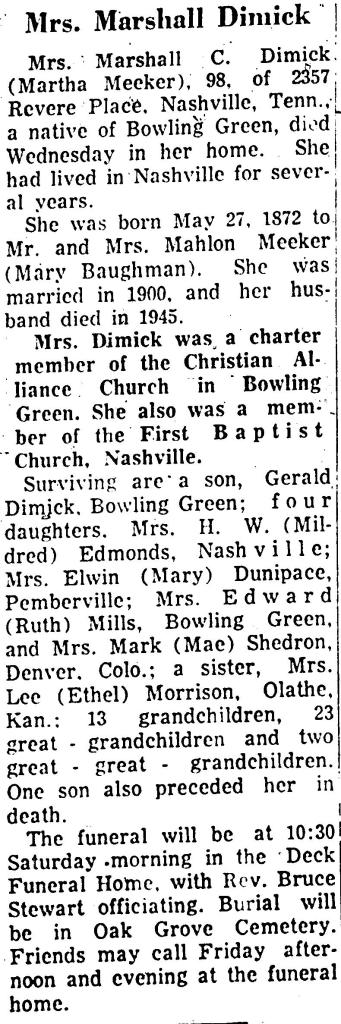
Mrs. Marshall C. Dimick (Martha Meeker), The Daily Sentinel-Tribune, Bowling Green, Ohio, 24 September 1970, pg. 2.

The above obituary states that Martha Meeker “was born May 27, 1872 to Mr. and Mrs. Mahlon Meeker (Mary Baughman).”

I was able to order Martha’s death certificate from Tennessee. She was living with one of her children at the time of her death.

Martha Meeler Dimick, death certificate, number 030044 (1970), State of Tennessee, Department of Public Health, Division of Vital Statistics, Nashville.

The death certificate states that her parents were Mahlon Meeker and Mary Baughman. I originally found these records back in the time when censuses only had head of household indexes on Ancestry. Do you remember those days? You could only search the database by the heads of household. When I found this obituary, I figured I should be able to find Martha Meeker with her parents Mahlon and Mary Meeker in the 1880 census and possibly the parents as a couple in 1870. I searched and searched and searched…and was unable to find them.

If you have Wood County, Ohio research, you might know that the Wood County Chapter of the Ohio Genealogical Society has done some fantastic projects indexing the county probate birth, marriage, and death records and making those indexes available to purchase in books. Before a lot of these records were available digitized by FamilySearch, I lived by these publications! I have every single one on my bookshelf and they were so useful to me in a time before online genealogy was as big as it is now. I took a look through the birth records and found an index entry for Martha Meeker, and I ordered a copy of her birth record.

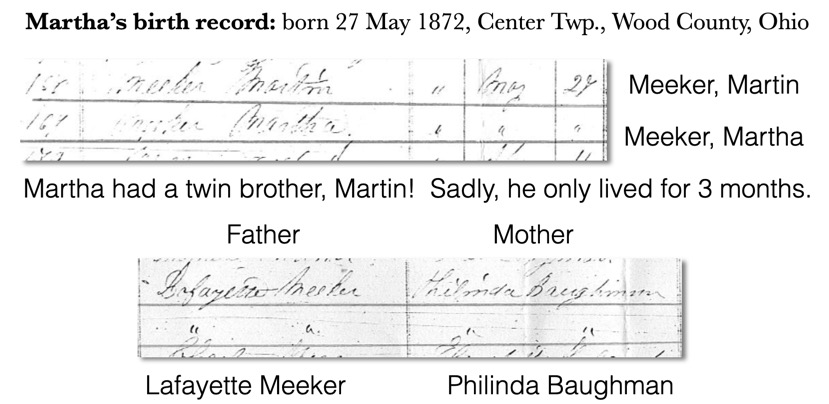
Martha Meeker entry, Wood County Births, vol. 1, p.106, no. 169; Probate Judge, Bowling Green, Ohio.

Ah ha! Now I have a birth record with different names for her parents: Lafayette Meeker and Philinda Baughman. Conflicting information that needs to be resolved. A birth record is so much better than an obituary or death record when trying to identify Martha’s parents. I will discuss why and some other factors in next week’s post. In the meantime, remember that corroborating information is very important when evaluating your evidence.

Using Newspapers: Leads to Other Records

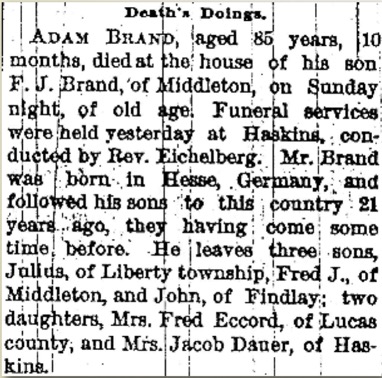
When you are researching in newspapers, the articles you find should lead you to other records. Well, unless the article is one of those from the gossip column that reported your ancestor went to the big city to go shopping last week. We are probably not going to find shopping receipts in our ancestors’ papers, but you never know! Articles, and obituaries in particular, can lead us to look for records such as: census, probate, land and tax, church, school, naturalization, ships’ lists, and … that list is nearly infinite. Here’s an example of what I mean.

Adam Brand obituary, Wood County Sentinel, Bowling Green, Ohio, 14 Nov 1889, p. 3

This obituary for Adam Brand states that he was “born in Hesse, Germany, and followed his sons to this country 21 years ago…” Since the paper was published in 1889 that means he arrived in the U.S. in about 1868. There are some other clues:

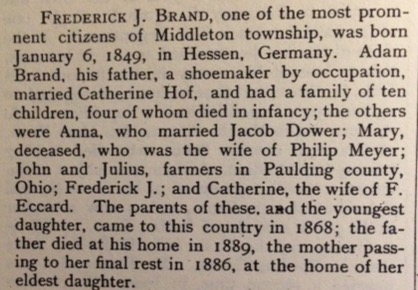
Frederick J. Brand biography, J. H. Beers, Commemorative, Historical and Biographical Record of Wood County, Ohio, (Chicago, Illinois: J.H. Beers and Co, 1897, p. 862.

In the biography of Adam’s son Frederick, Adam was “a shoemaker by occupation” was married to Catherine Hof, and his parents (Adam) came to this country in 1868.

These clues from the newspaper (and a corroborating biographical sketch) led me to ships’ passenger lists.

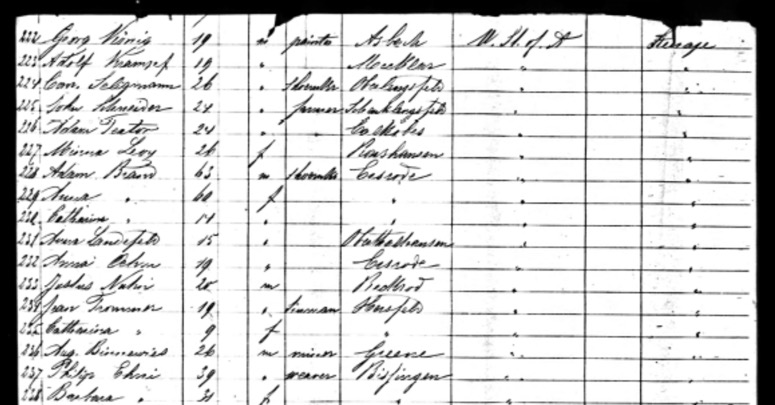
“New York Passenger Lists, 1820-1957,” digital images, Ancestry.com (http://www.ancestry.com : accessed 19 June 2012), manifest, S. S. America, 1 June 1868, [no page numbers on manifest], steerage passenger 228, for Adam Brand, age 63.

I know you can’t read that… here’s a zoom-in on the folks in question:

Adam Brand, 63, m, shoemaker, Ersrode
Anna Brand, 60, f, Ersrode
Catherine Brand, 14, f, Ersrode

Adam’s wife’s full name is Anna Catherine (as is his daughter’s). The clincher here is that his occupation is that of a shoemaker, corroborating the information I have from previous research. And they arrived in 1868, just as two other documents also reported.

So, go back through the newspaper articles you’ve found. What other records could they be leading you to? Make a list. Turn that list into a research plan. And then get started!

Using Newspapers: Birth Announcements

Depending on the time and place, you might get lucky and find birth announcements in the newspaper. It has been my experience that the earlier in time I’ve been looking, the less likely I was to find those birth announcements. I suspect it was because of high infant mortality and perhaps not wanting to announce the birth if the child was not going to live. However, I have found some early birth announcements, long before vital registration was required by state laws.

This example is one that was published probably because of its newsworthiness, having had triplets! But the genealogical information in this little announcement is both sad and helpful at the same time.

Boston Intelligencer, published as Boston Intelligencer & Evening Gazette, Boston, Massachusetts, 13 Mar 1819, p. 3. 

Keep in mind, the children may not have been named at the time of the announcement, so you may see announcements such as “a son born to Mr. and Mrs. Aaron Businger.” But based on your other research, you should be able to identify that child based on dates or birth orders.

Have you looked for your own birth announcement? Here’s mine:

“Wood County Hospital News,” Daily Sentinel Tribune, Bowling Green, Ohio, 1974.