Preparing for a Research Trip: Family Interviews

As we get together with family, especially over the holidays, this is the perfect time to conduct family interviews. If you have done much research on your family history, you likely have some questions that some older members of your family might be able to answer. What’s more, there might be some great stories you never knew. Getting your family to share stories over the dinner table is so much fun. Be sure to bring a recording device of some kind!

You might also plan to visit more distant family members that you’ve discovered through your research. You may have connected with new DNA cousins and have planned to meet up and share information. These tips will help you prepare:

Tips for Planning the Family Interview:

  • To help jog memories bring: a pedigree chart, family group sheets, any old photos you have on that family line. Having these things in front of you helps bring up memories and stories.
  • Determine the venue for your interview such as a family gathering or a one-on-one setting.
  • Think about who’s invited: if you don’t want too many distractions you might limit the number of people during the interview.
  • How many family members will you visit? Plan with maps if you are unfamiliar with the area and make a schedule.
  • Send a thank-you note when you get home.
A family visit with my grandmother and her family friends. Questions were asked. Stories were shared.

What’s in the bag?

Be sure to bring the following:

  • Recording device, phone app, digital recorder, or notepad & pens/pencils
  • Camera – to photograph photos, documents, and other family artifacts
  • Questions – What do you want to know? Make a list of questions to ask ahead of time, but be sure to be flexible. Also, ask open-ended questions to get more information.
  • DNA kits – you never know when you’ll find someone whose DNA will help with a research project
  • Extras – extension cords, batteries, tripod, plugs, chargers, etc.
  • A small gift or something genealogical to share

Resources for Interviews:

Preparing for a Research Trip: Types of Trips

These last 2 years have been very strange for most of us. I typically traveled several times per year for speaking, institute attendance, or research purposes. As we look toward the future and to a time when traveling safely might resume, let’s explore the ways to prepare for research trips.

There are several types of research trips to prepare for. Each one has similarities and differences. In this blog series we will examine ways to prepare for these:

  • Family Visits to conduct interviews, gather photos & documents or obtain DNA samples
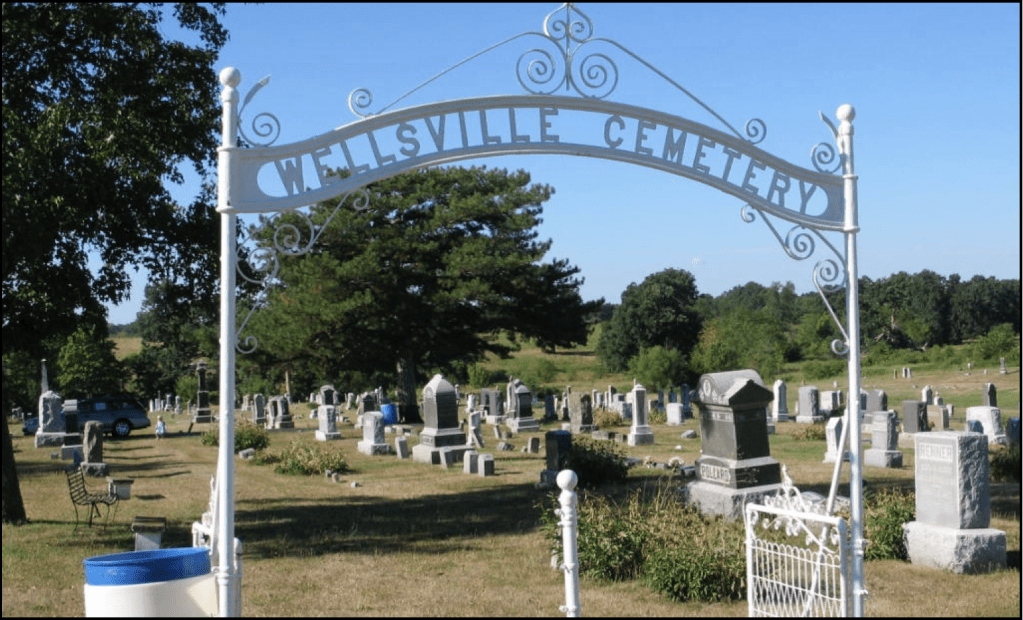
  • Cemetery Tour to visit cemeteries in ancestral or far flung locations
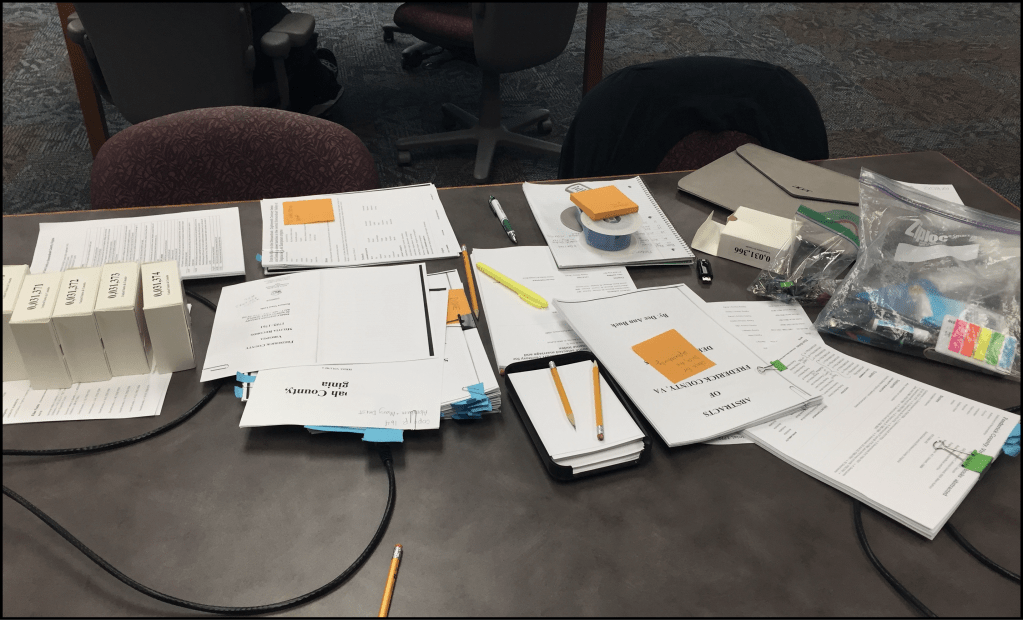
  • Repository Visits to conduct research in libraries, archives, and courthouses
  • “One-Stop” Library such as the Family History Library, Allen County Public Library, or Mid-Continent Public Library
Researching at the Family History Library

With any of these trips you’ll need to consider:

  • Travel such as air, train, bus, or car
  • Hotel, or staying with friends or family
  • Food, groceries, or restaurants
  • and other logistics unique to the area.

Over the next few weeks, we will examine each type of trip including what to bring and how to prepare ahead of time.

Upcoming Events

I just wanted to pause before I start my blog series to let you know of some upcoming speaking events that will be finishing out the year for me.

Clayton Library Friends – Webinar

I will be presenting “Making Molehills out of Mountains: Getting Organized” on Friday October 29 at 2pm CentralClick here for more information.

Genealogical Forum of Oregon Fall Seminar

On Saturday October 30, starting at 9am Pacific I will be presenting on 3 topics:

  • It’s in the Bag: Preparing for a Research Trip
  • How’d You Find That?!? Tips for Locating Obscure or Hidden Records
  • Using Google’s MyMaps as a Research, Analysis & Trip Planning Tool

Click here for more information.

Bay Area Genealogical Society (Texas)

On Friday, November 19, at 7pm Central, I will be presenting “Using Church Records to Find Ancestral Origins.” Click here for more information.

Orange County California Genealogical Society

On Saturday, December 4th at 10am Pacific, I will be presenting two lectures:

  • How’d You Find That?!? Tips for Locating Obscure or Hidden Records
  • Who Lived Next Door? Using the FAN Club

Click here for more information.

I hope you’ll join me at one or more! Happy fall!

Research in the Equality State: Online Resources

Every state is going to have a similar list of resources available online, so you can take what I share here and search for something similar in another state your are researching in. Most states will have a state archive and/or library. There may be a statewide digitizing project. You might find several universities that have archival collections. (In the case of Wyoming, there is only one, the University of Wyoming in Laramie.) There may be specialized museums around the state that have archival and research collections. And when I say “online,” I mean they have a web presence which may only be a catalog and you might need to contact them for copies or to find a research proxy.

These are some of the important collections of online resources in Wyoming:

  • Wyoming State Archives, located in Cheyenne, their online collection contains some county records, newspapers, maps, photos, and so much more.
  • American Heritage Center, located at the University of Wyoming in Laramie, their online collection consists of research guides and catalogs of their manuscript and rare book collection.
  • Wyoming State Historical Society‘s website is full of historical facts about the state including an encyclopedia, oral histories, field trip information, a blog, special topics, and more.
  • State or county-level genealogical societies are generally available. Wyoming does not have a state society, but there are several local societies such as the Cheyenne Genealogical & Historical Society.
  • Local public libraries often have a local history section, such as the Albany County Public Library in Laramie.

There are a lot of ho-to and link websites that we use everyday and are useful for finding Wyoming information such as:

This is the end of my series on Wyoming, for now. I did a webinar for Legacy Family Tree Webinars (subscription required to watch) on this topic back in 2019. So if you’d like to hear more details, you might head over there and give it a watch (this is an affiliate link).

Next week we will start something new. “See” you then!

Research in the Equality State: Online Card Catalogs

If you haven’t used the card catalog feature on a few of the main genealogical sites we all might use every day, let me take this moment in Wyoming research to demonstrate it. Main of the big genealogy sites have this feature but I have found that over the years, not many know about it or use it. I’ll show both Ancestry and FamilySearch’s card catalogs today, but be on the lookout for a similar feature on other sites.

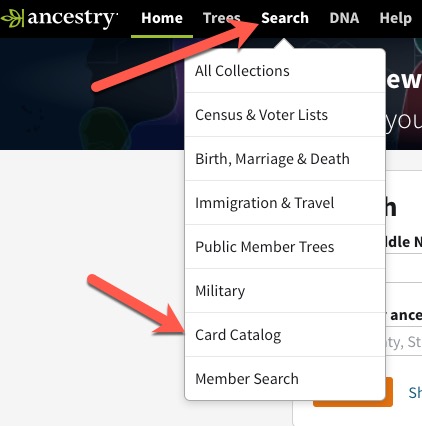
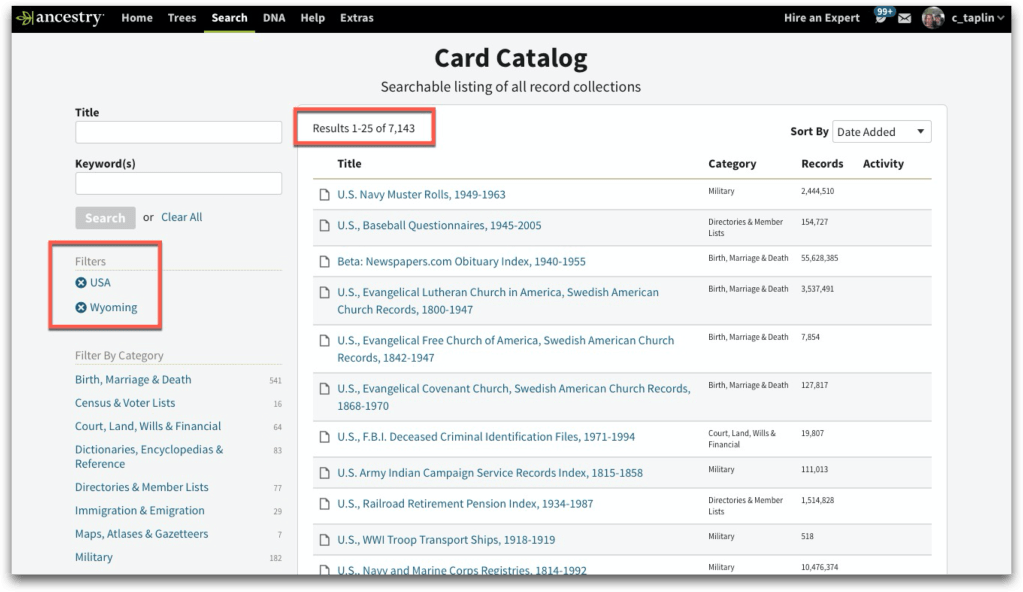
At Ancestry, you can find the Card Catalog under the Search Tab:

Ancestry’s Card Catalog

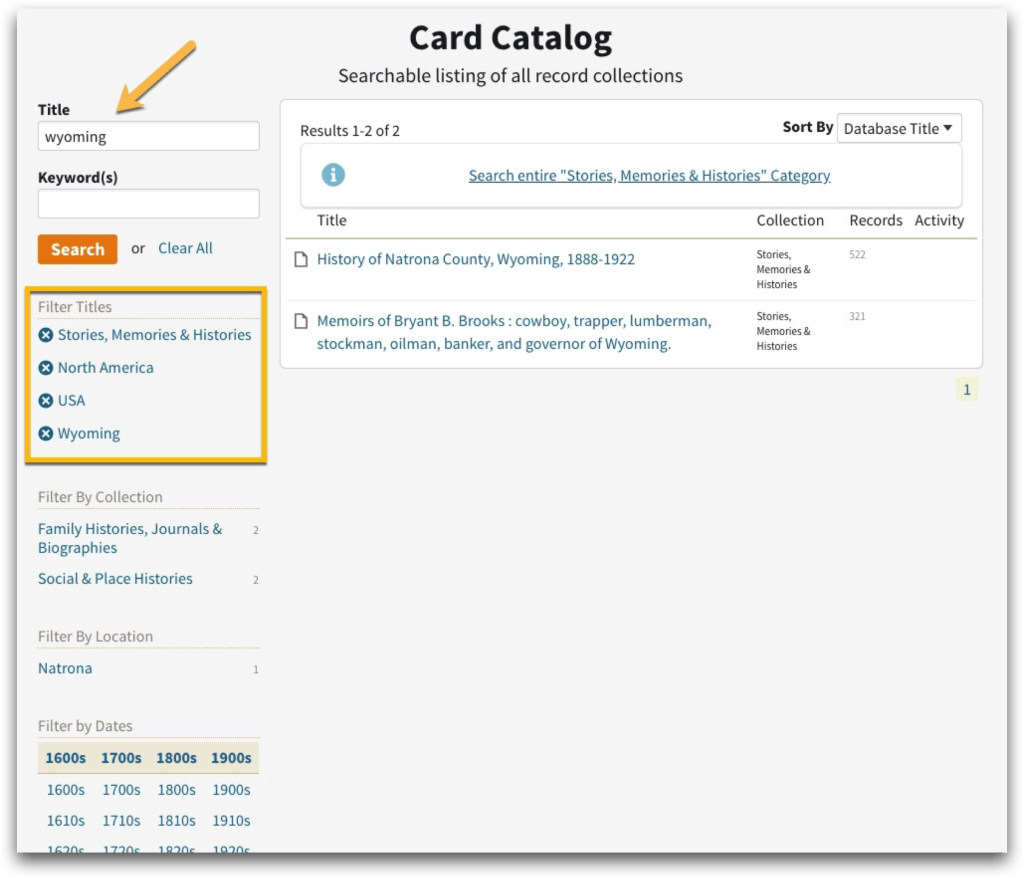
Once your in the card catalog, you can filter your results by using the options on the left. For this example, I have filtered by “USA” and “Wyoming:

You can further filter by the county, record category etc. This will help you see more quickly databases, record sets, and sources that Ancestry has for Wyoming specifically.

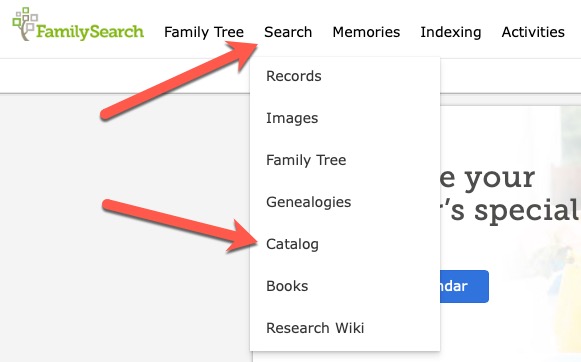
Similarly, at FamilySearch, you can also search the “Catalog.” From the home screen, it can be found under the Search tab:

FamilySearch’s Catalog

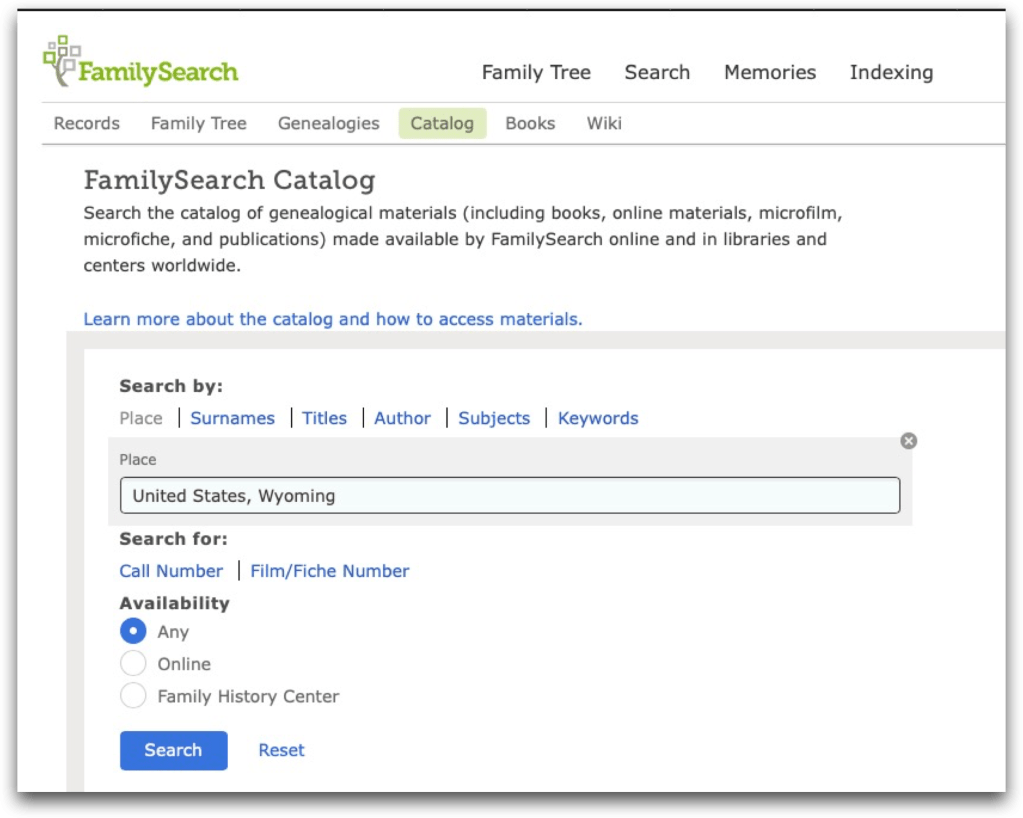
From this screen, you will see options to search by Place, Surnames, Titles, Author, Subject, and Keywords. Most of the time, I find I use the Place search.

FamilySearch’s Catalog

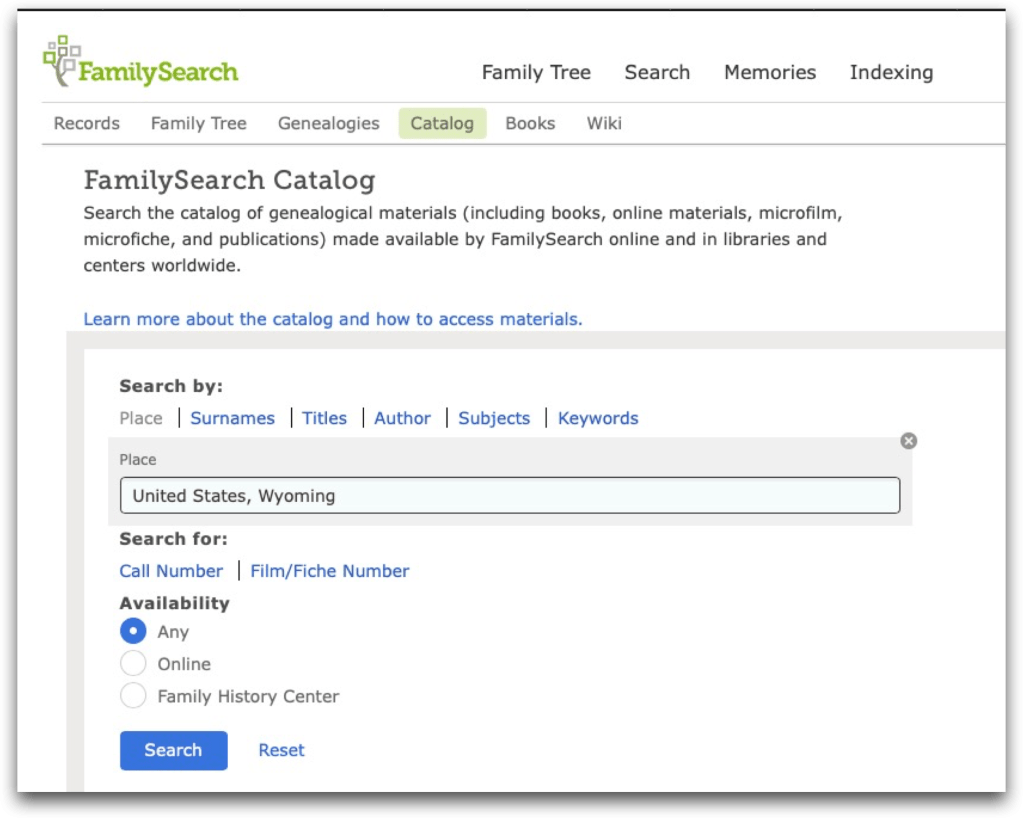
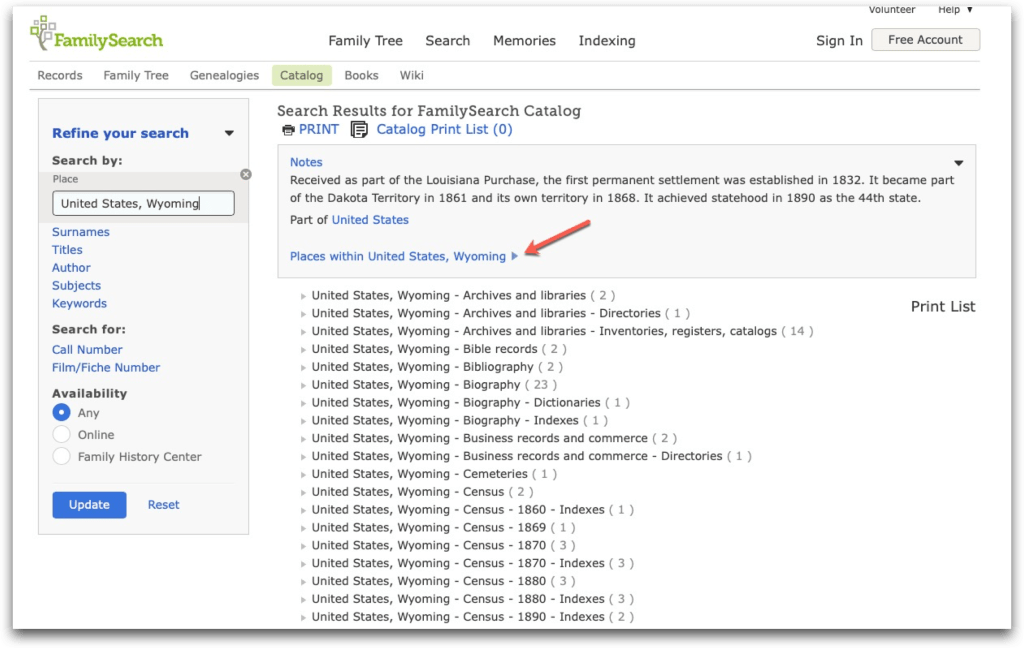
You can start your search broadly by typing in “Wyoming”:

FamilySearch’s Catalog

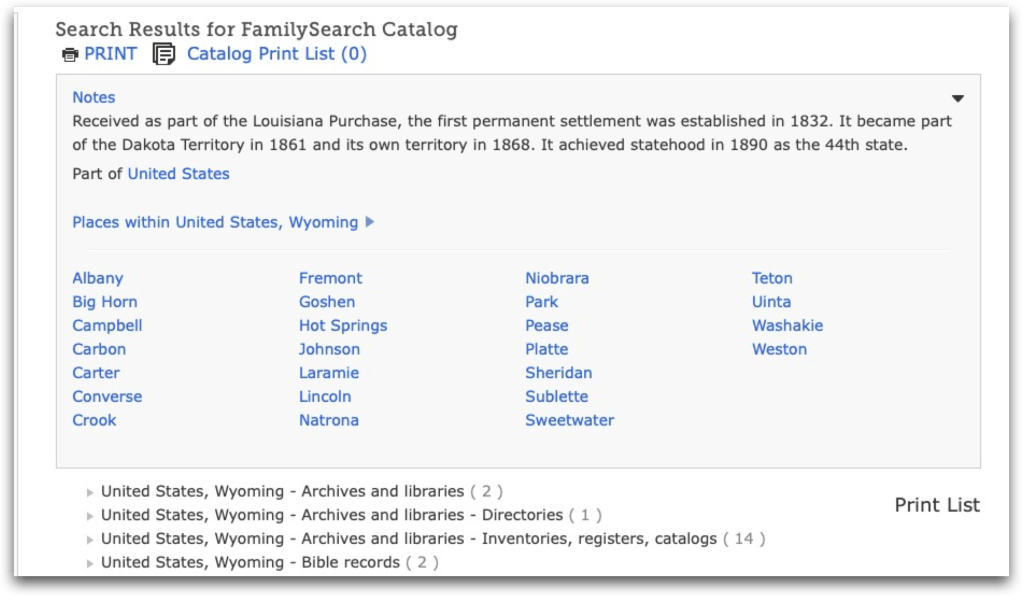
From there you can see all of the options that are at the state level, or you can click on “Places within United States, Wyoming” and see a list of counties:

FamilySearch’s Catalog – Wyoming
FamilySearch’s Catalog – Wyoming Counties List

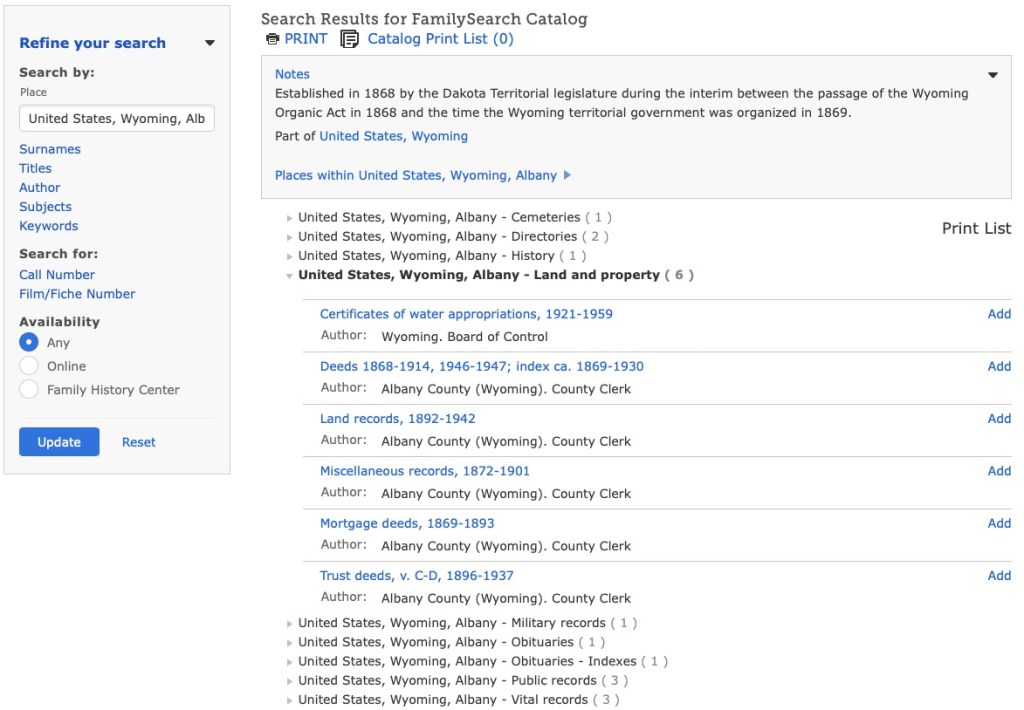
Once you’ve picked a county, you can see what records they have for Albany County land records:

FamilySearch – Albany County Land Records in the Catalog

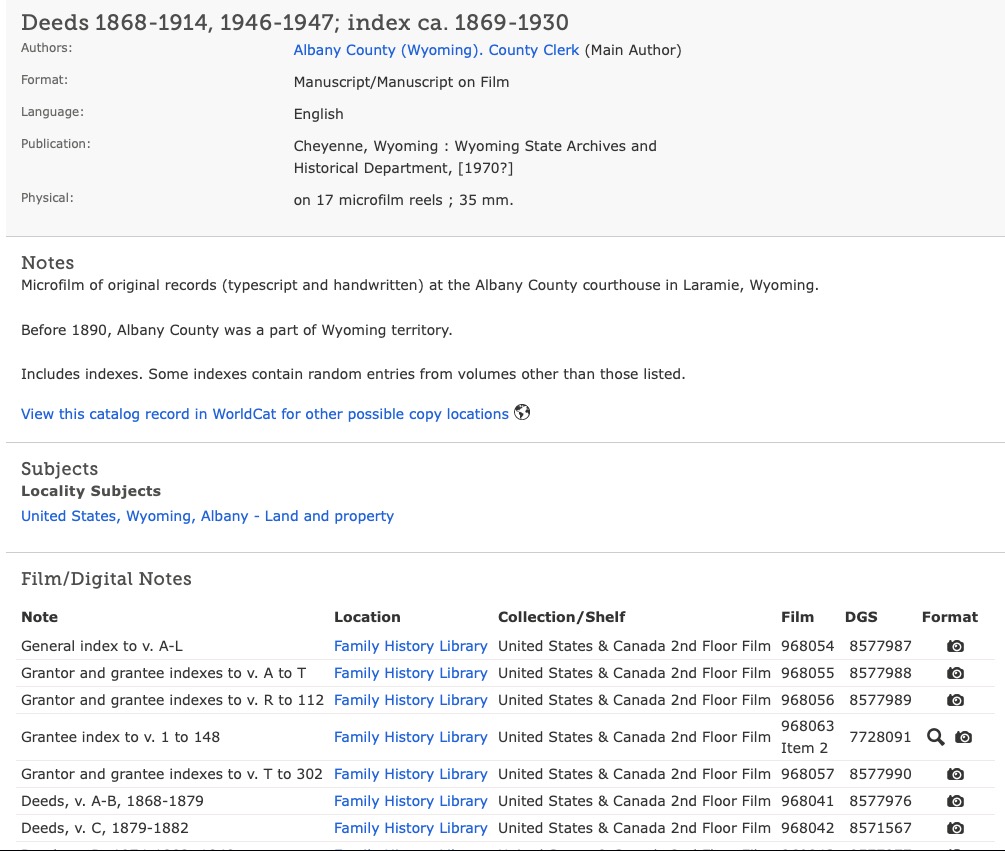
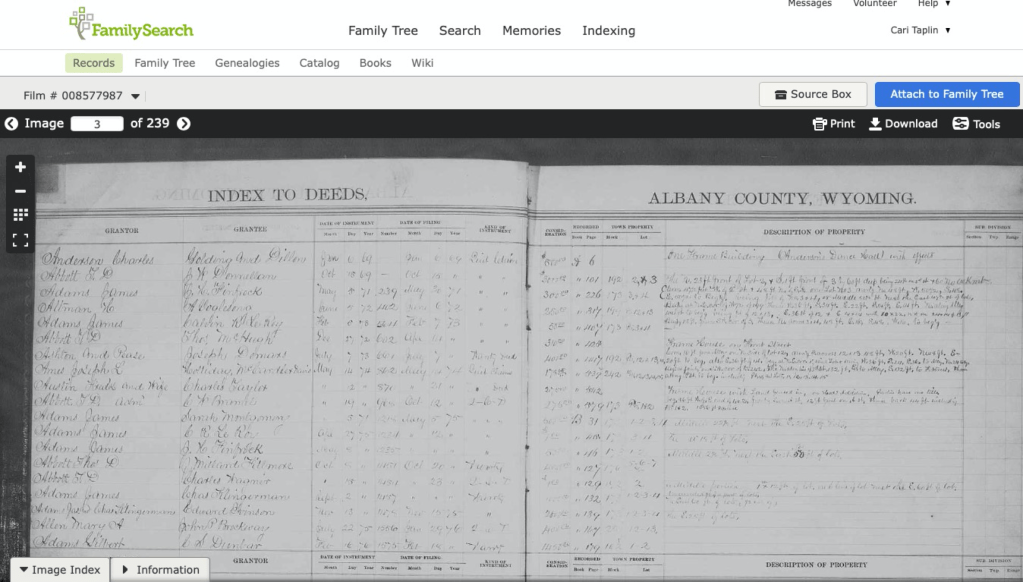
From there, it is almost like the “old days” of scrolling through microfilm, except you are at home. (Of course, there are some digitized films that must be looked at while at a Family History Center or Affiliate library due to contract restrictions.)

FamilySearch Catalog Entry for Deeds
FamilySearch Deed Index for Albany County

So, if I want to look up any deeds for Susan Baily, I can start “scrolling” or clicking and find the B entries in this index and then find the deed.

Using the card catalog allows me to be more thorough and intentional with my research. If you are just using the global search function from the front page of any of these large genealogical sites, you are probably missing a lot of records. Give the card catalog a look.

Research in the Equality State: Published Sources

Wyoming has a fair number of books published about it that are genealogically useful and historically interesting. Like other states, you will find county and regional histories. Your main repositories for published sources about Wyoming are:

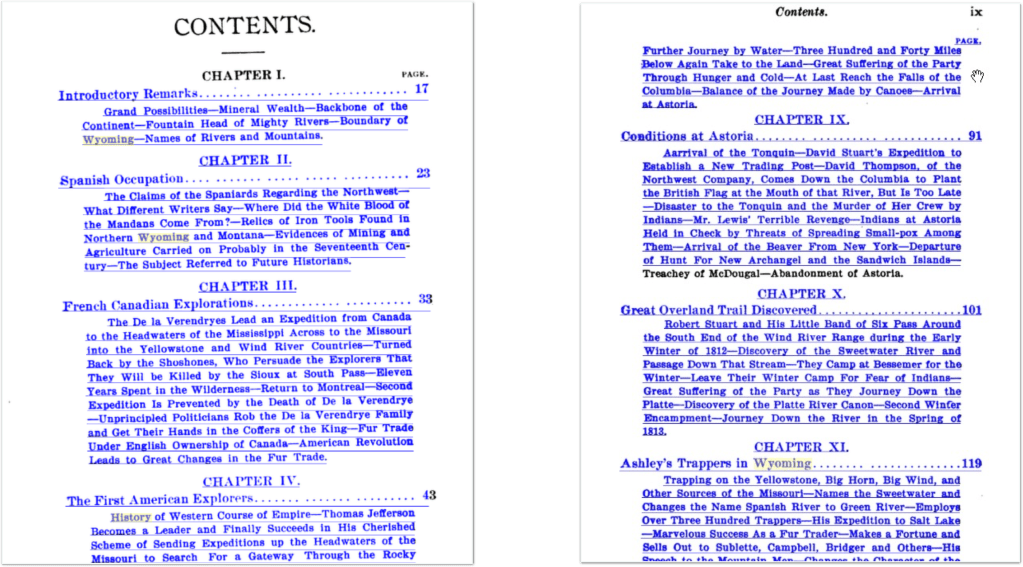
When examining county histories, don’t just look at the biographical sketches. Also examine the topical sections for important background.

Table of contents for A Sketch of the History of Wyoming by Isaac A. Chapman

You can also find published books at Ancestry. In the card catalog, use ‘Wyoming’ as the title and then use the filters on the left.

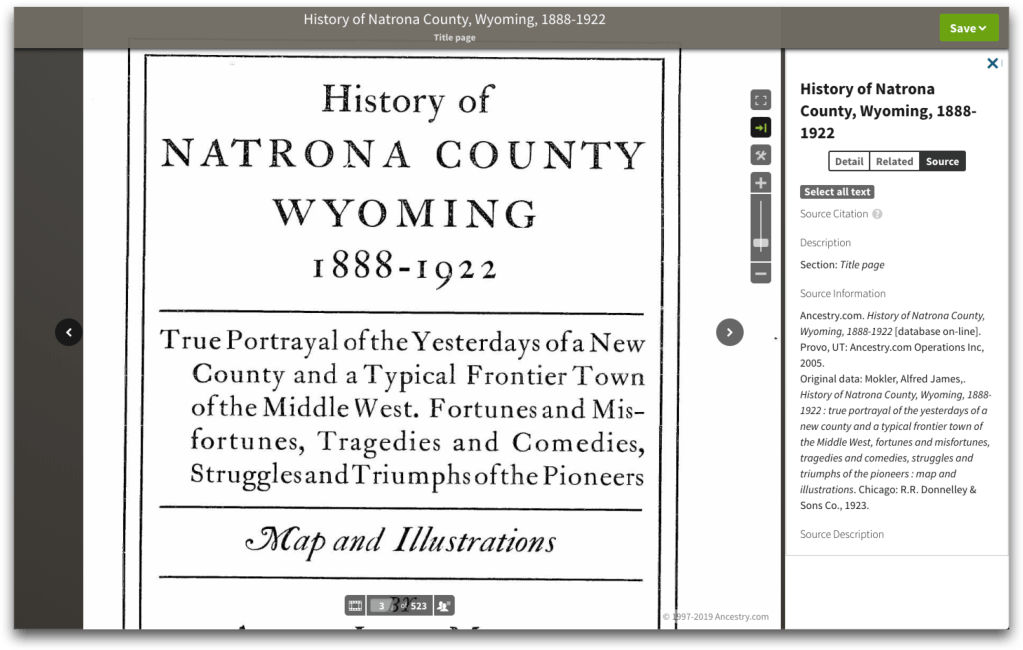
Using these filters, you can find a digital copy of History of Natrona County, Wyoming.

Examine these resources for books about the history and people of the county you are researching.

Next, we will examine some map collections for Wyoming.

Research in the Equality State: Newspapers

Newspapers are one of my absolute favorite sources when it comes to genealogy. Nothing gives you a better spotlight into a community and or a person’s life quite like a newspaper does. Wyoming had a fair number of newspapers throughout the state over time, and there are a number of excellent resources for finding them.

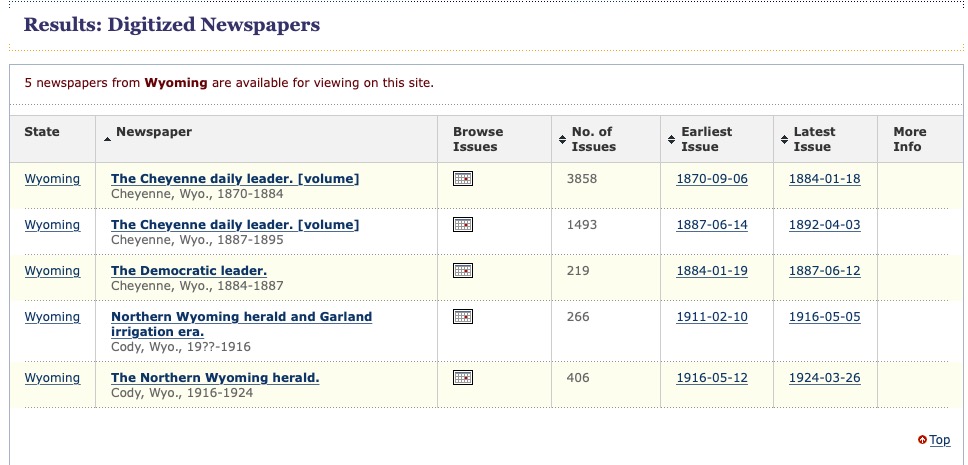
Of course you are going to want to examine some of the usual sites, such as Newspapers.com, NewspaperArchive, and GenealogyBank. It is just good practice to see what newspaper coverage those sites have for the area you are researching. Also, check with Chronicling America from the Library of Congress, which currently has five digitized newspapers available for Wyoming:

Chronicling America catalog of digitized newspapers for Wyoming.

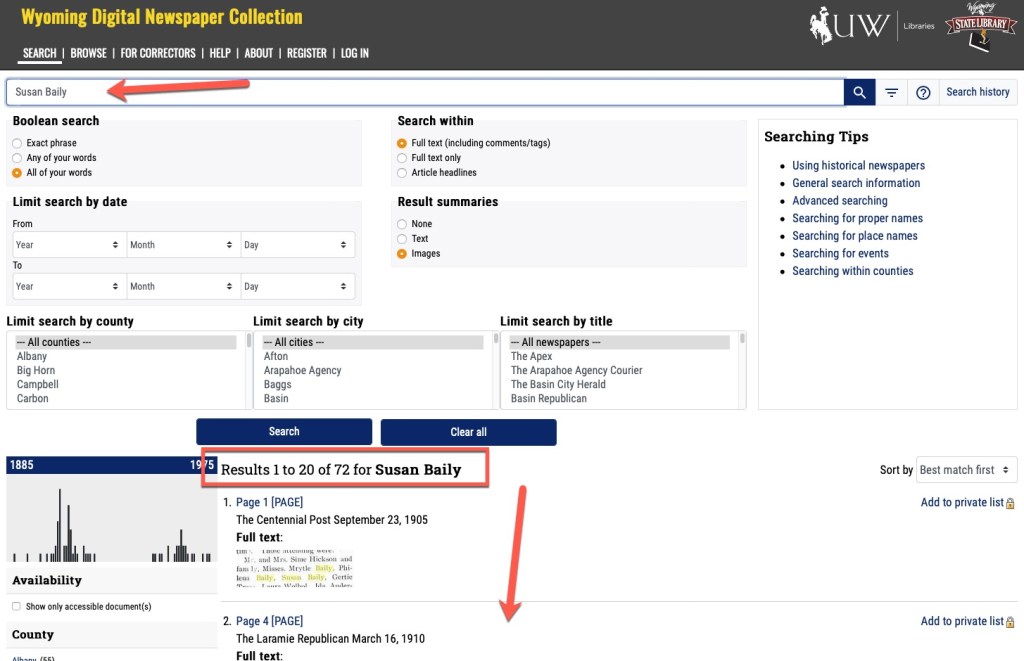
However, the best resource for digitized newspapers from Wyoming is the Wyoming Digital Newspapers Collection. This website is provided by the University of Wyoming and the Wyoming State Archives and contains newspapers back to 1849 and over 1.1 million pages of digitized content. We are going to conduct a search for our female homesteader Susan Baily:

We found 72 items for the phrase Susan Baily.

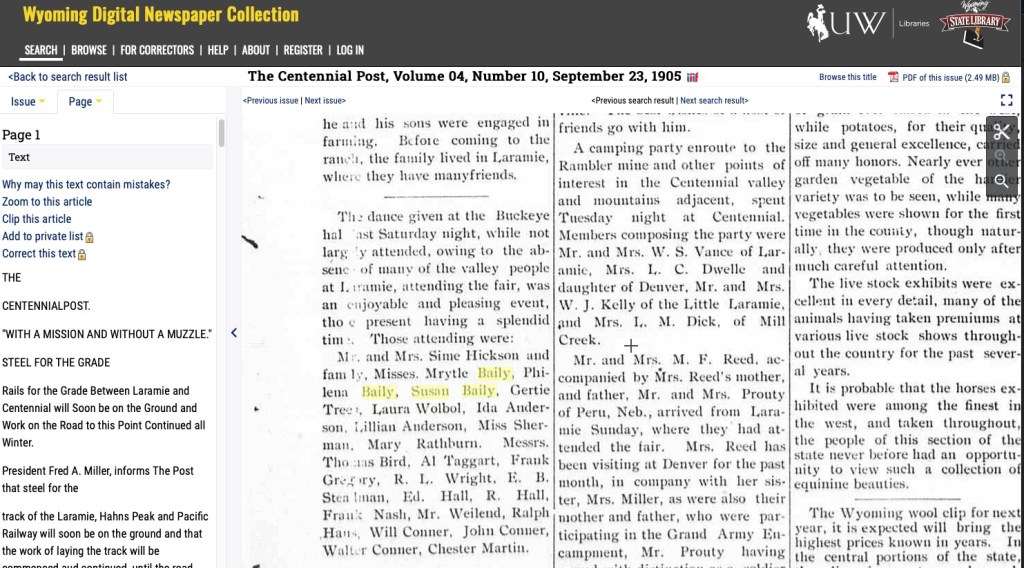
Our search for Susan Baily, without any other filters, returned 72 hits. As you can see, you can filter your search by exact phrase, date, county, city, and title. The first result is an article about a dance that was held in Centennial, Wyoming.

From the Wyoming Digital Newspaper Collection.

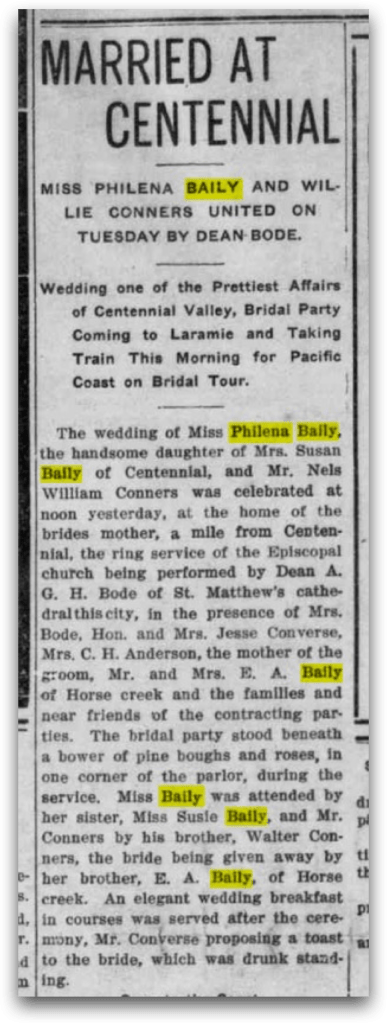
Digging a little further, we find an article about Susan’s sister, Philena Baily marring Willie Conners.

From the Laramie Republican, 16 March 1910

The state newspaper site is fantastic, and full of wonderful Wyoming newspapers. Have fun exploring!

Study Group Forming: Mastering Genealogical Proof

The last study group of 2021 is forming now. The group begins on October 6, 2021. There are two time slots, one with Cyndi Ingle (of Cyndi’s List) and one with me (Cari Taplin).

This will be a beginner/low-intermediate level class to study the book Mastering Genealogical Proof by Tom Jones. We will cover the principles outlined in the book as well as discuss the workbook questions.

We are also offering one free seat in each group on behalf of the Donna Hansen Peterson Scholarship.

For more information on the study group, you can read the details here: https://genealogypants.com/research-and-consultation-services/classes-and-study-groups/mastering-genealogical-proof-beginning-principles-class/

The group begins on October 6, 2021 so hurry to register:

Wednesdays, 3pm Eastern (with Cyndi): Click here to register. 

Wednesdays, 7pm Eastern (with Cari): Click here to register.

We look forward to studying with you!

Research in the Equality State: Wyoming Vital Records

In Wyoming, statewide vital registration was required starting in July 1909. Depending on the age of the records your are looking for, there are a couple of locations you might look for records.

  • For birth records under 100 years old and death records under 50 years old, they can be obtained at the Wyoming Department of Health. Their website indicates that birth records may be obtained by the “registrant if 18 years of age, either parent named on the certificate, lawyer representing the registrant or parent(s), or legal guardian with Court Ordered Guardianship papers.” As for death records, you must be an immediate family member, named on the certificate, a bank, a lawyer, or otherwise need to show proof of your relationship to the decedent. Marriage and Divorce records are also on file since May 1941. Prior to that, you will need to check at the county level.
  • For births older than 100 years and deaths older than 50 years you will find the records at the Wyoming State Archives. Of course, this is only back to July 1909. Prior to that, if a record was kept you might find it at the county level.
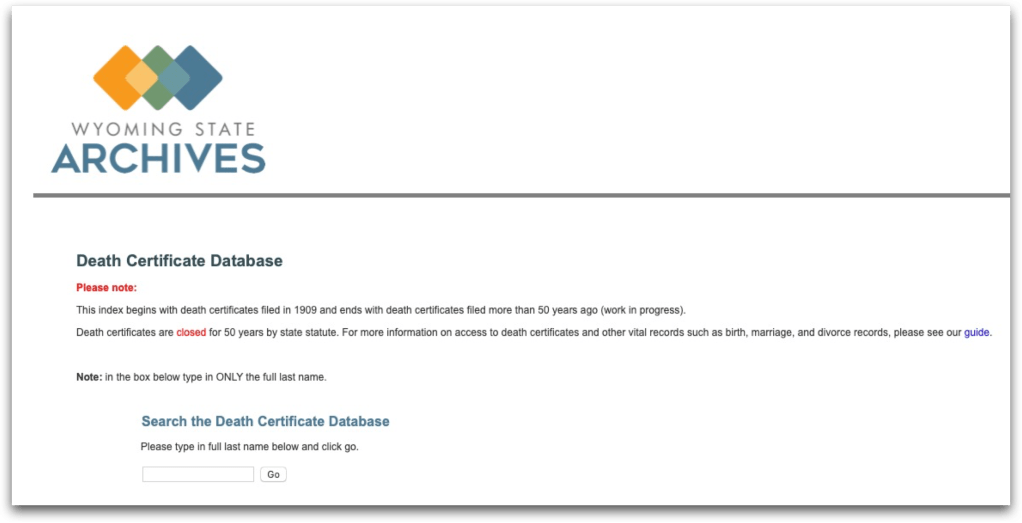
Wyoming State Archives Death Certificate Database
You request a copy from the State Archives by using the Contact Form.
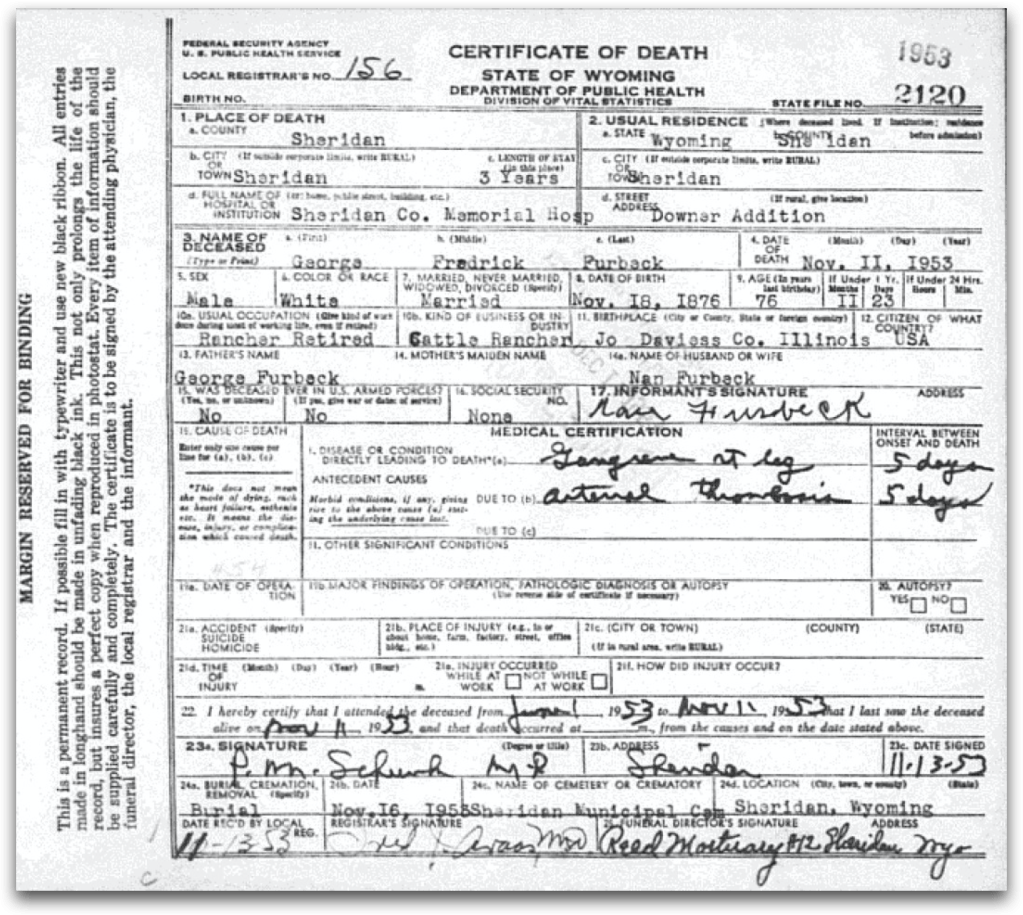
My husband’s great-uncle’s death certificate from Wyoming.

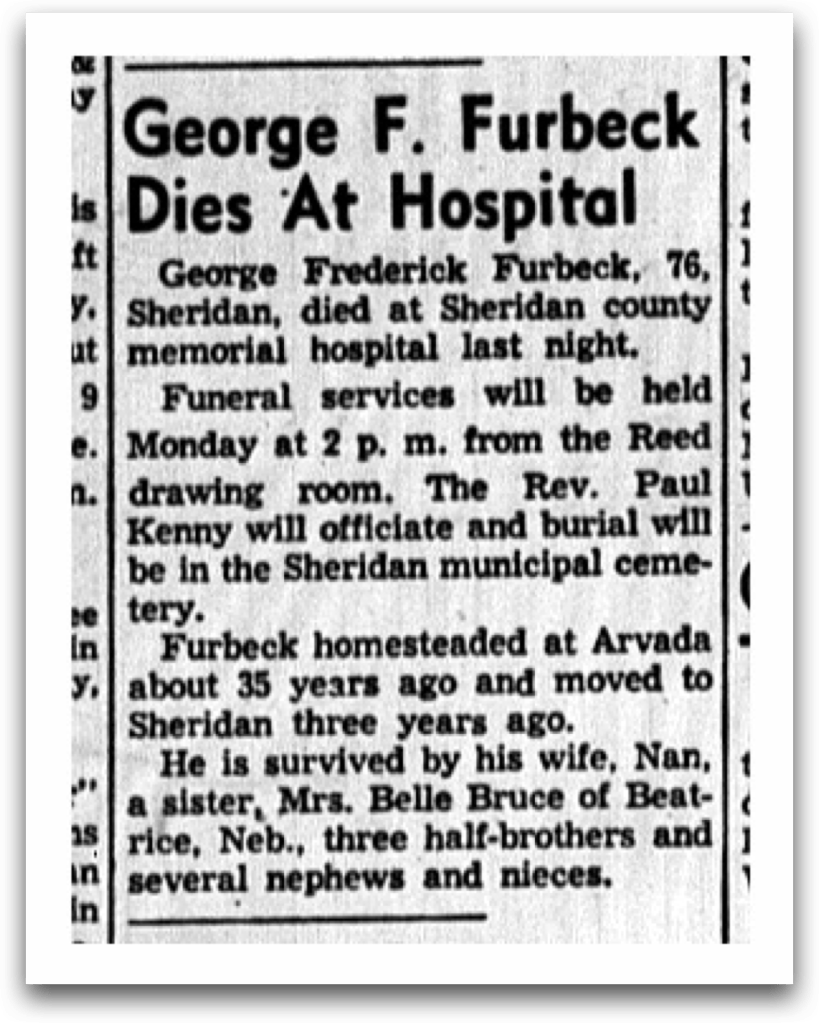
And even though we didn’t request it, the Wyoming State Archives also sent his obituary! And all of it was completely free!

Obituary for George F. Furbeck from Sheridan Press, 12 November 1953, p. 2.

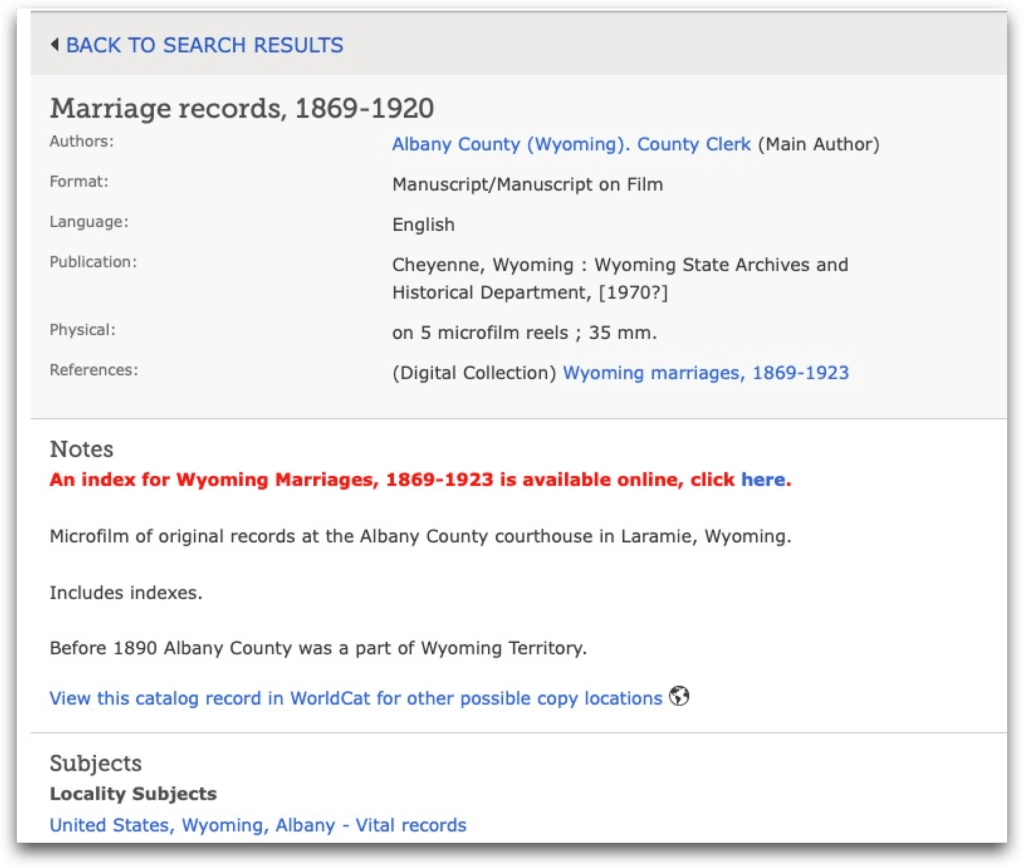
Of course, you will want to examine the FamilySearch catalog for the county in Wyoming that is of interest to you. Here is the catalog for Albany County marriage records:

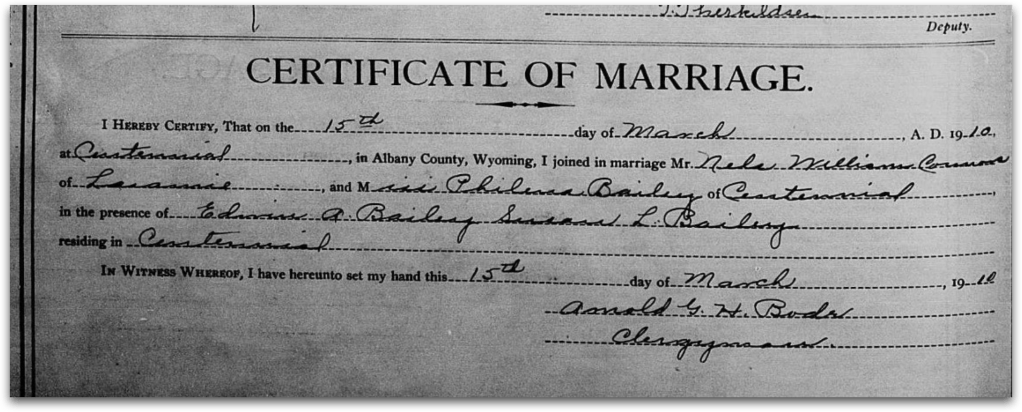
And here is the marriage certificate for Philena Bailey, one of the sisters of Susan Bailey, our homesteader from Centennial, Wyoming from the previous blog post:

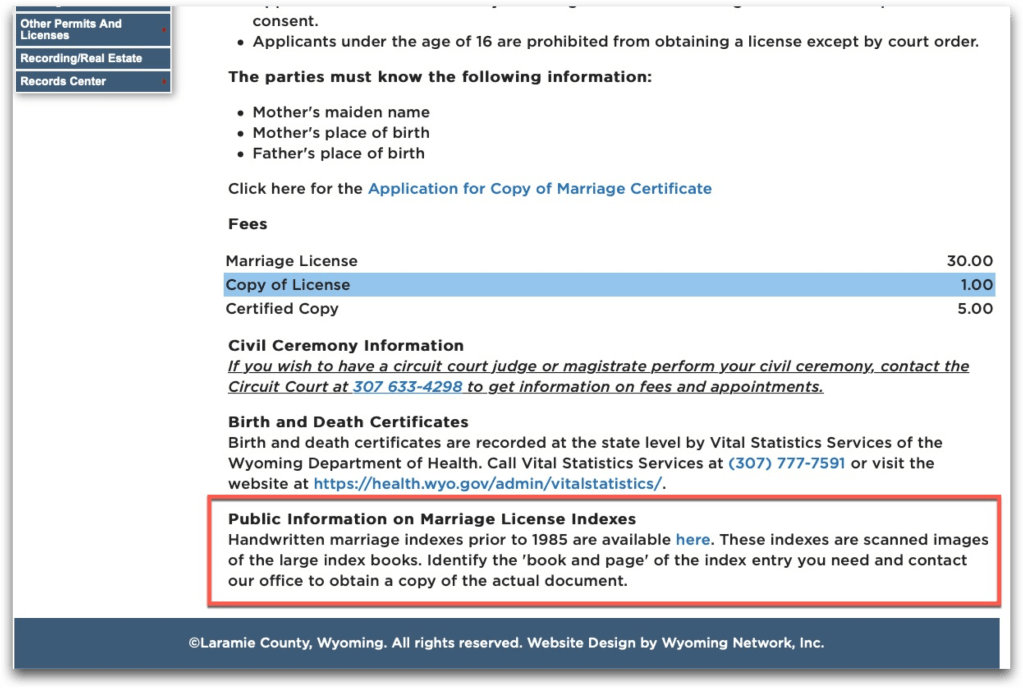
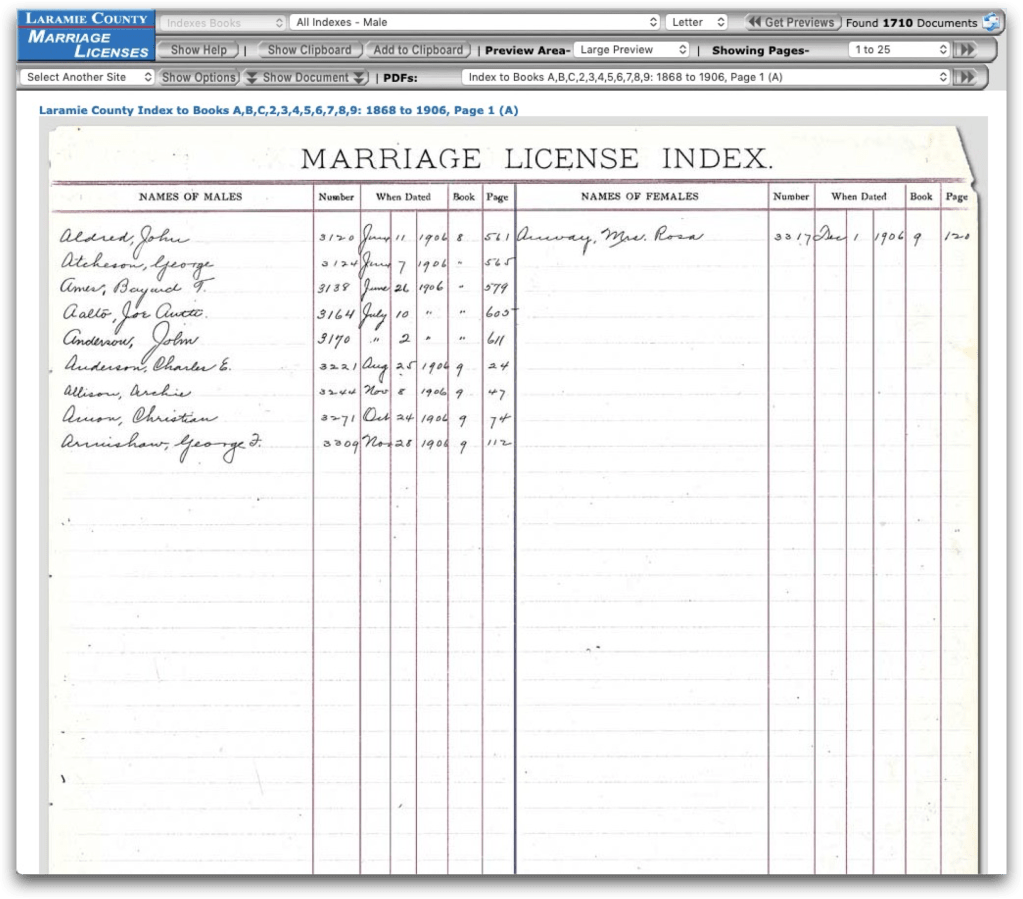
Be sure to check the county websites as well. You never know what you might find. This is the website for Laramie County (the county where Cheyenne is located, not Laramie, which is in Albany County). They have digitized their handwritten marriage index for the years prior to 1985.

A sample index page from Laramie County’s marriage index.

There are some other useful sites when looking for vital records in Wyoming beyond those listed above:

Next up, one of my favorite record sets, newspapers!

Research in the Equality State: Land

Wyoming is a big state, with big counties. The state only has 23 counties, and they are all fairly large in size.

Map from U.S. Census Bureau, 2000.

When we moved to Wyoming in 1988, we lived in Big Horn County, right up near the Montana border, in a little town called Cowley. When I went off to attend the University of Wyoming, we lived in Laramie, which is in Albany county, not Laramie County. My husband was born in Cheyenne, which IS in Laramie County… confusing, I know.

The land in Wyoming was part of the Public Land system. This was land, once obtained by the federal government was then sold by cash sale or given to settlers through various programs such as the Homestead Act. Once the land was distributed by the federal government it became the property of the individual. You can find the first disposition of the land at the Bureau of Land Management’s General Land Office website.

When you search for documents at the BLM website, you can search by the “authority” or the act by which the land was distributed.

BLM Website with a zoom in on the Authorities by which land was distributed with Homestead highlighted.

There was a female homesteader in Albany County named Susan Baily. She obtained 160 acres in two sections.

BLM website entry for Susan L. Baily in Albany County.
BLM website entry for Susan L. Baily in Albany County showing the map.

There is a great site called HistoryGeo (requires subscription) that has a “First Landowners Project” where they have pulled all of the individuals listed in the BLM database and placed them on maps beside each other. This allows you to see the neighbors, at least at the time of obtaining the land from the federal government. Looking for Susan Baily in this project showed me that several members of the Baily family obtained land near each other in Albany County.

HistoryGeo, Baily Family Entries
HistoryGeo, Baily Family Entries, Jason D. Baily is Susan’s father.

Homestead records for ten states have been digitized and are available on Ancestry: Alaska, Arizona, Illinois, Indiana, Iowa, Nebraska, Nevada, Ohio, Utah, and Wyoming. At that database, I was able to locate Jason Bailey’s homestead packet.

Homestead Packet at Ancestry for Jason D. Baily

In those homestead packets you often find genealogically useful information such as “I am a Native born citizen of the United States over the age of twenty one year and the head of a family consisting of wife and three children.” And that the land “is grazing and hay land, of timber, a few trees.”

Homestead Packet at Ancestry for Jason D. Baily

Once the land is obtained by the individual, and then later sold, those transactions are handled by the counties. Many of their records have been microfilmed by FamilySearch. Or contact the county to obtain records.

I’ve created an Ancestry Family Tree for Susan Baily as I work on her project. You can view it here.