Every year I write a post about my upcoming adventures in genealogy at least as I have planned at that point. Last December, I posted about the plans I had for the year and, with no idea about what was about to hit us this year, wrote about goal-setting. (Ha! I’d like to report most of my goals have been sidetracked and my latest goal is to get dressed everyday.)
So, most of my speaking engagements either got canceled by the sponsoring society or by me because I don’t feel that it is safe to travel this year (and possibly next, we shall see). I was able to convert one to a virtual event (the Caprock Genealogy Conference). The most recent to convert to virtual is the Federation of Genealogical Societies (FGS) Conference. I will be giving a class on finding and keeping volunteers, and workshop on using Google Maps to Plan and Analyze your Research.
This week, I am the coordinator for a new course for the Genealogical Research Institute of Pittsburgh (GRIP) “Following Your Ancestors in Time and Place.” We started on Monday and it has been a great week so far!
The course is meant to be an enjoyable “journey” through some of the processes for following ancestors as they arrived in the United States, why they may have decided to come, how they might have moved through the country, records they may have left along the way, some methodologies on how to find those records, and some in-depth tips on how to keep all of that information organized.
This course is a little different than most courses in that we have one instructor for each day:
- Monday – Rich Venezia – “FindingYourAncestors as theyCome to America”
- Tuesday – David McDonald – “Religion and Records: Colonials & Immigrants”
- Wednesday – Paula Stuart-Warren – “Finding Your Ancestors as they Moved and Migrated in the United States”
- Thursday – Me (Cari Taplin) – “Methodology for Finding Ancestors in Published Sources and Beyond”
- Friday – Cyndi Ingle – “Organizing and Maintaining Your Research Once You’ve Collected It”
I feel like we created a great line-up of super-stars who are the best in the field in their respective themes.
Having class in a virtual setting has its pros and cons (I like sleeping in my own bed every night and not missing my family while I’m away. BUT I miss seeing my friends in person and visiting my dear friend Rose Mary in Pittsburgh when I come to town.)
I hope you are doing ok making the switch to a virtual world. I know change is hard but I think this could have benefits for people who are homebound, can’t afford the travel, have other responsibilities that keeps them at home. This virtual option is opening the door for so many who haven’t been able to participate before and I want to welcome them aboard!
My scheduled speaking events for the rest of this year:
- GRIP, as mentioned
- Minnesota Genealogical Society Webinar, 5 August 2020
- Association of Professional Genealogists Webinar, 17 August 2020
- Southern California Genealogical Society Webinar, 19 August 2020
- Virtual Genealogical Association Conference, 13 November 2020
Maybe I’ll “see” you there!
 Who among us genealogists doesn’t struggle with maintaining focus? We all know too well about finding a tantalizing record that sends us down a road that we find ourselves still traveling at 3 a.m. Lack of focus can happen in the writing aspect as well. Distractions are often procrastination in disguise, particularly if you find writing difficult. We will always find something to keep us from writing. Procrastination feeds writer’s block and forms a cycle that is hard to break. Below are a few of my tips for maintaining focus when writing.
 I can hear many of you saying “I’m not a good writer.” And to that, I say “pish posh!” That is what editors are for. Editors (whether they are a trusted friend, someone you hire, or that from a journal) make your writing better! Don’t let that “I’m not a good writer” thought stop you from doing it. I sit in my office every day and look at my binders and worry that someday I’m going to come to a point in my life when I don’t get that work published somewhere, anywhere, where it can be used by future researchers. (I used to say “what if I’m hit by a bus” until a friend was literally hit by a bus, don’t worry, she’s ok. Another friend told me to think “what if I win the lottery and move to a private island” instead. She’s right. That’s a lot more fun to imagine. But even then, I’d probably figure out how to get the internet and do genealogical research even on my island.)
 that once met, you could hire a virtual assistant and/or subcontractors and take on even more clients. I haven’t met that threshold yet and so will cross that bridge when I get there!
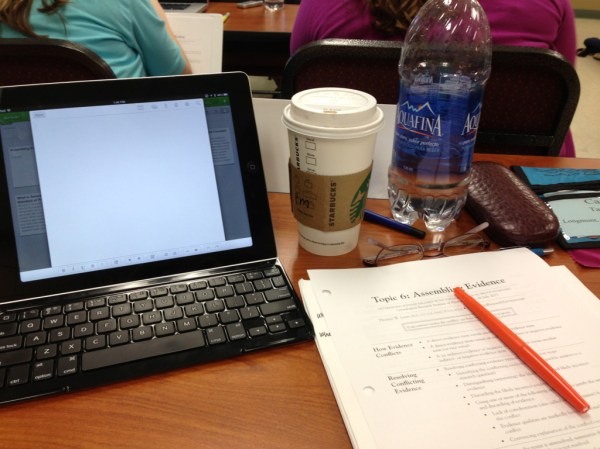 fill in those blanks. I will also seek out books, articles, blog posts, past webinars, and YouTube videos that might help start my education in that area.
 getting your genealogy organized can be a big time-saver in the long run. I encourage you to look at any system for organization and just take the leap and get it done. This is not something you sit down and do one day, usually. There’s a process: pick a system (this involves a little trial and error) then DO the system (get everything “synced” to the new system).
 sketch out the speaking agreements I’ve made. This helps me visualize when I have free time, when I need to plan time for travel, and so on.
 Genealogy Pants