Category Archives: Genealogy Program

Educational Opportunities in 2026

As 2025 winds down, I want to let you know about some of my plans in 2026.

The study groups that Cyndi Ingle and I lead are planned for 2026 and the schedules are posted on this website here: https://genealogypants.com/studygroups/

The only ones open for registration currently are the NGSQ study groups. These start in January and run for 11 months (we take December off). You can find more details and the registration links here: https://genealogypants.com/studygroups/ngsq-study-groups/ The other study groups open as we get closer to their start dates.

Also, coming up in February 2026, I’ll be presenting an all-day seminar for the lovely folks down at the West Valley Genealogical Society in Sun City West, Arizona. I for one am exciting to visit Arizona in the cold part of the Colorado winter! It is going to be a fun day in case you’d like to get out of the cold and join us. Details on that event can be found here: https://azwvgs.org/education/seminar/

Springtime with IGHR I’ll be teaching in the course “Repository Research: From Website to Doorway” which begins on March 12, 2026. Registration is open! You can find more details about this course or the many others here: https://ighr.gagensociety.org

I’ll be teaching at GRIP Virtual this summer in June with our course on “Not “Just” Farmers: Records, Relationships, and the Reality of Their Lives” with myself, Cyndi Ingle, and Paula Stuart-Warren. This course sold out last time so be ready when registration opens. For those details, see: https://grip.ngsgenealogy.org That week I’ll also be teaching in Paula Stuart-Warren’s course “Digging Deeper.” I hope you’ll join us!

That gets me through the summer… I’ll post more as new opportunities pop up. Consider adding one or more of these to your genealogical education plan for 2026.

NERGC Conference Coming Soon!

I’ll be one of the speakers at this year’s New England Regional Genealogical Consortium (NERGC). The conference is taking place October 29–November 1, 2025 in Manchester, New Hampshire. The pre-registration is closed but they also take walk-ins.

I am excited about the presentations I’ll be giving:

  • Wednesday, Oct 29, I’ll be providing a workshop on “Using Google’s MyMaps as a Research Tool.” I will show the attendees maps I’ve made for various uses on Google Maps.
  • Thursday, Oct 30 is “Genealogical Side Quests and Treasures Discovered,” a new lecture I’ve developed that talks about those research tangents we all find ourselves on and when that’s Ok and, when it’s not, tips for dealing with our curiosity to stay on track.
  • Friday, Oct 31 I’ll be sharing tips for “Utilizing Ancestry’s Databases: Beyond ‘Search’” and showing the audience ways to maximize the records at Ancestry.
  • Saturday, Nov 1 I start the day with a presentation on “Who Lived Next Door? Using the FAN Club in your Research” which walks the audience through using this strategy to advance our research and break down brick walls.
  • Another Saturday presentation is “Using Lists to Find Proof” where I discuss the various kinds of lists we encounter as genealogists and how using lists can be used to meet genealogical standards.
  • Saturday, Nov 1, Dinner Talk features stories of my kids in genealogical pursuits in “How Potty Training Helped My Genealogy.”

For more information on the conference, visit: https://nergc.org

After the conference, my husband and I are taking some much needed time off to explore New England and do some genealogical research while we’re at it.

2024 Study Group Schedule

Cyndi and I have finalized our plans for 2024 and wanted to share the schedule with you.

2024 NGSQ with Mastering Genealogical Proof Principles – There are four session times to choose from (limit of 25 per session). This course runs for 11 months (January – November) and we study one National Genealogical Society Quarterly (NGSQ) issue per month. Due to copyright, we cannot provide copies of the articles. You need to be a member of NGS or be able to make copies at a local public library. We read the articles ahead of students and create a list of unique questions for each article to discuss along with some standard questions we ask of all NGSQ articles. We don’t have the article list yet, but will post it as soon as it is available.

2024 Dates for NGSQ:

  • Jan 15 & 16  
  • Feb 12 & 13  
  • Mar 11 & 12  
  • Apr 8 & 9  
  • May 13 & 14 
  • Jun 10 & 11 
  • July 8 & 9 
  • Aug 12 & 13  
  • Sep 9 & 10 
  • Oct 14 & 15 
  • Nov 11 & 12
  • No class in December

Registration is open! Click here to see the options and to register: https://genealogypants.com/studygroups/ngsq-study-groups/

Writer’s Workshop Group 2024 – This writing group will work together to improve a piece of your own writing over 8 months (we January through August). The meeting times will be on usually the third Thursday of the month at 7 pm Eastern. Our overall focus will be genealogical writing. We will be mostly focusing on writing aspects but will also touch on genealogical issues such as meeting the Genealogical Proof Standard (GPS), looking at Genealogical Standards that are relevant to writing, and using citations. This is a participation required group. We will work on a piece of writing over the 8 months. You will be paired up each month with a partner to give feedback on that month’s topic. Participation is a must, and if you are looking for a hands-on writing group, this may be the one for you!

For full details and to register, click here:https://genealogypants.com/studygroups/writing-group/

Mastering Genealogical Proof (MGP) – a seven-week beginning principles course. There will be two sessions, Wednesday daytime at 3pm Eastern and Saturdays at 1pm Eastern (so adjust for your time zone). This is for those who have never studied this book before. We will be studying this from a beginner or slightly intermediate level. If you’ve done one of these groups before and want a refresher, that’s ok too! We will take 25 students in each class. This year, all classes will be taught by Cyndi Ingle. This is for those who have never studied this book before. We will be studying this from a beginner or slightly intermediate level. If you’ve done one of these groups before and want a refresher, that’s ok too! We will take 25 students in each class.

2024 Dates for MGP:

  • Wednesdays, February 7 – March 20 – Noon Pacific/3 pm Eastern
  • Saturdays, February 10 – March 23 – 10 am Pacific/1 pm Eastern
  • Wednesdays, August 7 – September 18 – Noon Pacific/3 pm Eastern
  • Saturdays, August 10 – September 21 – 10 am Pacific/1 pm Eastern

Registration will open 4-6 weeks before the class begins.

Mastering Genealogical Documentation (MGD) – a seven-Week beginning principles course – There will be two sessions: Wednesday daytime at 3pm Eastern, and Saturdays at 1pm Eastern (so adjust for your time zone). Each class will be about an hour. This is for those who have never studied this book before. We will be studying this from a beginner or slightly intermediate level. It is recommended that you have studied the book Mastering Genealogical Proof, but not a requirement for taking this class. If you’ve done one of these groups before and want a refresher, that’s ok too! We will take 25 students in each class.

2024 Dates for MGD:

  • Wednesdays, February 7 – March 20 – Noon Pacific/3 pm Eastern – Coming Soon
  • Saturdays, February 10 – March 23 – 10 am Pacific/1 pm Eastern – Coming Soon
  • Wednesdays, August 7 – September 18 – Noon Pacific/3 pm Eastern
  • Saturdays, August 10 – September 21 – 10 am Pacific/1 pm Eastern

Registration will open 4-6 weeks before the class begins.

Visit the Classes and Study Groups page at any time for most recent information. We hope to see you throughout the year!

Research “Plogs” – the Planning Part – part 1

Creating a research plan takes a bit of practice. There are differing opinions on just how much planning one should do for a given research question. I have seen long lists of sources one should consult when working on a project. Great, long lists that identify every source you may ever think of (even if it doesn’t apply to a particular ancestor or situation), like this one from the Puget Sound Genealogical Society. Others have taught that the plan should only be a few items, because what you find in those items may dictate where you look next. Some example research checklists, forms, and templates can be found here on Cyndi’s List.

I’ve discussed before that I think (at least in my experience) that are two phases of a genealogists “life.” The collection phase comes first; gathering as much as you can. In this phase you find all of the “low-hanging fruit” such as census records, vital records, newspaper articles, obituaries, and so on. The “easy” to find items for your ancestors. Then there is the phase that you face when the easy-to-find runs out. And not just runs out but when there are conflicts in the records you have found. The second phase I think of as the “brick wall” phase, or maybe just the “it is going to take more concentrated effort to figure out” phase.

I think the long checklist forms you can find are more appropriate for the collection phase. The more thoughtful, intentional, and detailed research plans are what is needed to get through the tougher problems. So, my point in saying all the above is this: What phase are you in? Choose the most appropriate system that works for you. I have two examples one for each “phase” that I will share both over the next few posts and discuss MY thoughts on the benefits of each.

Using Websites’ Card Catalogs: Ancestry

Many, if not all, major genealogical websites have some sort of catalog that allows you to see their holdings. This allows you to drill down to specific databases for a given location or topic. Effective searching when working on a specific research problem will hinge on utilizing the catalog.

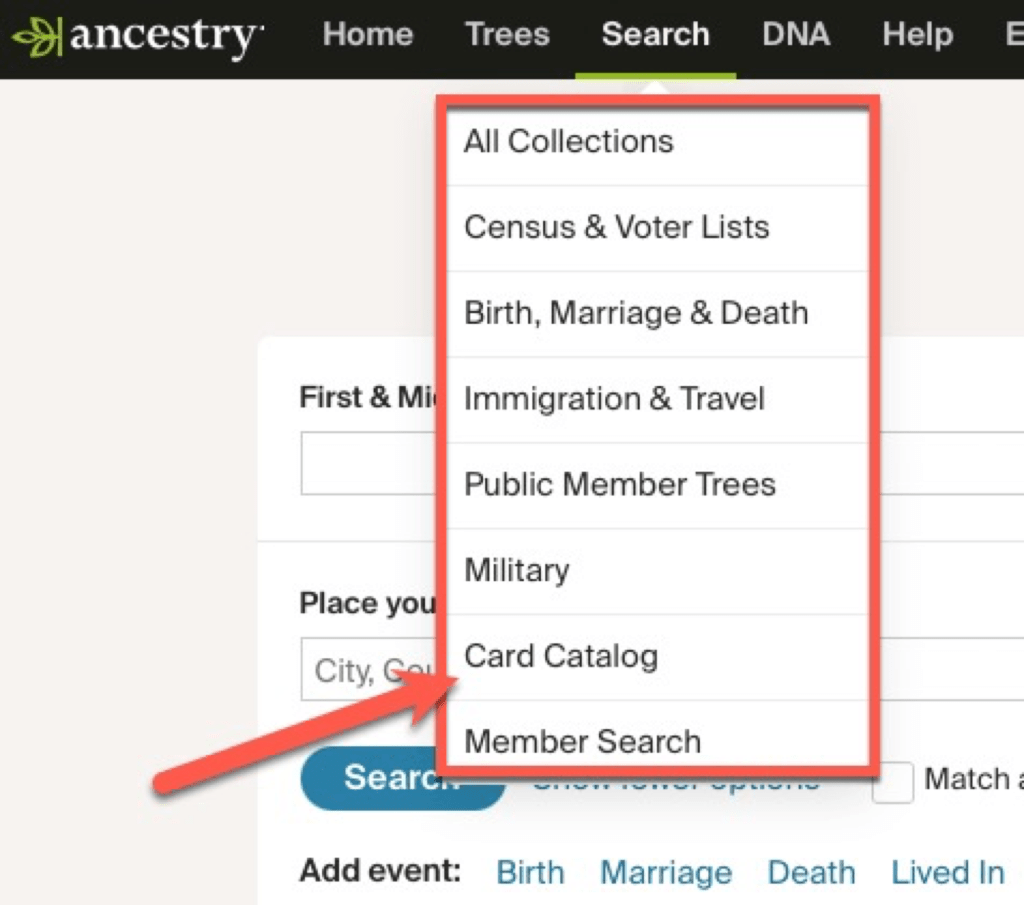
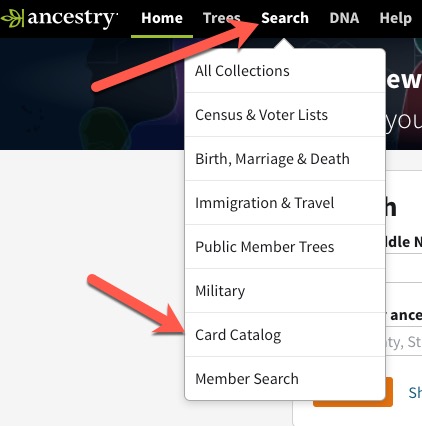
At Ancestry, from the home page, you’ll see some menu items along the top, to the right of the Ancestry logo. One of them is “Search.” When you click on that, a dropdown menu appears. Select “Card Catalog.”

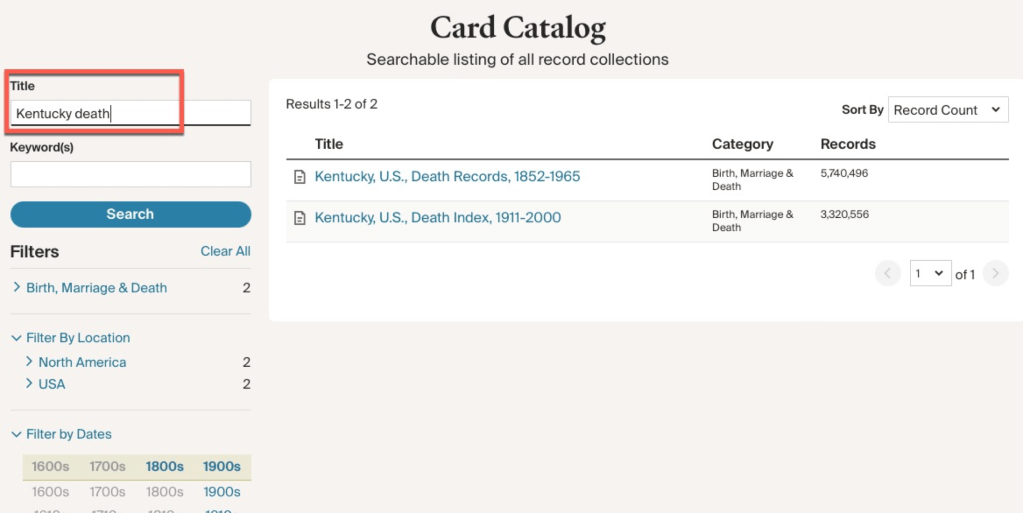
You will then get a full list of every individual database at Ancestry. At the time of writing this post, the total is 33,274 collections.

In the image above, you can see some tools on the left. At the top are title and keyword search boxes. Below that are a series of filters. Usually, I type in a word or two in either the title or keyword box (sometimes I do each separately depending on what kind of results I get). For example, “Kentucky death.”

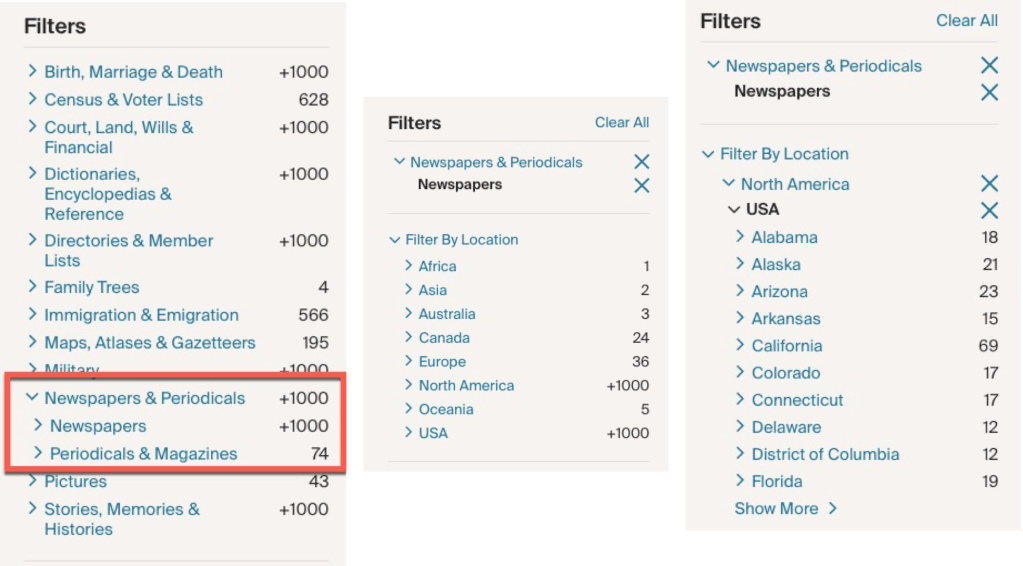
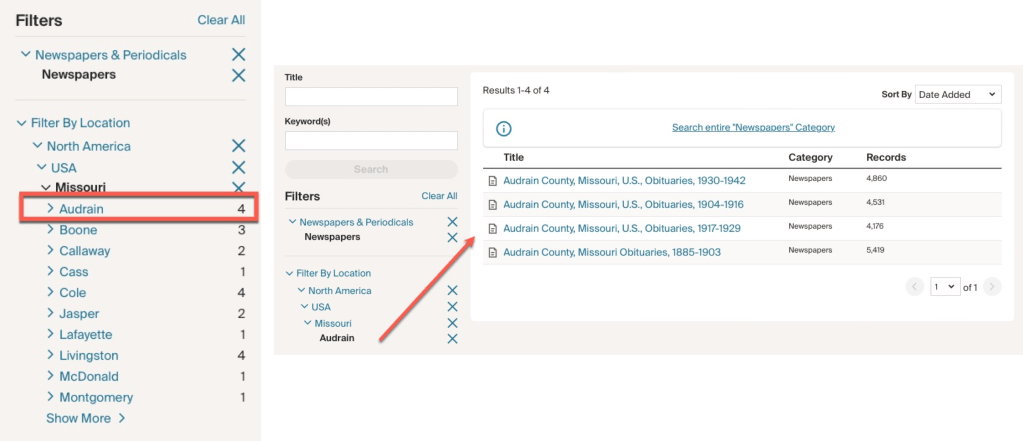
There are two items that come up with Kentucky death in the titles. You can also use the filters below to narrow down the database list. This is especially helpful if you don’t know exactly what you are looking for and you’d like to see what databases a website might have on a location or topic. Let’s say I want to see if there are any newspapers or obituary collections that might apply to Thomas Carroll Mitchell. Click on Newspapers & Periodicals, then Newspapers, then filter by location. In our case, we are looking for Missouri and Audrian County.

There are four databases from Audrain County (the neighboring county to Montgomery) that contain obituaries, one of them covering the year when Thomas C. Mitchell died in 1914. So, I will add this to my research plan. (Or, let’s be realistic, we’ll just jump in and search for Thomas.)

We will look at some more tips for using Ancestry’s catalog next time.

Happy Holidays!

Christmas will have just passed and the New Year is coming up quick!

I have the week off between Christmas and New Years and so does my husband, so I’m going to take some time away from the computer. I know, crazy, right? Ah, but it is a time to recharge, to rest, take a break, and spend time with my nearly grown kids.

I’ll be back next week with the next installment of County Histories. In the meantime, here is what’s on my plate for the first half of 2023:

You can view my calendar at any time by scrolling down below to the footer of this page.

I hope you all have a happy holiday season!

NGSQ 2023 Study Groups Forming

Just a quick note to let everyone know that our 2023 NGSQ study groups are now forming.

These are hosted by either myself or Cyndi Ingle (of Cyndi’s List). We will read and discuss one National Genealogical Society Quarterly (NGSQ) journal article per month as posted on the website NGSQ Study Groups. We will study these articles with a focus on principles taught in Mastering Genealogical Proof (MGP) by Tom Jones. We will discuss topics on the genealogy standards, evidence analysis and correlation, writing, citations, and more.

For more detailed information, the schedule, fees, and to sign up, visit this page.

The registration links are also below:

  • NGSQ/MGP Monday 1:00 pm Eastern Sessions, with Cyndi Ingle – Register Here
  • NGSQ/MGP Monday 3:30 pm Eastern Sessions, with Cyndi Ingle – Register Here
  • NGSQ/MGP Tuesday 1:00 pm Eastern Sessions, with Cari Taplin – Register Here
  • NGSQ/MGP Tuesday 7:00 pm Eastern Sessions, with Cari Taplin – SOLD OUT

If this doesn’t fit into your schedule this year, sign up to be notified when the 2024 NGSQ study group registration is open, add your name to the list.

Maps: Visualizing Your Ancestors – Metes and Bounds Land Descriptions

As described in the last post, there are two main survey methods in the United States. This post will discuss briefly the system of “metes and bounds.” There is a lot to know about this system and one blog post isn’t going to cover everything. In fact, they offer week-long institute courses on this subject (See SLIG 2023 course line-up.)

The metes and bounds system is a centuries-old system that was used in England and brought over with the early colonists. The land descriptions are in a “narrative” style that begin with a particular point and work their way around the land parcel being described. The describe physical points and markers such as trees, rocks, rivers and creeks, and often they will mention neighboring land lines. These types of descriptions heavily depend on physical characteristics of the land and because of that, the land description can change over time or be difficult to re-survey because those markers are no longer there. Trees die or blow down in storms, rocks get moved, rivers and creeks change their shape during floods, and so on.

The land description is a series of calls that give a point of reference, a direction, and a distance. The description uses “metes” and “bounds”:

  • metes – angles of the property, and in what direction (45 degrees southwest)
  • bounds – boundary lines of the property, length (60 chains, along John Smith’s line)
Metes and bounds land description, drawn by author’s spouse.

A metes and bounds description will read like “Beginning at the great white oak, 45 degrees southwest, 30 chains to the felled maple; 76 degrees southwest, 60 chains along John Smith’s line to the marked oak; 5 degrees southwest 16 chains, to the big rock…” You will get odd shaped land parcels. These unique shapes are very helpful if you are trying to reconstruct an area or neighborhood because they should fit together like a puzzle.

The cool thing about these land descriptions is that the naming of the neighbors giving you an instant “FAN Club” member (Friends, Associates, Neighbors). You also get a rough idea of what some of the land might have looked like. (I’ve seen a land descriptions out of Texas that used things like an old axle or a railroad ties as the markers, because the land was desolate and there weren’t any trees or rocks to use as starting points!)

Vocabulary you will see:

  • Acre – 43,560 square feet, 160 square rods
  • Arpent – Similar to acre, used in French sections of US (LA, MS, AL, MO, FL). One arpent is .84625 acres. In MO, it was .8507 acres, or 192.5 square feet.
  • Chain – 66 feet long, with 100 links; one mile is 80 chains
  • Degree – 1/360th of the distance around a circle; used to measure direction; 0 degrees is North or South and other directions given in terms of degrees from N or S
  • Link – 1/100th of a chain, 7.92 inches long; 25 links = 1 rod
  • Perch – same as a rod
  • Pole – same as a rod
  • Rod – 16½ feet; measured as ¼ of a chain or 25 links
  • Vara – Unit of measure used in sections of the US settled by Spain; varying lengths; Texas vara = 33.3333 inches or 36 varas = 100 feet (the Florida vara a little larger, the Southwest vara smaller)
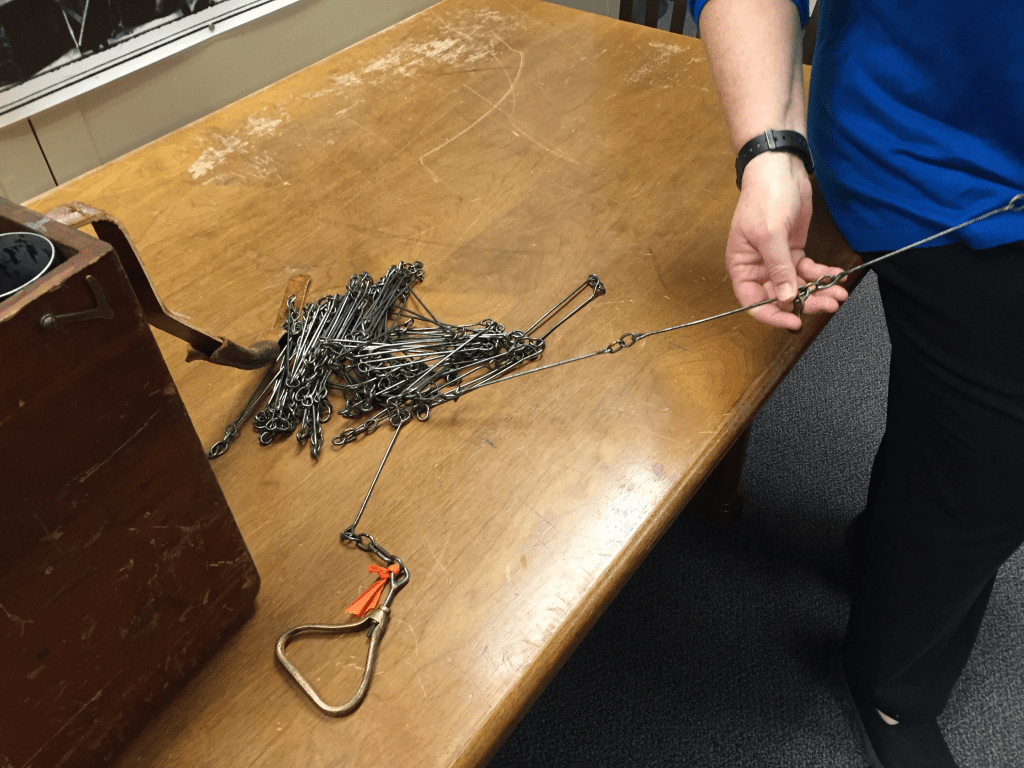
Surveyor’s chain, 100 links = 66 feet; photo taken by author.

Conversions:

  • 1 mile = 80 chains = 320 poles, rods, perches = 5,280 feet
  • 1 chain = 4 poles, rods, perches = 66 feet = 100 links
  • 1 pole, rod, perch = 25 links = 16½ feet
  • 1 link = 7.92 inches

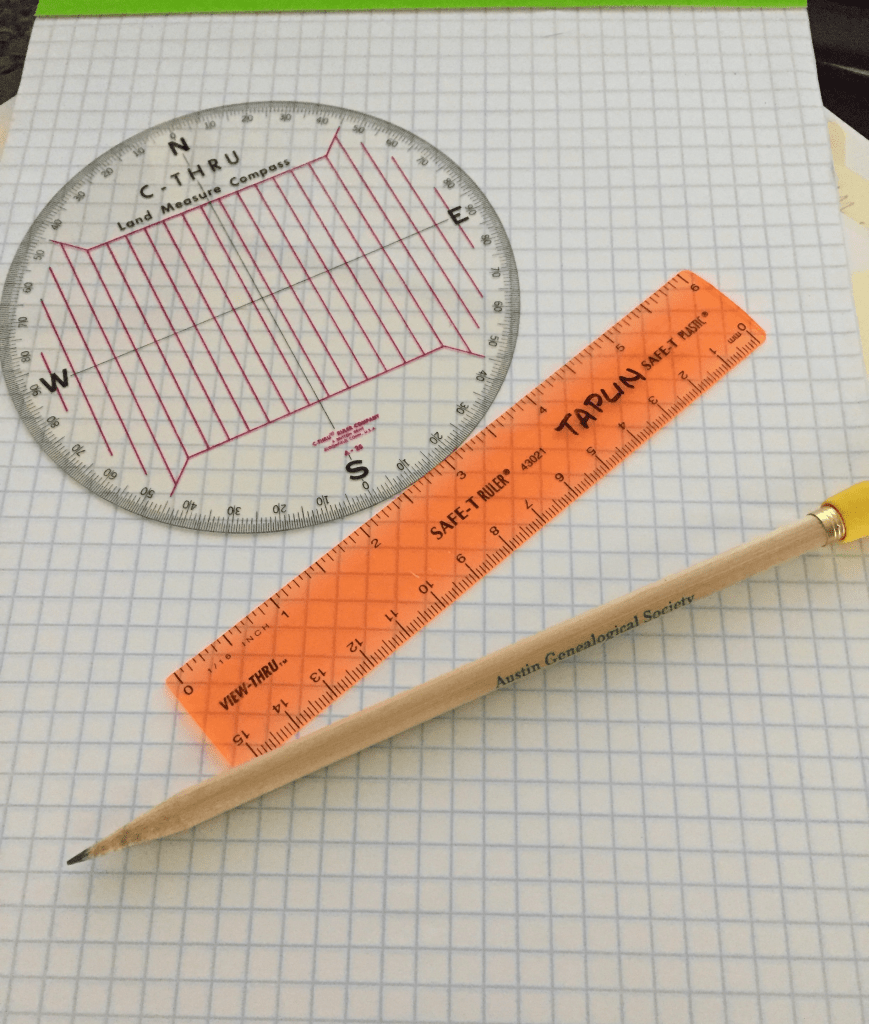
There are software packages that will draw the calls for you. I don’t do enough metes and bounds work in my research to use them. I use my trusty protractor, ruler, and graph paper to draw them when I need to.

Author’s metes and bounds drawing supplies.

There is a lot more to know about this survey system. More than I have time to cover in this blog post. If you have research in areas that used metes and bounds and want to understand your ancestors more, take a land-platting class.

We will talk about the rectangular system next time.

Research in the Equality State: Online Card Catalogs

If you haven’t used the card catalog feature on a few of the main genealogical sites we all might use every day, let me take this moment in Wyoming research to demonstrate it. Main of the big genealogy sites have this feature but I have found that over the years, not many know about it or use it. I’ll show both Ancestry and FamilySearch’s card catalogs today, but be on the lookout for a similar feature on other sites.

At Ancestry, you can find the Card Catalog under the Search Tab:

Ancestry’s Card Catalog

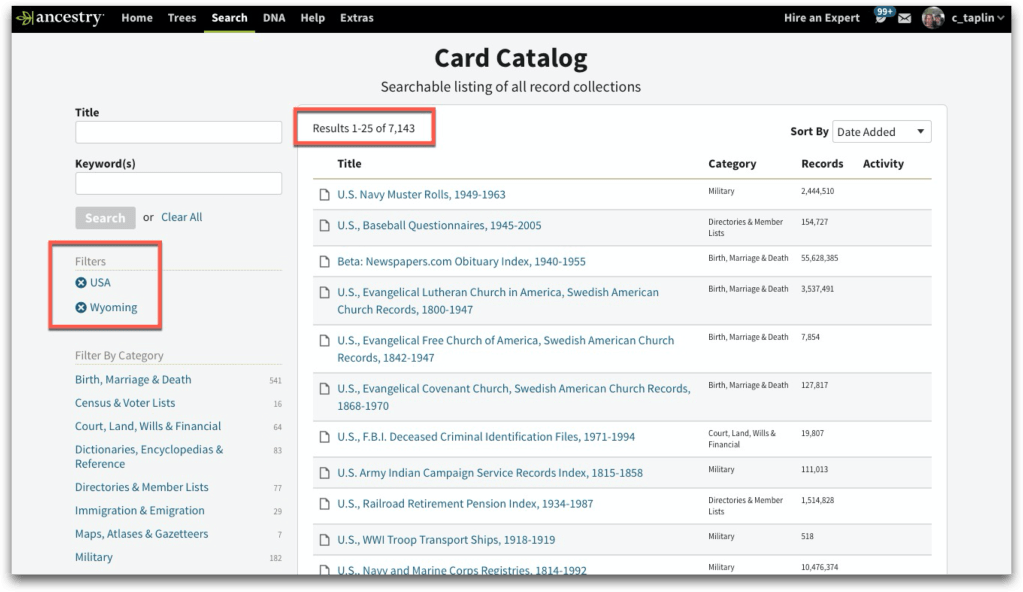
Once your in the card catalog, you can filter your results by using the options on the left. For this example, I have filtered by “USA” and “Wyoming:

You can further filter by the county, record category etc. This will help you see more quickly databases, record sets, and sources that Ancestry has for Wyoming specifically.

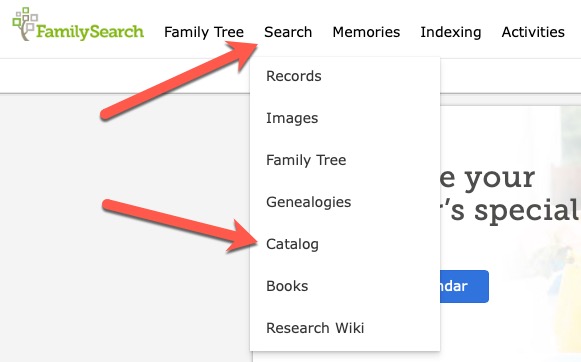
Similarly, at FamilySearch, you can also search the “Catalog.” From the home screen, it can be found under the Search tab:

FamilySearch’s Catalog

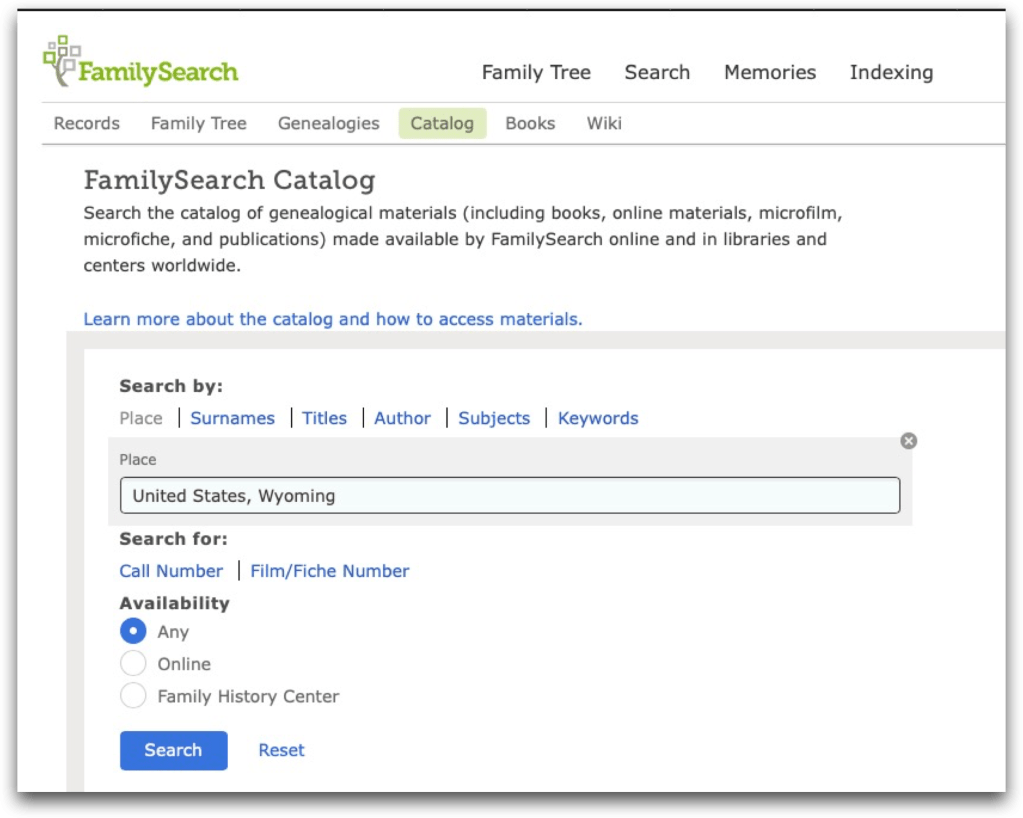
From this screen, you will see options to search by Place, Surnames, Titles, Author, Subject, and Keywords. Most of the time, I find I use the Place search.

FamilySearch’s Catalog

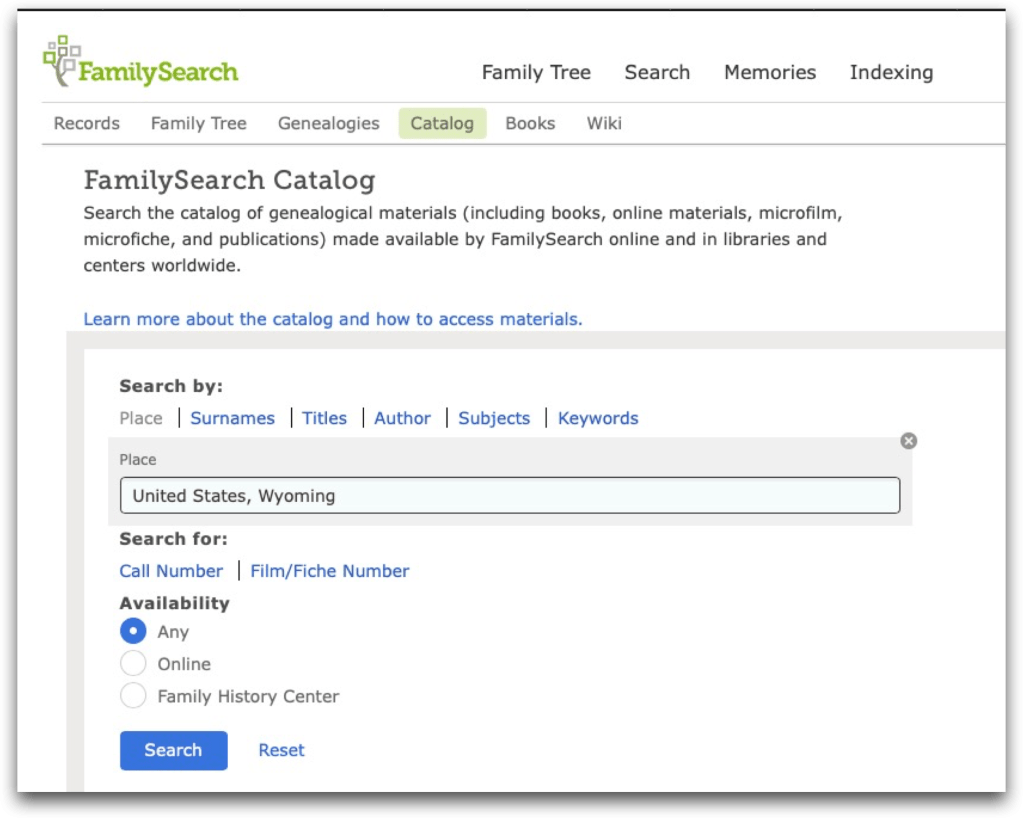
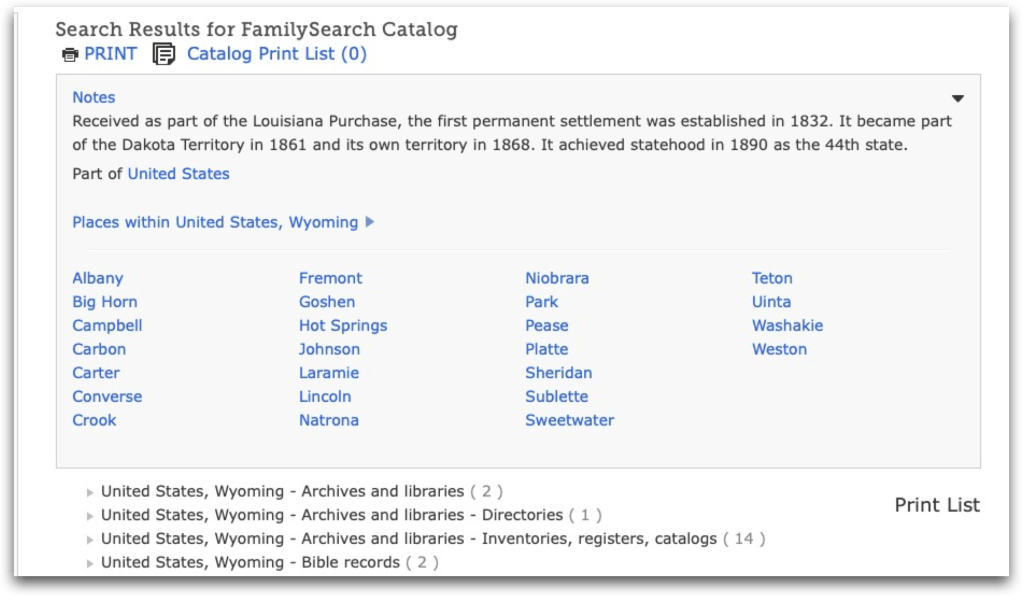
You can start your search broadly by typing in “Wyoming”:

FamilySearch’s Catalog

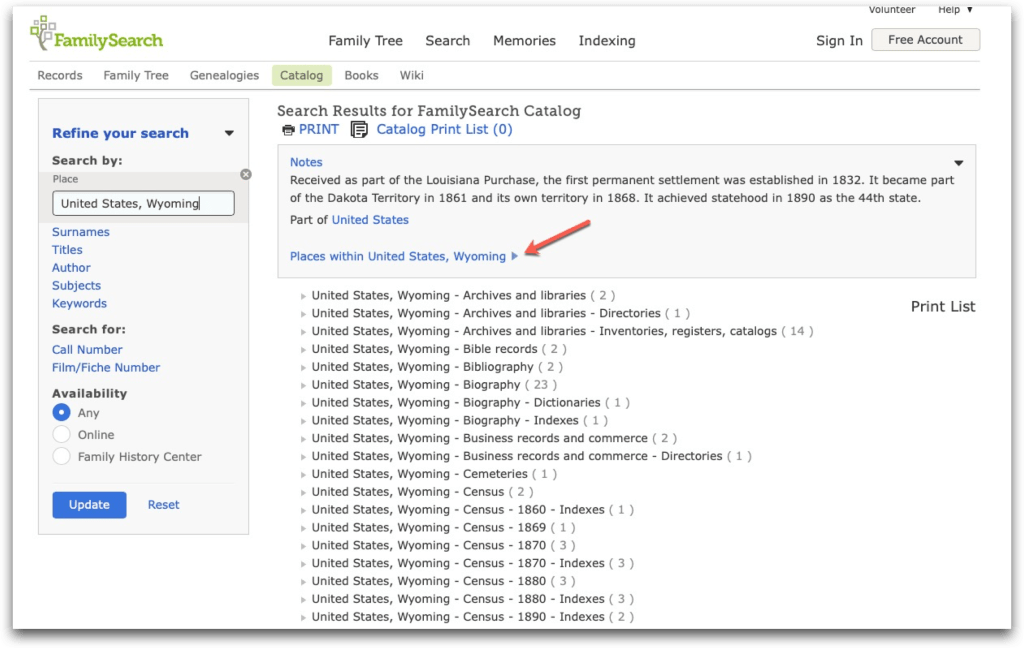
From there you can see all of the options that are at the state level, or you can click on “Places within United States, Wyoming” and see a list of counties:

FamilySearch’s Catalog – Wyoming
FamilySearch’s Catalog – Wyoming Counties List

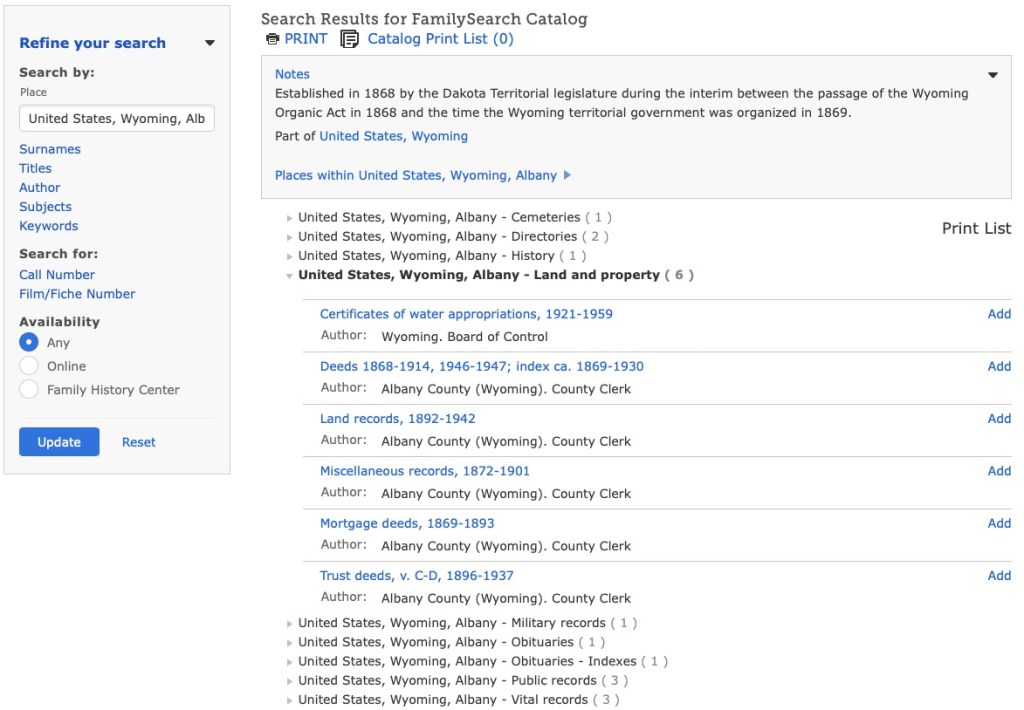
Once you’ve picked a county, you can see what records they have for Albany County land records:

FamilySearch – Albany County Land Records in the Catalog

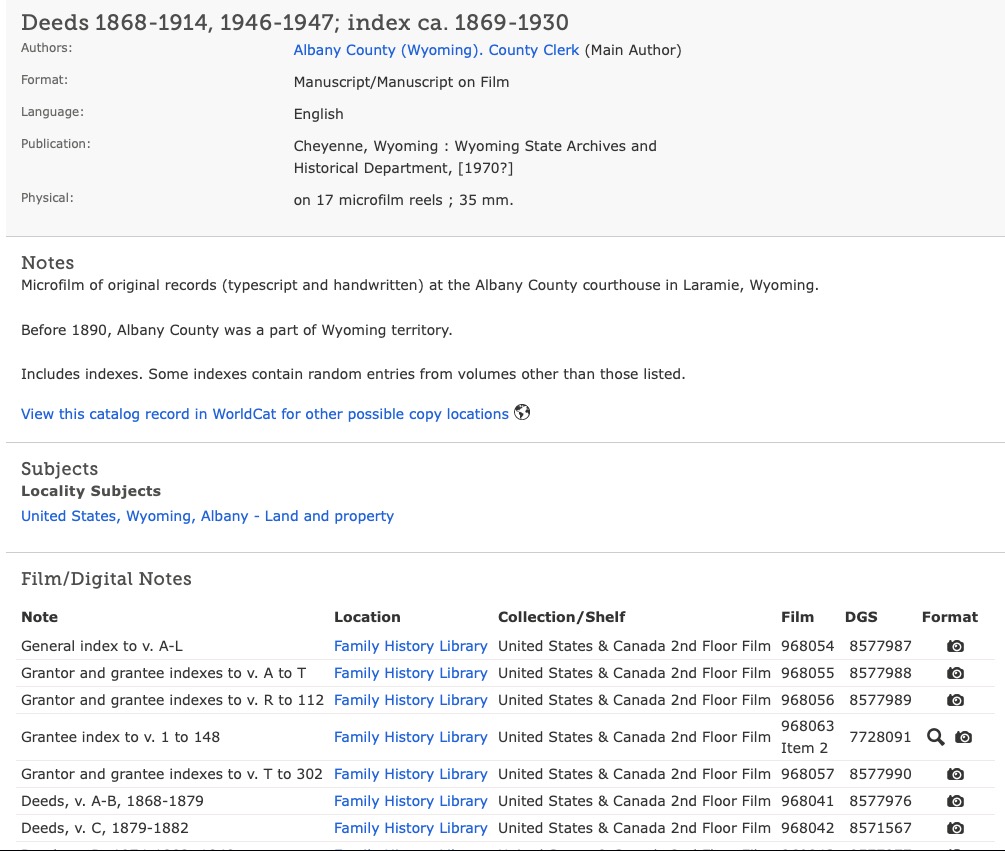
From there, it is almost like the “old days” of scrolling through microfilm, except you are at home. (Of course, there are some digitized films that must be looked at while at a Family History Center or Affiliate library due to contract restrictions.)

FamilySearch Catalog Entry for Deeds
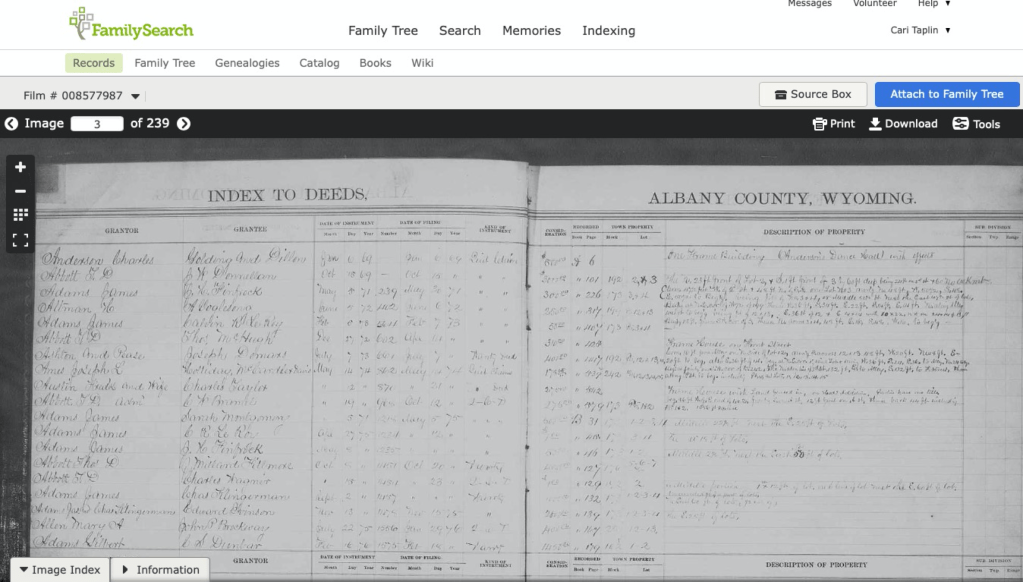
FamilySearch Deed Index for Albany County

So, if I want to look up any deeds for Susan Baily, I can start “scrolling” or clicking and find the B entries in this index and then find the deed.

Using the card catalog allows me to be more thorough and intentional with my research. If you are just using the global search function from the front page of any of these large genealogical sites, you are probably missing a lot of records. Give the card catalog a look.

Study Group Forming: Mastering Genealogical Proof

The last study group of 2021 is forming now. The group begins on October 6, 2021. There are two time slots, one with Cyndi Ingle (of Cyndi’s List) and one with me (Cari Taplin).

This will be a beginner/low-intermediate level class to study the book Mastering Genealogical Proof by Tom Jones. We will cover the principles outlined in the book as well as discuss the workbook questions.

We are also offering one free seat in each group on behalf of the Donna Hansen Peterson Scholarship.

For more information on the study group, you can read the details here: https://genealogypants.com/research-and-consultation-services/classes-and-study-groups/mastering-genealogical-proof-beginning-principles-class/

The group begins on October 6, 2021 so hurry to register:

Wednesdays, 3pm Eastern (with Cyndi): Click here to register. 

Wednesdays, 7pm Eastern (with Cari): Click here to register.

We look forward to studying with you!