Book Review: New Church Records Book!

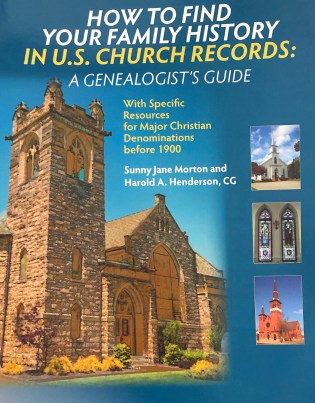
ChurchRecordsBookI have recently had the privilege to read and review the new book How to Find Your Family History in U.S. Church Records: A Genealogist’s Guide by Sunny Jane Morton and Harold A. Henderson, CG (Baltimore: Genealogical Publishing Co., 2019). Back in 2015 I attended the course “Problem Solving with Church Records” at the Genealogical Research Institute of Pittsburgh (GRIP) with Rev. David McDonald, CG as the instructor. It was a fantastic course (highly recommend!) and I have used the information from that course time and again but have longed to have a text with the information learned laid out in a concise manual. This book is the answer!

The book has two parts, the first is methodological and the second addresses twelve different denominations: Anglican/Episcopal, Baptist, Congregational, Dutch Reformed/Reformed Church in America, German Churches: Reformed and Sectarian, Latter-Day Saint (Mormon), Lutheran, Mennonite and Amish, Methodist, Quaker (Religious Society of Friends), Presbyterian, and Roman Catholic.

The meat of the book is in the first part, the methodology. This is an excellent, concise, and thorough section that delves into various techniques to identify your ancestor’s denominations, to determine if any records exist for that denomination, for working with old church records, and for expanding your research to include information for contextual understanding.

Quite possibly my favorite part of the first section is the survey of WPA (Works Progress Administration) resources available regarding church directories and church record inventories. The WPA inventories of all kinds can be so helpful to understand what records did exist during the 1930s and 1940s and give clues about what might exist now. Another enjoyable portion of the book was the discussion about other records that might discuss church life, these would be the items that give more context to our ancestors’ lives and communities. Beyond the baptisms, confirmations, burials, and such are a number of other resources to use, such as: denominational newspapers, church histories, denominational encyclopedias, administrative papers (membership lists, Sunday school records, membership lists, donors for various projects, pew rentals, ministers’ records, and so on.

Part two of this book delves into the specific history, practices, records, resources, and access instructions for the twelve denominations mentioned above. Each denomination’s chapter starts with a helpful “Quick Stats” section that gives you some at-a-glance information such as when the church was organized, its dominant region in the US, the dominant ethnic origin, and its affiliated faiths. I appreciate each section’s bibliography directing you to some helpful resources for a deeper understanding of that denomination.

In conclusion, this is a fantastic resource every genealogist needs on their bookshelf. As stated in the book’s introduction, church records are “a surprisingly neglected resource” and this book leaves very little room for excuse! Get this book, learn about church records, and then get out there and access them!

The book is $29.95 and available at Genealogical.com.

FGS Week was a Success!

I know this is going to come out a little bit late to my readers… but frankly, I was exhausted after the Federation of Genealogical Societies (FGS) conference that took place in Washington DC. I serve as the VP of Membership for the organization and so that came with some responsibilities. I was in charge of the Society Showcase area. Despite a few minor hiccups in the beginning, we got it all looking good! I worked the FGS booth quite a bit, I also volunteered at booths for the Association of Professional Genealogists (APG) and the Board for Certification of Genealogists (BCG). I was able to attend three lectures!

The big news out of this conference was the planned merger between FGS and the National Genealogical Society (NGS). NGS’s general focus is on genealogy education, methodology, their scholarly journal, and other aspects for the individual genealogist. FGS’s focus has been on society management and support. Both have held national conferences and focus on Records Preservation and Access (RPAC). To read the official press release, click here.

Personally, I am excited about the merger. As a board member, I have seen our strengths and weaknesses and believe that we can be supportive to each other rather than separate and competitive entities. I believe cooperation and collaboration is the direction we need to move toward. Helping each other and coming together rather than having a separation in the field. I often found that there were people who were “team FGS” or “team NGS” rather than seeing the two as complementary. So I do think this will be good for the field.

However, I don’t have a crystal ball and don’t really know what the future holds. Time will tell, for sure.

Accessing Archives from a Distance

I’ve tantalized you with what you might find in an archive in previous posts here and here. And I’ve given you some tips on how to find a collection that might apply to your personal research through the use of ArchiveGrid. Now, what happens if you find a collection in a repository that is far, far away?

You have three options:

  1. Create a research plan or list, saving all of the information you need to access that collection someday when you are nearby. I do this quite a bit for areas I think I might be visiting in the next 1-3 years and if it is on a personal project that is not time-sensitive. Save the URL to the collection, repository name, address, hours, and so on. I use Evernote for such a task. I have notebooks for various locations or repositories titled “Family History Library,” “Ohio Research Trip,” or “Washington DC.” And I just drop notes in there to access later. A word processing document, spreadsheet, or even a spiral notebook would work as well.
  2. Hire an on-site researcher. Many repositories have lists of proxy researchers because they do not have the staff or resources to do research for individuals. If a repository does not have such a list, check the directories for the Association of Professional Genealogists (APG), the Board for Certification of Genealogists (BCG), or International Commission for the Accreditation of Professional Genealogists (ICAPGEN). These directories allow you to search by location or by specialty. You might also consult with the state or county genealogical society for the area of interest as well. You might also find a cousin, hobbyist genealogist, poor college student, or some other person who would be willing to go to the repository for you.
  3. Ignore it. Now, I don’t recommend this one, especially if you are interested in not only the coolest possible finds out there, but also in conducting “reasonably exhaustive research.” I would at the very least put items in a list and get to them eventually.

I hope this series has convinced you to visit archives and manuscript collections. And if you weren’t sure about how to even go about it, I hope I gave you some helpful tips to quell your anxieties. Where else would you find a petticoat worn by Lizzie Johnson from 1865-1870? (The answer, of course: at the Southwestern University Special Collection in Georgetown, Texas.)

Use ArchiveGrid to Assist Your Search

One of my absolute favorite websites for helping with the task of locating items of interest to MY research project is ArchiveGrid.

archivegridlogo

You can read in detail about how ArchiveGrid works, its history, and so on, on the website. The summary from the website: “ArchiveGrid includes over 5 million records describing archival materials, bringing together information about historical documents, personal papers, family histories, and more. With over 1,000 different archival institutions represented, ArchiveGrid helps researchers looking for primary source materials held in archives, libraries, museums and historical societies.”

It is like WorldCat is to libraries. It is an online catalog of holdings from libraries, manuscript collections, and archives from across the globe. Of course, they have to be participating with the OCLC system to be included, but so many are! And some of the participating collections are not your typical collection you might think about in terms of genealogy. Just reading through the “recent additions” I see Indiana University’s Latin American Music Center, United States Marine Band Library and Archives, the American Bookbinders Museum, the Boston Symphony Orchestra, and the Museum of Flight Archives.

ArchiveGrid is very easy to use. It employs a simple keyword search and then a filter system is available when you click on “Summary View.” There are also more advanced ways to search. As always, read the help pages and “how to search” instructions for better results. For example, if you remember the leather pocketbook from the last post, it belonged to Thomas Jefferson Johnson. If you search ArchiveGrid for Thomas Jefferson Johnson you will get all kinds of hits for the president Thomas Jefferson. However, ArchiveGrid, like many databases, allows you to put the name in quotes. When I did that search, I found a collection of papers down at the Austin History Center that includes family correspondence dating back to 1853. It is very likely that some of those family papers complement the collection I viewed at Southwestern University’s Special Collection.

Access ArchiveGrid, enter some family names or topics relating to your research, and see what you find. You might be pleasantly surprised!

How to Visit an Archive

Some of you might be intimidated by the thought of visiting an archive or manuscript collection. I mean, they aren’t like a regular library usually. They tend to have a lot of rules and they will get after you if you don’t follow them. You can’t always bring in items you want to bring in. Why would you want to subject yourself to all of that hassle? I did feel this way in the beginning…when I was a “baby” genealogist. But I hope the last couple of posts (here and here) have convinced you to get over it and get in there!

Most (if not all) will have a website (such as that for the Briscoe Center for American History on the University of Texas Campus). Be sure to read it! It will prepare you for what to expect, the rules in terms of what you can bring in, copy policies, photography fees, parking, hours, closings, and so on. They will often have a catalog or finding aids on that website. Some archives have a system with which you can make an account and order your items ahead of time so they are ready for you when you show up. Often you will have to register as a researcher, showing your ID, filling our a form, or some other way for them to identity you. Also, do not be afraid to email the archivist with any questions. Sometimes a repository is behind in cataloging and not everything is listed. The archivist will know more about what is in the collection, or if you are having trouble locating something, they can help you find it.

Briscoe Center Website

Most often the rules are: no loose papers unless they look at them and stamp them with a stamp indicating it was something brought in or they provide you with a colored sheet of paper for notes; no pens, pencils only; laptops are usually ok but they will want to look inside it before you leave; usually photos are ok, some repositories have a photography fee; no drinks. I might have forgotten some, but those are the main rules I’ve experienced.

All of those rules are in place to protect the collection. No one is accusing you of anything when they ask to see inside your laptop or at your papers. Over the years, as you might imagine, items have been stolen, ripped, marked on with pen, had coffee spilled on them, and so on. These items are unique, one-of-a-kind, priceless, historical items. We don’t want to lose them and therefore they are in “protective custody” and you are required to follow these rules so they can survive for many generations to come.

The best advice I have is to read ahead to understand the rules then follow them without complaint, and you will have a great time at the archive. You never know what you will find but you will definitely have a great time in these original records!

Archival Finds

I wanted to share a few more finds from my visit to the Southwestern University’s Special Collection from last week’s blog post. I had so much fun and got to see and hold so many cool things!

IMG_3509
Leather pocketbook belonging to Thomas Jefferson Johnson

This is probably one of the best examples for visiting the archives…you truly never know what you are going to find! This leather pocketbook belonged to Thomas Jefferson Johnson. On the inside:

IMG_3508
The inside of Thomas Jefferson Johnson’s leather pocketbook.

The transcription: “Thomas Johnson’s pocket book living in St. Louis County state of Missouri this 4th of July 1829 –– Thos. Johnson was born Oct. 8th 1805.”

Ok… when you are looking for those vital records for your ancestors, did you ever think to look in their leather pocketbooks? I didn’t.

Now, will you find your ancestors’ birth information in a leather wallet? Probably not. Will you find some other cool items in an archive near you? Most definitely!

Go to an Archive!

I had the absolute pleasure and surprise of being invited to visit the Special Collections at Southwestern University in Georgetown, Texas. The archivist, Megan Firestone, found my name on a list of researchers and invited me up…and of course I accepted! She is an absolute gem and I’m so glad I visited.

I received a lovely tour of the reading room and a peek into some of the backrooms!

IMG_2534

This week I visited again with a goal in mind. I asked if they had any old scrapbooks or autograph books. I was not disappointed. After looking at the finding aids and emailing with Megan to decide on what I’d like to see, I made another visit to the archive where they had a large cart of items waiting for me.

I will share a few exciting things here:

IMG_3409
Natha Pritchett Scrapbook
IMG_3416
Inside Natha’s scrapbook
IMG_3512
Lunch pail

I saw so many cool and interesting items. More than I can really share in one post. I will likely highlight some other items in future posts.

I really want to encourage genealogists to visit an archive near you. You do not need to have a research project in mind. Check their website for a catalog or finding aid. Find a topic of interest to you, whatever it might be. Communicate with the archivist, as they might know of items that haven’t been cataloged yet. But go and look at these lovely original treasures.

There is nothing like looking at old letters, scrapbooks, and ephemera that delves into a person’s life in much more detail than a vital record or census enumeration. You get a sense of people’s personalities and some really specific details about their lives. Of course, the trick is finding the items, boxes, and papers that apply to your family, but I believe your research experience can be enhanced by looking at any item in the archive. Rather than looking for a person, search by topic, such as scrapbooks, farming, women’s issues, and so on. Give it a try.

Get out there!

FGS Conference Events, Register by Friday!

I am so excited to attend the Federation of Genealogical Societies (FGS) Conference in Washington DC, August 21-24. Registration ends this Friday, August 2nd so get registered!

There is still room at the conference hotel (Omni Shoreham) for an incredible $169 (a steal for D.C.) which is good for a few days before and after the conference (see the conference website for complete details). If you want to do some research at the Library of Congress, the Daughters of the American Revolution library, or the National Archives, this is a fantastic opportunity! If you have never been to one of these repositories, there are several guided tours that still have space available, as well as a tour of the National Museum of African American History & Culture. Check this page for more information.

In addition, this conference is different from previous FGS conferences. The society management topics are woven throughout the entire 4-day conference allowing you more choices in each time slot.

The Friday night event sounds fantastic, “Swing Back to the 30s with Your Ancestors” where you can represent one of your 1930s ancestors with live jazz playing in the background! Personally, I am excited for some of the luncheon speakers! There are still a few tickets left for those as well.

I will be speaking on Thursday, once on the society management topic “Create an Attractive Education Plan for Your Society” (T-217), once on research methodology “Unfamiliar Territory: Researching in a New (to you) Geographic Area” (T-232), and I’ll be participating in “Ask FGS! Panel with FGS Leaders” (T-247) with other members of FGS leadership.

This incredible opportunity is coming up quickly and I hope to see you there!

This post is not so much about genealogy…

I am reading the new book Advanced Genetic Genealogy edited by Debbie Parker Wayne. So far, excellent book, full of challenging methodology, case studies, and much more detailed information on how and why DNA works for genealogy than any other books on the market so far.

I was just reading the chapter by Kathryn J. Johnston, MD on X-DNA in which there is a section titled “The Fibonacci sequence is what makes the X unique.” The Fibonacci sequence is a really cool phenomenon that happens in nature quite regularly. The numbers in the Fibonacci sequence are 1, 1, 2, 3, 5, 8, 13, and so on. The sequence starts with the number one and the number that follows is a sum of the previous two numbers (1+1=2, 1+2 = 3, 2+3=5, etc.). The numbers of X-DNA ancestors in each generation follows the Fibonacci sequence!1

First of all, I graduated with a Bachelor’s Degree in Fine Art. I am not a math person. But I know about the Fibonacci sequence by watching these YouTube videos by Vihart called “Doodling in Math Class.”2 I love how math and nature interact.

While this does not really have much to do with genealogy, I thought it was a really cool point that reminded me of some fun videos and I just wanted to share. Fibonacci is everywhere in nature, even in our DNA!


     1. Debbie Parker Wayne, editor, Advanced Genetic Genealogy: Techniques and Case Studies (Cushing, Tx.: Wayne Research, 2019), 76.
     2. There is a series of three videos having to do with the spirals in plants. Very cool!

My Lineage Society Goals

I know you’ve probably heard about DAR (Daughters of the American Revolution) (I’ve joined under my ancestor Samuel Dimmick #A032219) and the Mayflower Society (General Society of Mayflower Descendants) (as far as I can tell, I didn’t have any ancestors on the Mayflower, but I’m still looking).

There are a wide variety of lineage societies, however. You probably qualify for several. Many are state or regional such as the many “First Families of _____ ” (insert a state) or “Descendants of _____” (insert a military action or special group). Regardless of which society, they all have something in common: “A lineage society is an organization created to honor a specific heritage or event. Members of lineage societies must prove their descent of that heritage or event through industry approved genealogical proof standards.”1 We like to honor our ancestors and our heritage in many ways.

I recently mailed in an application to the National Society Descendants of American Farmers (NSDOAF). This is a relatively new society, who is at the time of this writing, still accepting charter lifetime members (through 30 November 2019). The qualifications:

Membership is open to Men and Women 18 years of age or older who are lineal descendants of a “farmer” living within the present boundaries of the United States between July 4, 1776 – December 31, 1900.

Miller_William and Carrie
William and Carrie (Limmer) Miller, date unknown.

I am applying under my great-grandfather, William John Miller. I am named after his wife Carrie Ann (though mine is spelled differently). They helped raise my grandpa after his mother died shortly after his younger brother was born. I never had the chance to meet them but my grandpa always spoke very highly of them. He wanted to be a farmer and when he could afford it, bought 80 acres near his grandparents in Perrysburg Township, Wood County, Ohio.

So many times as a genealogical speaker, I hear people say something along the lines of “my ancestors were just farmers, they didn’t do much.” To that I say “baloney.”2 They worked to feed their community and their nation. They deserve as much recognition as anyone and I hope if you have farmers in your family tree (most of us do), that you consider honoring their unsung service to America by joining NSDOAF. The qualifications are pretty easy!

If you want an interactive group while you are preparing your application, they have a Facebook group where you can ask questions, get the forms, and generally be supported. (I received word via the group that my application was received and approved!)

(Now to finish my Daughters of 1812 application…)


1. From “Quick List of Lineage Societies” on Lineage Society of America (viewed 10 July 2019).

2. Or is that “bologna”?