Tag Archives: Methodology

Timelines: Why?

As genealogists, we gather a lot of data. We find our ancestors in many records such as obituaries, death and birth certificates, deeds, wills, church records, tax records, military records, and so on. The list is endless. How do you analyze, process, or understand the information you’ve gathered? And if you’re working on a trickier project, say figuring out which of the 12 George Longs is your ancestor, how do you keep it all straight?

One of my absolute favorite strategies is timelines. Creating a timeline for your ancestor puts his or her life into context and perspective. Obviously (or maybe not), a timeline is a list of events in chronological order. They show the “lifespan” of an individual, a place, or an historical event. Depending on what your goals are, you can create timelines with different focuses. The two main focuses I use are event-focused or document/source-focused.

Each document was created on a date (sometimes you know that date because it is written on the document, sometimes you might have to make an educated guess based on context). By putting together a document-focused timeline you can assess your research and make a plan for any research holes you find.
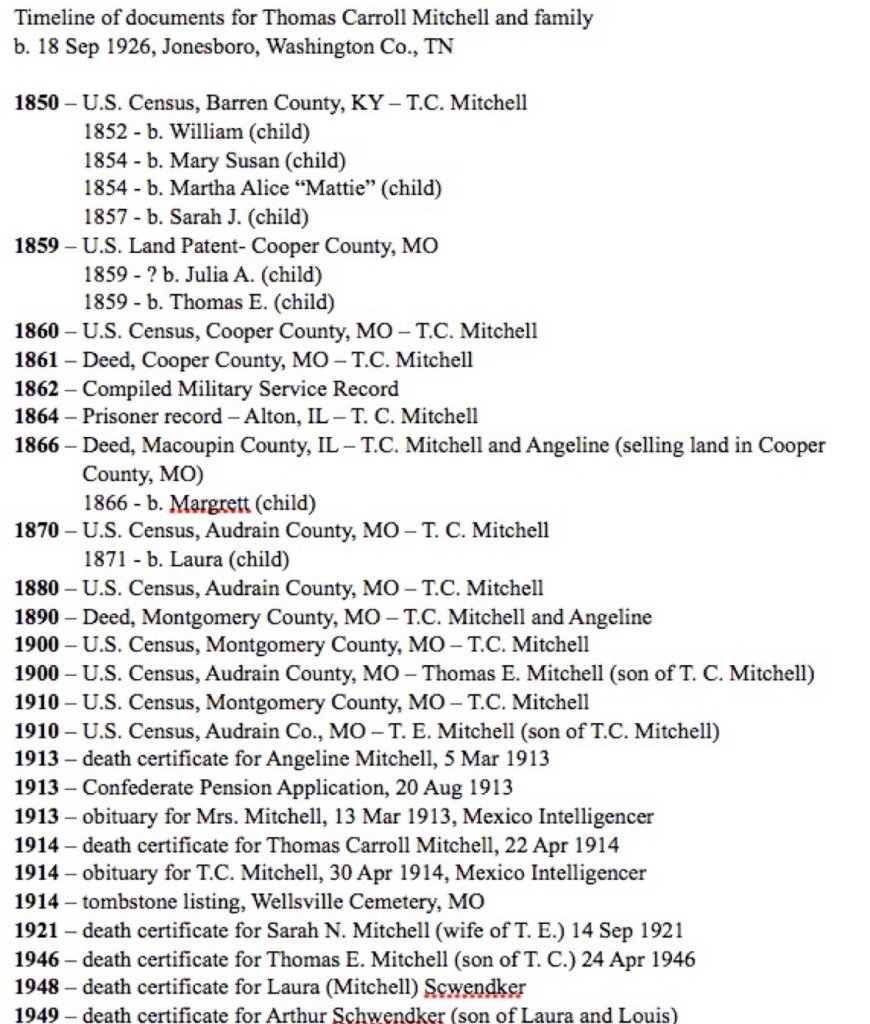
Document-focused timeline

Documents or sources may list multiple events. A death certificate, for example, will list a date of death, but also may list the birth date, the burial date, the onset of an illness, the date of a coroner’s inquest, etc. An event-focused timeline pulls all those dates out.
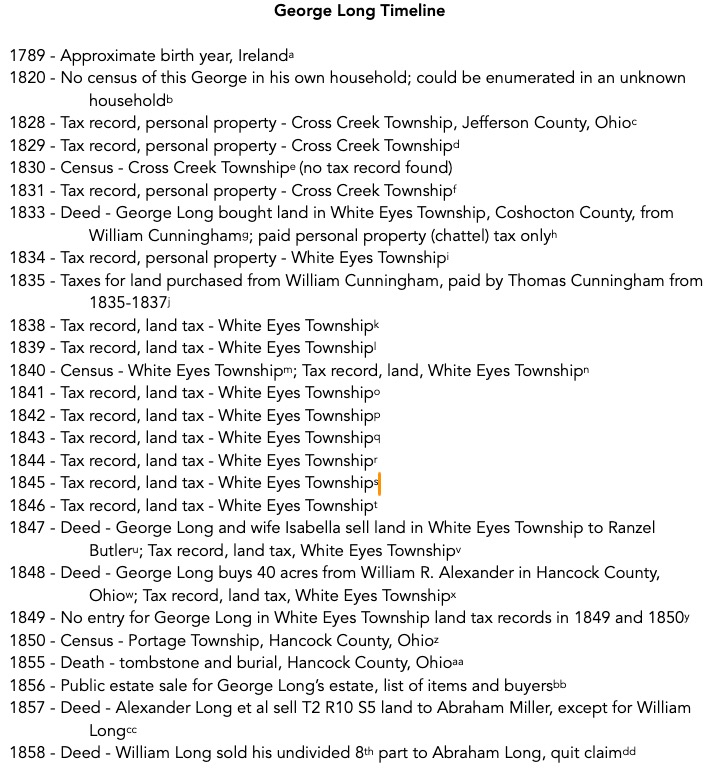
Event-focused timeline

As you enter your data into your genealogical software or online tree, if you use them, they may automatically put the events in chronological order, helping you to visualize your ancestor’s life. When I get deep into a project, however, I tend to work in a spreadsheet or word processor so I can reorder things, put in items that may I may not want in my software, add historical context items, and link citations.

Next, we will look at using timelines to compare and analyze your research.
County Histories: Follow Every Lead

In the last blog post, we looked at the general family information we found in Samuel C. Dimick’s biographical sketch. Now let’s discuss all of the minutiae and details that we (and by ‘we’ I mean I) might gloss over the first (or second, or tenth) time we read a biographical sketch.

When I began researching Samuel, I didn’t know anything about him, of course, so the details that were important to me at that time were the main biographical points we looked at in the last post. However, as time moved on, I gained more experience, and I wanted to know more specific information about him and his family, I started focusing on some of that minutiae. Sometimes we just aren’t ready to absorb information from a source. And that’s ok, as long as at some point in your process (this could be many years later), you go back and review your previous research.

After really digging into the details, I was able to compile a list of other sources I needed to examine to verify those details and get more information:

  • Census Records
  • Newspapers
  • Obituaries
  • Land Records
  • Land Ownership Maps
  • Vital Records
  • City Directories
  • School Records
  • Agricultural Census
  • Indian Reservation Records
  • Revolutionary War Records
  • Expand search to other states mentioned in the sketch: New Hampshire, Wisconsin, Massachusetts, Minnesota

Over the next several posts, we are going to look at some of these in detail. I won’t go over each and every one, because, well, that could get boring. But, there are some highlights I want to hit that really opened some new research avenues and helped me understand Samuel’s life better and in more detail.

Maps: Visualizing Your Ancestors – Types of Maps – Plat Maps

One type of map that can be helpful to pay attention to are boundary maps. I’m usually focusing at the county level. I have a couple of ancestors who were “border dwellers” meaning they lived on or near a county boundary. Sometimes I find records for them in one county, sometimes another. What is going on there? Did they move? Or did the county boundary change? OR, a third option, was the nearest courthouse in the next county over? Some court actions did not have to be in the county where a person lived so it may have been more convenient to go to a neighboring county to file that record.

I usually use a county map that is at least at the township level, and I typically use them in conjunction with a landowner map. You have to know where exactly in the county (and township) someone lived to understand if they moved or if the boundary changed.

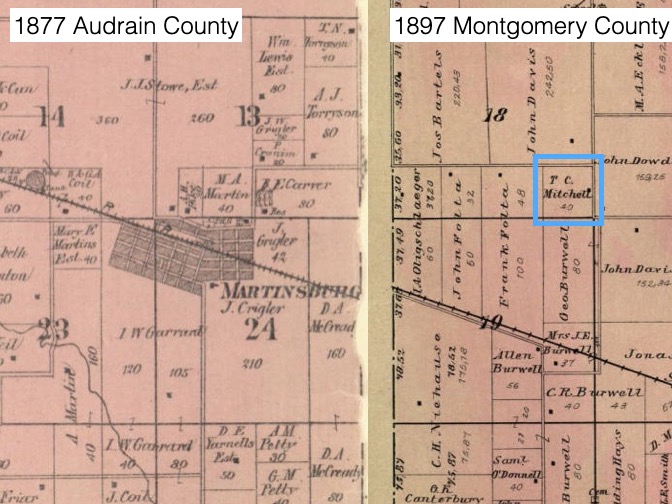
One of my favorite ancestors to research is Thomas C. Mitchell. After the Civil War, he lived in Montgomery County, Missouri, but right on the border with Audrain County.

Two landowner maps showing T.C. Mitchell’s proximity to the border.

Sometimes you cannot find a map for exactly the right time frame. Simply find the next closest and use that for your comparisons and analyses. In my example above, you can see the map on the left is from 1877 Audrain County and the map on the right is 1897 Montgomery County. I lined them up as best as I could using the train line as a guide.

These township maps show you the section numbers; Thomas lived in section 18 in that particular Township/Range. We know that each section is one square mile. That means that Thomas lived about 1.5 miles from the nearest town of Martinsburg. If he could do the business he needed to do, you can bet that he did it in Martinsburg. I have found many records for Thomas in Audrain County even though he lived in Montgomery County.

If your ancestor never moved but the county boundary changed, you have to look for records in both counties. The county clerks did not sit down and divvy up the records according to those that lived in the new county. They just kept the records in their original location. So, for border dwellers, always be checking nearby counties. A landowner and county boundary map can help you decide in which counties to look.

More map types next time…