Monthly Archives: December 2022

Happy Holidays!

Christmas will have just passed and the New Year is coming up quick!

I have the week off between Christmas and New Years and so does my husband, so I’m going to take some time away from the computer. I know, crazy, right? Ah, but it is a time to recharge, to rest, take a break, and spend time with my nearly grown kids.

I’ll be back next week with the next installment of County Histories. In the meantime, here is what’s on my plate for the first half of 2023:

You can view my calendar at any time by scrolling down below to the footer of this page.

I hope you all have a happy holiday season!

County Histories: Other Records, Indian Reservation Records

Last time we looked at the land records we discovered for S. C. Dimick’s father, Chester. The statement from the county history mentioned that S. C. worked on an Indian Reservation there. Possibly he saw an opportunity for his father to invest in land once he got there. We don’t know. There are no records or letters that have been handed down in my family that indicates how this came about.

I did want to confirm that S. C. Dimick worked on an Indian Reservation in Minnesota, as described in the biographical sketch. The following map indicates what Indian Reservations were in Minnesota. The land was located in Mill Lacs and Morrison counties. And there is a reservation in Mill Lacs:

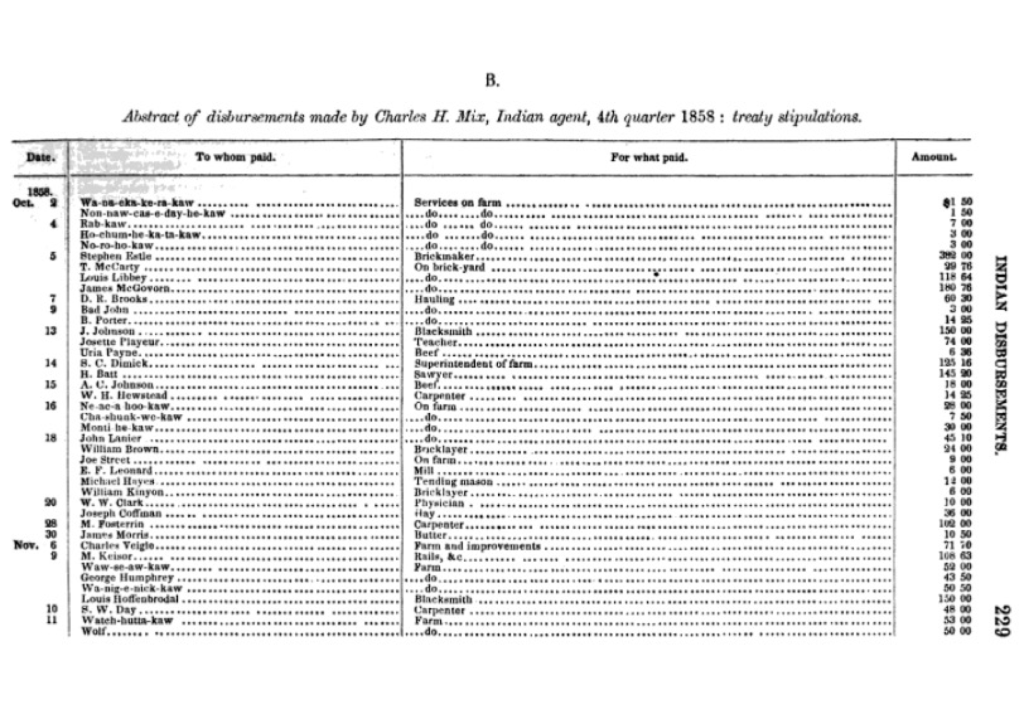
We found S. C. Dimick in the payment list:

Congressional Serial Set, Issue 1046: First Session of the Thirty-Sixth Congress, 1859-’60, 229.
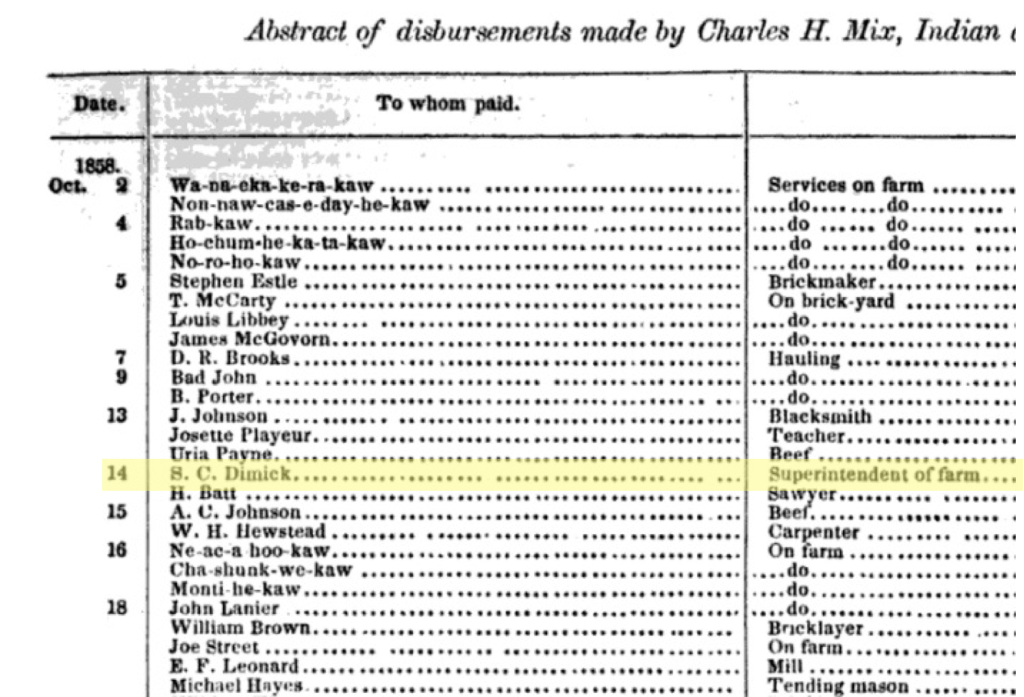
Close-up and highlight of S. C. Dimick, paid on 14 Oct 1858.

This record confirms that S. C. Dimick was the Superintendent of the farm and was paid $195.14. When I was in Washington, D.C. in August 2019, I looked for records that might give more details but was unsuccessful in locating any more information about his employment.

This does not explain the family’s move to Ohio, but it does speak to Samuel’s personality trait of what seems to be always looking for adventure and opportunity. I have written about S. C. Dimick in a newspaper advertisement (see this post) which also seems to speak to his penchant for seeking out opportunities.

We will look at some other records this sketch led me to.

County Histories: Clues in Other Records, Land (Part 2)

Last time we looked at one statement that led to the deed for the “Old Williams Farm” that S. C. Dimick purchased. This time a clue to land prior to his purchase of the Old Williams Farm.

The second statement from the sketch: “After working on his father’s farm for a time, he removed to Wisconsin, where he was in the lumber business for a year, and, on the expiration of that time, went to southern Minnesota, where for a year and a half he had charge of a government farm on the Indian reservation.”

At this time, land was often acquired from the Federal Government by special acquisitions such as homestead, timber, and mining claims, or by a cash sale. This led me to the Bureau of Land Management website: https://glorecords.blm.gov This website has a database of land obtained from the Federal Government, searchable by name, location, land description, etc. Thinking about the above statement, I looked for S. C. Dimick in both Wisconsin and Minnesota. I searched by the surname only first. I did not find any records for him in Wisconsin, but I found some intriguing information for him in Minnesota.

BLM Website Searching for Dimick in Minnesota.
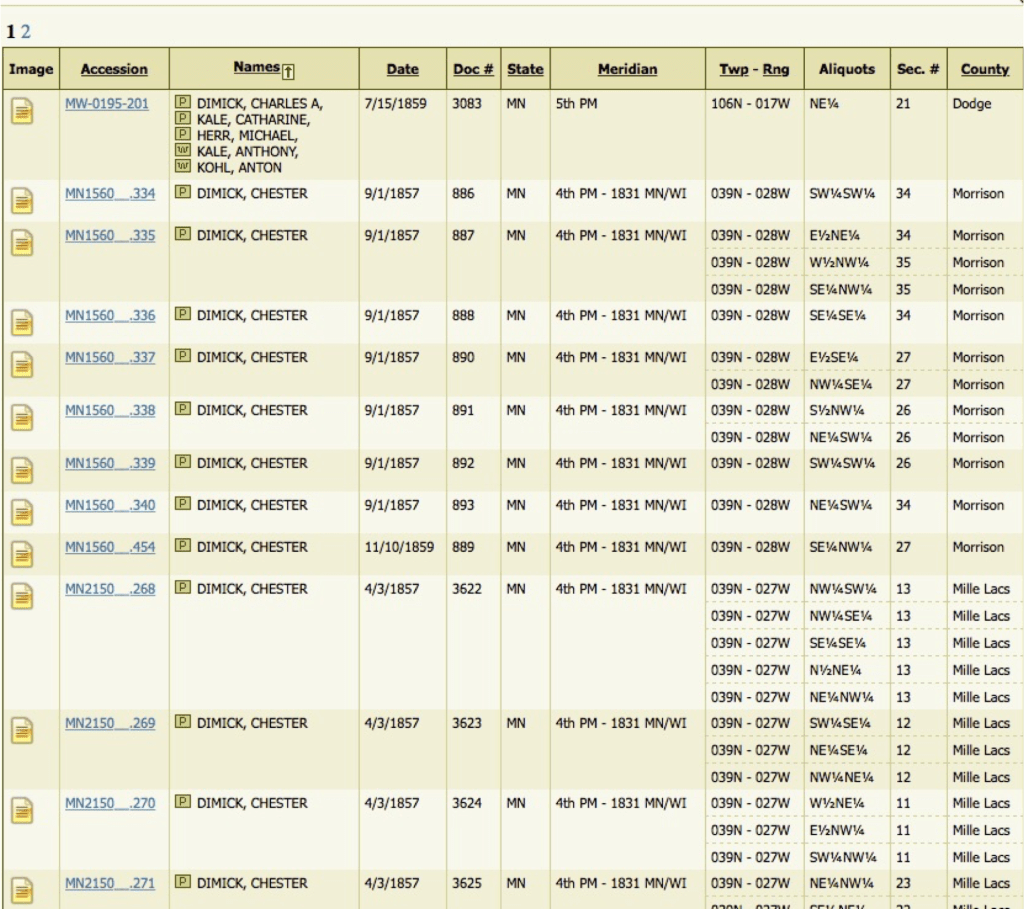
Search Results at BLM website.

There are a lot of entries for Chester Dimick. Do you remember Samuel’s father’s name? It was Chester! Well, I thought there might be the possibility of a man by the same name, so I took a closer look at one of the original documents.

Chester Dimick, (Morrison County, Minnesota), Land Patent No. 886; Bureau of Land Management, “Land Patent Search,” digital images, General Land Office Records (www.glorecords.blm.gov/PatentSearch : downloaded August 2015).

The original patent names the purchaser as “Chester Dimick of Grafton County, New Hampshire.” I fairly certain we are working with the same family.

Here is a summation of the land obtained by Chester in Minnesota:

  • Fifteen different land patents
  • Cash sale entries ($1.25-2.00 per acre)
  • Dated on 3 separate days between 1857-1859
  • Totaling 1607.44 acres in Morrison and Mille Lacs counties

To give you context on where the land was located:

The following shows the sections the parcels of land were located in in these three township/range. The land was near each other but not all of it was adjoining.

I have not yet looked for the deeds of sale to determine just how much Chester might have made on this land investment. I just haven’t taken the time yet. However, it is on my genealogical to do list.

As far as I can tell, Chester never lived in Minnesota. He was always found in New Hampshire in the censuses. This appears to have been an investment situation. S. C. Dimick was only in Minnesota for a year or two, working on an Indian Reservation. We will look at those records next.

County Histories: Clues in Other Records, Land (Part 1)

There were a few statements in S. C. Dimick’s biographical sketch that led me to examine land records.

First: “In 1875, we find him a resident of Center township, Wood county, where he purchased 120 acres of the old Williams farm, and has here since made his home. He has one of the best orchards in the township, and his excellent farm has been brought under a high state of cultivation by industry and good management, with its attendant hard labor.”

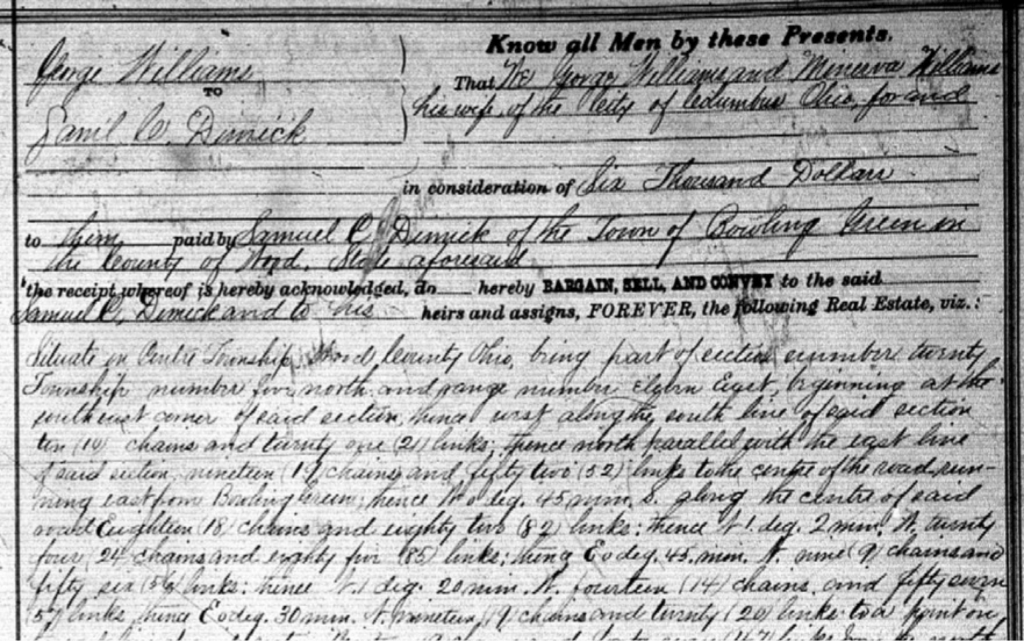
Wood County, Ohio, Deed Book 48:123 (1876), County Recorder’s Office, Bowling Green, Ohio; FHL microfilm 409,648.
Close-up, describing the 120 acres purchased.
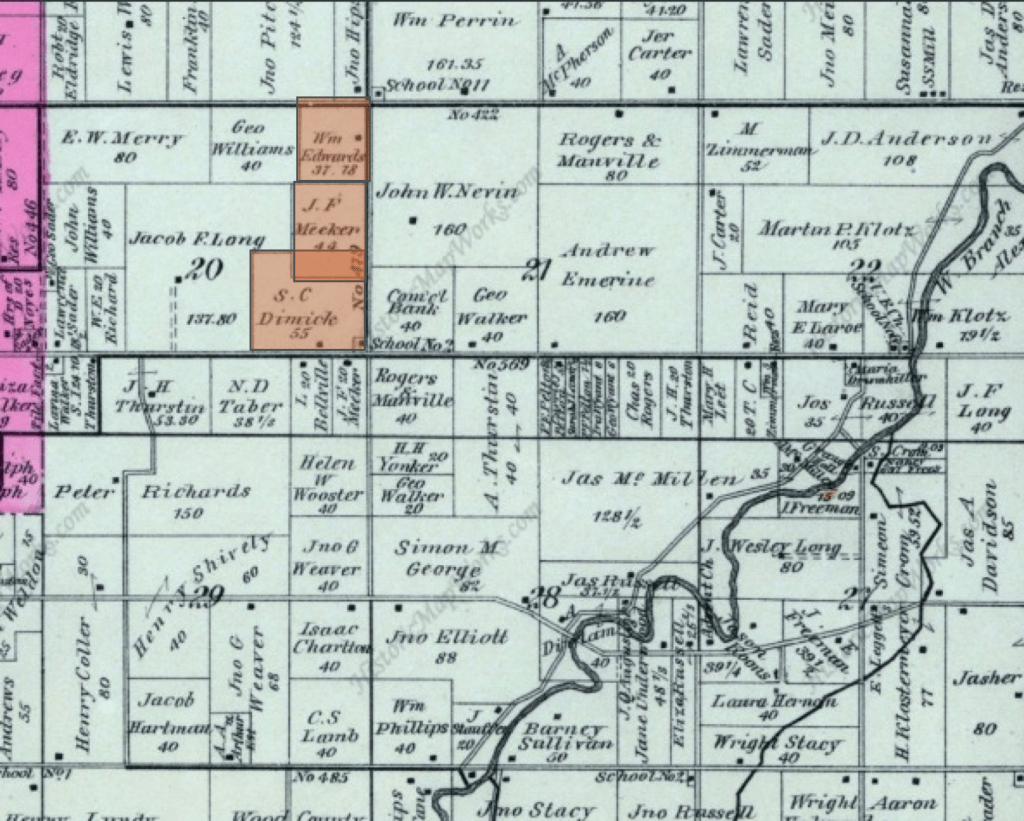
Ohio, Wood County, 1886 (Philadelphia: Griffing, Gordon & Co., 1886), 17; digital image, Historic Mapworks (www.historicmapworks.com : accessed 15 March 2015).

This map shows approximately where that 120 acres were located. This is after he sold some of the 120 acres to some relatives of his daughter-in-law.

Samuel bought this land outright. It was not a military warrant, or homestead, or some other acquisition from the Federal Government. So, this did not answer why he moved his family to Ohio. We will keep looking at the clues.

Next time, more land clues.