Samuel C. Dimick’s biographical sketch mentioned that “after attending the district schools of Lyme, [he] entered the high school of Orford, N. H., where he completed his education.” I set out to learn more about the school in Orford and what that experience may have entailed.
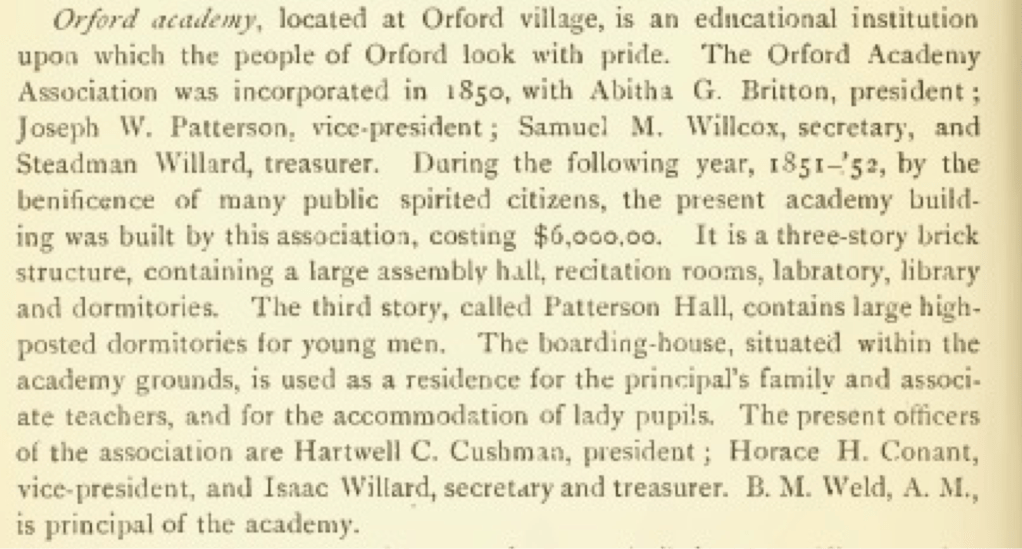
I found a description of the school in a county-history-style book about Grafton County, New Hampshire. This entry describes it as a boarding school.
Hamilton Child, editor, Gazetteer of Grafton County, New Hampshire, 1709-1886 (Syracuse, NY: Syracuse Journal Company Printers, 1886), page 240 (page 1052 on digital copy); digital images, FamilySearch Books (https://books.familysearch.org).
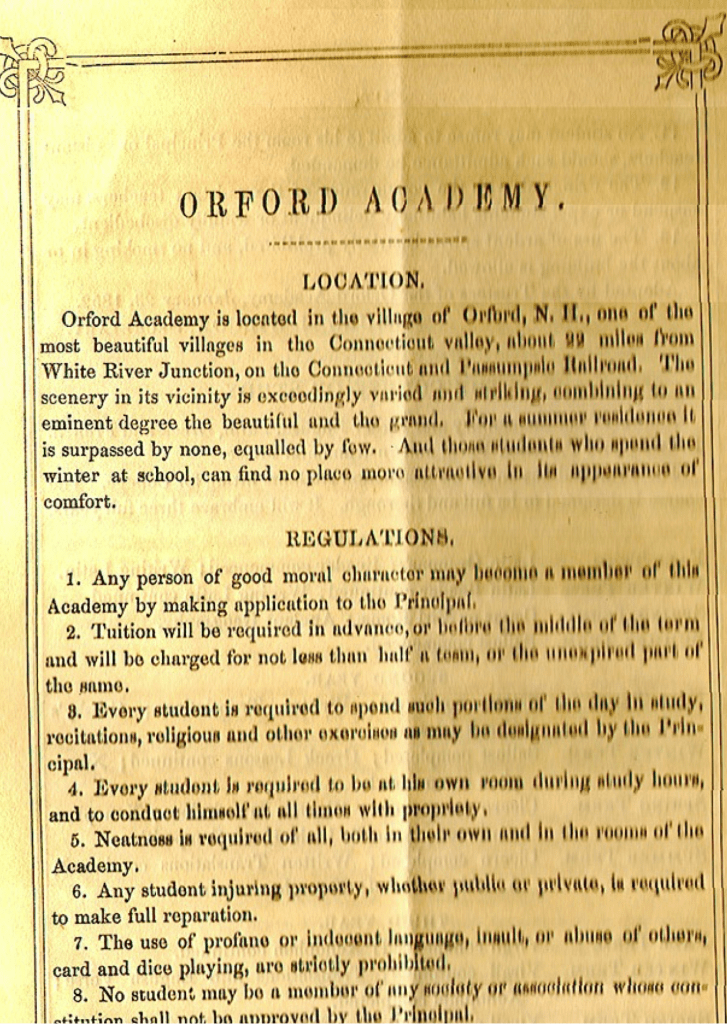
I did some more digging around on the internet and came across a bit of ephemera someone had digitized and posted online. The image is of what looks like a flyer or pamphlet describing the rules of the school. (The image is a partial scan and part of it is blurry, but we can get the idea of the rules and regulations from this portion.)
“Academy Structure and Regulations,” Encountering History Along the Cross Rivendell Trail (rivendelltrailshistory.org : dowloaded August 2015).
To quote parts:
“Any person of good moral character may become a member of this Academy…
“Tuition will be required in advance…
“Every student is required to spend such portions of the day in study, recitations, religious and other exercises as may be designated by the Principal.
“Every student is required to be at his own room during study hours and to conduct himself at all times with propriety.
“Neatness is required of all, both in their own and in the rooms of the Academy.
“The use of profane or indecent language, insult, or abuse of others, card and dice playing, are strictly prohibited.”
I was unable to locate any individual school records that might include the registration, grades, classes, etc. that Samuel may have taken but this find at least gives me a bit of insight into the character and upbringing of S. C. Dimick.
Christmas will have just passed and the New Year is coming up quick!
I have the week off between Christmas and New Years and so does my husband, so I’m going to take some time away from the computer. I know, crazy, right? Ah, but it is a time to recharge, to rest, take a break, and spend time with my nearly grown kids.
I’ll be back next week with the next installment of County Histories. In the meantime, here is what’s on my plate for the first half of 2023:
January 10 – First NGSQ Study groups starting. There are still a couple of seats. Visit this page for more information and to register if you are interested.
June 19-23 – Genealogical Research Institute of Pittsburgh (GRIP) – “The Spirit of the Inland Seas: Research in the Great Lakes Region” with Cyndi Ingle and Paula Stuart-Warren. I will also be teaching a couple of classes in Paula’s course “Digging Deeper.”
You can view my calendar at any time by scrolling down below to the footer of this page.
Last time we looked at the land records we discovered for S. C. Dimick’s father, Chester. The statement from the county history mentioned that S. C. worked on an Indian Reservation there. Possibly he saw an opportunity for his father to invest in land once he got there. We don’t know. There are no records or letters that have been handed down in my family that indicates how this came about.
I did want to confirm that S. C. Dimick worked on an Indian Reservation in Minnesota, as described in the biographical sketch. The following map indicates what Indian Reservations were in Minnesota. The land was located in Mill Lacs and Morrison counties. And there is a reservation in Mill Lacs:
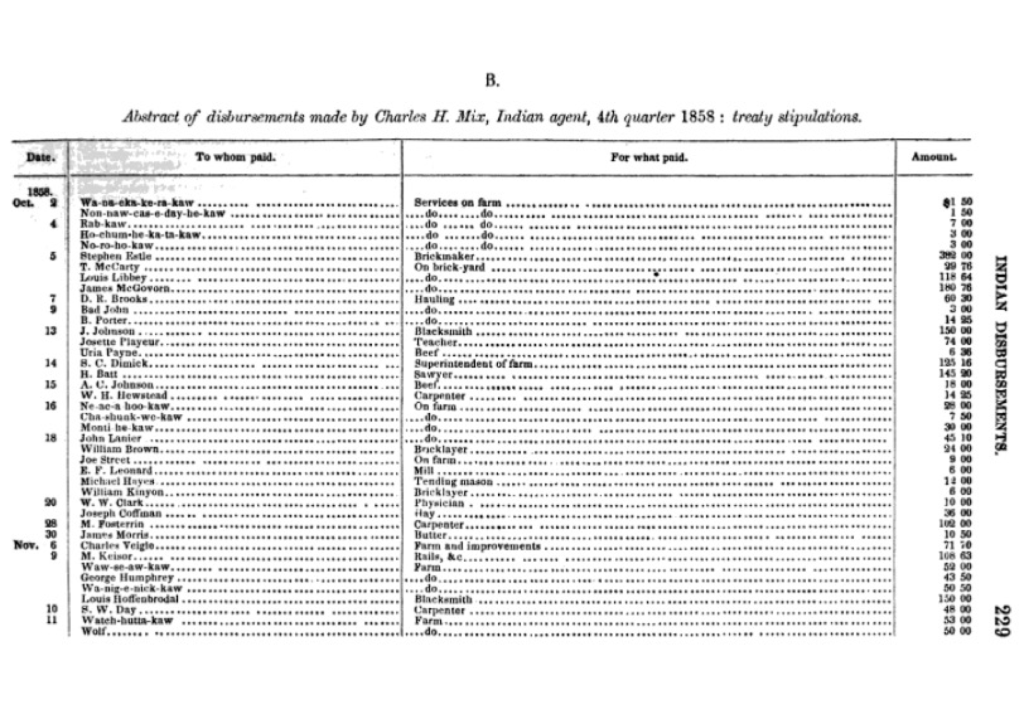
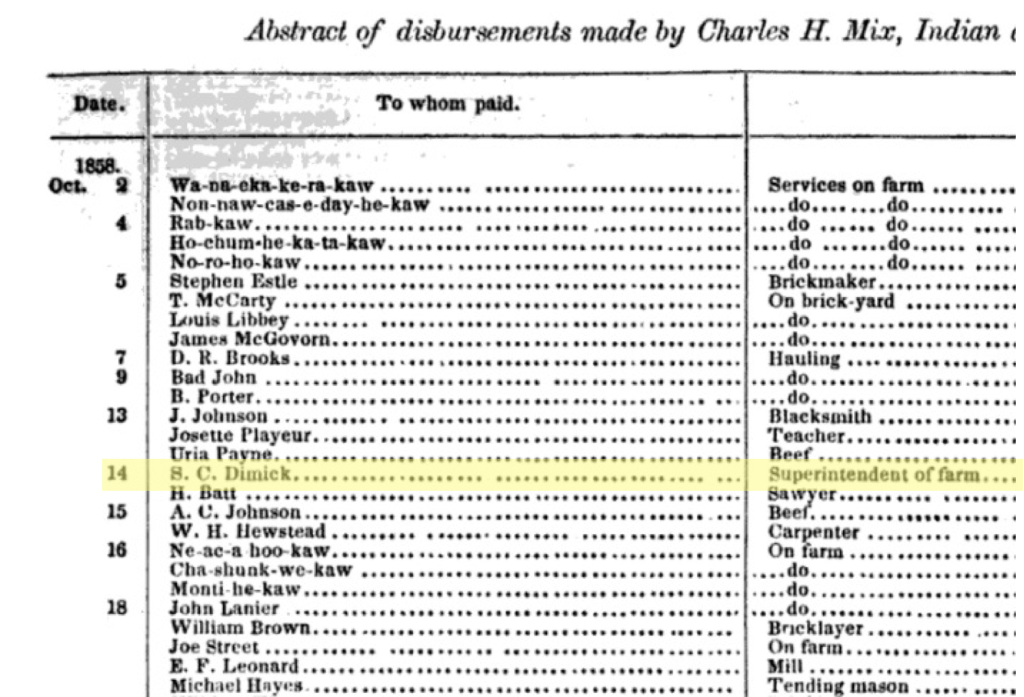
We found S. C. Dimick in the payment list:
Congressional Serial Set, Issue 1046: First Session of the Thirty-Sixth Congress, 1859-’60, 229.Close-up and highlight of S. C. Dimick, paid on 14 Oct 1858.
This record confirms that S. C. Dimick was the Superintendent of the farm and was paid $195.14. When I was in Washington, D.C. in August 2019, I looked for records that might give more details but was unsuccessful in locating any more information about his employment.
This does not explain the family’s move to Ohio, but it does speak to Samuel’s personality trait of what seems to be always looking for adventure and opportunity. I have written about S. C. Dimick in a newspaper advertisement (see this post) which also seems to speak to his penchant for seeking out opportunities.
We will look at some other records this sketch led me to.
Last time we looked at one statement that led to the deed for the “Old Williams Farm” that S. C. Dimick purchased. This time a clue to land prior to his purchase of the Old Williams Farm.
The second statement from the sketch: “After working on his father’s farm for a time, he removed to Wisconsin, where he was in the lumber business for a year, and, on the expiration of that time, went to southern Minnesota, where for a year and a half he had charge of a government farm on the Indian reservation.”
At this time, land was often acquired from the Federal Government by special acquisitions such as homestead, timber, and mining claims, or by a cash sale. This led me to the Bureau of Land Management website: https://glorecords.blm.gov This website has a database of land obtained from the Federal Government, searchable by name, location, land description, etc. Thinking about the above statement, I looked for S. C. Dimick in both Wisconsin and Minnesota. I searched by the surname only first. I did not find any records for him in Wisconsin, but I found some intriguing information for him in Minnesota.
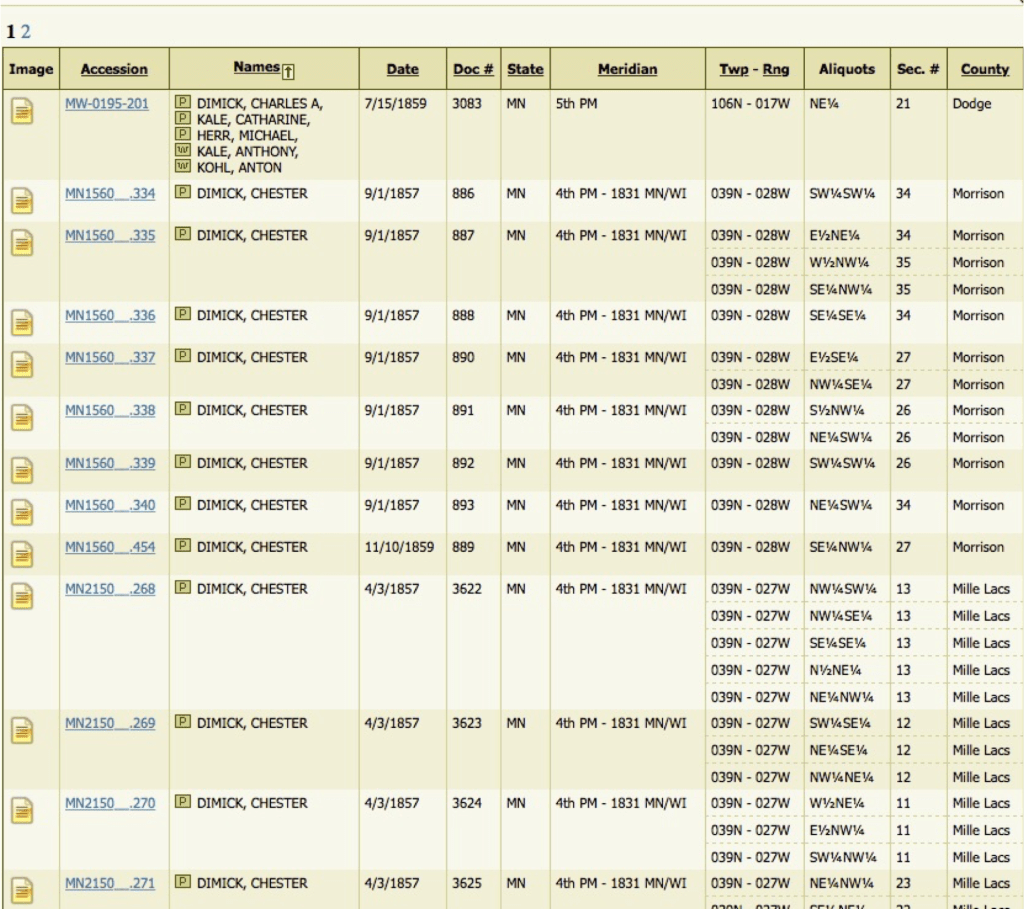
BLM Website Searching for Dimick in Minnesota.Search Results at BLM website.
There are a lot of entries for Chester Dimick. Do you remember Samuel’s father’s name? It was Chester! Well, I thought there might be the possibility of a man by the same name, so I took a closer look at one of the original documents.
Chester Dimick, (Morrison County, Minnesota), Land Patent No. 886; Bureau of Land Management, “Land Patent Search,” digital images, General Land Office Records (www.glorecords.blm.gov/PatentSearch : downloaded August 2015).
The original patent names the purchaser as “Chester Dimick of Grafton County, New Hampshire.” I fairly certain we are working with the same family.
Here is a summation of the land obtained by Chester in Minnesota:
Fifteen different land patents
Cash sale entries ($1.25-2.00 per acre)
Dated on 3 separate days between 1857-1859
Totaling 1607.44 acres in Morrison and Mille Lacs counties
To give you context on where the land was located:
The following shows the sections the parcels of land were located in in these three township/range. The land was near each other but not all of it was adjoining.
I have not yet looked for the deeds of sale to determine just how much Chester might have made on this land investment. I just haven’t taken the time yet. However, it is on my genealogical to do list.
As far as I can tell, Chester never lived in Minnesota. He was always found in New Hampshire in the censuses. This appears to have been an investment situation. S. C. Dimick was only in Minnesota for a year or two, working on an Indian Reservation. We will look at those records next.
There were a few statements in S. C. Dimick’s biographical sketch that led me to examine land records.
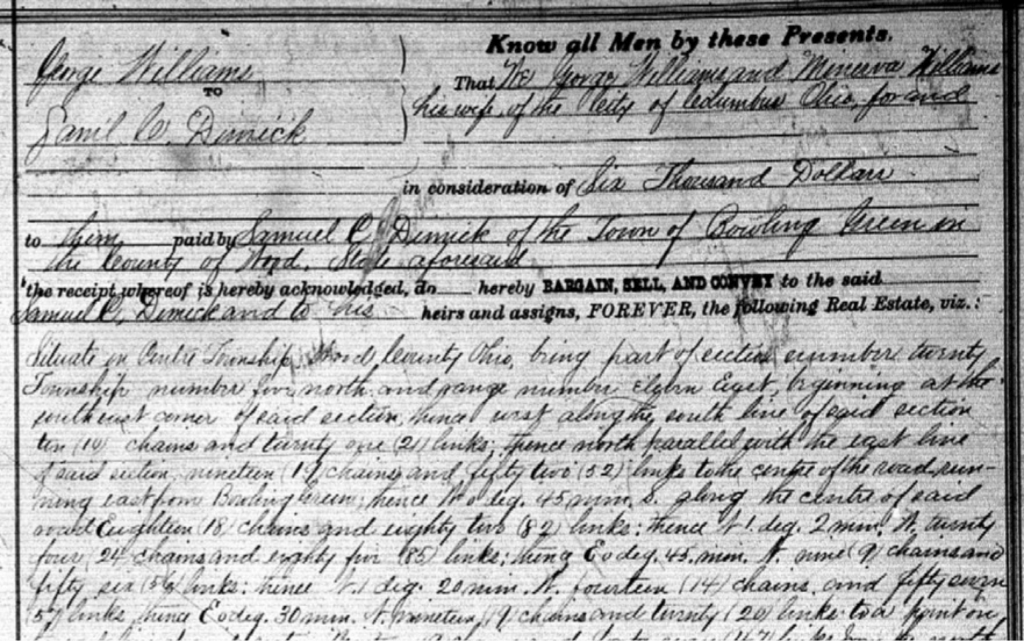
First: “In 1875, we find him a resident of Center township, Wood county, where he purchased 120 acres of the old Williams farm, and has here since made his home. He has one of the best orchards in the township, and his excellent farm has been brought under a high state of cultivation by industry and good management, with its attendant hard labor.”
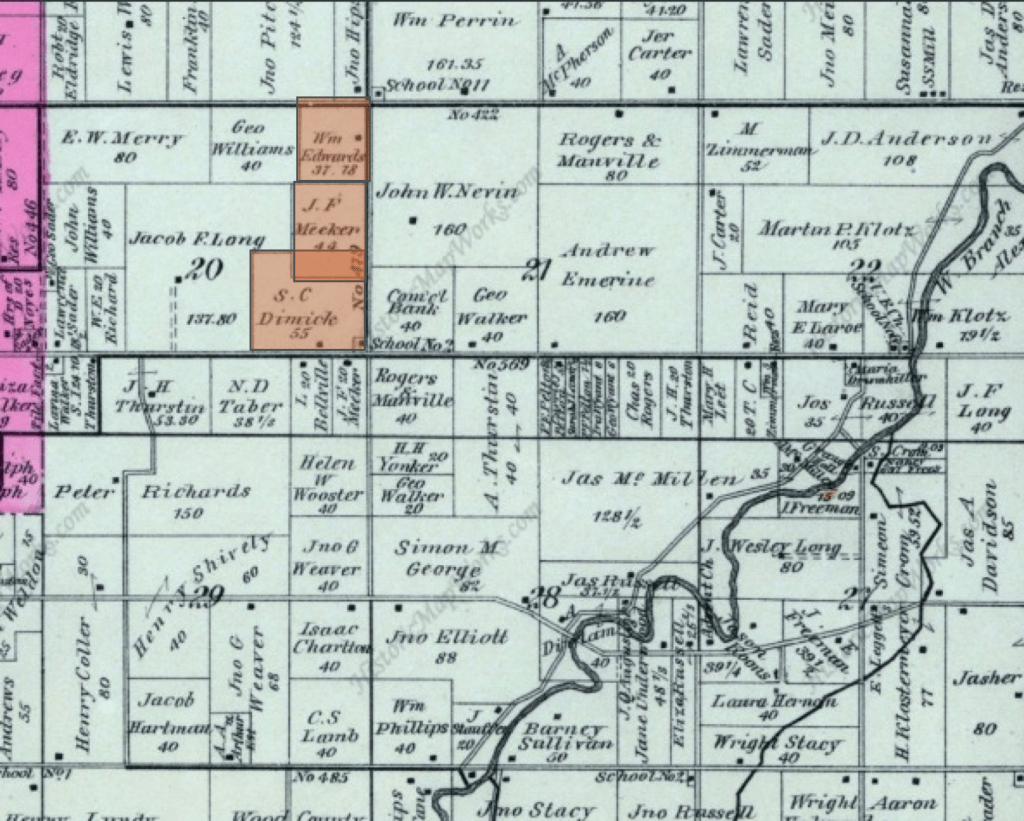
Wood County, Ohio, Deed Book 48:123 (1876), County Recorder’s Office, Bowling Green, Ohio; FHL microfilm 409,648.Close-up, describing the 120 acres purchased.Ohio, Wood County, 1886 (Philadelphia: Griffing, Gordon & Co., 1886), 17; digital image, Historic Mapworks (www.historicmapworks.com : accessed 15 March 2015).
This map shows approximately where that 120 acres were located. This is after he sold some of the 120 acres to some relatives of his daughter-in-law.
Samuel bought this land outright. It was not a military warrant, or homestead, or some other acquisition from the Federal Government. So, this did not answer why he moved his family to Ohio. We will keep looking at the clues.
Last we found S. C. Dimick in the census records, in 1870 still in Lyme, New Hampshire and in 1880 he was living in Wood County, Ohio. Let’s look at other clues in his biographical sketch that lead me to other records.
Newspapers
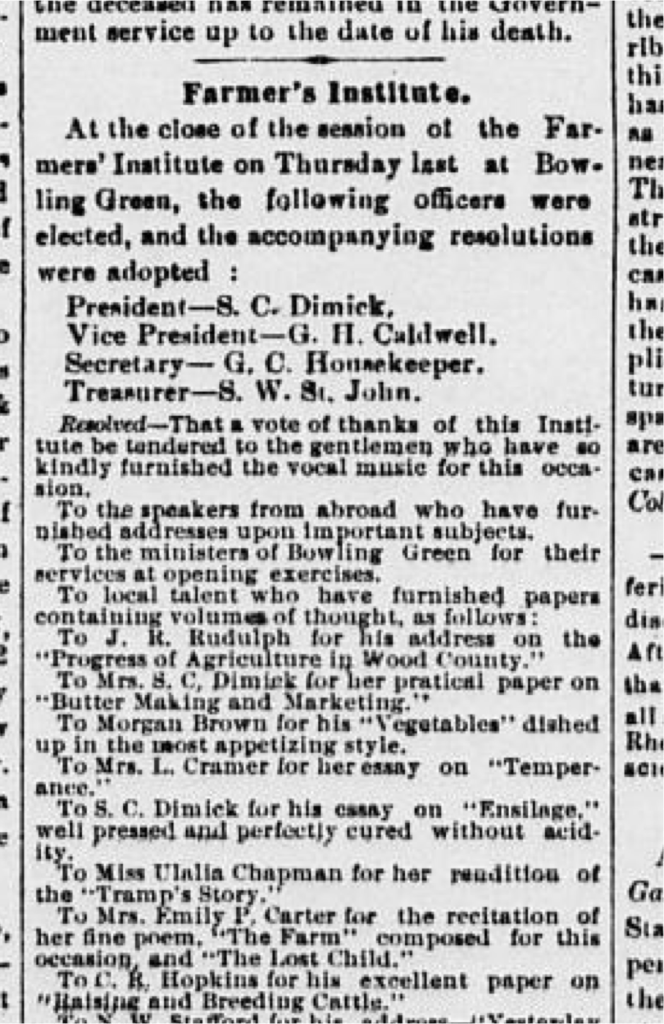
I found several news articles for S. C. Dimick who was involved in the Wood County Farmer’s Institute. In 1886 he served as the president! The institute also resolved to thank various people. Included was a thanks to Mrs. S. C. Dimick for her paper on “Butter Making and Marketing” as well as an essay by Mr. S. C. Dimick on “Ensilage.”
“Farmer’s Institute,” Perrysburg Journal (Ohio), 12 February 1886, p. 3, c. 4.
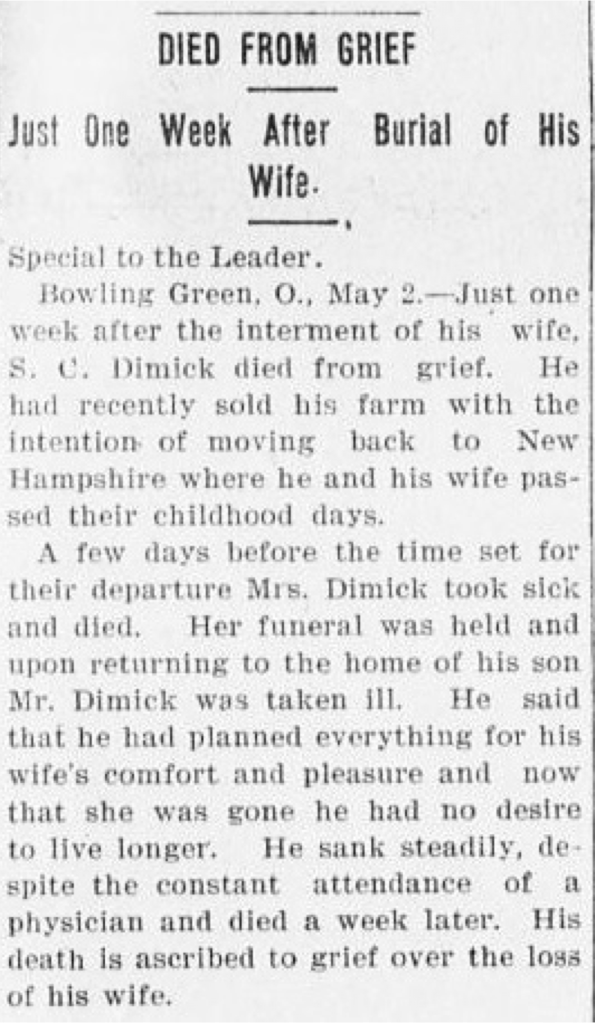
I also located his obituary stating that he “died from grief” just days after his wife died.
“Died from Grief,” Marietta Leader, (Ohio), 3 May 1903, p. 3, c. 4.
Neither of these news articles gave any clues about when or why they moved to Ohio from New Hampshire.
Just a quick note to let everyone know that our 2023 NGSQ study groups are now forming.
These are hosted by either myself or Cyndi Ingle (of Cyndi’s List). We will read and discuss one National Genealogical Society Quarterly (NGSQ) journal article per month as posted on the website NGSQ Study Groups. We will study these articles with a focus on principles taught in Mastering Genealogical Proof (MGP) by Tom Jones. We will discuss topics on the genealogy standards, evidence analysis and correlation, writing, citations, and more.
For more detailed information, the schedule, fees, and to sign up, visit this page.
The registration links are also below:
NGSQ/MGP Monday 1:00 pm Eastern Sessions, with Cyndi Ingle – Register Here
NGSQ/MGP Monday 3:30 pm Eastern Sessions, with Cyndi Ingle – Register Here
NGSQ/MGP Tuesday 1:00 pm Eastern Sessions, with Cari Taplin – Register Here
NGSQ/MGP Tuesday 7:00 pm Eastern Sessions, with Cari Taplin – SOLD OUT
If this doesn’t fit into your schedule this year, sign up to be notified when the 2024 NGSQ study group registration is open, add your name to the list.
This week, I’m pausing my discussion on county histories to remember a friend with a shared love of genealogy that we lost too soon.
My good friend and genealogy buddy, Annette Sands Botello died on 17 November 2022 at about 1:30 in the morning. I was able to visit her on the 16th in her hospice bed. She was not really “there” though she looked at me once, accidentally kicked me when she moved her leg and she uttered a “sorry,” and smiled occasionally as I chatted with her husband Ys about good times we’ve had and our fond memories. It was only about four weeks between diagnosis and her death. It was quite sudden and none of us were prepared for it.
The last trip Annette and I took to the Family History Library in Salt Lake City in 2018.
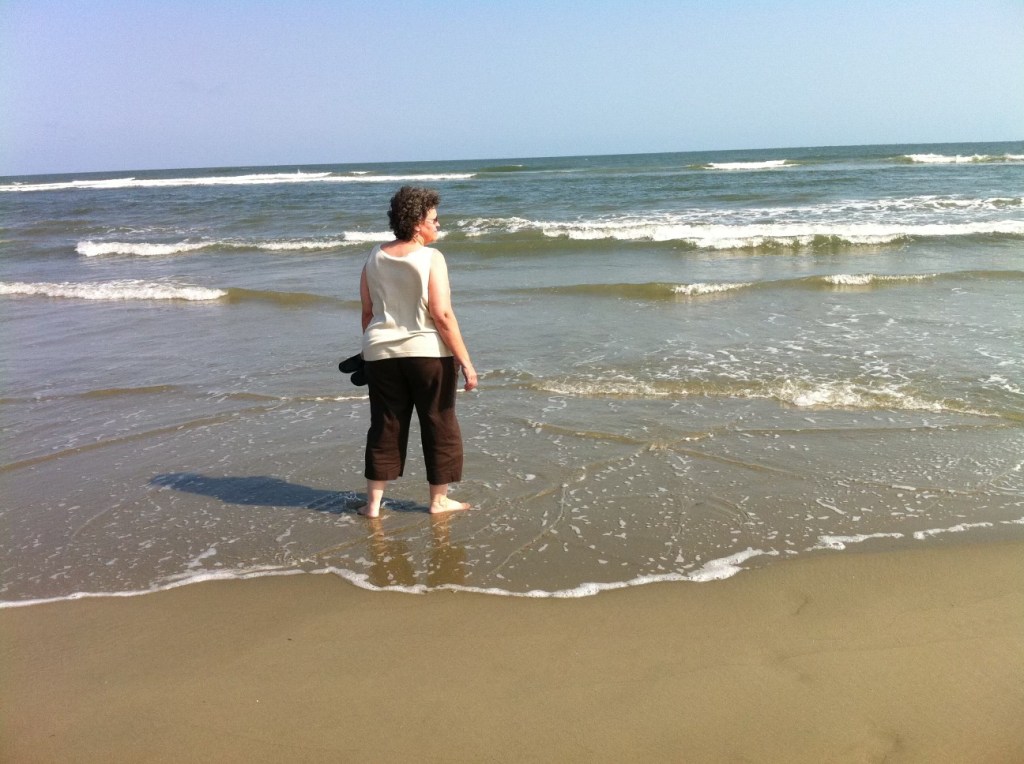
Annette and I took a couple of genealogy trips together, usually to the Family History Library in Salt Lake City. We would research all day, take a sack lunch to eat outdoors in the beautiful gardens of Temple Square, and work on our findings in our room at night. One time, we went to Charleston, South Carolina for an NGS Conference. One afternoon we played hooky and took a little drive to visit some ancestral lands of some folks she was researching. We also stopped at a beach and put our toes in the ocean.
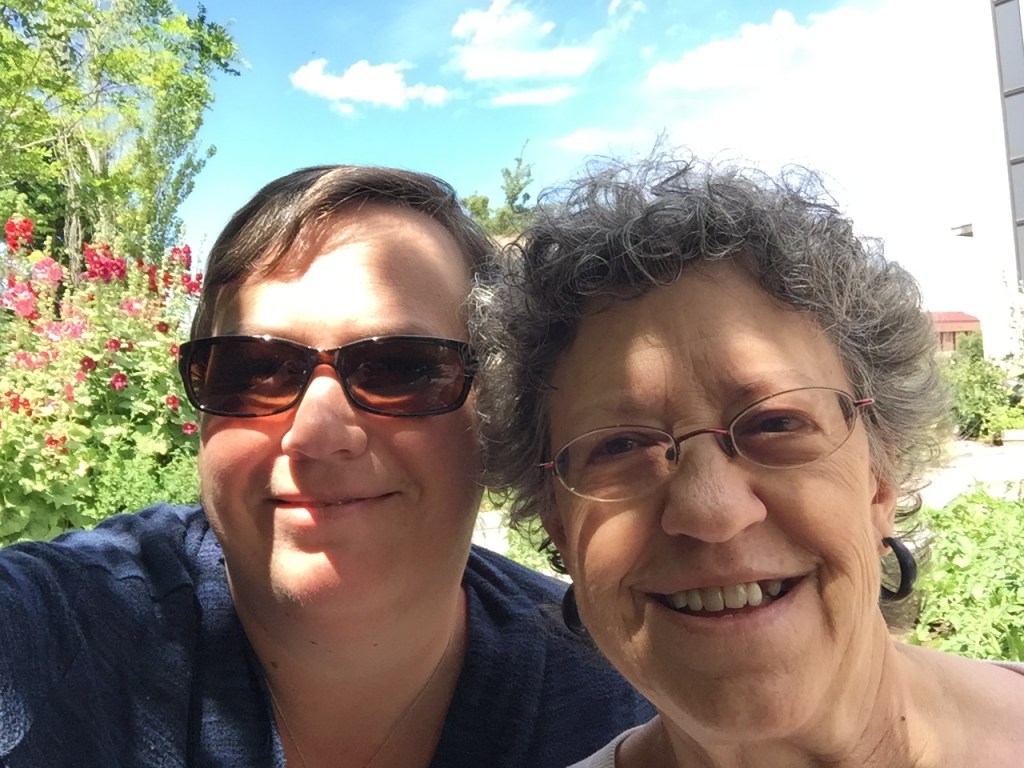
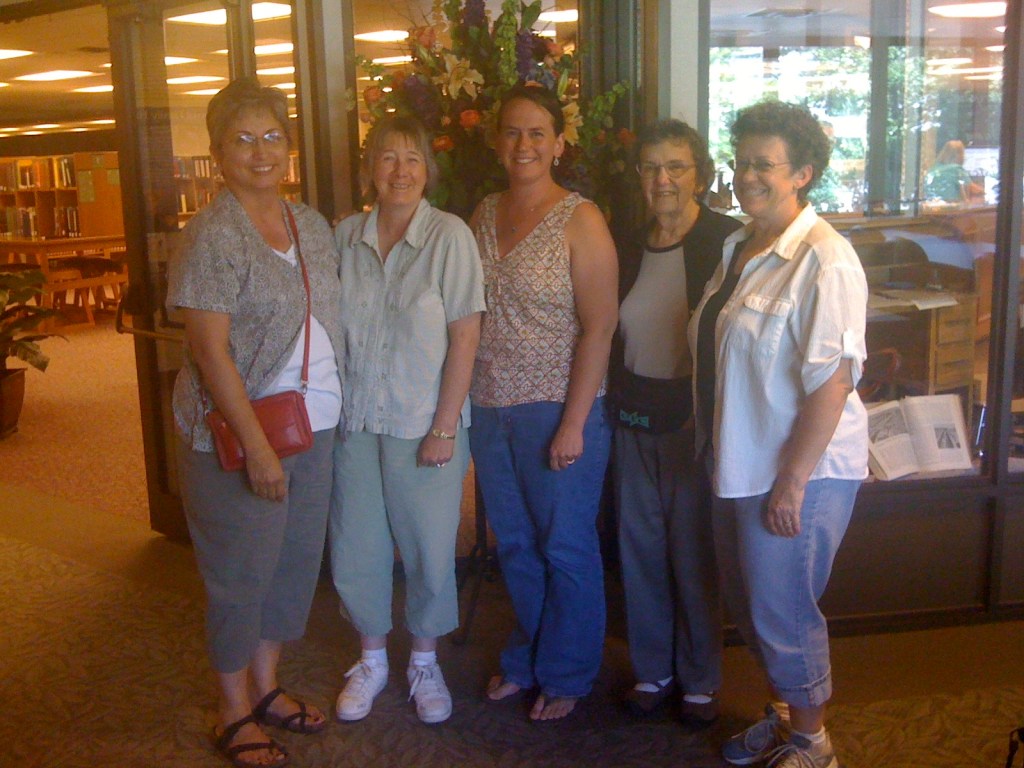
Just two girls from Colorado with our toes in the Atlantic.Annette with her feet in the ocean. Annette on the wooden walkway that leads to the ocean.Annette and I on one of our many visits to the Family History Library in Salt Lake City.From left: Henrietta Christmas, Denise Miller, Me, Ruth Ratliff, and Annette Botello. At one of our trips to the Family History Library, this time in June 2010.
Annette was very passionate about her family history. She gave several fantastic presentations here in Colorado, usually case studies on the work she’d done with her ancestors. She facilitated a Mexico genealogy group in Denver and helped many learn how to work on their genealogy. She always had time to meet up at a coffee shop and talk genealogy. Most recently we met up at Starbucks on a warm summer day and she shared with me her plan for an upcoming trip to West Virginia to meet up with many cousins she hadn’t seen in a long time. She really wanted to find a particular cemetery and conducted all of this research in old and modern maps to locate it. She had a fantastic trip and shared her stories with our little genealogy group when she returned.
This is our little genealogy club at our favorite coffee shop. From left: Annette, Deb, Me, Birdie, Denise, and Ruth. This was taken in February 2010.
I met Annette near the same time I met Birdie Holsclaw. Most of us attended the Boulder Genealogical Society. Denise Miller wanted to start a “support group” for those of us interested in getting our genealogy certification. Our group consisted of Birdie, Denise, Annette, Deb Skoff, and Ruth Ratliff. We met about once per month at a little local coffee shop. We did that until I moved to Texas for a while. During that time we tried to do Skype calls but it was too noisy in the coffee shop and the internet wasn’t great so it was a bit frustrating for myself to try to attend remotely. Then came the pandemic and we all started meeting on Zoom and our group was restored! It may be the only great thing that came out of the pandemic, me getting to meet with these ladies on the regular again!
I know for a fact that Annette was not “done” with her genealogy, nor was it in a state to be left for others to pick up. She was always working on it. She always had plans for more. And she thought she had more time. I am taking this as a sign that I need to get my genealogical affairs in order so that if the end came suddenly for me, all of my hard work would be in a reasonable state for someone else to take over or benefit from the work I’d done.
Annette hasn’t only been a genealogy friend. Her family has been so welcoming to my family over the years. Her husband Ys helped my son one school year with his math class when he did homeschooling. My son was not really a math person and having someone other than mom help him with a difficult subject seemed to do the trick. I’m forever grateful for Ys helping us through that year of school! When we moved back to Colorado in August 2020, we moved in two stages. Our daughter Ellie and I came to Colorado so she could get started in school while my husband stayed behind in Texas to get the house ready to sell and to pack up the remainder of our stuff. We lived in a rental for the first part and we kept our lawn mower in Texas so Seth could keep the yard looking nice. Ys kindly came once a week to lend his mower and his labor to help us keep the rental house lawn mowed until Seth got there. I got to know their daughters and have watched them grow from young teens into fine young women each with their own interesting path, yet always a close and loving family. It was a real blessing to have the Botellos in our lives. As they move into this new phase of their lives, I can only imagine the hole they must feel without Annette by their sides. And I know they all had a very strong faith and know she is in a better place.
I just imagine her hanging out with Birdie again, taking genealogy and movies and technology, and it makes me smile.
You will be missed, Annette.
There is a fundraiser to help the family with expenses, if you are so inclined.
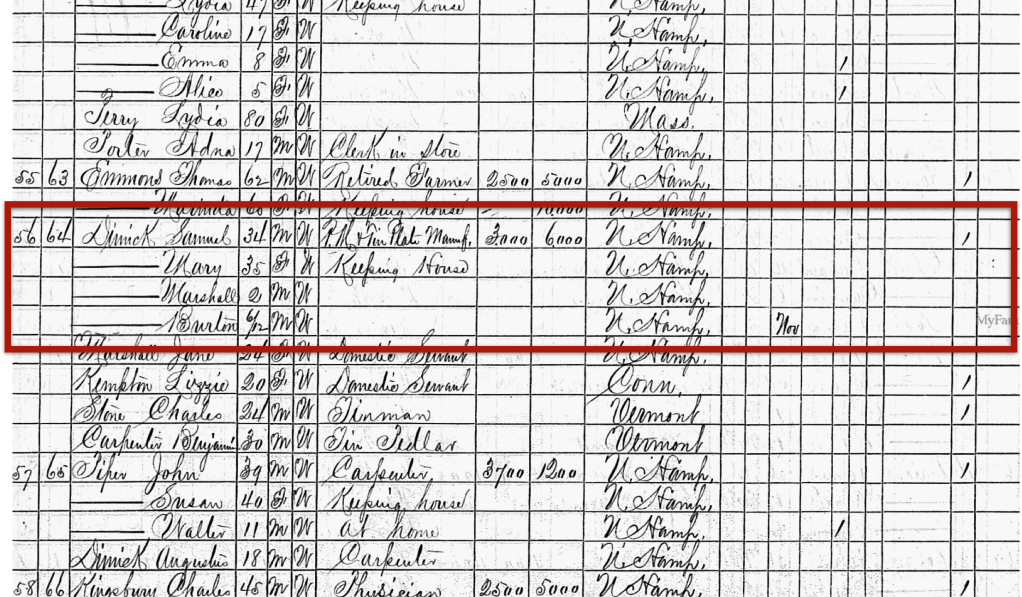
When looking at the details found in Samuel C. Dimick’s biographical sketch, let’s start with a basic one. Let’s look at him in the census. For each of my research subjects, I try to find them in every census they should be in. For Samuel, we will just look at a couple that I focused on because I primarily wanted to know why he came to Ohio from New Hampshire. We can’t always answer ‘why’ questions in genealogy but we can make some good educated guesses if we find the right information. So, I wanted to figure that out if I could.
1870, Lyme, Grafton County, New Hampshire
In 1870, Samuel was living with his wife Mary in Lyme, New Hampshire. He was 34, she was 35, and they had two sons, Marshall, age 2, and Burton, age 6 months. Samuel’s occupation is hard to make out, but it looks like “R.M. & Tin Plate Manuf.” I only knew he was a farmer from my earlier research.
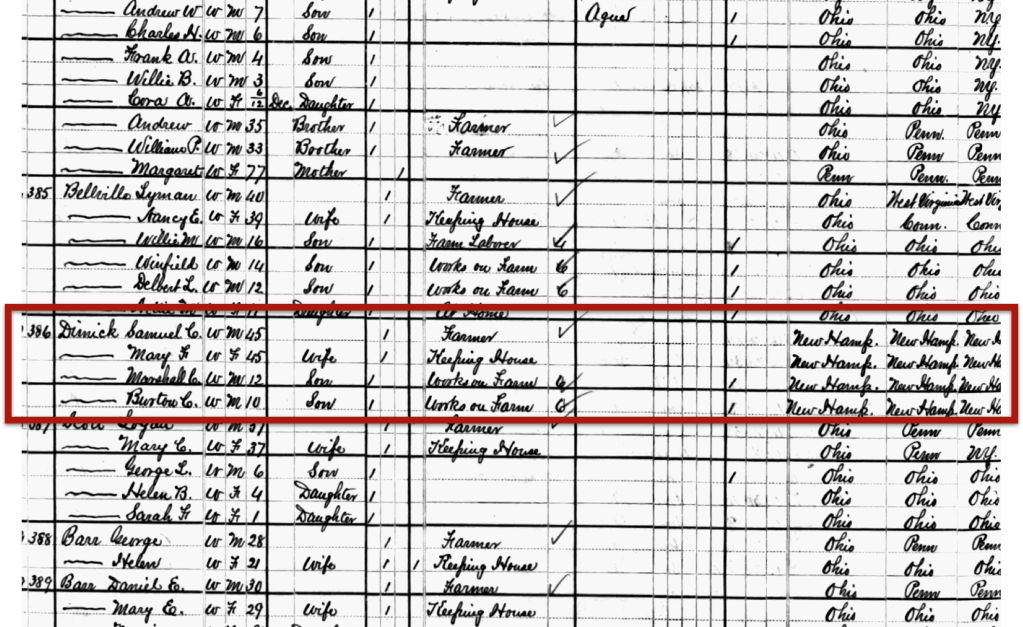
1880, Center Township, Wood County, Ohio
By 1880, he was living in Center Township in Wood County, Ohio, which is near Bowling Green. He is listed as a farmer.
These two censuses at the bookends to his migration to Ohio. Sometime between 1870 and 1880 he and his family made the move. We will continue to look for clues about his life in the county history and see what more we can learn.
In the last blog post, we looked at the general family information we found in Samuel C. Dimick’s biographical sketch. Now let’s discuss all of the minutiae and details that we (and by ‘we’ I mean I) might gloss over the first (or second, or tenth) time we read a biographical sketch.
When I began researching Samuel, I didn’t know anything about him, of course, so the details that were important to me at that time were the main biographical points we looked at in the last post. However, as time moved on, I gained more experience, and I wanted to know more specific information about him and his family, I started focusing on some of that minutiae. Sometimes we just aren’t ready to absorb information from a source. And that’s ok, as long as at some point in your process (this could be many years later), you go back and review your previous research.
After really digging into the details, I was able to compile a list of other sources I needed to examine to verify those details and get more information:
Census Records
Newspapers
Obituaries
Land Records
Land Ownership Maps
Vital Records
City Directories
School Records
Agricultural Census
Indian Reservation Records
Revolutionary War Records
Expand search to other states mentioned in the sketch: New Hampshire, Wisconsin, Massachusetts, Minnesota
Over the next several posts, we are going to look at some of these in detail. I won’t go over each and every one, because, well, that could get boring. But, there are some highlights I want to hit that really opened some new research avenues and helped me understand Samuel’s life better and in more detail.