“We now come to the personal history of our subject, who, after attending the district schools of Lyme, entered the high school of Orford, N. H., where he completed his education. After working on his father’s farm for a time, he removed to Wisconsin, where he was in the lumber business for a year, and, on the expiration of that time, went to southern Minnesota, where for a year and a half he had charge of a government farm on the Indian reservation…
“In 1875, we find him a resident of Center township, Wood county, where he purchased 120 acres of the old Williams farm, and has here since made his home. He has one of the best orchards in the township, and his excellent farm has been brought under a high state of cultivation by industry and good management, with its attendant hard labor…
“Mr. Dimick was married at Lyme, N. H., in 1860, to Mary Marshall, who was born in 1835, and they became the parents of two children, the younger of whom, Burton C., born November 4, 1869, died July, 1889…
““…Marshall C., born December 13, 1867, was educated at Toledo and Bowling Green, and now has a half-interest in the homestead farm, to the cultivation and improvement of which he now devotes his energies. He is a young man of good address, genial and industrious, and is one of the most enterprising and progressive farmers of Center township…”
I only shared some of the most vital or interesting bits about Samuel in the quotes above. In the full sketch, some of the things we learned about him include:
Born: 23 June 1835, Lyme, New Hampshire
Married: 1860, Lyme to Mary Marshall
Children: Marshall Chester and Burton Cook
Occupations: Farming, lumber, hardware store, can manufacturing
Other locations: New Hampshire, Minnesota, Wisconsin
Land ownership: bought 120 acres of the “Old Williams Farm” in Wood County, Ohio
Extensive details on Mary Marshall’s family background
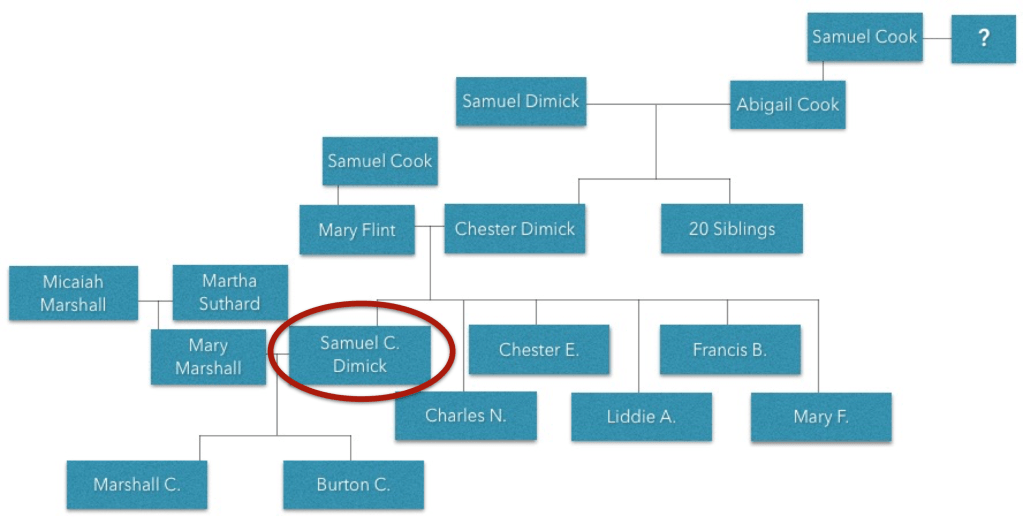
We have also been able to reconstruct family groups from this biographical sketch. Here is what we learned about Samuel:
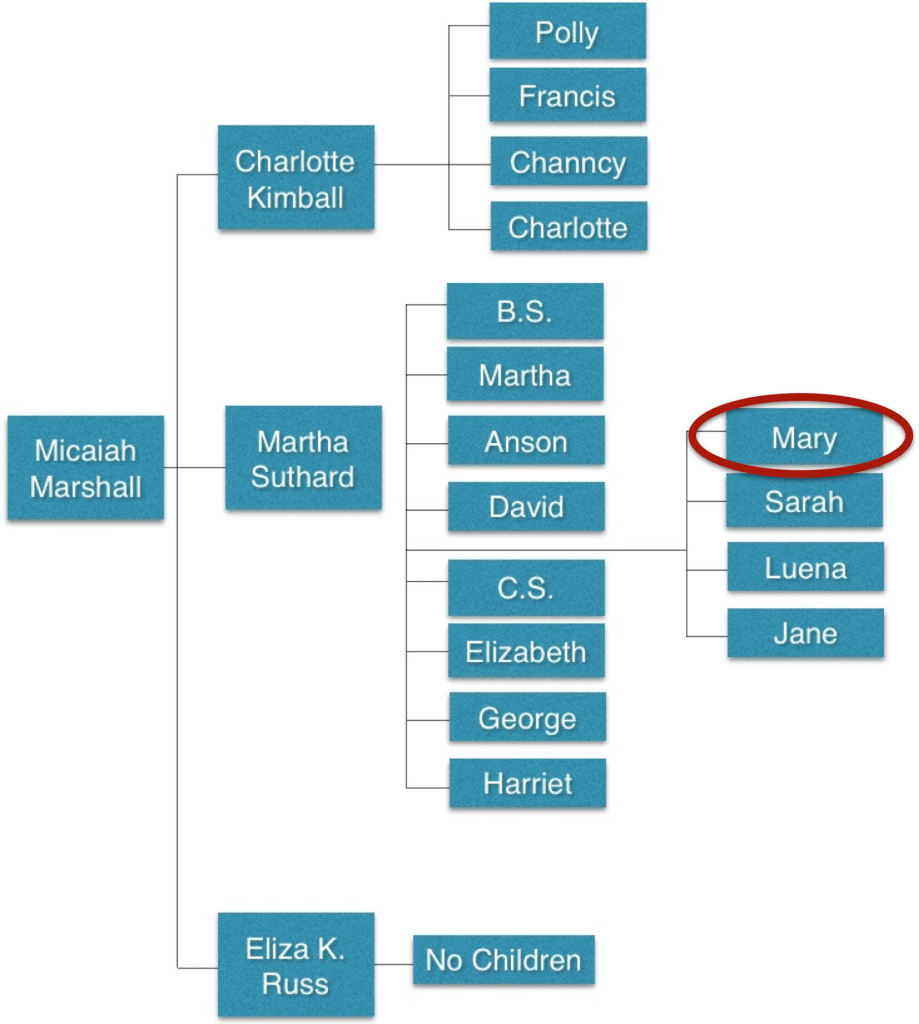
We were also able to reconstruct his wife’s family:
Next time, we will start looking at some of the information in more detail and discuss following every lead from these sketches.
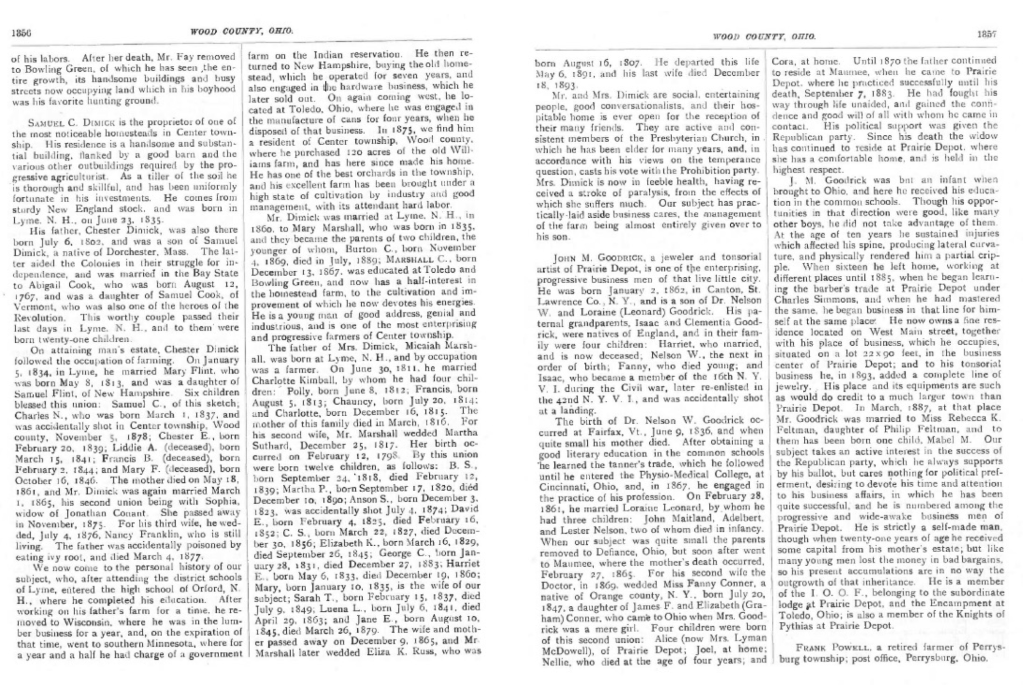
Biographical Sketch of Samuel C. Dimick in the county history for Wood County, Ohio.
I know this image is incredibly tiny and I’m not expecting you to read it. I’m going to share some of the main points and highlights and some things I’ve learned and some things I’m still working on from this particular biographical sketch. If you want to read the sketch in its entirety, click here.
Samuel Cook Dimick is one of the ancestors I focused on early in my genealogy-hood. My paternal grandmother, Marge, was a Dimick. She was very interested in the Dimick family history and we were able to take her on a trip to New England to visit some ancestral towns and cemeteries. She had a copy of this book in her possession. So this was a book I was familiar with early on. This biographical sketch shares so much information about Samuel C. Dimick and alerted me to things I had not found in other records.
The sketch contains many of the usual things you would find such a general genealogical birth, marriage, death information.
“Samuel C. Dimick is the proprietor of one of the most noticeable homesteads in Center township… He comes from sturdy New England stock, and was born in Lyme, N.H. on June 23, 1835… “His father, Chester Dimick, was also there born July 6, 1802, and was a son of Samuel Dimick, a native of Dorchester, Mass. The latter aided the Colonies in their struggle for independence, and was married in the Bay State to Abigail Cook, who was born August 12, 1767, and was a daughter of Samuel Cook, of Vermont, who was also one of the heroes of the Revolution. This worthy couple passed their last days in Lyme, N. H. and to them were born twenty-one children.”
Pretty typical of general biographical sketches in county histories. This one traces ancestor back to the Revolution. The county histories generally were a celebration of our immigrant ancestors the formation of the country. We will continue exploring this sketch in future posts.
If you haven’t used a county history or found your ancestors in one, I encourage you to look. Later in this series we will get to some search and locating techniques. Let’s discuss what you might expect to find in a county history.
Many county histories have two parts, even if they are not formally called out. Generally speaking, there is the part that discusses the history of the county, of the place, itself. This section will contain information on topics such as: early geography, geology, Native American tribes in the area, early settlers, the first towns in that county, the first government officials, the first churches, schools, and so on.
Table of Contents from the Wood County, Ohio county history.
From the table of contents for the history from Wood County, Ohio, you can see several topics just from this one section of the page that would be of interest to genealogists: newspapers, medicine, military, churches, schools, early pioneers, agricultural societies, etc.
You might find more modern publications such as Patterns and Pieces from Lyme, New Hampshire. As you can see, many similar topics are included.
Title page from Patterns and Pieces.
Then there is the second section, the section with the biographical sketches of our ancestors. These biographical sketches usually followed a male and his lineage back to the immigrant ancestor. Sometimes you will also get a lineage from his wife back to her immigrant ancestor, usually along her father’s line. If you are lucky, you might find a photograph or a sketch of your ancestor (I have not been that lucky yet.)
Next time, we will look at one of my favorite biographical sketches.
County histories have been a huge help to my research over the years and so I wanted to take some time to discuss them. There are definitely pros and cons when it comes to working with county histories. Big pro, often they were informed by family members, people who should know the data being published. Big con, there are rarely citations, well because of the previous “pro” mostly. Why would you give a citation for something you know from firsthand knowledge or at the very least, family lore?
The author’s copy of the county history for Wood County, Ohio.
County histories are, well, histories of a particular county. You may also find regional histories that encompass several counties in one. Primarily, they provide a history of the area and sometimes biographical sketches of many of the citizens of that county. They are sometimes called “mug books” or “vanity sketches.” Traditional county histories were published by companies who sold “subscriptions” to the book in order to have a family’s sketch included. You may also find county histories that were funded as a project by a county or town for an anniversary, or by a historical or genealogical society in that town.
Generally speaking, county histories became popular around 1876, at the centennial of the United States, and typically followed the lineage of that family back to their immigrant ancestor as a way to celebrate the growth of the nation. These books were published for about a 45-year period until about 1920. You may also find some books that could be considered county histories published near the bicentennial in 1976. Some of these later publications may be in the form of oral history interviews and recollections.
These county histories are not just an excellent source for a large amount of information about a family, they also contain valuable information about the formation of the county or region as well. Over the next several weeks, we will look at county histories, many as they related to personal research projects and how they guided my research.
Before I start the next series of my blog, I just wanted to give a quick update for me and the rest of the year and some exciting things starting next year.
First, the last Mastering Genealogical Proof study group for 2022 is starting next week. You only have a few days left to register if you are interested. (The 2023 schedule is still being formed for both MGP and MGD so stay tuned.) You can check the webpage for all class schedules or follow my Facebook page or subscribe to this blog to be kept up to date. (At the bottom of each page is a place to enter your email address to get updates to my blog.)
Scroll to the bottom of this page to find the location for getting emails when a new blog post is published.
Second, I am starting a new group focused on WRITING in 2023. It is called the “Writer’s Workshop Group 2023” and will be held once per month to allow for attendees to work on various aspects of their writing. More information and registration can be found here. The class size is limited so do not wait to sign up!
Third, Cyndi Ingle (of Cyndi’s List) and I will be holding our NGSQ study groups again next year. If you have not participated, but would like to be notified when registration happens, please sign up on the waitlist here.
Fourth, I will be participating in the Ohio Genealogical Society Conference in April 2023. I am going to present the keynote on Thursday titled “The Virtue of the Great Lakes: Contributions to Westward Expansion,” as well as several other lectures.
Fifth, I am excited to be coordinating our Great Lakes course again at GRIP in June 2023. The instructors are myself, Cyndi Ingle, Paula Stuart-Warren, and Judy Russell. We had a blast last time and many good comments so we are excited to do it again. It is one of my favorite topics.
I am always providing webinars throughout the year. Between living through the pandemic and now having a full-time job, I have decided to limit my in-person speaking. So, I will mostly be found at online events. (No gas money, driving through stressful traffic, not to mention the time commitment for travel. Not only is that easier for me and less expense for the societies I’m speaking to, it is better for the environment.) My speaking calendar can be found at the bottom of my webpages or click here. I hope to see you at any of the events above.
Our next round of Mastering Genealogical Proof study groups is forming! We are studying the book by Tom Jones and working through the workbook questions. These two groups will be lead by Cyndi Ingle (of Cyndi’s List). Here are the details:
There will be two sessions: Wednesday daytime at 3pm Eastern, and Wednesday evenings at 7pm Eastern (so adjust for your time zone), both being led by Cyndi Ingle. Beginning October 5 – November 16, 2022 (7 weeks, plus optional 8th week). Each class will be about an hour.
We will meet on Zoom.
Cost for the course: $75
You will need to have the book, Mastering Genealogical Proof by Tom Jones. It can be purchased on Amazon or through the National Genealogical Society if you don’t already have it.
There are questions in the book that we will use to guide discussion. Reading the chapter and answering the discussion questions will prepare you for each week’s class.
For first half (or so) of each class session, we will present/recap the principles for that week (we’ll have slides).
The second half will be going over the discussion questions.
There will also be a private Facebook group for this class only so you can ask questions and discuss issues in-between class sessions.
Class size is limited to 25.
Choose either of these two times, click the link to register:
If this session does not work for you, we will be holding the next session in 2023. To be notified when registration opens for the next session, please click this link to sign up for the waitlist. (This waitlist is just a way for us to collect your email so we can notify you of registration and is not a guarantee of a seat in the class.)
Since I wrote a blog series about using Cyndi’s List, I thought I’d ask Cyndi some questions that had been lingering after writing about her website. Here are the words straight from the desk of Cyndi. Enjoy!
Give a brief origin story for Cyndi’s List. How’d you get started? What made you want to turn this into a business?
I’m a member of the Tacoma-Pierce County Genealogical Society. Every summer we take time off, but in September we get back together and do a show-and-tell. In September 1995 my show-and-tell was that I had bought a new computer and started exploring the Internet for genealogy. I made a list, a whole page long, of everything I could find online for genealogy. The quarterly editor cornered me and asked if I could make it into a longer article, maybe 5 to 6 pages long. I told her I could, but I would have to probably categorize the links. It was published that fall. And in January 1996 I started teaching myself how to write HTML and put up a rudimentary personal web site on 4 March 1996 that included this little side-page with a list of links from that article. It was never intended to be a business. But by 1997-8 it had gained notoriety online and the various genealogy companies came knocking. I had sponsorship from Sierra Online for about 3 years, started running ads on the site and before I knew it, it was a business.
What has been the biggest frustration of running the website? What’s the biggest misunderstanding of what you do or how the site works? (Or both?)
There are several frustrations throughout the years. In general, it comes down to people and their perceptions of the web site or of me running the web site. I have had people insist that I add links to their sites within their timeline. I have had people argue that Cyndi is not a real person and that there is a team of people who run the site. I have had people copy my work and slap their own name on it. I have had people assume a lot about me, about the contents of the site, and about what I do and how I do it. Most of the time that assumption is that things must be automated, and the site run by many.
First, it really is just me. I have had some help here and there throughout the years, but it is a one-woman show. I do need to sleep and eat sometimes. And I do have other obligations. I do my best to keep up with the requests for links and the broken link reports. But I’m only human. And all this work is done manually, one at a time. I am a genealogist with 42 years of experience. I use that experience and my tech abilities to track down everything I can find for genealogical research. Then I determine ways to categorize and sub-categorize the links to make it as easy to find as possible. I try to outthink my fellow genealogist by cross-referencing whenever I can. And I spend a lot of time educating myself on new topics to build new categories or to improve on old ones. As one person, I would greatly appreciate patience and kindness from the people who use the site.
Probably one of the most frustrating statements I hear is that the site is just too big. That’s like saying there are too many books in the library. What it means is that the general user doesn’t know how to focus their research when using the site. You don’t use the entire site if you only need to look for resources in Ohio. You just browse to the U.S. and then Ohio.
And another frustrating statement I hear, “I used to use Cyndi’s List. Now I just use Google.” Well, if you don’t know that something exists in the first place, how would you know to Google for it? That’s my standard answer and it fits. Browsing Cyndi’s List and the categories, sub-categories, and links is the strength of the site. Finding things that you didn’t know were out there. Or things that Google cannot reach or didn’t reach and bring back in your searches. Please trust this experienced genealogist to find them for you.
And last, I wish wish wish that people would let me know when they change their sites or move their sites. I often get a lot of communication from people who want me to add a new link to their website. But, after that I don’t often hear from them again. I don’t think it occurs to them to let me know when I need to update those links. But, a broken link to their site is not great advertising for their site. And I don’t know when links break unless I physically check them myself or when someone else informs me.
How do you make a living?
The site is free for everyone to access and to use. It costs the visitor nothing. But the site costs money for me to maintain and to run. And my 12-hour workdays mean this is a real-live job. My income from Cyndi’s List comes from advertising and affiliate links. You will see graphic ads around the edges of every page – along the top, sides, and the bottom. Google AdSense is also inserting some new ads that popup and sometimes get inserted in the text (not yet sure how I like those, but the Google ads are necessary). And some of the commercial text links in the site are coded for affiliates. Viewing these ads, clicking on these ads and links, and sometimes even making a purchase after you have clicked, will help to generate commissions for Cyndi’s List. It costs you nothing, but it helps to support CL. After the last major upgrade of the site in 2011 I also added a PayPal Donate button. It took 5 years, but users of Cyndi’s List helped me pay for that upgrade in whole. You can shop using any of the affiliate links here: https://www.cyndislist.com/shop/
How do you handle broken links?
Broken links are the biggest issue online. It is the nature of the Internet. Links will break on Cyndi’s List, on Google, and everywhere in between. I have some links from 1996 that still work, and I have links that are only a year old that have already become broken. Every time a web site is rearranged, the URLs get changed and links break. I spend at least half my time updating broken links, if not more. People can use the purple tab on the left side of the pages to Report a Broken Link to me. I will do my best to fix the link and will likely email you when I do. And often if you report one broken link to me it means that I will fix multiple other links that relate to that one. Sometimes I also find new links to add to the site while I’m busy locating a fix for the broken link. Overall, it is a win-win for everyone if you report just one broken link to me. I don’t know that a link is broken unless you report them to me or if I happen to click on one myself. I really appreciate any help you all give me by letting me know about them.
What has been the best thing from doing the website?
One of the best things ever is hearing of success stories because someone used Cyndi’s List. I love knowing that it has helped people in their research. I learned early on that Cyndi’s List helped people learn how to do research too. Browsing the categories gives them ideas for new research avenues to follow. It teaches them about new topics and methodology. Using the site helps them become better researchers. I’ve also been incredibly lucky that something I love to do has also served as my job and a way to earn an income from home as I raised my son and now care for my mother.
Is there anything else you’d like the world to know?
I’m incredibly proud of what I created. It started as a small way to help my local genealogical society and ended up as a massive way to help genealogists all around the world. I want the world to know that I’m still here and I’m still happy to help. Please submit a new link or report those broken links and we will keep plugging away together!
Last time we went “shopping” at Cyndi’s List with the topic of fur trading in mind. Let’s go about this a different way. My ancestors did not stay in one place forever. Eventually as you research, you will find that they came from somewhere. Once you figure out where that somewhere was, you’ll eventually encounter a place you know very little about. Let’s go to Cyndi’s List with a place in mind.
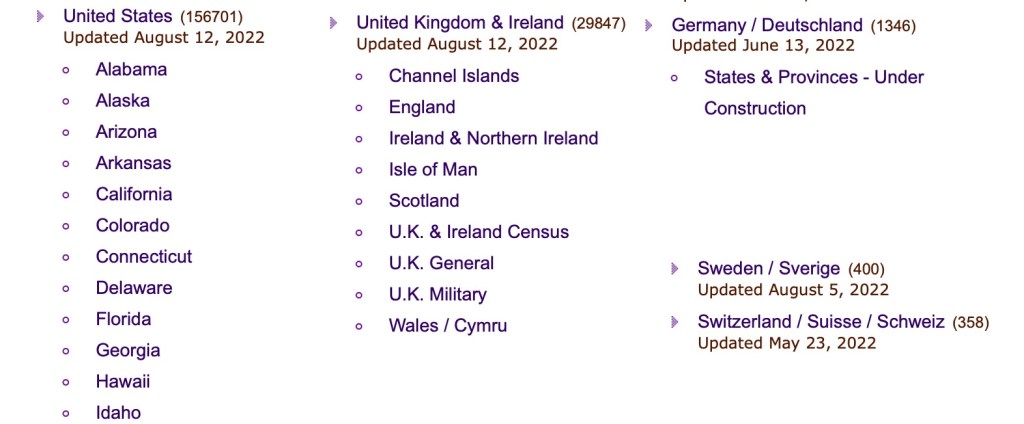
When you scroll through the categories on Cyndi’s list you will find places among the list. Here are a few screen captures of some of them:
Screen captures of some of the locations in the category list.
So, if you are looking for a particular state in the United States, you will find it under “U” fur “United States.” There’s also many other countries in the list, for example “United Kingdom & Ireland,” “Germany / Deutschland,” “Sweden/Sverige,” and “Switzerland/Suisse/Schweiz” just to name a few. When you encounter a new location in your research, head over to Cyndi’s List categories to find that location and see what you can learn.
I recently had some new work in Mexico. I have a very small amount of experience in Mexican records, primarily those that are near the Texas border. I wanted to know more and find resources that I probably didn’t know existed, so I headed over to Cyndi’s List.
Mexico Category on Cyndi’s List
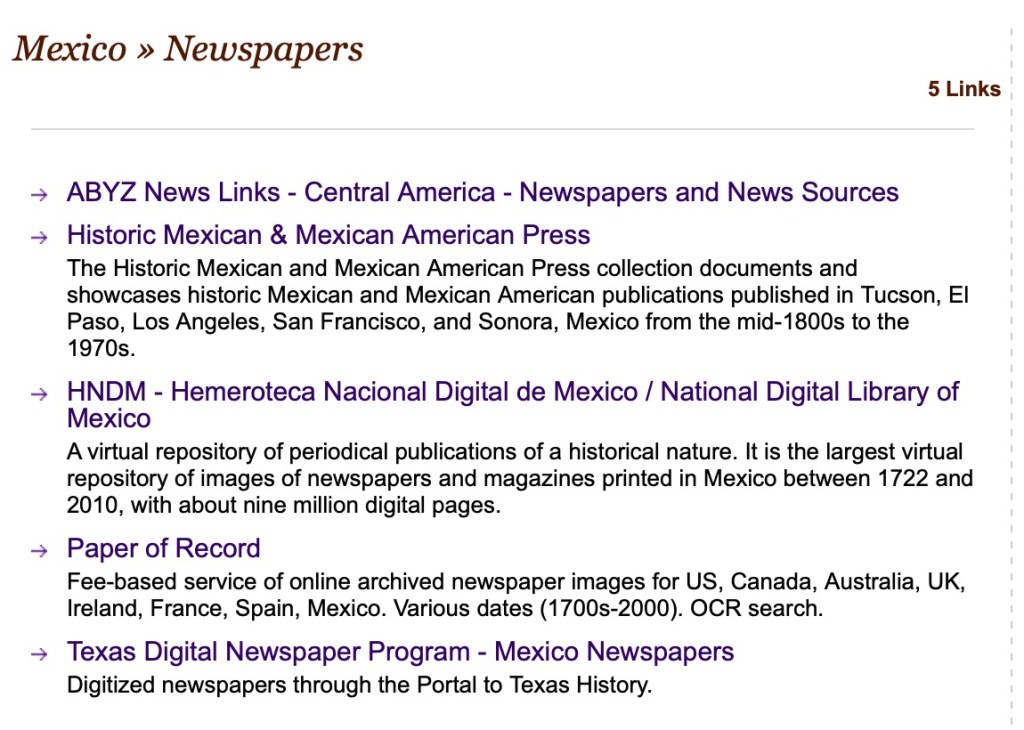
If you look at the Birth, Marriage, Death category, you will find that Cyndi has links directly to databases at Ancestry, FamilySearch, and other major websites. But there will also be other links in there as well. For this example, let’s look at the Newspapers sub-category.
A look at the Newspapers sub-category.
From looking at this subcategory I found a wonderful collection of digital newspapers at the National Digital Library of Mexico.
National Digital Library of Mexico, showing a digitized newspaper
Let’s look at another place example. I have a lot of my personal research that is in northwestern Ohio, primarily Wood, Hancock, Lucas, and other counties in the area. Under each state there is a sub-category for Counties:
Subcategories for OhioCounties list for Ohio
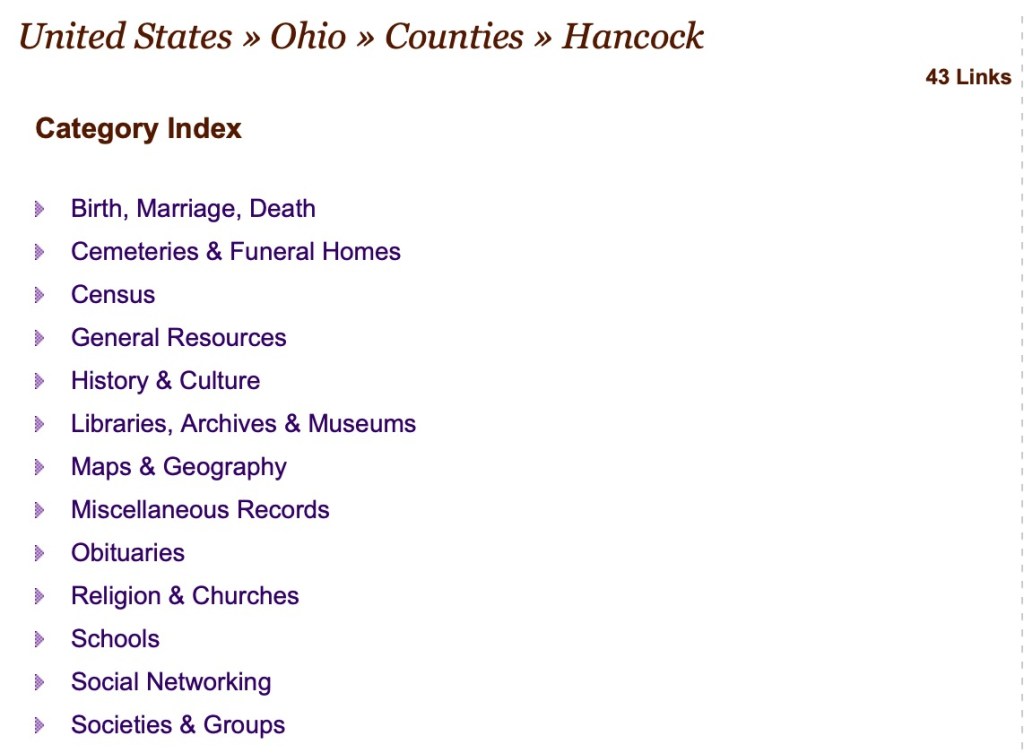
Let’s take a look at Hancock County.
Hancock County, Ohio sub-categories on Cyndi’s List
You may notice that the subcategories are very similar if not the same across multiple categories. Let’s look at the Libraries, Archives & Museums category:
Libraries, Archives & Museums Category for Hancock County, Ohio on Cyndi’s List
I have been to the Findlay-Hancock County Public Library. My dad used to live in Findlay for many years. His mother’s maternal side, the Urbans, were from Findlay. So I’ve visited that library many times to do research. However, I have never visited neither the Kaubisch Memorial Library nor the McComb Public Library and will have to do so on a future visit. I honestly did not know they existed and do not know if they might have additional information than I have been able to obtain from Findlay. If it weren’t for Cyndi’s List, I may have never known to look there.
So, think of the locations you are researching. It is very possible if not likely that Cyndi’s List has some hidden gems waiting for you in those categories and sub-categories. Go take a look.
First of all, HAPPY BIRTHDAY, Cyndi! Next… let’s continue the series.
Let’s look at using Cyndi’s List with a plan. The analogy: you walk into Costco with your shopping list. Let’s say you have some topics in mind. Perhaps you are just starting to work in a new state or country and you know very little about that area. Or you just discovered that an ancestor was involved in an event or activity you don’t know much about. In these scenarios, using Cyndi’s List is a good way to learn what is out there that is genealogically-related.
Let’s say you learned that an ancestor was a fur trader and may have been involved in the Hudson’s Bay Company (HBC). Let’s see what we can find about fur trading and HBC on Cyndi’s List. Let’s head to the categories page:
Categories on Cyndi’s List
Scrolling down the page looking for a fur trade category:
Find a category for fur traders on Cyndi’s List
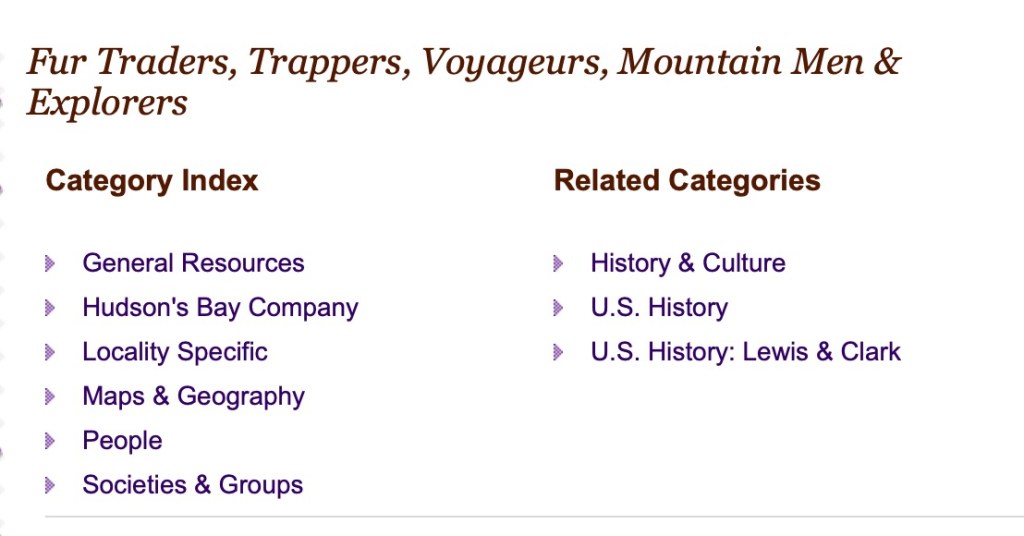
We can see from the link that there are 63 links in this category and it was last updated on 29 June 2022.
Fur Traders, Trappers, Voyageurs, Mountain Men & Explorers category on Cyndi’s List
You can see the sub-categories above. Let’s take a look at General Resources.
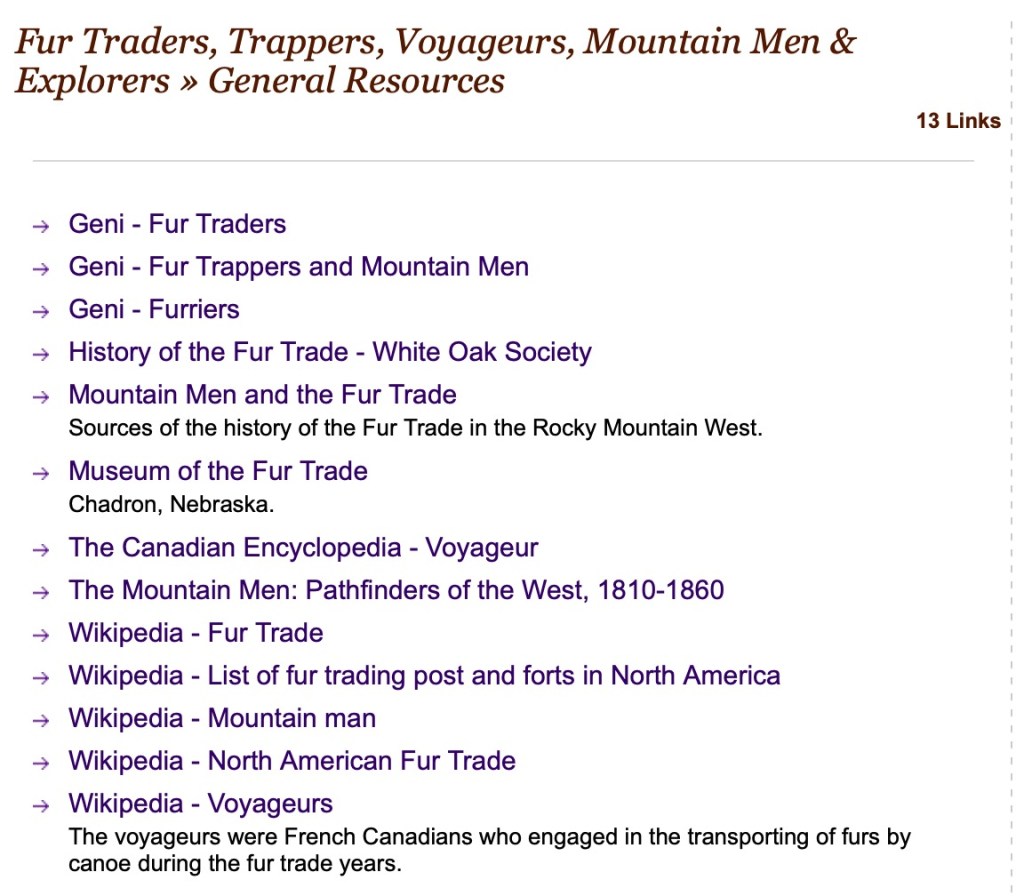
General Resources in the Fur Trader category on Cyndi’s List
There are several links to Geni for these topics, a link to the Museum in Chadron, Nebraska, several Wikipedia pages to give you general information on the topic. I clicked on the “History of the Fur Trade – White Oak Society” and found a broken link. Let’s ask again as I did last time…should I despair? NO! Click on the “Report a Broken Link” button on the left and help Cyndi out! I found the new URL for that page and reported it to Cyndi using the button on the page.
The new location of the History of the Fur Trade – White Oak Historical Society
Let’s take a look at some Hudson’s Bay Company specific links.
Hudson’s Bay Company sub-category
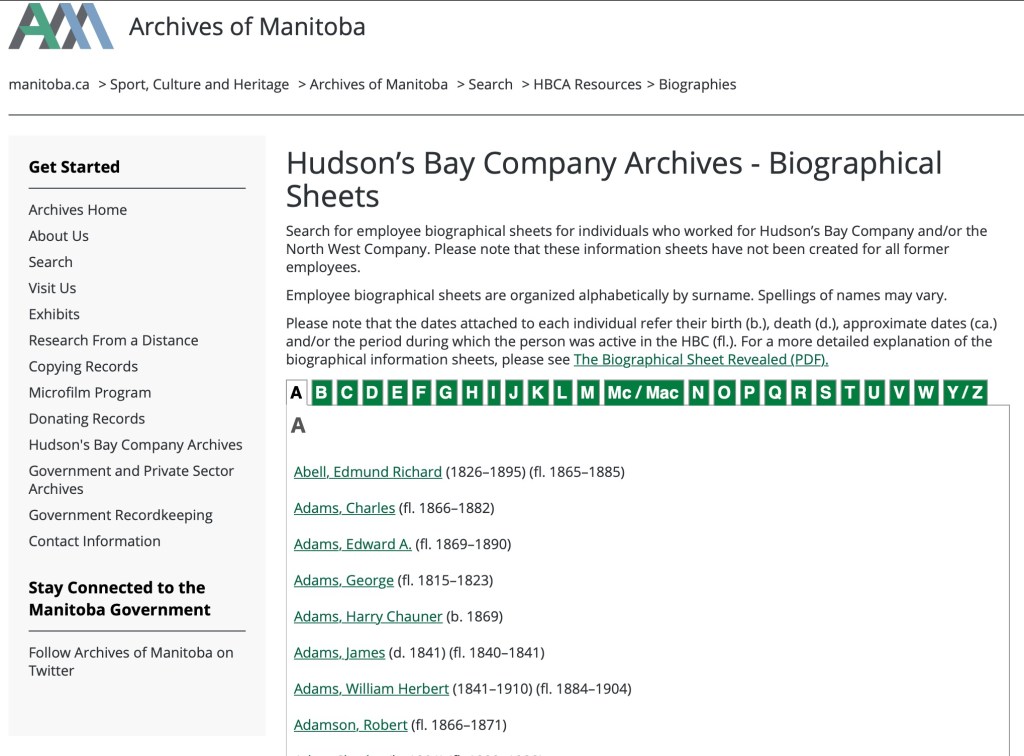
As a demonstration, let’s look at the Hudson’s Bay Company Archives (HBCA).
HBCA Biographical Sheets
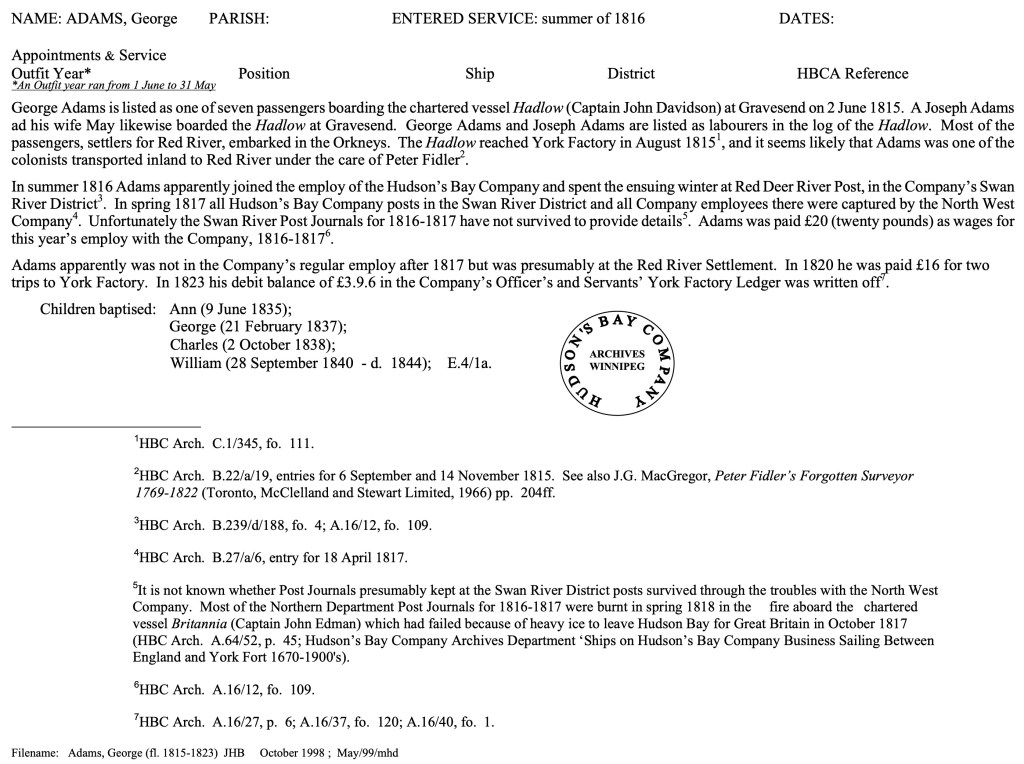
The HBCA has biographical sheets on employees. How cool is that? Let’s look at George Adams (1815-1823).
Employee biographical sheet for George Adams at the HBCA website.
You can see that you get information about George Adams regarding his employment with the Hudson’s Bay Company.
Now, that was an example regarding fur traders. What other topics are there are on Cyndi’s List? The answer is many. AND you are not going to find that all of the links work. PLEASE report them and if you can find a new one, let Cyndi know. Next time we will do a similar exercise but with a location or two in mind.
There’s two ways you can use Cyndi’s List (ok, maybe there’s more than two, but I’m going to demonstrate two in the next couple of posts). This week let’s talk about how you can use Cyndi’s List if you don’t have a plan, or a Costco shopping list if we stick with that metaphor.
When you walk into the big warehouse store with no list, what do you do? You start walking up and down the aisles and see the items with no plan. This is a fine way to do things on Cyndi’s list and a very viable way to learn about what you don’t know. Let’s walk down the “aisles” of Cyndi’s List.
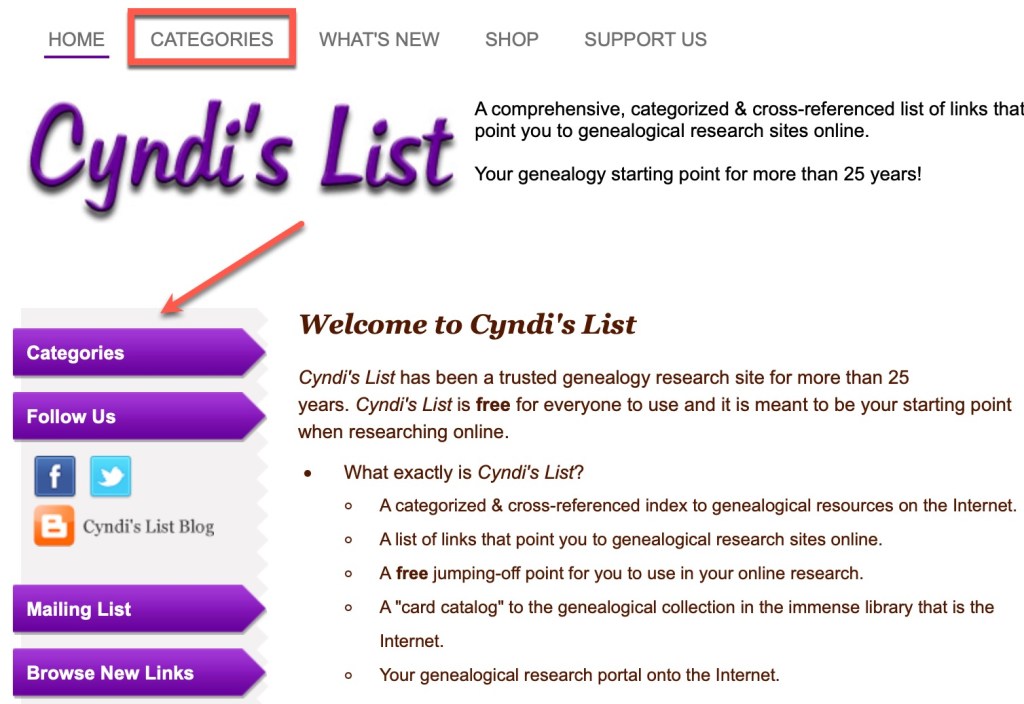
To find the “aisles,” go to the Categories tab at the top of the screen, or the first purple button on the left:
Showing the Categories tab and button on Cyndi’s List
What you will first see is probably an ad. Remember from last post, all you have to do is click the close button to move on. (Also remember that this is a completely free resource and Cyndi funds it through ads and donations. Running a website of this size is not cheap.)
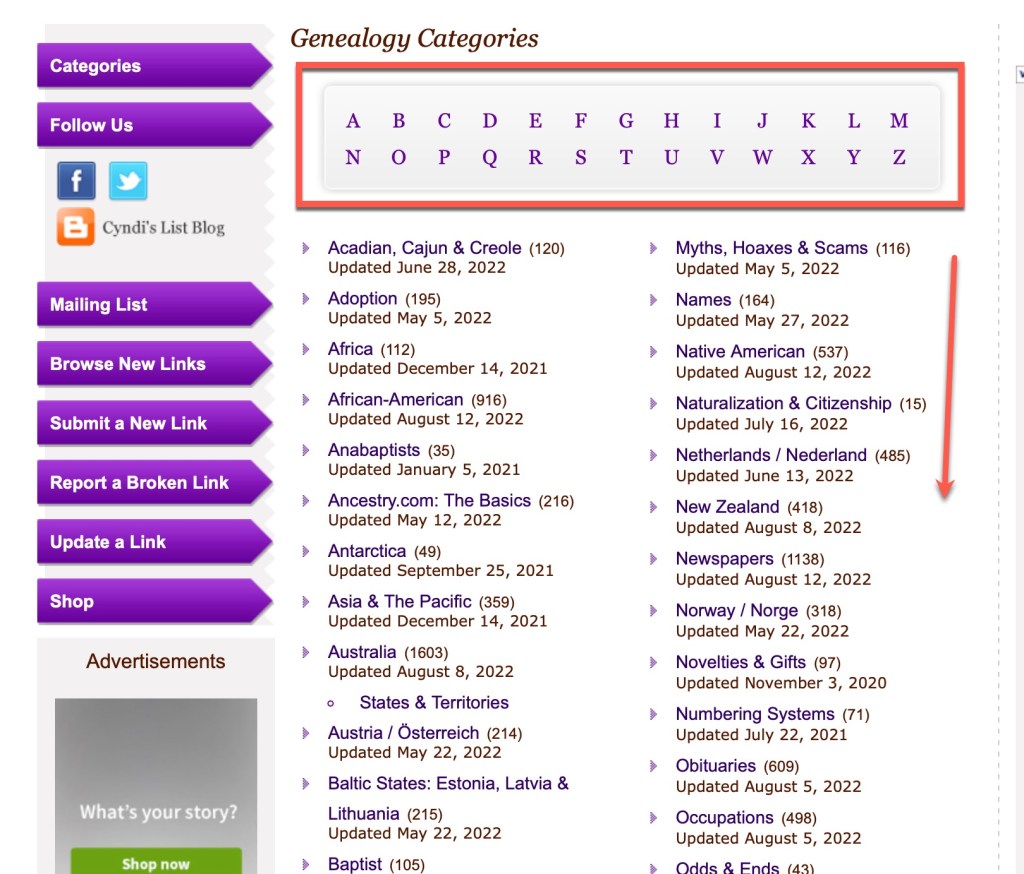
Once you’ve found the “aisles” (the categories), you can start browsing. Along the top is an alphabet so you can jump to that letter in the categories list. Or you can just scroll down the page to see what you find. Again, you don’t know what you don’t know. So this kind of browsing reveals some of those things to you.
Alphabet across the top to jump to a topic or scroll the categories.
You can see from the list above, it is two columns. and from these you can see some of the categories: “Acadian, Cajun & Creole,” “Adoption,” “Africa,” “African-American,” etc. There is a number in parentheses after the title of the category that indicates how many links are in each. So, Adoption, for example, has 195 links in the category at the time of this blog post. Below each category, there is a date that the category was last updated So, adoption was updated in May of this year, whereas, Novelties & Gifts (on the right hand column) has not been updated since November 2020. As I said last time, Cyndi’s List is a one-woman operation. She fixes broken links nearly every day (I asked).
Let’s look at the African-American category. It was last updated very recently, on 12 August 2022. It contains 916 links. When you click on the African-American category, you will find all of the subcategories and related topics.
African-American category on Cyndi’s List
The sub-categories in each is listed in alphabetical order. She is constantly working on these categories and massaging them to keep them updated. Some of the sub-categories in this section include: “Birth, Marriage, Death,” “Blogs, Podcasts, and Video,” “Cemeteries & Funeral Homes,” “Freedmens’ Bureau,” “Laws & Statutes,” “Occupations,” “Slavery,” “Social Networking,” “Societies & Groups,” and “Wills & Probate,” to name several (but not all).
Let’s look at the “Birth, Marriage, Death” category.
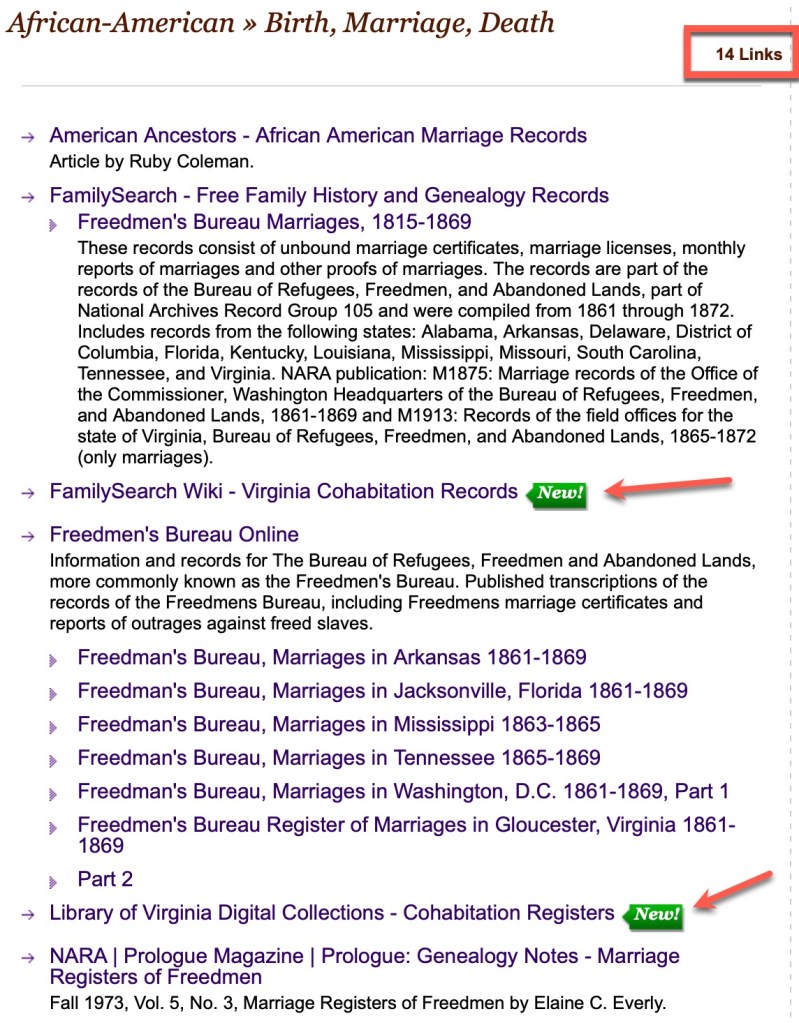
Birth, Marriage, Death sub-category
There is a link count at the top that tells you that there are 14 links in this sub-category. Each recently added link gets a “New!” icon so you can see some of the newest resources added.
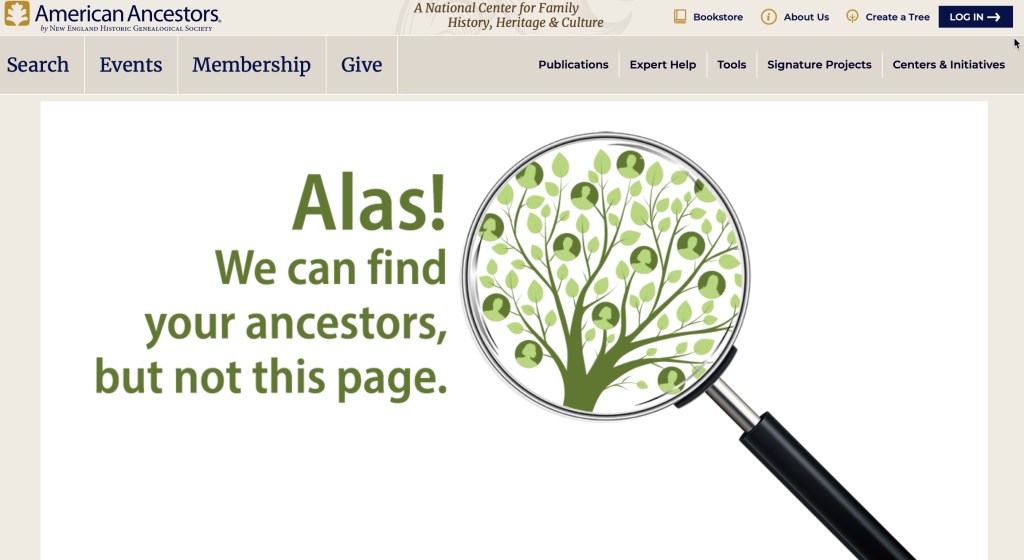
As I was browsing the items in this category, I found that the first link, that to an article by Ruby Coleman at American Ancestors, is broken. It points to this:
Broken link at American Ancestors
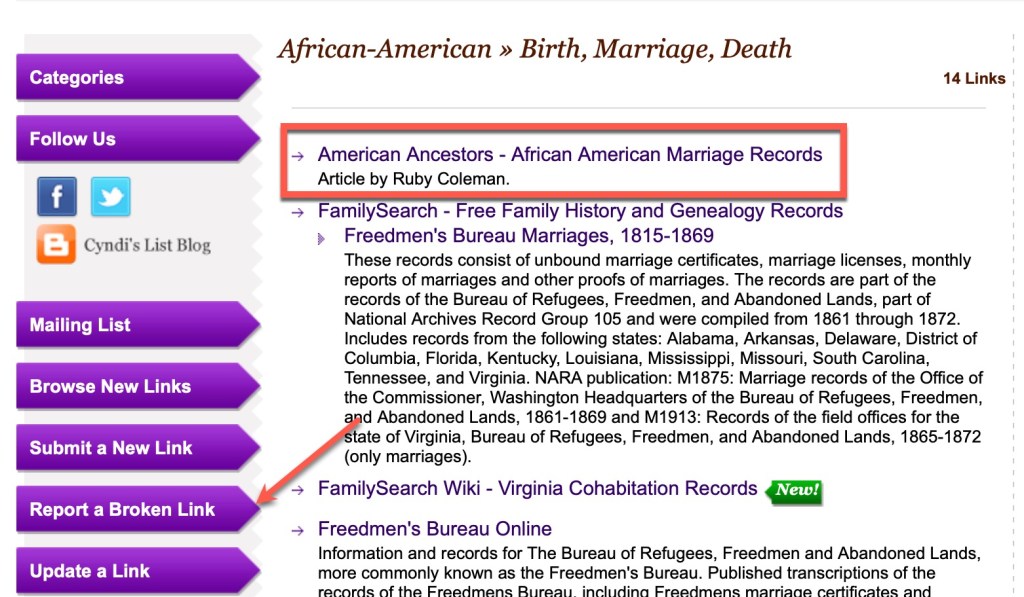
Should you immediately think “Aw, Cyndi’s List is so out of date. All of these broken links makes the site unusable!”? NO! The answer is no. And in case you tend to do that, please don’t. And here’s why. If there is an item on Cyndi’s List that you really want to see, that means it exists somewhere. And do you know who can and will help you find it (especially if you are polite and patient, and maybe send brownies)? Cyndi. She is a WHIZ at finding things that have moved online. So there is at least one thing you should do next when you encounter this: Report a Broken Link!
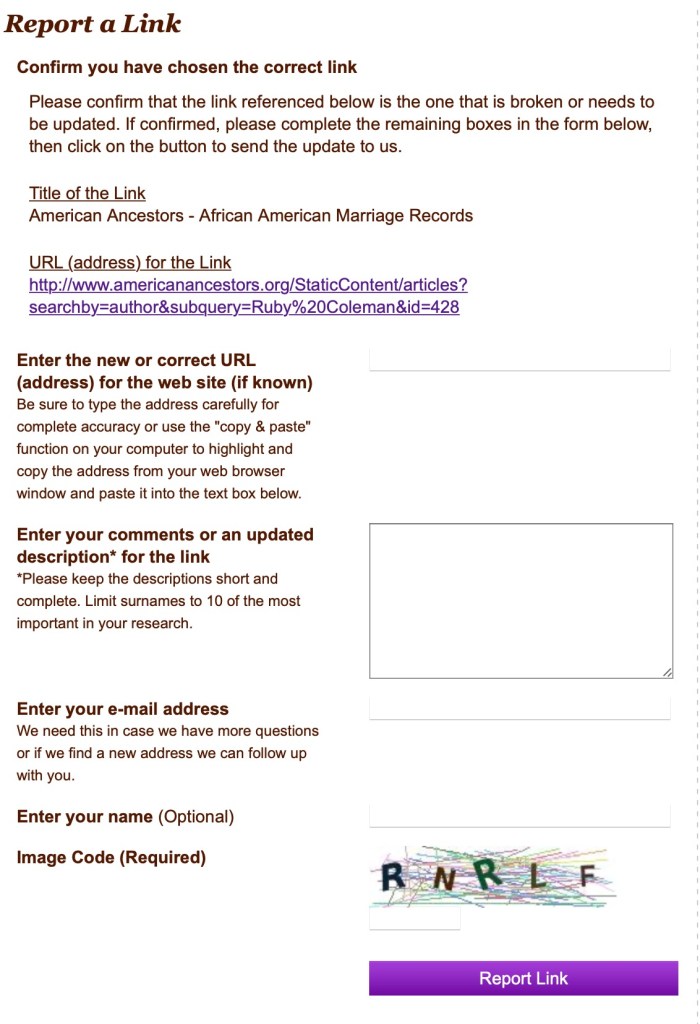
Reporting a Broken LinkClick on the broken link graphic next to the link you’re reporting.Report a broken link page at Cyndi’s List
Ok, so the above is the page you get when you report a broken link. At minimum, put your email address in there. If Cyndi finds a replacement link, she will let you know. She will! It’s happened to me! Seriously. She tries to help everyone and keep the site up-to-date. IF you can find the new home of that broken item, let her know. It will save her a bit of time. I did a quick search for that article at AmericanAncestors and didn’t find it (to be fair, I didn’t put a ton of time into it). So I just submitted it without comment. At some point, when Cyndi finds where they put it, she’ll send me an email telling me that the link has been updated.
So, that was us walking up and down the African-American aisle of Cyndi’s List. There are 229 categories (aisles) at Cyndi’s List. Get walking! We will discuss “shopping” at Cyndi’s List WITH a plan (shopping list) next time.