Box Adventures: Get the Right Tools

Copy of Box Adventures_ Sorting and PlanningWe unpacked the box and sorted it into types of items. I then hired my daughter to do the scanning for me. We discovered my old scanner was just not working fast enough. A job that should take a small amount of time was taking forever. Since I’m paying her by the hour, and she was getting completely bored waiting for the scanner to do its thing, I decided to upgrade my scanner. My old scanner was a built-in scanner, copier, printer. In computer years, it was old. It still works, mind you, but it is slow. So, the need for speed got me shopping.
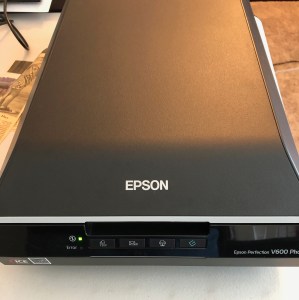
ScannerI opted for an Epson Perfection V600 photo scanner. It has some features I need for a price I was willing to pay. You can find it on Amazon here. I am not here to tell you this is the best scanner ever and the one you should order. That’s not what this blog is about. This is the scanner that had the features I needed at a price I was willing to pay. And it has worked out great. It scans faster, the images are turning out great, and my daughter is finding the software easier to use.

So, in between online class zoom meetings, school work, and her private flute lesson over Skype, my daughter has been scanning away and finding some great little tidbits. Here are just two, I’ll share more in the future:

Miller_Cari_NP-1976 Flag Day


This is me, little Cari Ann Miller in 1976, the bicentennial. I wore a stars-and-stripes covered outfit, undoubtedly handmade by one of my grandmothers, and was caught waving my flag at the town parade. We lived in a little town called Weston in Wood County, Ohio. This clipping does not have any date of the newspaper but this was most likely published in the Daily Sentinel-Tribune out of Bowling Green.


Miller_Kenny_NP-Fireman of the Year

And this is one of my dad who was a volunteer fireman in Weston. Apparently, he was named Fireman of the Year one year and then passed off the honor to another man the next year. Again, no dates were written on these clippings but this would have been sometime prior to 1980.


Stay tuned for more Box Adventures. I will post some of the delights that I find as we move through the process of unpacking the old photographs, newspaper clippings, slides, artifacts, and more!

Box Adventures: Sorting and Planning

Box Adventures_ Sorting and Planning

Ok, so I’ve unpacked my box. It was jam-packed full of treasures that will take me months to sort through. I’m excited. So what to do first? Honestly, I have no idea…but here is what my preliminary plan is.

Step 1: Sort into types of items

Largely, there are photographs here. Some of them, I know I already have digital copies of from a time back when I was allowed to scan them, but not keep them (before the downsizing). There are also newspaper clippings as well as full newspapers. I will need to figure out why that newspaper was kept and perhaps clip out the important part (keeping the title, date, page, column for the citation, of course). There are large family reunion photo prints that have been rolled up. There are envelopes with who knows what inside. So sorting is my current project.

Step 2: Decide how to preserve each type of item

I could scan, photograph, frame, clip, store in archival boxes, and so on. Each item is going to have a different solution. Determining that solution will be next and I’ll tackle each item separately. For example, I probably don’t need to keep the actual newspaper or clipping if I get a good scan of them. Newsprint is terribly acidic and doesn’t hold up well over time. But if I make a scan and print on archival paper, it might last longer. Making each of these determinations is going to vary.

Step 3: Do the task set forth in step 2 for each item

This step could take months. The process of scanning and putting the item into whatever the final form will be is going to be lengthy. And I think one I can hire my teenaged daughter to help with since she’s home right now.

Step 4: Catalog each item

Putting the information into my family tree software, the digital image stored in my digital filing system, and a copy stored in my binder system will likely come at the end. And this is going to be the fun part! My initial thought is that my daughter can scan the item and name them in a pre-determined format then put them in a dropbox folder we share. Then one-by-one I can go through them and put them in their appropriate places. It is during this step that I will also craft the citations for each item.

Up next…getting into the sorting. I hope my daughter is ready!

Mastering Genealogical Proof Class forming

As planned, a new class is opening this summer on Mastering Genealogical Proof. This will be a seven-Week Beginning Principles Course taking place on Wednesday Evenings (7pm Central) June 3rd through July 15. This is for those who have never studied this book before. We will be studying this from a beginner or slightly intermediate level. If you’ve done one of these groups before and want a refresher, that’s ok too! I will take 25 students.

Sign up here

I am still in the planning stages of the documentation class for the fall. And maybe starting a writer’s group but am still trying to decide how that one will work most effectively. You can sign up for early notification on either of those here: https://genealogypants.com/research-and-consultation-services/classes-and-study-groups/

Box Adventures: Getting it Out of the Closet

Box Adventures_ Closet

IMG_5089

See the box in this photo? I shipped it to myself in 2010. That’s what the label says. Can it really have been 10 years? Ten years ago, my grandmother decided to downsize her home (after already downsizing from a large farm several years prior) and move into a small apartment. She was not able to keep up with the yard and housework anymore. A large garage sale would take place and a dumpster may have been mentioned. I got on a plane.

In fact, I sent four boxes home. Items were delivered to a pack-n-ship where they very carefully wrapped everything and got it ready for the cross country journey from Ohio to Colorado. I’m happy to add that nothing was broken! Three of the boxes were dishes or other things that used to belong to my great grandmother (whom I’m named after). But this one box is FULL of papers, photos, and I cannot remember what else because even though I packed the box, it has been ten years. And within those ten years, my family moved from Colorado to Texas. So… this is LONG overdue.

You don’t have any projects like that sitting around, do you? Surely not. I’m the only bad, bad genealogist out there.

Well, I’ll be unpacking the box over the next couple of weeks and scanning, sorting, and storing in archival boxes. (I have a couple I bought TEN years ago for this project!) I’ll share some of the cool treasures I find along the way. I hope you get out a scanning project or two you have tucked away and join me!

Writing: Tips on the Rough Draft

Tips for Rough DraftWhen getting started on the writing, you might feel overwhelmed. Where do I begin? What should come first? How do I build this story so that it is clear, concise, easy to understand, and makes the case?

Consider this: try writing BEFORE you finished the research. Maybe even at the outset or early-to-middle stages of your research. When you’ve determined you have a tougher problem on your hands maybe? Start the writing then.

Start writing when you start the research. It can go like this:

  • Research…discover you don’t have a straightforward problem.
  • Write a research plan which starts with a clear and concise research question.
  • As you research, you add to that document your findings, conclusions, analysis, summations, and add to the plan.
  • Eventually that same document (or I like to make a copy to work from) can become your rough draft.
  • Edit, rearrange, add, delete, and discover more research to be done.
  • And as they say, “rinse and repeat” until you get a good solid third, fourth, fifth, sixth draft.

Tip: Keep a copy of each draft. If you’re like me, you’ll change your mind about something and wish you had an earlier copy to refer back to.

Whether you write before you think you’re finished or at the end of your research, you will find “holes” or things you didn’t consider when you begin writing it all out. This is good. And this is why I try to start writing before I get too far along in the research. It helps my research stay focused, and points those holes out to me sooner rather than later.

This rough draft stage can and should go through many versions. In this stage consider:

  • The rough draft should not be “pretty.” It should be quite ugly, actually. The uglier the better. Let it be as ugly as possible, then you’ll know you are doing it right!
  • DO NOT EDIT yourself, the writing, get out the Chicago Manual Of Style, or anything like that at this stage. Keep the errors, typos, misspellings, etc.
  • DO NOT worry about citation formats at this stage. If you don’t have the citation written already, do not worry about it when doing this part. Put a placeholder footnote in so you know where you need to add the citations later.

Worry about editing, errors, typos, style, citations, and all of that will only slow you down and deter you. Don’t do it! My rough drafts begin with a lot of bullet points that can easily be made into full sentences later. I tend to repeat myself, use the wrong their, there, or they’re, put in too many commas or not enough. DO NOT WORRY ABOUT IT! That is what the editing phase is for when you think you’re nearly done with the bones of the writing.

Get some writing done! There’s no time like the present…seriously.

Writing: Be Organized with Your Words

Be Organized With Your Words-2I like to write in “bits.” By ‘bits’ I mean short thoughts, a couple of paragraphs on one idea, or a page at a time. My ‘bits’ can be found everywhere: notebooks, margins, on my phone in the notes app, in emails or texts to myself, slips of paper on my desk, sticky notes sticking to all kinds of things, in Evernote, and in other places. This is not very organized! Unfortunately, many writers that I’ve talked to are like this. When an idea hits you, you have to take a moment to write it down wherever you can.
How do you manage all of those ‘bits’? Here are some ideas I’ve developed over the years:

  • Keep a notebook on your desk. I have a notebook that I use as a holder for my writing ideas of whatever kind. I prefer paper most of the time. I find it easier to jot my ideas down rather than finding my phone, opening an app, being clutzy with the typing and dealing with autocorrect, and so on.
  • Evernote. I already use it a lot for research notes. This one is easy for the mobile aspect of note-keeping. I may not always have my notebook, but I’m rarely without my phone. Now, instead of texting myself or emailing myself or using the notes app, I try to put thoughts into my Evernote app in a folder called “writing ideas” if it is a general idea, or in a particular folder if it has something to do with something I’m already working on. And if you aren’t an Evernote user, use your software/app of choice.
  • Use timelines and tables. When working on certain research projects, especially trying to determine if I’m working with one man or two (or more), timelines and tables can be helpful in organizing the evidence I’ve found and then make a reasonable determination.
  • Use note cards. Yep. I said it. Use that old-school item, the 3×5 notecard. I use them when I’m working on how to organize my evidence items. They help me decide when to introduce a new evidence item, concept, or individual when working on a larger writing project such as a case study.

When you accumulate a lot of ‘bits’ you need to do something with them to keep them organized. Some of the above might work for you, or you may find another system that speaks to your way of doing things. However you do it, your system should help you keep your ‘bits’ in a logical order, contained (to avoid tangents), and on topic or theme.

I find that over time, that I can take those ‘bits’ and put them into a larger writing piece. And nothing is better than getting a larger writing piece put together!

Writing: Patterns Matter

Writing Patterns Matter

Now that we are all supposed to be staying home as much as possible, you MAY find yourself with extra time. I’m going to be working on some organizing and writing projects. I will have my teens at home so I might not have as much time as I thought though I am not going to complain about having extra time with my kids. I hope you find some time to work on projects you have been putting off. But let’s keep going on my tips for writing…

When working on a piece of writing, you may not consider the writing pattern in the beginning. And that’s ok. The most important thing is to first get all of that information, knowledge, analysis, correlation, and hypotheses out of your brain, database, and documents, and onto paper (or screen). When you begin polishing the piece, you will want to consider the writing pattern.

I think of the “pattern” as “how best to tell the story.” What order should the evidence points be told in so that it makes the most sense? Or delivers the most compelling argument? Or is clear and easy to follow and doesn’t require a lot of jumping back and forth while reading? There are several patterns that genealogical writing typically follows. And which one you use will depend on the story you are telling and/or on the evidence you have to present.

Tom Jones wrote the fantastic book, Mastering Genealogical Documentation, which addresses some of these patterns and more.1 Some of the patterns I use and see most often are:

  • Building Blocks: this type of organization treats each piece of evidence like a building block, each piece building on the one before it.

BuildingBlocks

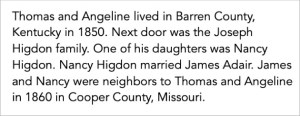
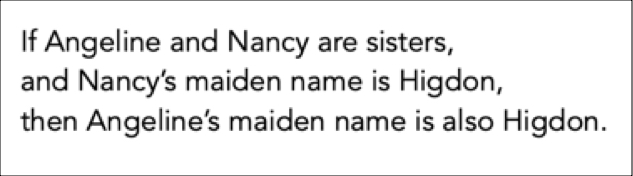
  • Syllogisms: uses if-then statements (if this is true then that must be true), useful in proof arguments and case studies that depend on indirect or conflicting evidence.

IfThen

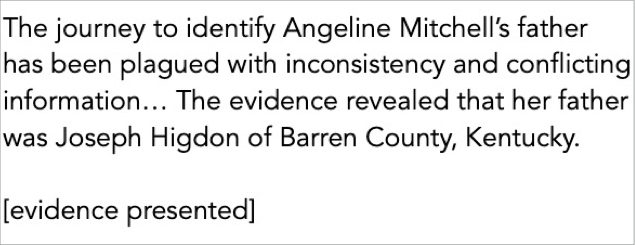
  • Mystery-Style: built by asking the research question first and then making the reader wait until the end before revealing the answer, all of the evidence pieces building suspense along the way.

1mystery

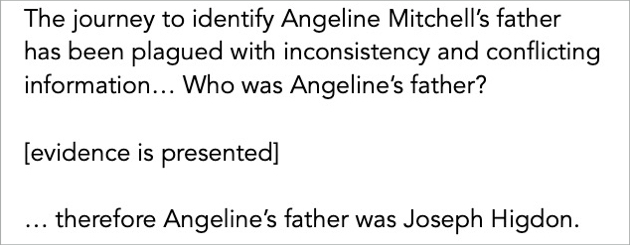
  • Flashback-Style: asking and answering the research question upfront and then leading the reader through the evidence to the conclusion.

flashback

It isn’t always clear when you begin writing which pattern you should use. Especially with today’s cut and paste capabilities, you can play with the writing pattern quite easily. A word to the wise: make sure you save an original and various copies before you start playing! I’m never one to discredit those who use paper over the computer screen. Consider cutting (with scissors!) sections of your writing apart and physically rearranging them on a table to give you a visual idea of what these various writing patterns might look like. This may not work as well with syllogisms, but this can definitely work when determining between mystery, flashback, or building blocks.

I find this part of the writing process to be fun, much like rearranging quilt blocks to get different patterns. Some patterns will “look” better than others. Have your writing buddy give you their opinion on which pattern to use. But most of all, do it.


1. I don’t address all writing patterns here so pick up a copy of the book and give it a read.

Writing: What’s Your Type?

When you are working on a project, it may not be clear as to what type of writing project you may end up with. There are a lot of options, anywhere from a one-page anecdote to a how-to article, THE BOOK. Here are some types of projects you might consider when working with various aspects of your research.

  • Anecdotal or Memoir-Style: short, possibly entertaining or thought-provoking tales that capture a moment or a lesson learned. I think of these as short snippets, one page or less. For example, I had the opportunity to informally interview my grandma and two of her friends when they came to visit me in Colorado. I asked about their experiences during the Great Depression in northwest Ohio. The piece was called “Losing at Euchre to Win at Genealogy” and here are a few excerpts:

“All three of them agreed that they didn’t notice the depression much. They all lived on farms that were mainly self-sustaining. They do not recall having many struggles. They just figured out how to live with what they had…

“All three of them remembered that they had a “school dress,” usually just one that they would have to change out of when they got home to save it for the next day. They received a lot of hand-me-downs for their clothes and they remember hand-making the blankets they used…

“There were big gardens on their farms; all of their food was grown at home. They canned everything to stock up for the winter. They also raised cows and pigs for meat…

“One thing they all agreed on was that they played a lot of cards growing up. Besides being fun, it is free…”

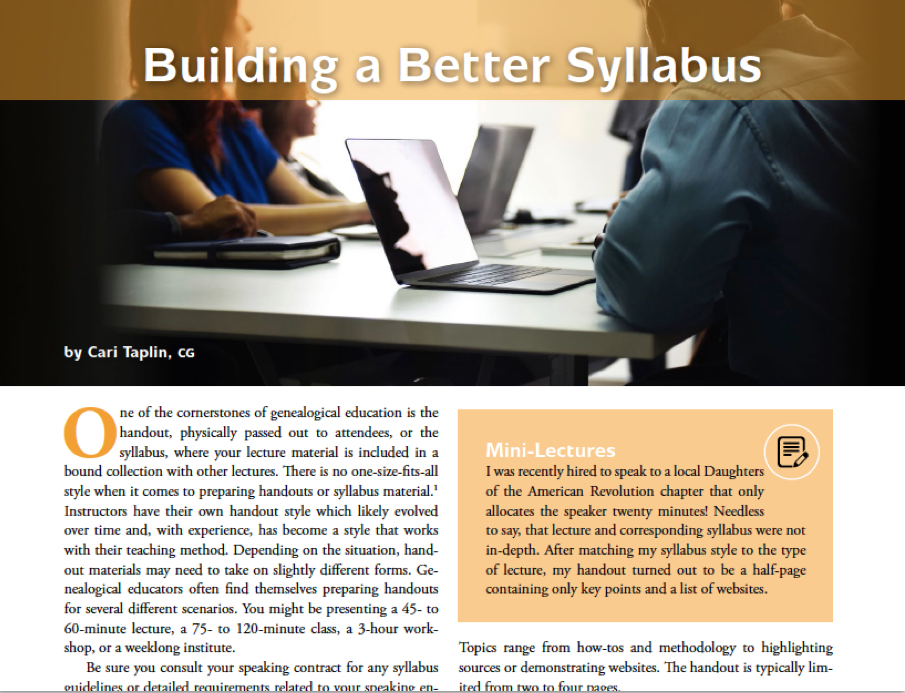
  • How-To Articles: Did you discover an interesting set of records? In your quest to break down a brick wall, did you do so in an interesting or inventive way? Did you learn a lesson that you think others might benefit from hearing about? If so, consider writing an article to share your experience. After spending years as a student and an instructor, I had formed some ideas and opinions about good and bad syllabus material and wrote an article that was published in the December 2018 issue of the Association of Professional Genealogists Quarterly:

build a better syllabus

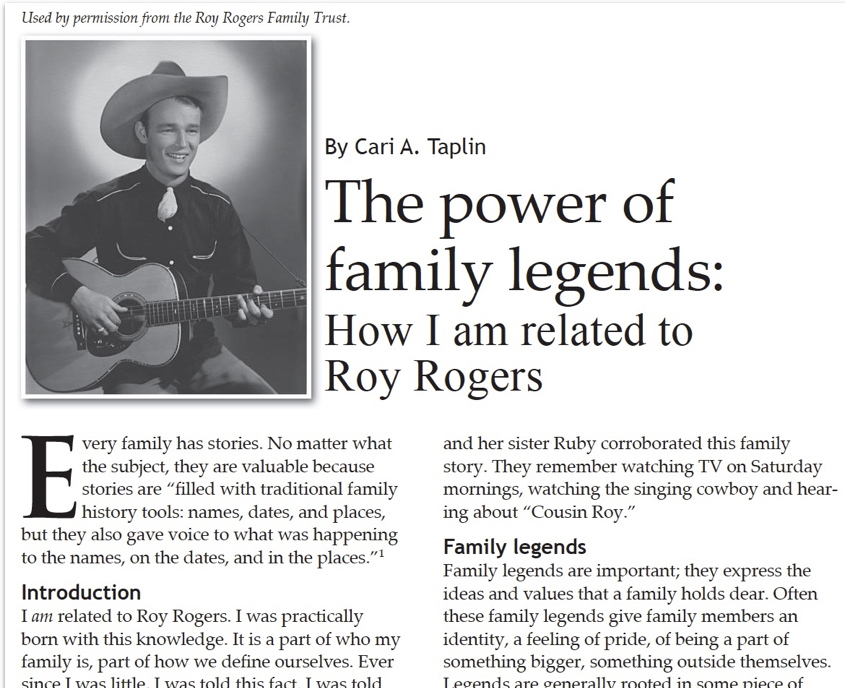
  • Genealogical Stories or Biographical Sketches: Maybe you have a fun genealogical story to tell that could also be turned into a teaching moment. This may be similar to anecdotal writing but typically longer. I shared the experience I had in researching a family legend which was published in the National Genealogical Society publication, the NGS Magazine in the Jan-Mar 2011 issue:

Roy Rogers

  • Case Studies: These usually consist of pulling together indirect and conflicting evidence to make an argument when no direct evidence exists. This type of writing is most often found in the National Genealogical Society Quarterly.
  • The Book: This is the decades-long project to pull together all of your research regarding a particular family line or group into a large tome. These books can be quite useful when found on a library shelf. Just be sure to include citations!

I hope the breakdown of some options gives you some ideas for future writing. Not everything we do will fit into a case study, or we figured something out in a really cool way and want to share how we did it. Whatever you decide to do, please do it. But also please send it somewhere to be published. There are options from the small local society journals all the way up to the large national magazine, and points in between.

Writing: Stay Focused!

Spread the like and love! #WhowearsthegenealogypantsWho among us genealogists doesn’t struggle with maintaining focus? We all know too well about finding a tantalizing record that sends us down a road that we find ourselves still traveling at 3 a.m. Lack of focus can happen in the writing aspect as well. Distractions are often procrastination in disguise, particularly if you find writing difficult. We will always find something to keep us from writing. Procrastination feeds writer’s block and forms a cycle that is hard to break. Below are a few of my tips for maintaining focus when writing.

When it comes to writing, time management is going to be your biggest asset for maintaining focus when writing. Try some of the following:

  • Set a daily or weekly goal. Try a target number of words per day or a number of pages.
  • Set a timer. Determine how many minutes you can work without interruption. I like to work for 50 minutes and then spend 10 minutes taking a break or doing another task such as folding laundry.
  • Set a daily focus. Maybe today you are going to only work on a certain topic such as those land records or wills you just haven’t taken the time to transcribe. Or maybe you’ll work on fixing up your citations. Or changing your passive voice (to be verbs) to active voice. Having one focus boosts progress.
  • Turn off interruptions. Turn off your phone or better yet put it in another room. Shut down your email program. Take off your smartwatch. Shut off the electronic doorbell. Whatever you’ve got that can interrupt you, shut it down. At least for the 50 minutes that you’ll be writing.
  • Schedule your time. And stick to your schedule. Find a consistent time in your schedule that you can dedicate to writing and give yourself PERMISSION to stick to that time. Set an appointment in your calendar. You are just as important as everything else in your calendar (if not more so).

When we allow ourselves to work on our own projects, and we make progress, it refills
us and gives us some of our passion for the project back. When I think about all of the
things I’m not getting done, it really weighs me down and takes away some of my enthusiasm. I find when I set aside time, and stick to my schedule, my energy, passion, and enthusiasm “bucket” gets refilled and I’m much happier.

I hope you’ll give it a try!

Writing: Can You Self-Edit?

I don’t know about you, but when I read someone else’s writing, I nearly always find something to correct or suggest, from small typos to major sentence-rewrites. But when it comes to my own writing, I can put the dumbest things into writing and be completely blind to it! Again, from the smallest typos (I still mess up it’s and its when I’m not actively thinking about it) to the largest errors. (I once had to write a paper about artists’ manifestos and literally wrote “The communists wrote a manifesto, Karl Marx wrote a manifesto…” Yeah, I did.)

So, my question to you is, can you self-edit? I think it is the absolute hardest thing to do when it comes to writing. If you’re a long-time reader, you’ve probably found typos and errors in my writing, simply because I can’t self-edit. So, here are some things I’ve come to do when a project gets down to the nitty-gritty and really needs to be polished.

Find a writing buddy or willing proofreader –– This is usually my husband and he
usually doesn’t have a lot of choice in the matter. (Love you, hun.) He proofreads all of my syllabi and articles before they go out. And the things he finds! Woah. I sound a lot correcting-1870721_1280more intelligent after he’s given these things a read. So find someone who is willing to do that for you. You can find another writer and trade. With the internet, email, video calls, screen-sharing, and so on, you don’t need to be in the same region to do this. If you’ve connected with a like-minded person you get along with at a conference, build up a relationship and become writing buddies.

Read your writing out loud –– Nothing will bring your poor sentence structure to light than reading it out loud to your cat (or dog). For some reason, when you hear what you’ve written, it becomes a lot more obvious when you’ve written something a bit wonky. If you don’t have a buddy or your buddy isn’t available, give this technique a try. It works very well for me.

Do some reading –– This might sound strange, but they say the best writers are also avid readers. Reading someone else’s work gives your mind ideas on how to write sentences, how to string the words together in an elegant way, and gives your brain a break from “output” and instead engages in “input” while also engaging in the craft of wordsmithing.

Use some resources –– I have three books I couldn’t say enough about when it comes to
self-editing. When I’m not sure how to handle a writing situation these books come to my rescue:

  • Chicago Manual of Style (we’re on version 17 right now). I have the hardback but I also purchased the online subscription because you can do a quick search by topic online. However, I do like to browse the book as well. (I’m nerdy that way.)
  • Strunk and White’s The Elements of Style, a nice quick read on usage and grammar which can really tighten up your writing.
  • Edit Yourself by Bruce Ross-Larson, which is similar to Strunk and White but gives some comparison examples along the lines of “if you wrote this, try this instead” all throughout the book. It also focuses on using more direct or clearer writing.

If you struggle with self-editing like I do, I hope you’ll give these things a try. Writing up what we’ve researched is such an important step. Don’t let the editing get in the way!