What I Don’t Know, Part 7: Dimick’s Land in Hardin County

Similar to what I demonstrated in the last post regarding the Scroggins family land, I did a similar search for the Dimick family in Hardin County. Jeduthan and his wife Mary purchased land from the Federal government and the transaction is recorded at the General Land Office website:


2014-03-31 05.42.06 pm2014-03-31 05.44.20 pm

Jeduthan’s land was purchased in 1834. He died in 1837. Mary’s land was purchased in 1838, a year after his death. If you examine where each parcel of land was located you might notice something interesting. The entries in this database tell you where the land was located with what looks like a secret code. Jeduthan’s land is described as: NE1/4 of the NW1/4 in Township 12 South, Range 8 East in Section 32. Mary’s land is described as: E1/2 of the SW1/4 in Township 29, Range 8 East in Section 29.

Every township is numbered in the same way, beginning from the upper right corner of the township, moving to the left (west), then down and across to the right (east) and so forth. Each township is 1 square mile and consists of 36 sections or 36 square miles. If you examine Jeduthan and Mary’s land purchases on a map, they line up more or less like this:
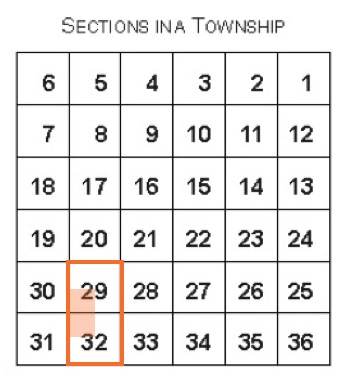
2014-03-31 06.20.12 pmOk, the above map is not to scale but I know that the land they purchased lined up and gave the family a large farm. How does their land location compare to the Scroggins family? Using the GLO site’s map feature and Photoshop, I layered the two maps to line them up:
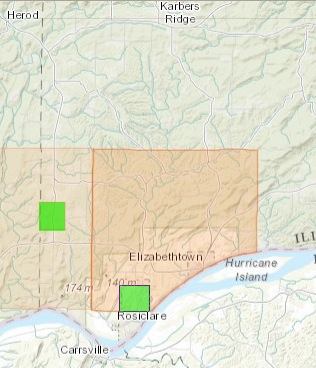
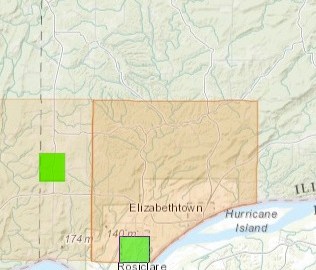
2014-03-31 09.39.29 pmSanders Scroggins land is within the green square on the left of the screen and Jeduthan and Mary Dimick’s land is within the square on the right. The families lived fairly close to one another, possibly attended the same church, social gatherings, or perhaps did business in the town of Rosiclare or Elizabethtown.

Using land records puts the families in a time and place and in relation to each other. By doing this exercise, you can see how your ancestors may have interacted or maybe determine if you are even working with the correct ancestors. If they lived too far apart, it might be a case of mistaken identity. However with names like Sanders Scroggins and Jeduthan Dimick, I think I’ve got the right men.

In the next several posts I will follow these men in vital, military and other records that are available online.

What I Don’t Know, Part 6: Scroggins’ Land in Hardin County

After reviewing the census and getting at least a beginning framework for the families I’m researching, I like to turn to land records and maps. This allows me to put the people in a physical location, and in relation to each other.

Illinois is a public land state meaning their lands were surveyed using the rectangular system. For my search I used two online databases to help locate the Scroggins and Dimick families:

These two databases seem to index the same information, however, you may find that one site is easier to use than the other. The GLO site has the advantage of having maps and original documents attached to the entries. Regardless of which site you use, always use the information to locate your research subjects on a map.

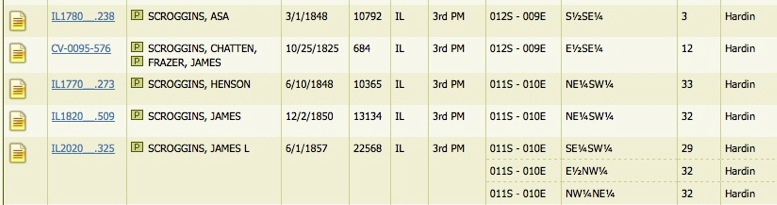
Beginning with the GLO records I found several Scroggins entries in Hardin County, Illinois.

2014-03-31 02.41.06 pm
Sanders Scroggins bought land with two other men in 1851.
2014-03-31 02.40.52 pm
Many men with the surname “Scroggins” obtained land from the federal government, including Chatten Scroggins in 1825.
2014-03-31 02.44.48 pm
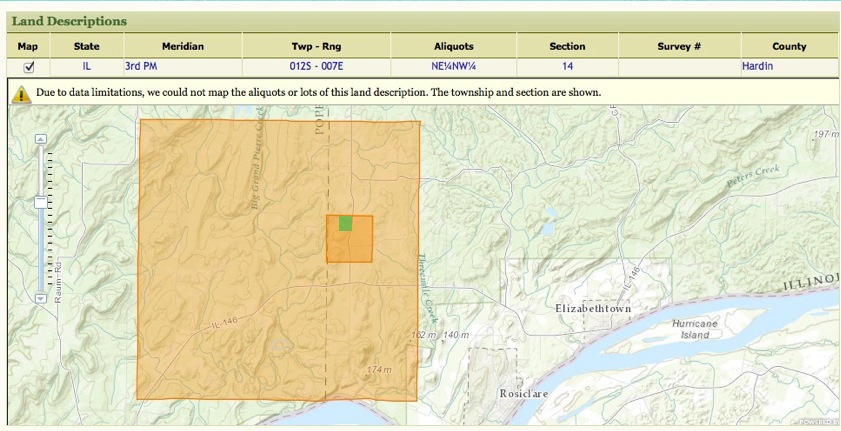
In 1855 Sanders Scroggins obtains more land.

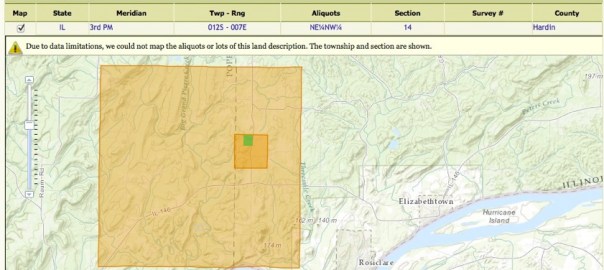
The area in green is where Sanders Scroggins 1855 land is located. (This map can be obtained at the GLO database site.)

2014-03-31 02.57.27 pm
The land is located northwest of Elizabethtown and Rosiclare.

I won’t bore you with all of the maps for all of the land transactions described above, but take a look for yourself if you wish. The GLO database is a rich treasure chest of information. You can find the original land patents and maps showing their locations.

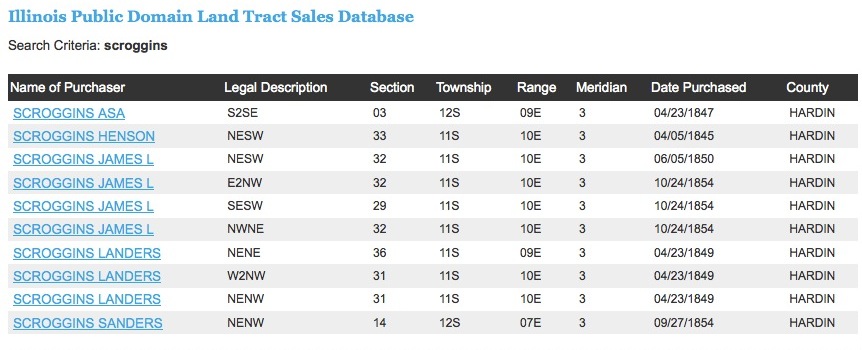
The Illinois State Archives has an index of their Public Domain Land Sales. When searching for “Scroggins” I found the following entries:

2014-03-31 03.01.46 pmOften a capitalized “S” can look like a capitalized “L” so I am willing to bet that all of those “Landers” Scroggins are really Sanders’ land purchases. The Illinois Archive does not have digitized copies of the originals, instead you will get a transcription.

The next post will discuss the Dimick family’s entries and how the two families relate to each other on a map.

What I Don’t Know, Part 5: Census Records

Once I have oriented myself with the geography of a new research area, I generally begin looking for my research subjects in the census. I will start with what I know. Usually it’s that they died in a location, so working back to the census year just before their death date, I will locate them and then work backward. This constructs the family group(s) giving a rough skeleton to their familial framework. Census records can contain many errors but I find they are a great tool to get started and create a sketch of the family structure, often for several generations.

In the case of Jeduthan Dimick, I knew from his biographical sketch in the compiled genealogy that he died in 1839 in Pope County, Illinois. Using census indexes at Ancestry.com I located Jeduthan and his household in the 1830 census in Hardin County, Illinois.

2014-03-30 10.43.06 pmAny census before 1850 consists of the name of the head of household and then hash marks for the rest of the family members broken down by age and sex. The household for Jeduthan consisted of:

Jeduthan Dimick household analysis:
Males under 19 = 3       (possibly Fayette, Mary? and Franklin)
Males 40-49 = 1             (Jeduthan)
Females under 19 = 1    (Sarah)
Females 40-49 = 1         (wife Mary)

This is probably Jeduthan, his wife, 3 sons and 1 daughter, but we can’t be sure with no names to identify them by. However, according to the compiled genealogy I started with, Jeduthan had 2 sons and 2 daughters. It is possible the census taker counted one of the girls (Mary) as a boy, it is impossible to know, but I am fairly certain this is the right family since no other “Jeduthan Dimicks” showed up in the searches.

Chatten Scroggins, Sanders’ father, also shows up in the 1830 census, in Gallatin County, Illinois. If you remember my earlier discussion on geography, Hardin County was formed from part of Gallatin County, so we are looking at a nearby location to the Dimick family.

2014-03-30 10.48.57 pmChatten’s household consisted of:

Chattan Scroggins household analysis:
Males under 19 = 5         (John, James Lewis, Sanders and two unknown boys)
Males 40-49 = 1               (Chatten)
Females under 19 = 3     (Mary and 2 unknown girls)
Females 40-49 = 1           (wife Elizabeth)

This family probably consisted of Chatten’s wife, 5 sons and 3 daughters. Again, the children don’t exactly line up with what is indicated by the compiled genealogies but no other “Chatten Scroggins” showed up in my searches.

I did a similar search for the 1840 census, but knowing that Jeduthan Dimick died in 1839, it was difficult to locate the rest of the family in 1840. Likely they lived with friends or relatives in 1840 while they were getting their living arrangements in order. Since the 1840 census lists only the head of household, it is difficult to know right now where they are in the census.

The Scroggins household is located in the Gallatin County census enumeration. Sanders has moved into his own household and is living next door to his father’s home. He has only one female of about his age living with him, likely his first wife, and no children are living with him.

This is just the first step with the census records. I conducted this research through the 1870 census for the purposes of the program I put together. I would normally follow as many family members as possible through the 1940 census. I also found the families in the Illinois State Censuses that were available. Going through the census records, I was able to put the family groups together in time, place and relationship. This beginning work then allowed me to move on to other records and resources.

What I Don’t Know, Part 4: Understanding Geography

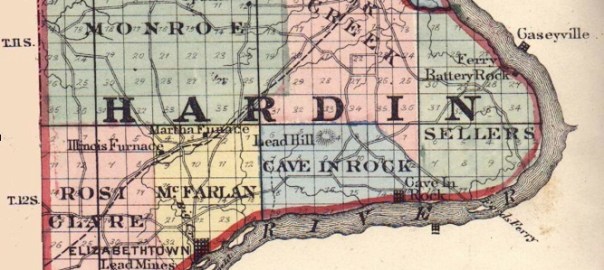
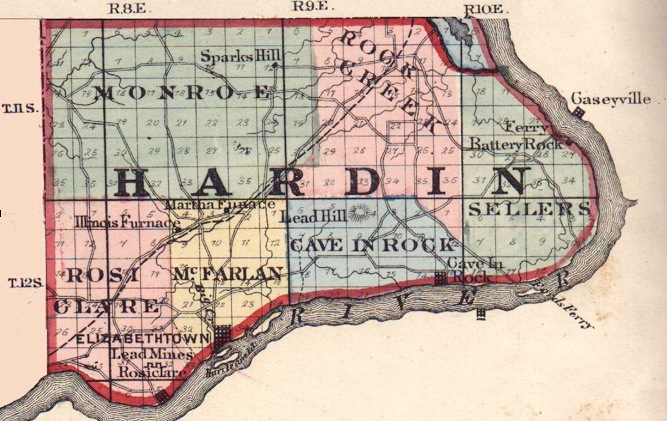
2014-03-30 10.20.28 pmWhen you begin any new project, you need to understand the geography of the area you are researching. It is possible that it’s an entirely new location, an unfamiliar county or state, and understanding where you are researching can have a profound effect on who you are researching.

My first step is usually to Google the county. I look at it on a map, I look at its entry in Wikipedia and I’ll look at the FamilySearch Wiki to see what’s been written about it. I will do a quick scan of the Ancestry.com card catalog and the Family History Library catalog to see in general what holdings and databases they have available. I will also see if there are any local genealogical societies, historical societies, libraries, archives, courthouses, and so forth. In essence, I create my own locality guide.

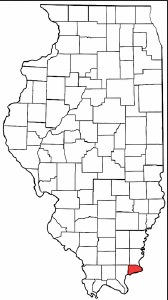
2014-03-30 10.29.08 pmSanders Scroggins and Sarah Dimick lived in Hardin and Gallatin Counties which are in the southern tip of Illinois along the Ohio river. Hardin County was created out of Gallatin County, so some of the records I might need may be in one or the other of those counties. When you are researching a new area, be sure to learn about county formation and boundary changes. Locate a county history to learn more. These are readily available through Google Books, FamilySearch Books, Internet Archive, Hathi Trust or sometimes through local library, university or historical society websites.

The History of Hardin County, Illinois was very helpful in understanding the migration to and from this county on the Ohio River. The area was largely settled by people moving from Tennessee and Kentucky, mostly Irish. Some English and French settlers arrived early on before moving farther west. The book also contains some information on the first pioneers, agriculture, Ohio River transportation, and much more.

Familiarizing yourself with the geography of a new area can help you understand where records might be located and how the people may have traveled. This is an essential first step when undertaking any research in an unfamiliar area.

What I Don’t Know, Part 3: Start with what you know

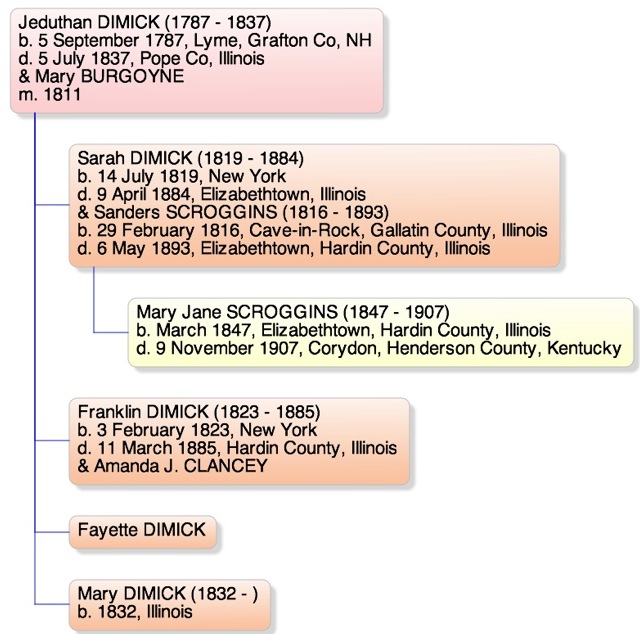
From the compiled genealogies I mentioned in the previous post, I compiled the following data:

  • Jeduthan Dimick, 1787-1837 m. Mary Burgoyne
    daughter Sarah Dimick, 1819-1884, m. Sanders Scroggins (she was his second wife)
    Franklin Dimick, 1823-1885, m. Amanda Clancey
    2 other children: Fayette and Mary
2014-03-30 09.40.22 pm
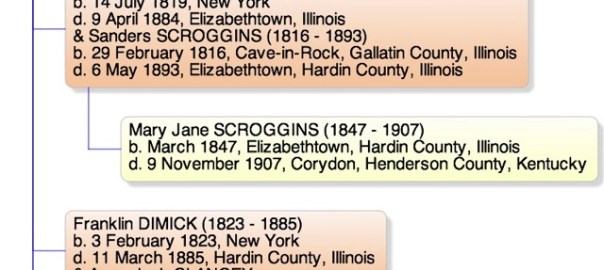
A graphic depiction of Jeduthan Dimick’s family
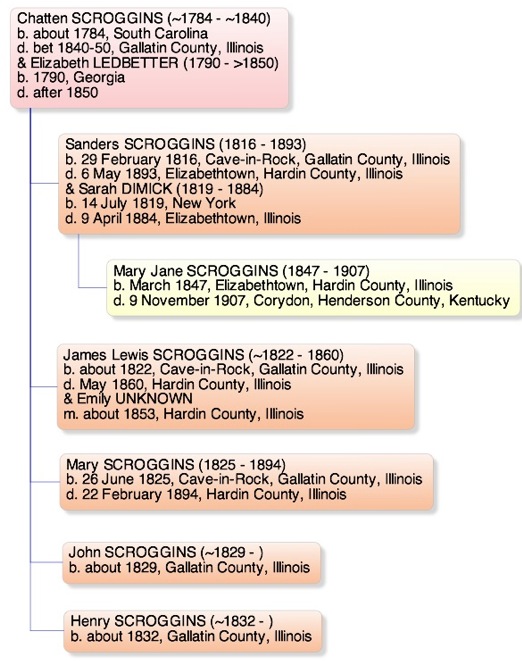
  • Chatten Scroggins, c. 1787 – bet. 1840&50, m. Elizabeth Ledbetter, 1790-aft. 1850
    Son Sanders Scroggins, 1816-1893, m. Sarah Dimick (his second wife)
    other children: James Lewis, Mary, John, Henry
A graphic depiction of the Scroggins family.
A graphic depiction of the Scroggins family

So, this was what I had to work with to begin my research. The next several posts will go into detail the geography of the area, record types searched, websites used and more.


What I Don’t Know, Part 2: Undocumented Family Histories

I needed an Illinois family to research, quickly. I had less than a month to put together a program all about Illinois research. I knew VERY LITTLE about Illinois research. (I am still baffled that I pulled off the program.) Most of my research experience is in Ohio, Michigan, Minnesota, Colorado, Missouri and New Hampshire, with a smattering of stops in other states. I pulled up my database and searched for any individuals who had “IL” or “Illinois” in any of their fields. I found four. 4! Yikes.

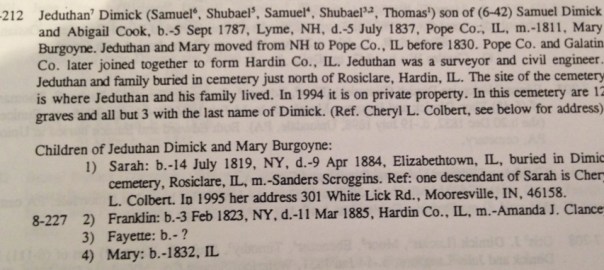
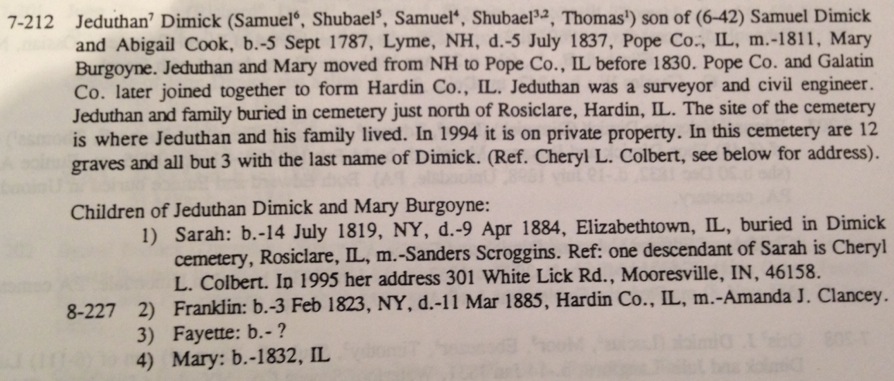
It turns out one of those four is a surname I’ve done quite a bit of research on: Dimick. However, this line of the Dimicks is a collateral line that I have spent no time researching until now. The only information I had was from an undocumented (no sources given) compiled genealogy from Dr. Alan Dimick. He has compiled an impressive amount of research on all of the known Dimicks in this country since the 1600s. However, there are very few sources (a few names of contributors now and then) so I can’t be sure how accurate it is. I actually find this situation to be a lot of fun. A compiled genealogy is full of clues and breadcrumbs to be followed. I personally love working with them.

A quick look at the entry for Jeduthan Dimick's family.
A quick look at the entry for Jeduthan Dimick’s family.

The entry in my database was for a daughter of Jeduthan Dimick, Sarah. Jeduthan is the cousin of my ancestor who moved to Ohio from New Hampshire. His daughter Sarah Dimick, according to this compiled genealogy, married a man named Sanders Scroggins. Sanders Scroggins. I’m sorry, but that name is so rare and odd that I had to take it on. There was also a compiled genealogy on the Scroggins family (the surname was more prevalent than I thought it would be) available online.

With these two compiled genealogies as a starting point, I was on my way. I spent the next couple of weeks learning as much as possible about the geographic area and the individuals as possible using the Internet. As any good researcher will do, I scoured the Internet from the comfort of my home office in my slippers, hot coffee in hand, and learned as much as possible before stepping foot outside and spending one dollar on gas or one minute driving to a repository.

What I Don’t Know, Part 1: Researching in a new area

2014-03-18 08.53.38 am

I know it has been quite some time since my last post. I don’t know if you noticed. It’s been almost 2 months! Well, I took a little break from the blog because some other projects landed on my desk. One of which is the topic of this next series of posts. I was compelled to volunteer for something, that had to be done within a month. I told myself, in order to get my portfolio done, I need to lay off the volunteering. But I did it anyway and I learned a few things along the way and I am able to use it as a sharing/teaching opportunity.

Maybe you are like me, one of those people who finds herself volunteering for things when she didn’t mean to. I have been taking part in a study group that focuses on mid-western research. The first year there were lectures on the various record types to be found in the area. The second year (this year) we’ve been hearing case studies from study group members, one per month on one of the states. It turned out that no one had volunteered to present a case for Illinois. The coordinator was threatening to either cancel or give everyone a homework assignment instead. I watched myself as I raised my hand and volunteered to present on Illinois. I don’t really have any research in Illinois! I had just a few collateral ancestors who I knew at least passed through Illinois but I had not done any research to speak of in the state up until last month.

The next series of posts will demonstrate all of the research points I didn’t know but figured out in about 2 weeks from the comfort of home. This series will show just how much can be done from home using Internet sources and Google searches. It will also demonstrate that not EVERYTHING is on the Internet. There are many records I need to order and more I still need to find. Having very little knowledge of Illinois research when I began the project, I was able to put together an hour-long presentation that shared a good rough biographical sketch of two families that intersected in Southern Illinois, the Scroggins and Dimicks of Hardin and Gallatin Counties.

Love and Marriage and Death – And Suicide

Sadly, some couples find their lives too difficult to continue living, for a variety of reasons. This phenomenon of the suicide pact is not new. The couple below were engaged to be married yet decided to commit suicide by strychnine ingestion:

Salem Star-Journal, Salem, Ohio, 30 October 1903, p1.
Salem Daily News, Salem, Ohio, 2 Jun 1891, p1.

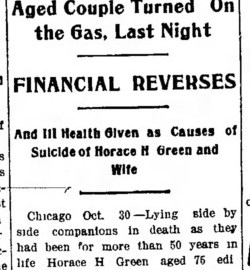
Suicide pacts are not just for the young. The following older couple decided to commit suicide together because of financial difficulties and ailing health.

Sandusky Star-Journal, 30 October 1903, p1.
Sandusky Star-Journal, Sandusky, Ohio, 30 October 1903, p1.

Probably the most tragic are the murder-suicide incidents. This young man felt that he would never be enough to marry the girl he loved and was so distraught that he felt that the only solution was to kill her and then himself.

The Marion Star, Marion, Ohio, 9 May 1894, p1.

Sometimes love is so strong and so mind-bending that logical and clear thought seems to escape some. Of course we can’t know for sure what was going on for these couples but their love tied them together even to death.


Love and Marriage and Death – Dying together

I don’t know about you, but it seems like there are a lot of couples who die very closely together. It could be coincidence, it could be they were both equally unhealthy at the end, it could be just my romantic notion that sometimes people are just so in love that they can’t live without each other. Who knows, but here is another example:

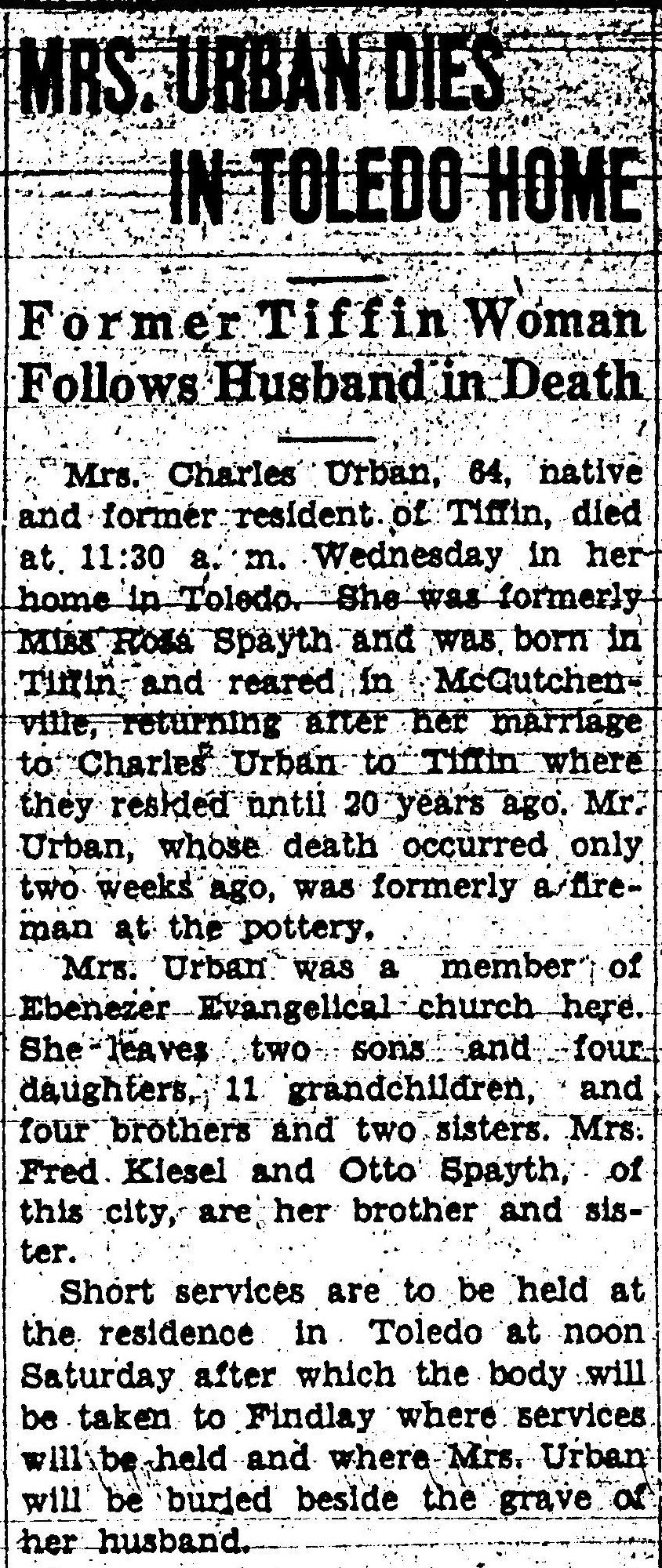
Charles Urban died just two weeks before his wife of 30 years:

Urban_Rosa-obit
Mrs. Charles Urban obituary, Advertiser-Tribune, Tiffin, Ohio, 3 Aug 1933, p5 c7.

Love and Marriage and Death – S. C. Dimick

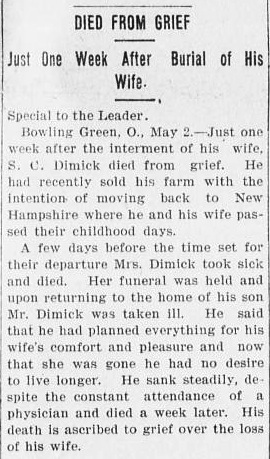
The Marietta (Ohio) Daily Leader, 3 May 1901, p.3.

Samuel Cook Dimick moved to Wood County, Ohio from Lyme, New Hampshire in the 1870s. He married his wife, Mary Marshall in Lyme in 1860 and they spent the next 41 years building a life together. Their family only brought them 2 children, both sons, one who sadly died at age 19. Mary died at the end of April 1901. According to Samuel’s obituary he died just one week later: “He said that he had planned everything for his wife’s comfort and pleasure and now that she was gone he had no desire to live longer.”