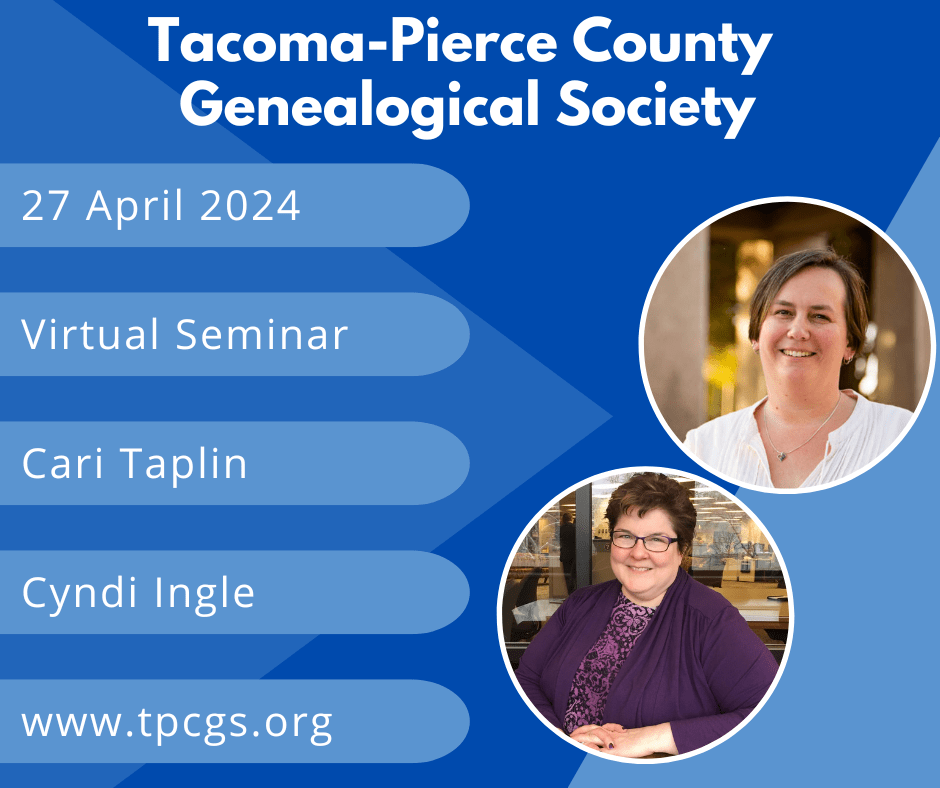
Coming up at the end of April, an all day seminar with Cyndi Ingle (of Cyndi’s List) and myself hosted by the Tacoma-Pierce County Genealogical Society. This is a VIRTUAL seminar so you can join us from the comfort of your own home! There will be two lectures by each of us.
Cyndi’s Topics:
Smarter Searching: Refining Search Parameters for Genealogists
Off the Shelf: The Unexplored Potential for eBooks in Genealogy
Cari’s Topics:
Using Timelines to Analyze Your Research
The Heart of it All: A New Hampshire to Ohio Migration Case Study
Seminar Schedule – Pacific Time, so convert for your time zone:
One of the topics I’ll be teaching in our “Not Just Farmers” course at GRIP Genealogy Institute is on ranching. both cattle and sheep. We really want to cover as many agricultural pursuits as possible, and ranching and farming are interconnected.
One topic I’ll be discussing is “Texas Fever,” and unlike “gold fever” “Texas Fever” was a bad thing.
St. Louis Globe-Democrat, 28 August 1855
“Texas Fever,” or “Texian Fever” as the above article called it, sometimes also called “Spanish Fever” was a disease that Texas cattle carried. They thought the disease was tick-borne and spread in southern cattle because the weather was not cold enough to kill the ticks or disease. The cattle would carry this disease on the long cattle drives to the north. Reports in newspapers in towns all along the famous cattle drive trails reported on this disease. The Texas cattle seemed to be immune to it but when they intermingled with other breeds in the north, the northern cattle died from it, causing farmers and ranchers to lose thousands of dollars in their businesses and livelihoods.
The problem was so harmful to northern herds that vigilante groups took action on their own until laws were passed to stop the importation of Texas cattle. A law was passed in Missouri 1855 that made it illegal to bring diseased cattle into the state with a penalty of a fine and killing of the cattle.1 In 1861, another Missouri law was passed attempting to control Texas Fever. The law appointed “three competent and discreet persons” in each township to serve as cattle inspectors with the power to “examine all Texas, Mexican, or Indian stock” driven into the township. They could order the owner to removed the cattle and if the owner did not comply, they could call the sheriff to kill the cattle.2
Cattle tick fever is still a problem. “The pathogens that cause Texas cattle fever are transmitted from infected to non-infected cattle by two closely related tick species known as ‘cattle fever ticks.’ There are no vaccines or drugs available to prevent or cure Texas cattle fever.”3
1. Revised Statutes of Missouri, 1855, Volume 2 (Jefferson City, Missouri: 1856), 1104. ↩ 2. Laws of the State of Missouri Passed at the Regular Session of the 21st General Assembly (Jefferson City, Missouri: 1861), 26. ↩ 3. See “Eradicating Cattle Fever Ticks” from Texas A&M.]↩
Hello friends. You may have noticed (or maybe not) that my blog went a bit silent there for a bit. That’s because I’ve been in writing overdrive preparing for my newest course “Not Just Farmers: Records, Relationships, and the Reality of Their Lives” that will occur at the NGS GRIP Genealogy Institute (formerly the Genealogical Institute of Pittsburgh), virtually, June 23-28., 2024. Registration is now open. Of course, I’m not the only instructor. I am being joined by Cyndi Ingle and Paula Stuart-Warren as well.
I get tired of hearing genealogists of all kinds say “oh my ancestors weren’t that _____ (interesting, important, etc.) because they were ‘just farmers.'” There is a commonly held belief that they did not lead interesting or important lives, and that they just didn’t leave many records. So, this course is designed to defy all of those misconceptions. There is nothing more important than providing food and other necessary supplies to your family and community.
The focus of our course is on North American farming and agricultural ancestors and their families. The course will dispel the myth that our ancestors are “just farmers” without a rich and documented life. Farmers have often been dismissed by the assumption that there is not much to find or to learn about their lives and the issues they faced. The variety of records–often underused or undiscovered–give depth and breadth to the lives of our ancestors. Understanding the history of farming and learning about the unique records of the people, products, and land, will give a deeper picture of what hearty families we descend from. Students will build an “agricultural profile” for their farming ancestors by the end of the week. This profile can help to craft a robust background of their “just farmer” ancestors.
My Grandpa Karl Miller on His Tractor
The full breakdown of the courses and who will be teaching those can be seen on the GRIP website. My topics include:
Inventions and Ingenuity: Advancement in Farming Over Time
Get Along, Little Doggy! The Agricultural Contributions of Ranches
Historical Side-Hustles: Other Income Streams of Our Farming Ancestors
Farming Outside the Law: Squatters, Tax-Evaders, and Bootleggers
Female Farmers: Women’s Issues in Agricultural Families
Taking Care of the Farmers: Social Programs Benefitting Our Farming Ancestors
A Case Study – Building Your Ancestor’s Agricultural Profile
I am going to share tidbits that I’ve been writing and collecting for this course on my blog over the next several months. So, break out your bibbed-overalls and work boots, and hang on to the tractor’s steering wheel and let’s go for a hay ride through farming lives and their records. (Did I get enough farming metaphors in there?)
It’s that time of year again where we think about the past year and plan for the next. 2023 had its ups and downs, but I’m looking forward to 2024 and have a lot of plans, both personally and professionally. Here’s just a few things going on for me in 2024. Some of them you can join along with me!
NGSQ Study groups are starting up again. Cyndi Ingle (of Cyndi’s List) and I each run two groups. We read an NGSQ article and discuss it each month, and we come up with unique discussion questions to lead us through some of the important points of each article. This is one of my favorite activities each month. No matter if I “liked” an article or not, I ALWAYS learn something I can use in my own research and writing. Two of the four groups still have space. Check out the details and register here.
I hosted a writer’s group last year as a trial. It went really well so I am doing it again this year. This is a working group, participation is required. But we go over different aspects of writing and then trade pieces with a different partner each month to give/get feedback. It was very helpful for me and I heard the same from other participants last year. If you want to do more writing in 2024, consider joining this group.
Cyndi will be leading the Mastering Genealogical Proof and Mastering Genealogical Documentation groups this year. These are study groups based off of the books by Dr. Thomas W. Jones and are fundamental for any genealogist looking to advance their knowledge and skill. Consider one or both if you want to up your game this year.
I will be attending SLIG this year and am looking forward to taking one of the courses that has been on my list for several years: Course 3: Exploring Their Life: The Social History of Your Family with Gena Philibert-Ortega.
I have several online webinars planned for the year and more to come. You can follow my speaking schedule here.
I am also working on a couple of projects I hope to get published so stay tuned about those!
I hope you have some great plans for 2024, especially as it pertains to your genealogical education and practice.
Cyndi and I have finalized our plans for 2024 and wanted to share the schedule with you.
2024 NGSQ with Mastering Genealogical Proof Principles – There are four session times to choose from (limit of 25 per session). This course runs for 11 months (January – November) and we study one National Genealogical Society Quarterly (NGSQ) issue per month. Due to copyright, we cannot provide copies of the articles. You need to be a member of NGS or be able to make copies at a local public library. We read the articles ahead of students and create a list of unique questions for each article to discuss along with some standard questions we ask of all NGSQ articles. We don’t have the article list yet, but will post it as soon as it is available.
Writer’s Workshop Group 2024 – This writing group will work together to improve a piece of your own writing over 8 months (we January through August). The meeting times will be on usually the third Thursday of the month at 7 pm Eastern. Our overall focus will be genealogical writing. We will be mostly focusing on writing aspects but will also touch on genealogical issues such as meeting the Genealogical Proof Standard (GPS), looking at Genealogical Standards that are relevant to writing, and using citations. This is a participation required group. We will work on a piece of writing over the 8 months. You will be paired up each month with a partner to give feedback on that month’s topic. Participation is a must, and if you are looking for a hands-on writing group, this may be the one for you!
Mastering Genealogical Proof (MGP) – a seven-week beginning principles course. There will be two sessions, Wednesday daytime at 3pm Eastern and Saturdays at 1pm Eastern (so adjust for your time zone). This is for those who have never studied this book before. We will be studying this from a beginner or slightly intermediate level. If you’ve done one of these groups before and want a refresher, that’s ok too! We will take 25 students in each class. This year, all classes will be taught by Cyndi Ingle. This is for those who have never studied this book before. We will be studying this from a beginner or slightly intermediate level. If you’ve done one of these groups before and want a refresher, that’s ok too! We will take 25 students in each class.
2024 Dates for MGP:
Wednesdays, February 7 – March 20 – Noon Pacific/3 pm Eastern
Saturdays, February 10 – March 23 – 10 am Pacific/1 pm Eastern
Wednesdays, August 7 – September 18 – Noon Pacific/3 pm Eastern
Saturdays, August 10 – September 21 – 10 am Pacific/1 pm Eastern
Registration will open 4-6 weeks before the class begins.
Mastering Genealogical Documentation (MGD) – a seven-Week beginning principles course – There will be two sessions: Wednesday daytime at 3pm Eastern, and Saturdays at 1pm Eastern (so adjust for your time zone). Each class will be about an hour. This is for those who have never studied this book before. We will be studying this from a beginner or slightly intermediate level. It is recommended that you have studied the book Mastering Genealogical Proof, but not a requirement for taking this class. If you’ve done one of these groups before and want a refresher, that’s ok too! We will take 25 students in each class.
2024 Dates for MGD:
Wednesdays, February 7 – March 20 – Noon Pacific/3 pm Eastern – Coming Soon
Saturdays, February 10 – March 23 – 10 am Pacific/1 pm Eastern – Coming Soon
Wednesdays, August 7 – September 18 – Noon Pacific/3 pm Eastern
Saturdays, August 10 – September 21 – 10 am Pacific/1 pm Eastern
Registration will open 4-6 weeks before the class begins.
Visit the Classes and Study Groups page at any time for most recent information. We hope to see you throughout the year!
Birdie was a dear friend and my genealogy mentor. She was a special person, just always making you feel welcome, seen, heard, validated, and like your ideas matter. When she died in 2010, I was devastated, and I know many others were too. It’s not everyday that a Birdie comes along, takes you under your wing, makes you laugh, and gives you a career path you hadn’t considered. I would not be a professional genealogist today if it weren’t for Birdie. I owe her so much.
After he passing, a fund was created in her honor that had three parts: a sponsored lecture at the NGS conference, a volunteer of the year award, and an scholarship to attend IGHR (the Institute for Genealogy and Historical Research). The fund has since been closed. However, IGHR wanted to revive the scholarship in Birdie’s name and offered to hold and administer the funds if I would help coordinate it and help find donors. Of course, I said yes. If one more person can benefit from Birdie’s influence, then it is worth it! Birdie was the one to first encourage me to attend IGHR.
IGHR will accept donations (tax-deductible) for the Birdie scholarship and they will collect applications for those who wish to apply for it.
Please feel free to share this information with your societies and genealogical friends, either to help get donations but also to let students know about the scholarship opportunity. I would appreciate it and I know Birdie would be so pleased to have students attending IGHR. She was an ardent supporter of high-quality education and I’m so happy to help fellow genealogists attend as well.
When you are starting to work on a more difficult research problem, beyond the collection phase, you’ll want to make more directed, pointed, plans for your research. Here are the steps I take to plan research:
Think about your research question. Clear it up if it isn’t already clear. Who exactly are you trying to identify? Have you singled out a unique person in time and place? Don’t make it too complicated or to simple. There is a Goldilocks effect when it comes to a research question, one that is “just right.”
I catalog my starting point information. During this process, I reevaluate what I have. Many times this is research I haven’t looked at for a long time. Are the assumptions I’ve made sound and based on documents? Is my starting point information actually correct and known to be for the right individual? Are there any conflicts in the starting information? I write all of this down, usually in bullet points. If there are a lot of conflicts, they may get their own section. Sometimes (often?) I find some kind of mistake I made in my reasoning, often because I didn’t know then what I know now. I have more experience and knowledge now and sometimes that breaks through a brick wall all by itself.
I make a list of what I need to do to resolve anything from step 2. If there are conflicts, can I give sound reasoning as to why they may exist? If not, what additional research do I need to do to resolve them? If I made an incorrect assumption, what do I need to do to correct it?
You’ll notice that everything above is not even planning the RESEARCH yet!
I survey the records that are available (both online and off) that may answer my research question. I utilize the catalogs available on websites such as Ancestry, FamilySearch, and local public libraries, archives, universities, and etc. as it applies to the topic or the location I’m working in. From that research, I may make a larger list, but I truly start with a top 3-5 items. Invariably, you’re going to find something that changes the course of your research. Spending too much time creating an extensive and detailed plan will likely be a waste of time.
Conduct the research! This is the fun part. Look at what you planned on looking at. Note why you are looking at it (purpose of search) and what you found. Collect any URLs, waypoints, download images, note any conflicts, note any negative findings, and note any changes in your plan or direction of your research.
Whether you are in collection mode or brick-wall mode, planning your research is an important part of being efficient with your research time. Hopefully you found some trips or tricks you can use from this series on how I do it. Everyone thinks and plans and organizes differently. So take what you think will work for you and go make it happen!
We looked at a blank example of my research PLOG template that I use in Evernote last time. You do not have to use Evernote to make something like this. You could use Word, Mac Pages, Google Docs, a spreadsheet, or any other note-taking tool of your choice. This is simply how I do it. Please adapt to find something that works for you and your way of thinking.
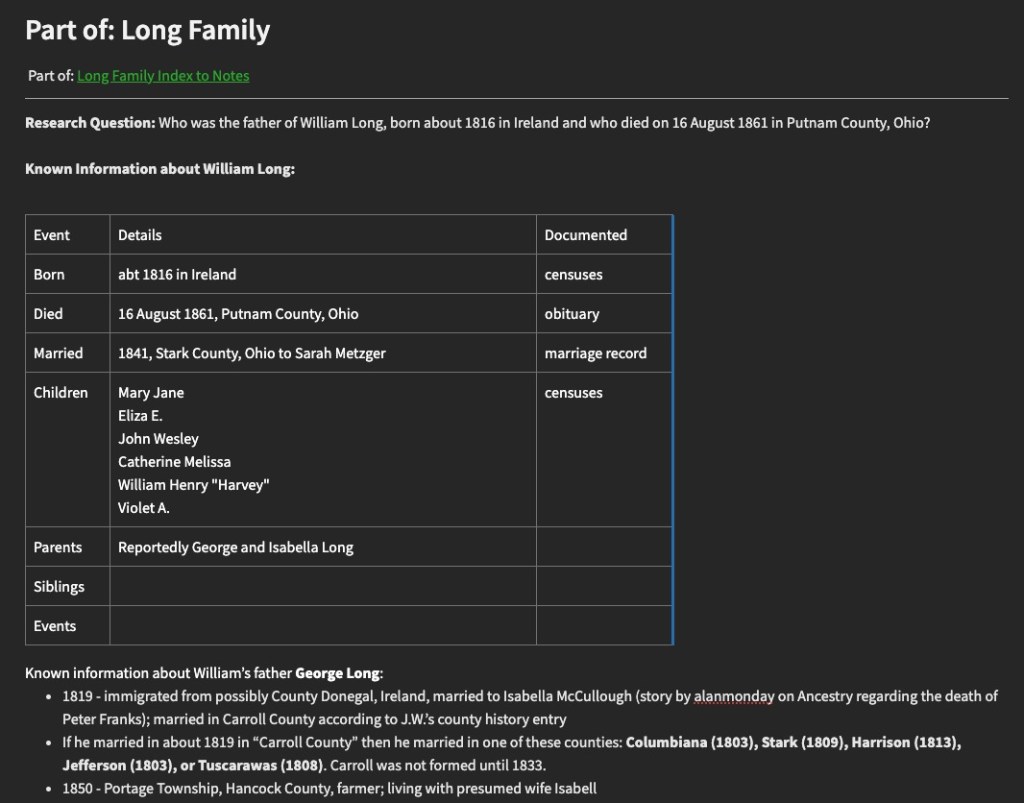
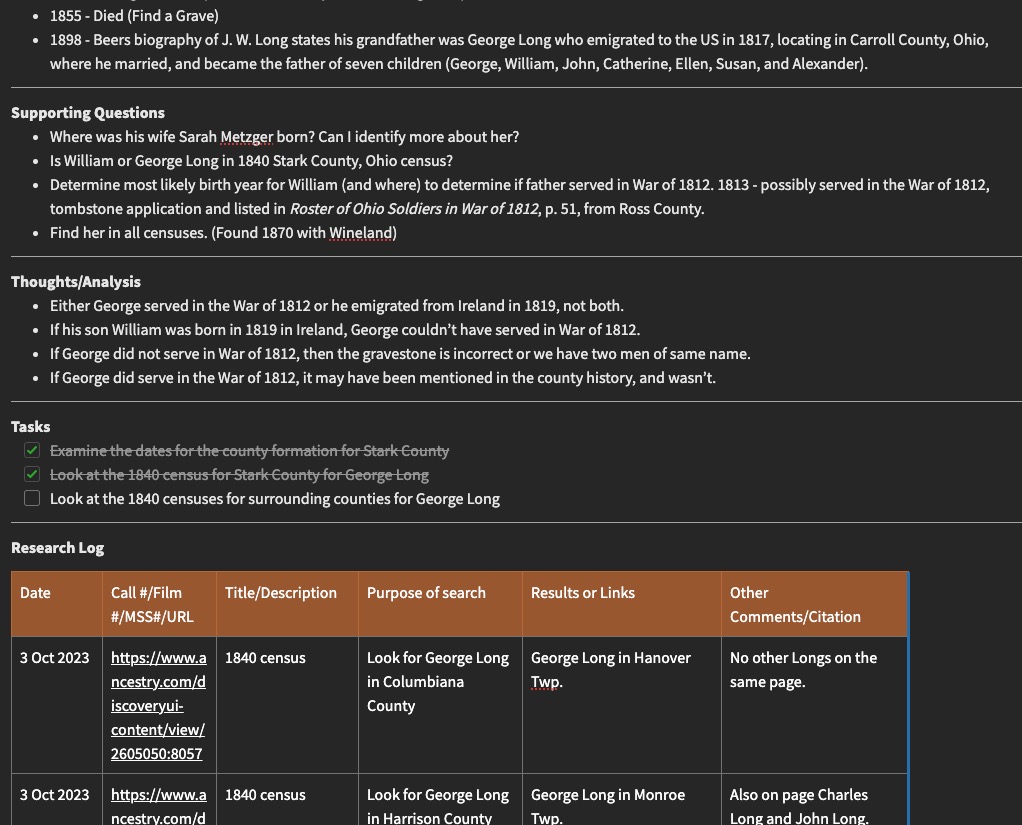
I am currently working on a project to identify the father of William Long who was born in about 1819 in Ireland and who married Sarah Metzger in Stark County, Ohio, in 1841, and died in Putnam County, Ohio, in 1861. I have only a name for his father “George Long.” The problem is, there are a lot of George Longs that could be the father of William. The son of William, John W. Long, has a biographical sketch in the Wood County, Ohio, county history that states that his grandfather was “George Long” and he “emigrated to the United States in 1817, locating in Carroll County, Ohio, where he was married and became the father of seven children: George, William, John, Catherine, Ellen, Susan, and Alexander.” There are a few problems with this, one of which is that Carroll County was not formed until 1833 from Columbiana (1803), Stark (1809), Harrison (1813), Jefferson (1803), or Tuscarawas (1808).
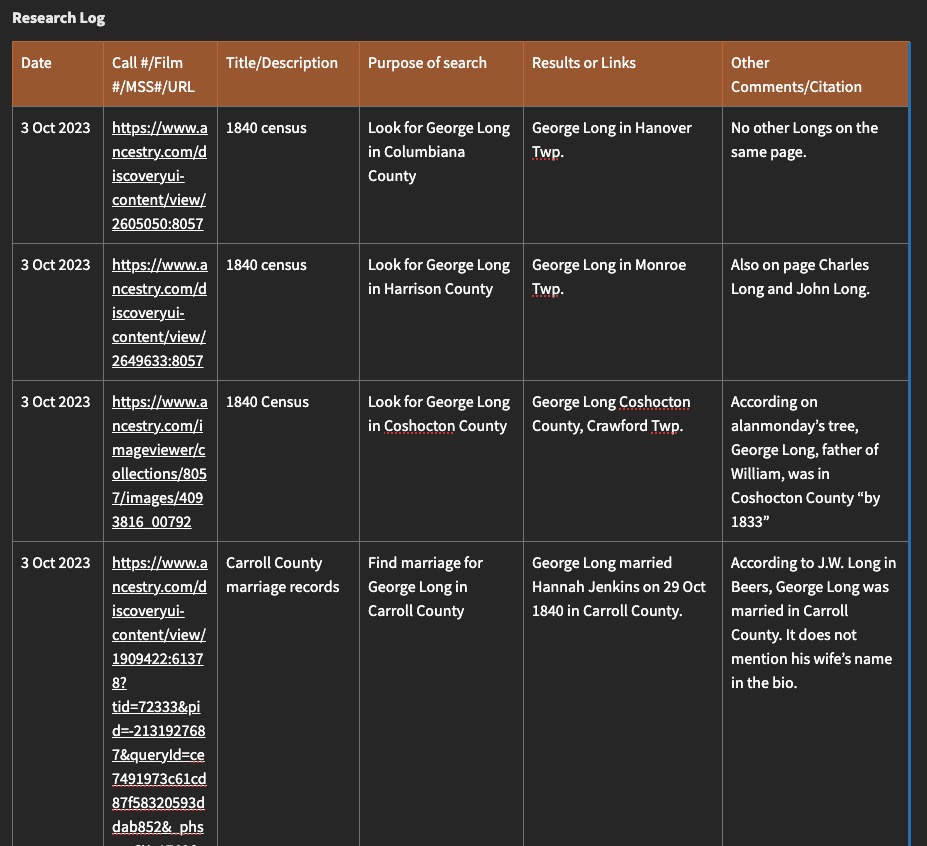
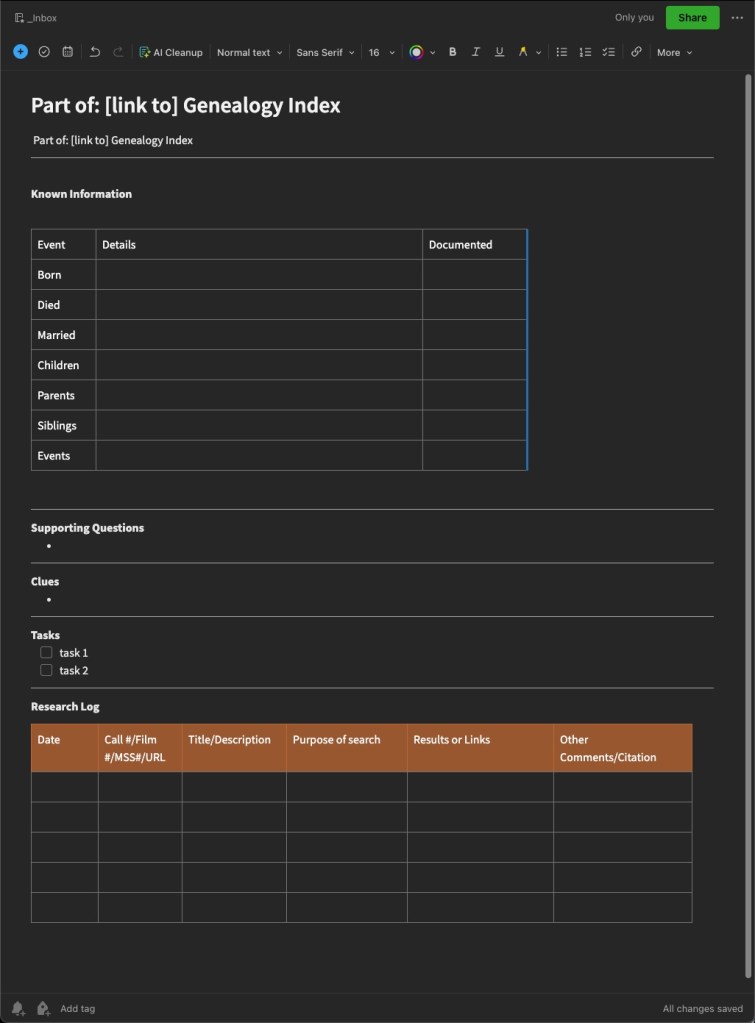
So, my research question is listed at the top of my “plog” template, followed by a cataloging of known information, supporting questions to answer, thoughts and analysis of the problem, some tasks, and then the research log portion of the template, which will get filled in as I complete the tasks.
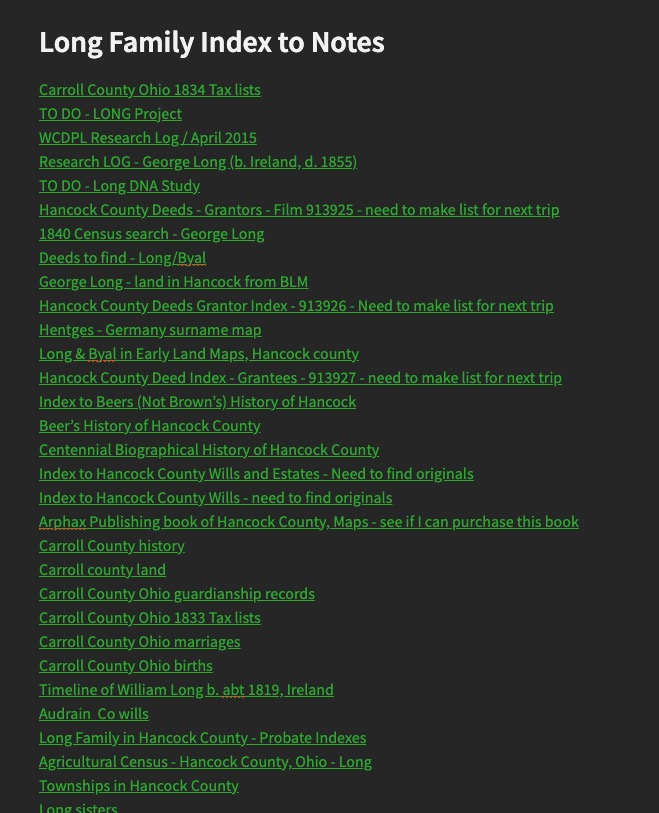
As you complete tasks, they often create more questions than they do answers. I document these in the last column and add things to the task list. Sometimes the template gets too long and too much scrolling needs to be done. One cool feature of Evernote is that you can link the notes together and essentially create an index where you can see all of your notes for one particular project in a list. Provided you titled your notes in a meaningful way, this will be great to get to notes quickly rather than scrolling through long notes. There are likely ways to do something similar in other programs.
So, that’s the mechanics of research “Plogs” and how I use them. The next post will have some final thoughts on research planning and logging in general, tips and tricks, etc.
Last time we looked at research planning for when you’re in the “collection” phase. Usually the collection phase happens when we are just starting out and gathering as much as we can on our ancestors, or it may happen when you are starting a new client project or a new project for yourself that you haven’t researched before. The collection phase is when you are gathering as much of the “low-hanging fruit” as you can, the easy to find documents and sources to advance your family trees.
What do you do when you get to a point of resistance, commonly called a “brick wall” in our field. We invariably get to a point where the low-hanging fruit doesn’t identify that next generation, for example, and we have to do some extra work to determine who the parents are. This is where we can really put our skills to the test, or learn new skills and methods if that is the case. Part of this is effective research planning.
I have an Evernote template that I use for more directed research. This same sort of “set up” will work in Word or Excel or your note-keeping tools of choice. The most important thing is that you figure out what works best for you, for your way of thinking, and how you view your findings.
My Evernote Research Plan/Log template.
I fashioned this template after one I found online, probably from Cyndi of Cyndi’s List (click here to see all her Evernote templates.) I almost always end up changing or adapting them to fit the needs of whatever I am working on. Do not try to shoehorn yourself into something that someone else created. If that doesn’t work for you, change it until it does. You can recreate something similar to mine, find one that works from Cyndi’s list, or create your own in Word, Excel, or the program of your choice.
When I set out to work on a “brick wall” in earnest, I will start one of these “plogs” to help me get myself and my thoughts organized, and ready for research. Next time, we will look at this template filled in for a project I am currently working on so you can see how I use it in actual practice.
In the previous post, I discussed two “phases” that I saw in myself in terms of my genealogical development. There is the “collection” phase where you are gathering the information for your family tree, perhaps regardless of a family line or specific problem. When I started out, I spent hours and hours at libraries and on websites gathering what I call the “low-hanging fruit” or the easier to find records for family groups and my direct line ancestors. Those records often include censuses, death certificates, obituaries, tombstone photos, etc. Depending on the area where your research is located, some of these may be easier than others.
In terms of research planning when working in the “collection” phase, when I was in this phase, things were a little bit different than they are now, but the planning portion is pretty much the same. The difference is in how we might access those records and collect them. I started research in 2000. Ancestry as a research website was in its early stages so a large portion of my early collecting was done at local public libraries, local cemeteries, the Family History Library, the local branch of the National Archives (where you could view the census on microfilm before it was digitized and available online).
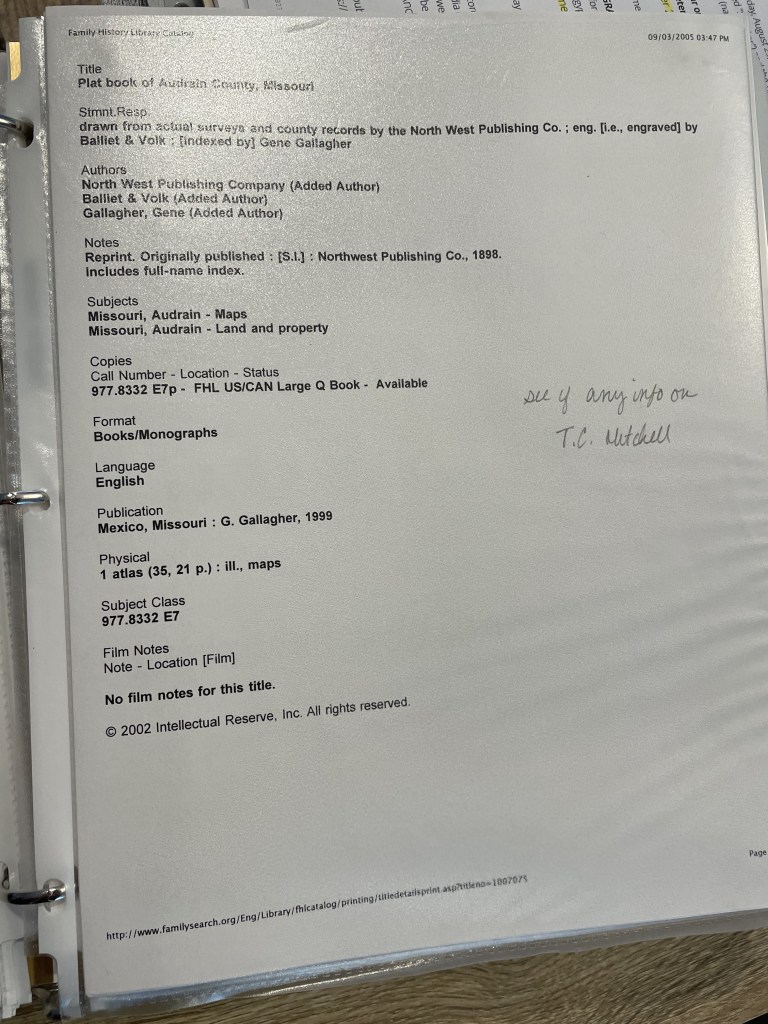
When preparing to visit any library, I visit that library’s catalog to determine what sources I plan to use to find records for my family tree. Remember, I’m in the “collection” phase here, so these will be a lot more broad-purpose searches. My tasks might be something like “find the obituary for Thomas Mitchell” or “Find Thomas Mitchell in the 1900 census.” When I started, I would print out that catalog item and put it in a sheet protector in a binder specific to that repository. Then, when I visited the repository, I used my binder as a guide or a to-do list and would complete each item. Back then, you made photo copies. We didn’t have scanning or photography (well not conveniently), when I started. I would tuck the photocopies into the sheet protector that contained the original catalog entry. Keeping the photocopy and the catalog entry together allowed me to go back later and create the citations for the items found.
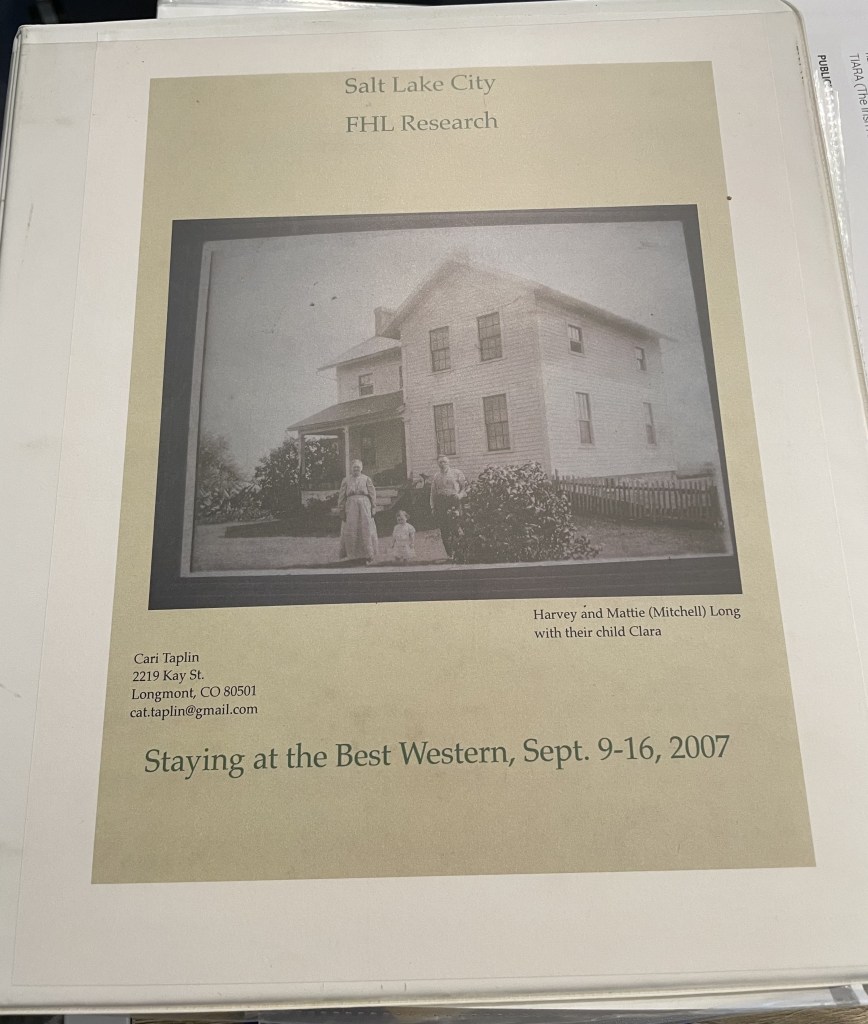
My binder from a 2007 trip to the Family History Library. I do not live at that address any longer.Print out of catalog page from the FamilySearch CatalogPrintouts of Items Found from the FamilySearch Catalog Entry Above, tucked into the sheet protector.
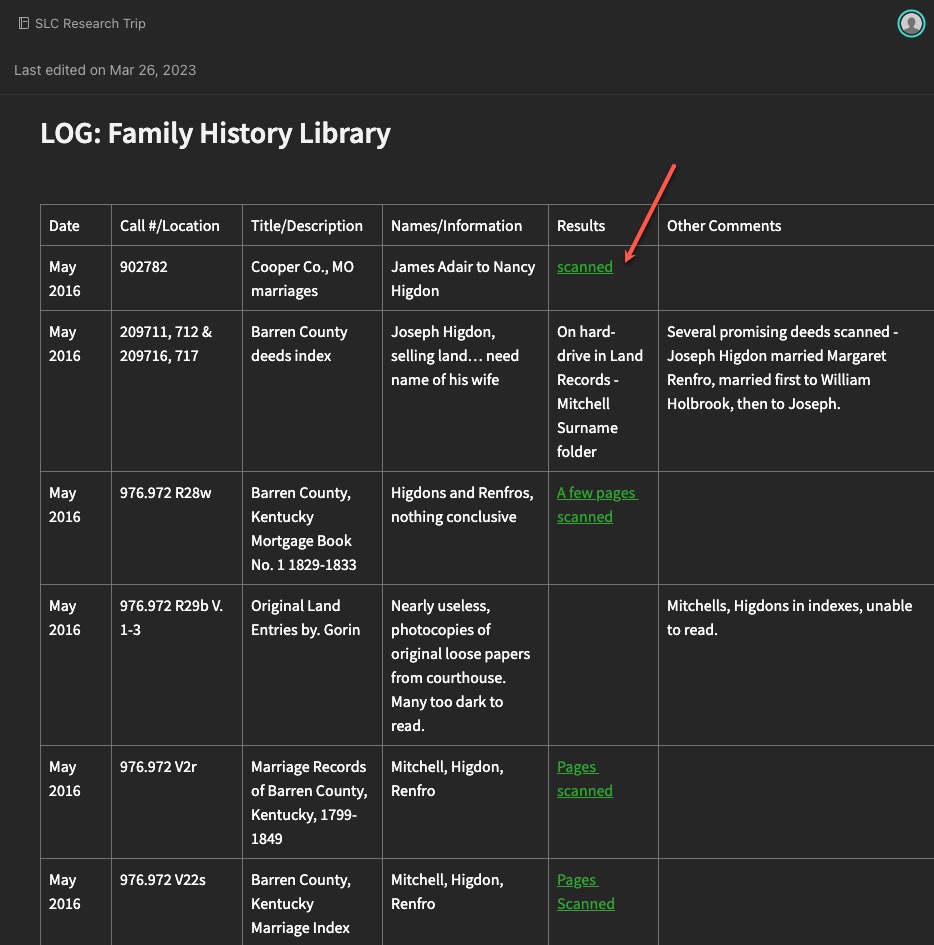
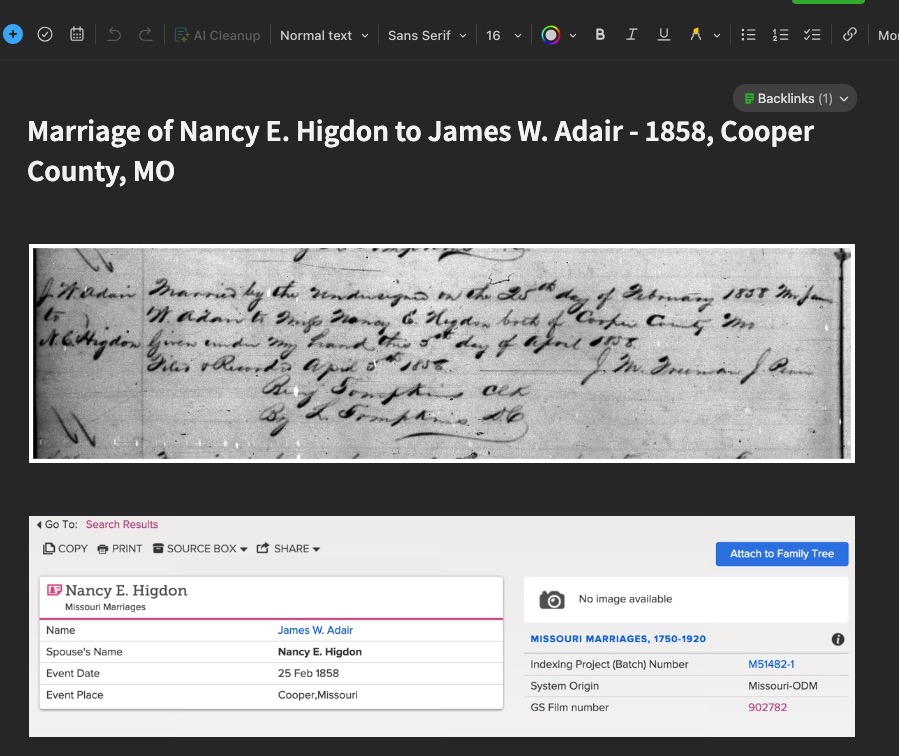
Ok, so that isn’t exactly the same system I used today when I’m “collecting.” I still visit the catalogs, but many items (not ALL) I’m looking for are now digitized and available online from home. So, my plan consists of a spreadsheet or Evernote note with links to databases, and the tasks, rather than a printout. If items are only available at the repository, I still copy the link into my plog, and then retrieve it next time I’m at that repository. I then collect my “copies” (scans or phone photos these days) and add them to Evernote where I can link them to the “plog.”
Evernote note showing a “collection” example with links to scanned items (red arrow).The scanned item from the “scanned” link above.
You might still like to have printouts. You might also prefer to only work in digital. And you might be a combination of both like I am. That doesn’t matter. What matters is that you have a system for keeping track of what you want to research, what you expect to (hope to) find in a particular source, and then what you found.
Next time, we will look at some examples of more directed research plogs based on specific research questions and projects.


 Genealogy Pants