
Tag Archives: research

Revisiting My Roots: A Case in Point

Several posts ago, I talked about how I “believed” others who had built the family tree before I started researching. I put a lot of “trust” out there.

“I believed everyone out there doing genealogy on the same families as me had been doing it longer and therefore must know more than I did, must have found the records already, and therefore their pedigrees, family group sheets, and trees posted online were correct.”

Well, I have just discovered an error that I’ve believed, and other genealogists before me had believed as well.

During my tree cleanup, I have recently been working on the Avery family. In one generation, the Averys and the Meekers lived next door to each other. From that, four Avery siblings married four Meeker siblings, creating a lot of chaos in my family tree. One generation down from this, I had another Avery marrying another Meeker. I hadn’t noticed before, because the Averys and Meekers are so intermingled. However, today, I noticed that this coupling was not in the right generation. I have in my tree, as many others do, that Mahlon I. Meeker married Pauline Avery. This would make these two first cousins. As I set out to research that, I could not find a marriage record for them, at a time when the marriage records exist and are pretty good.

So, I did a more global search for the Avery bride. I noticed a hint to another online tree that had the right groom, but the bride was Pauline Dunning, not Avery. At first, I thought this tree must be incorrect. So many trees have Pauline Avery as the wife of Mahlon I. Meeker. Well, I’ve learned that genealogy is not democracy, and just because there are so many “votes” for one thing does not make it true.

I reviewed the information I had that gave Pauline’s husband as Mahlon I. Meeker: they were all things from other researchers, not actual records. (See, I was believing them.) Then I reviewed the actual records I have. Pauline’s father’s obituary lists only “Polly deceased.” It does not give her a married name like her other siblings. Following the records for Mahlon I. Meeker, I do find a marriage record for him to Paulina Dunning. He is the correct Mahlon I. Meeker, but she was not the correct Paulina. I did consider that maybe Paulina was previously married before marrying Meeker, but I did not find that to be true. Mahlon’s wife’s maiden name was in fact Dunning and her parents have been identified; they are not Averys.

This was just the perfect situation to demonstrate why it is important to go back through your old research and clean it up. The good news, at least in this situation, is that both Mahlon and Paulina Avery are still in my tree, so I’m not lopping off an entire branch in this case.

Now on the hunt to find out what happened to the “real” Paulina.
Recertification: What is it? And What Did I Do?

Once you pass your first portfolio with the Board for Certification of Genealogists, you have to submit a project every five years that shows you are not only keeping up with your skills but also improving on any shortfalls they noted in your last portfolio. This time only one project is required at minimum, but it must meet the Genealogical Proof Standard.

My recertification project this time was to identify the father of William Long, my third great grandfather. I had one starting piece of information about William’s father. His William’s son, J. W. Long’s biographical sketch in the Wood County, Ohio, county history. The sketch claims that his grandfather, George Long, came from “North of Ireland” to Carroll County, Ohio, in 1817, married there, and then had several children named in the sketch: George, William, John, Catherine, Ellen, Susan, and Alexander. It does not name his grandmother, George’s wife.

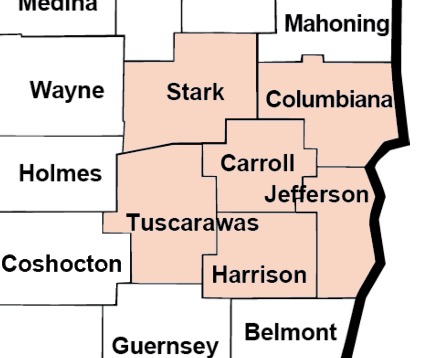
There are some problems with this statement, which I will breakdown over the course of this series. As I was researching this family, several things became clear to me. The first thing was that Carroll County did not exist in 1817. It was not formed until 1833 when it originated from land taken from five counties: Columbiana, Harrison, Jefferson, Stark, and Tuscarawas.1 When George Long arrived in “Carroll County” in 1817, it must have still been one of these other original counties.

This meant that I had to widen my search from one county to five or six, depending on the time frame.

If George arrived in Ohio in 1817, then surely he was enumerated in the 1820 census. Of the nine George Longs in Ohio in 1820, only two lived in one of the target counties: George Long in Salem Township, Columbiana County, and George Long in Brown Township, Stark County. A similar search in the 1830 census shows there were 22 households in Ohio headed by a man named George Long (or similar), four of whom were in a target county. Depending on what record sets I looked at, I found MANY George Longs in and about the correct area in 1820 to 1840.

I identified twelve (12!) candidates that could have fathered William Long. The main purpose of my project was to examine these twelve candidates and eliminate them until only one man made sense. Some were easy to eliminate, others were trickier. I will share some of my information organization tricks in the next post.


1. Acts of A General Nature Passed at the First Session of the Thirty First General Assembly of the State of Ohio (Columbus: State of Ohio, 1832), p. 8; image, Google Books (https://books.google.com/).

The Battle of the 12 George Longs

(The title is a Lord of the Rings/Hobbit reference in case you missed it. It made sense to me.)

I’ve mentioned a few times in past blog posts a project I’m working on to determine which George Long of the seemingly thousands in Ohio in the 1820s to 1830s is the George Long who died in Hancock County in 1855. I started working on this project as preparation for taking one of the Irish courses I’ve taken over the years… thinking I’d figure out how to get my George into Ireland. However, once I really got started, I realized I’d need to figure out WHICH George Long was even mine to begin with. And once I started analyzing things, I identified 12 George Longs who had even the slightest potential to be the right man. You have to eliminate those to be sure. The final element of the Genealogical Proof Standard is that you have to present your findings in writing, especially in tough cases that aren’t self-explanatory. If it isn’t in writing and accessible somewhere, it does no good to other researchers anyway.

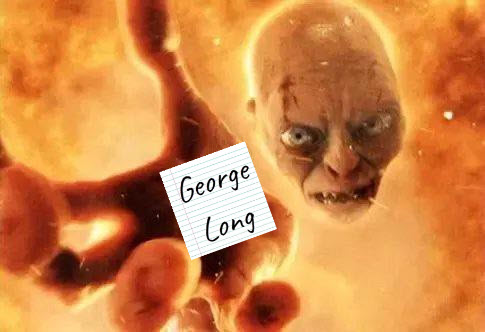
[Unless you are one of those people who love to find the answer and then hoard it for yourself (like Gollum). Don’t be Gollum. He nearly destroyed all of Middle Earth.]

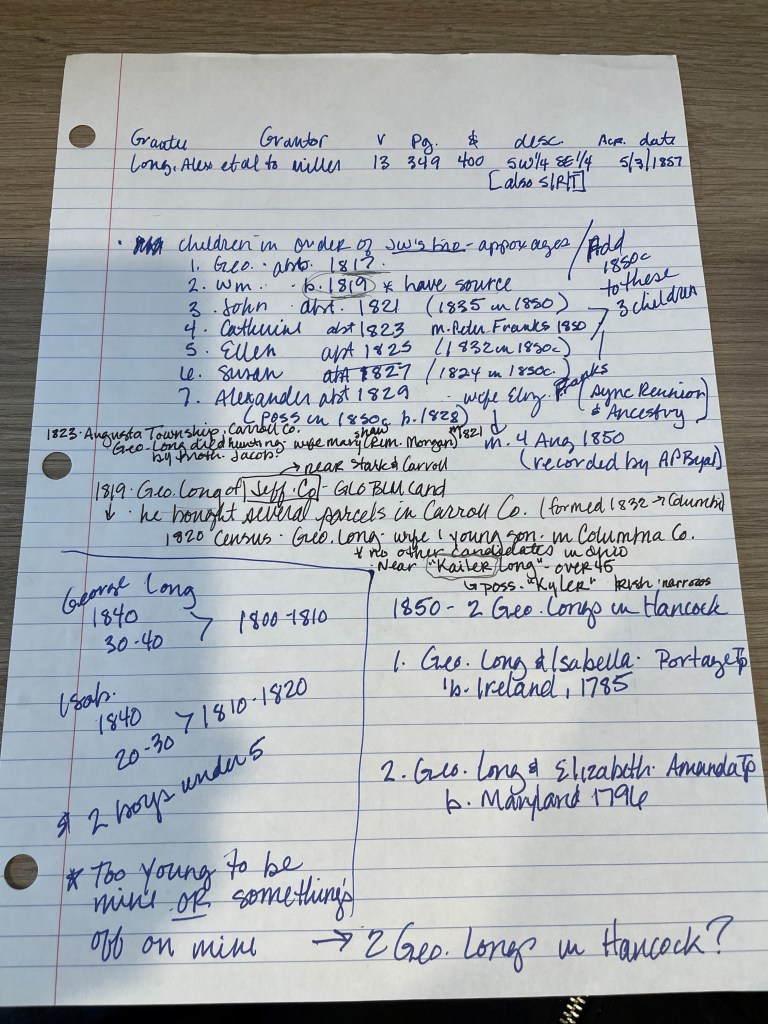
I am finishing up this project but ran across my early beginning notes, which are funny but also have part of the resolution I came to on them!

It was fun to look back at these scribbles once I’ve nearly finished and am confident in my findings. And it is good to know, even after this journey of identifying the correct George Long, that I was on the right track in the beginning.

This has been consuming my time over the past few months (along with my day job and my family), but I’ll be back to blogging more regularly (I hope) once I finalize this project and get it off my desk. In the meantime, happy scribbling!

Research “Plogs” – Get Started

Last time I discussed the “why” of using research research “plogs” (a combo plan/log). Now we will look at some of the “how” for creating a plog that will work for you. The first thing you’ll want to decide is how you’re going to create yours. I have ideas and suggestions, but ultimately, it will be up to you to decide what makes sense for your workflow.

Over the years, I have done this in many different formats. My first research plogs, were just logs (not plans), and were written on paper! I don’t have any of those old plans at my finger tips (if I even kept them at all) or I would should you a picture. You can find PDF forms that you can print and fill in if paper is the way you’d like to go. Check out this category on Cyndi’s List for some options.

Now I utilize digital options for my research plans/logs. The main advantage to this is that they are searchable. Once your plog gets lengthy, and you want to check something, being able to do a keyword search with the “find” option on the software you use is so valuable. The other advantage is that digital plogs can be mobile. If you’re using paper, you have to make sure you don’t forget it when you head off on a research trip. Whereas, depending on the software you use, it can be accessed via your laptop or mobile device if you’re syncing to the cloud.

Options for plogs:

  • Paper forms
  • Spreadsheets
  • Word processing documents or tables
  • Note-taking software, I use Evernote but others exist

The other aspect I want to share about how I use plogs in the setup stage, is by project. My plogs are based on one project, and those projects are based on a research question.

Early on, I made logs that had to do with a repository visit and nothing at all to do with a particular project, or even a surname. Those got very clunky and unwieldy and just not very usable. They were not organized in a logical way that I didn’t not really discover until later when I went to review what I had done for one particular surname or project.

So I evolved. And that’s what we do, right? We try things, make mistakes, make adjustments, and try again. I guarantee I will likely change how I use my research “plogs” in the future. But for now, they are working for me. We will dive into some in more detail next time and discuss their pros and cons for different types, styles, and versions.

Research Plans/Logs – Why?

When I was a “baby genealogist” I did not know about research plans or logs (I call them “Plogs” by the way) for quite some time. Then I heard someone discuss them (can’t recall exactly where or who, far too many years have passed) and I really tried to incorporate them into my research routine.

You know that phenomenon where you’ll hear about something but your brain isn’t ready to use it or understand it. And then you’ll hear the same thing years later and that “Ah ha! It makes so much sense now!” happens? That is what happened with me and research plans and logs.

Why should we even bother? They can be somewhat tedious and take up valuable research time!

Here are some of the reasons why I use research “Plogs”:

  1. I can avoid repeat searching. If we have limited research time, why waste it conducting a search we’ve already done?
  2. I can double check my previous search parameters to determine if I do need to repeat some searches. Databases change, we learn about new names or items to search for, etc. If we keep good notes about what we searched for before, we can determine if we DO need to search again.
  3. Plogs allow me to collect the data I need for creating citations.
  4. Plogs allow me to analyze information and evidence while I’m looking at it.
  5. I can put a “bookmark” in a research project if I keep good notes in my Plog.

In this series, we will look in-depth at how I use research plogs, my evolution using plogs over the years, some of my best tips, dos and don’ts, and ideas for effective, efficient research.

Having a Good Research Question

I know at the end of the last post I said I would next be talking about the Ancestry catalog. But as I started that, I felt like I needed to give a little background on why I’m even writing this series. I’ve probably talked about this before on this blog, but it is so important, that I’m going to say it again. Good research begins with a good research question. If you don’t know what you are looking for, how are you going to know when you find it?

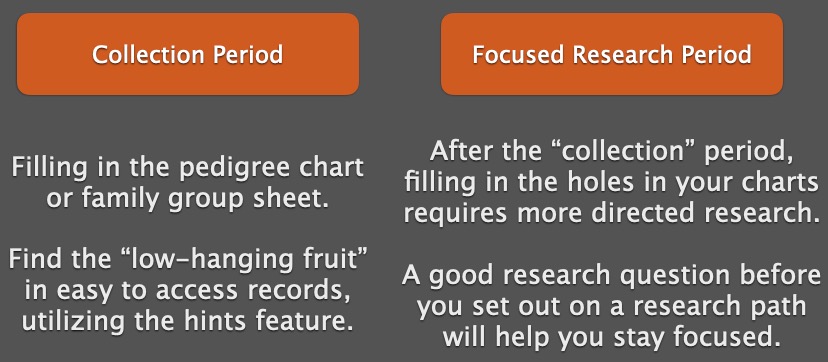
I talked previously in this series about the two phases I’ve seen and experienced throughout my genealogical lifespan, collecting and then focused research.

The two genealogical phases.

Having a good research question guides your research in the second phase. It helps tell you where to look for answers.

There’s a Goldilocks effect when it comes to research questions. They can be too broad, too narrow, or just right. And we aim for the “just right” question. The question needs to identify a unique person in time and place, and it needs to be answerable. For example:

Who were the parents of Thomas Carroll Mitchell who died in Montgomery County, Missouri on 29 April 1914?

This question identifies a unique person by giving a full name and death date and location. It says “I’m talking about this specific Thomas Mitchell, not the man of the same name who lived two counties over and died a year later.”

A question too broad will not give those details: Who was Thomas Mitchell? Who were Thomas Mitchell’s parents? When was Thomas Mitchell born? All these only provide a name, and not a full name (use it if you have it), and not location or dates. There are far too many Thomas Mitchells in the world for these to be useful questions. They do not give enough information to even know where to start.

A question too specific might be: What was Thomas Carroll Mitchell’s exact date of birth? Believe it or not, some people did not know their exact birth dates, or records may not have been left that provide that information. A better question might ask for “when was he born” which can be answered with a date range or a year only.

The “just right” question will give enough information to guide our research. Let’s look at the example above. From that question, we know where and when Thomas died. Likely we have a document (death certificate or burial records) that provided that information. Now, we can work backwards to try to identify his parents. We know he died in 1914, so one step in our research plan might be to find him in all of the censuses starting with 1910 in Montgomery County, Missouri, provided he didn’t recently move there.

Based on what you find in the censuses, you then decide where to go from there. Part of that is what I call “pre-research.” How do you know where to go to find the records you want to look at? Guess what. It’s the catalog.

Maps: Visualizing Your Ancestors – Types of Maps – Plat Maps

One type of map that can be helpful to pay attention to are boundary maps. I’m usually focusing at the county level. I have a couple of ancestors who were “border dwellers” meaning they lived on or near a county boundary. Sometimes I find records for them in one county, sometimes another. What is going on there? Did they move? Or did the county boundary change? OR, a third option, was the nearest courthouse in the next county over? Some court actions did not have to be in the county where a person lived so it may have been more convenient to go to a neighboring county to file that record.

I usually use a county map that is at least at the township level, and I typically use them in conjunction with a landowner map. You have to know where exactly in the county (and township) someone lived to understand if they moved or if the boundary changed.

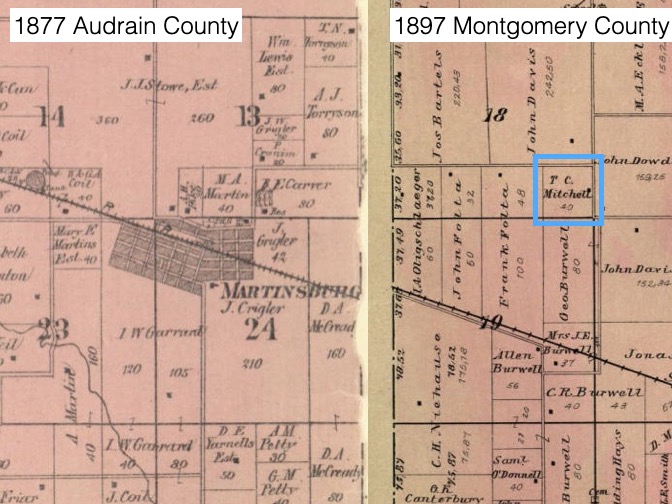
One of my favorite ancestors to research is Thomas C. Mitchell. After the Civil War, he lived in Montgomery County, Missouri, but right on the border with Audrain County.

Two landowner maps showing T.C. Mitchell’s proximity to the border.

Sometimes you cannot find a map for exactly the right time frame. Simply find the next closest and use that for your comparisons and analyses. In my example above, you can see the map on the left is from 1877 Audrain County and the map on the right is 1897 Montgomery County. I lined them up as best as I could using the train line as a guide.

These township maps show you the section numbers; Thomas lived in section 18 in that particular Township/Range. We know that each section is one square mile. That means that Thomas lived about 1.5 miles from the nearest town of Martinsburg. If he could do the business he needed to do, you can bet that he did it in Martinsburg. I have found many records for Thomas in Audrain County even though he lived in Montgomery County.

If your ancestor never moved but the county boundary changed, you have to look for records in both counties. The county clerks did not sit down and divvy up the records according to those that lived in the new county. They just kept the records in their original location. So, for border dwellers, always be checking nearby counties. A landowner and county boundary map can help you decide in which counties to look.

More map types next time…

Maps: Visualizing Your Ancestors – Types of Maps – Topographical

When it comes to understanding ancestral migration patterns, it really helps to look at a map. The reason an ancestor ended up in a certain location might be explained by geography, and more specifically, topography. Using a topological map can be quite helpful in understanding some of the potential “whys” for things our ancestors did.

Topography is “the arrangement of the natural and artificial physical features of an area.”1 Examining the physical features can explain a possible migration route or why they stayed in a particular location.

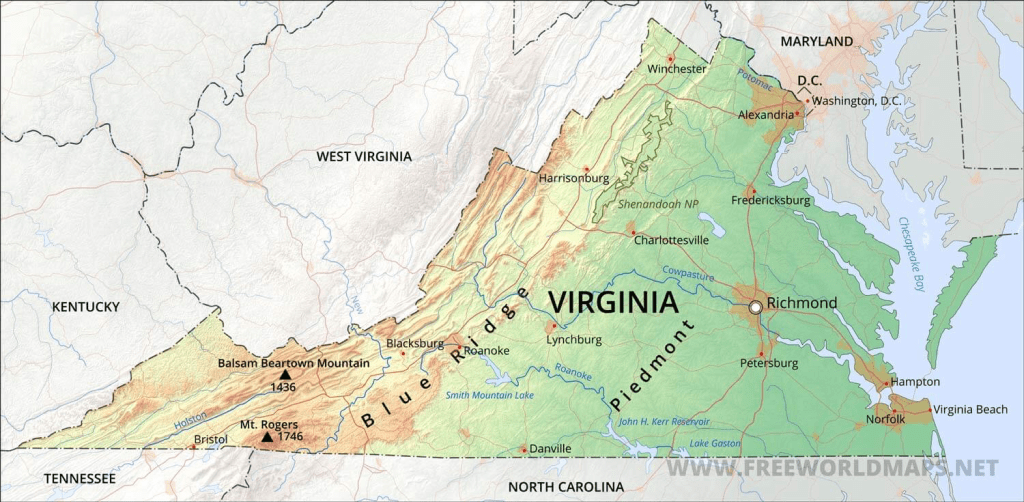
One excellent example of topography affecting migration is that of large mountain ranges. Let’s look at Virginia as an example. Let’s say you had ancestors in early Virginia and they wanted to move west to the “frontier.” They set off past Richmond only to discover a large mountain range in front of them. The Blue Ridge Mountains caused a lot of adventurous folks to head north or south to go around them.

Map of Virginia from FreeWorldMaps.net

This barrier caused more settlements to the north and south. As I imagine it, you make a long journey to get around these mountains…why not just stop here a spell? And then just never leave. I imagine that happened quite a bit.

My ancestor, Samuel Cook Dimick, moved from Lyme, New Hampshire to Toledo, Ohio. One account says that after the business he was working for began shutting down (or he decided to quit working there, it isn’t clear) he was to move on further west (perhaps to Minnesota where his father owned some land). But someone told him of land for sale just one county to the south and he decided to stay in Wood County, Ohio. And that’s the reason I was born in Wood County, Ohio and not Lyme, New Hampshire.

We will continue our look at types of maps that can help us understand our ancestors’ decisions and circumstances next time.


1. Definition of “topography” from Oxford Languages (https://languages.oup.com/google-dictionary-en/)↩

Many Paths to Sources: Vital Records Part 1

Generally speaking, in the United States, the requirement to record vital records (I’m primarily referring to birth and death certificates here, marriages are a bit different and we will discuss them in a later post) did not begin until the early part of the 1900s. This requirement was done on a state-by-state basis, so each state’s law started at a different time. Each state will have different privacy protections in place based on the state law at the time. This means some states are very difficult to get a vital record from and others are easier. For example, a birth certificate may not be available to the public for 100 years, but a close family member (you will most likely have to prove your relationship) may be able to get a copy of the record. These requirements differ from state-to-state, and the laws change over time. So, it is best to examine the state’s vital records office for the most recent information.

Ohio Death Certificate for Marshall C. Dimick

When I am looking for vital records, I usually have a few things I do to locate them. The order in which I do these may depend on how old the birth or death certificate is. If it is more recent, I might start at the state vital records office. If it is an older record, I might start at the FamilySearch catalog. My steps:

  • Read up at the state vital records office website.
  • Read the FamilySearch Wiki for that state’s vital records.
  • Look at some of the larger genealogy websites for vital records databases, such as Ancestry.
  • Examine the state-level archives, historical society, genealogical society, or whatever repository the state sends its historical materials to (if they do).
  • Examine the state and county of interest at the FamilySearch catalog to see if they’ve been microfilmed. Some counties may have done a local registration for births and deaths years before the state requirement was in place. This is true for Wood County, Ohio and Audrain County, Missouri, two locations I have successfully found county level vital records.
  • Look at online, user-contributed sources such as Find a Grave or public online trees in case anyone has posted a birth or death certificate for the person in question. (This can be surprisingly successful.)

The most important thing when trying to get a vital record is understanding when each state began requiring them. And understanding that it took a while for the counties to comply with new state laws. If a death certificate was required in 1909 and you cannot find a death certificate for 1909 or even for several years after, realize that things did not happen instantly in the early 1900s. I have looked for vital records in some states and sometimes cannot find them for 10 or more years after registration was required. That doesn’t mean it wasn’t recorded at the county level (though it may). More likely, the systems weren’t in place yet to comply with the laws.

Next time, we will look at some vital records substitutes and places to look for alternatives to the traditional birth or death certificate.

Many Paths to Sources: City Directories, Part 2

Last time we looked at major online locations where you might be able to find city directories. But what happens when that does not turn up a city directory for the location you are hoping to find one? There are a couple of extra steps I take before I declare “There was no city directory!”

The first stop for me is WorldCat. WorldCat stands for the “world’s catalog.” It is a conglomeration/consolidation/consortium (I’m not sure what the exact right word is here) of libraries who participate in sharing their collection’s catalog in this larger catalog, called WorldCat. It allows users to find books, journals, articles, and other media across many, many collections, making it much easier to locate a source you are looking for.

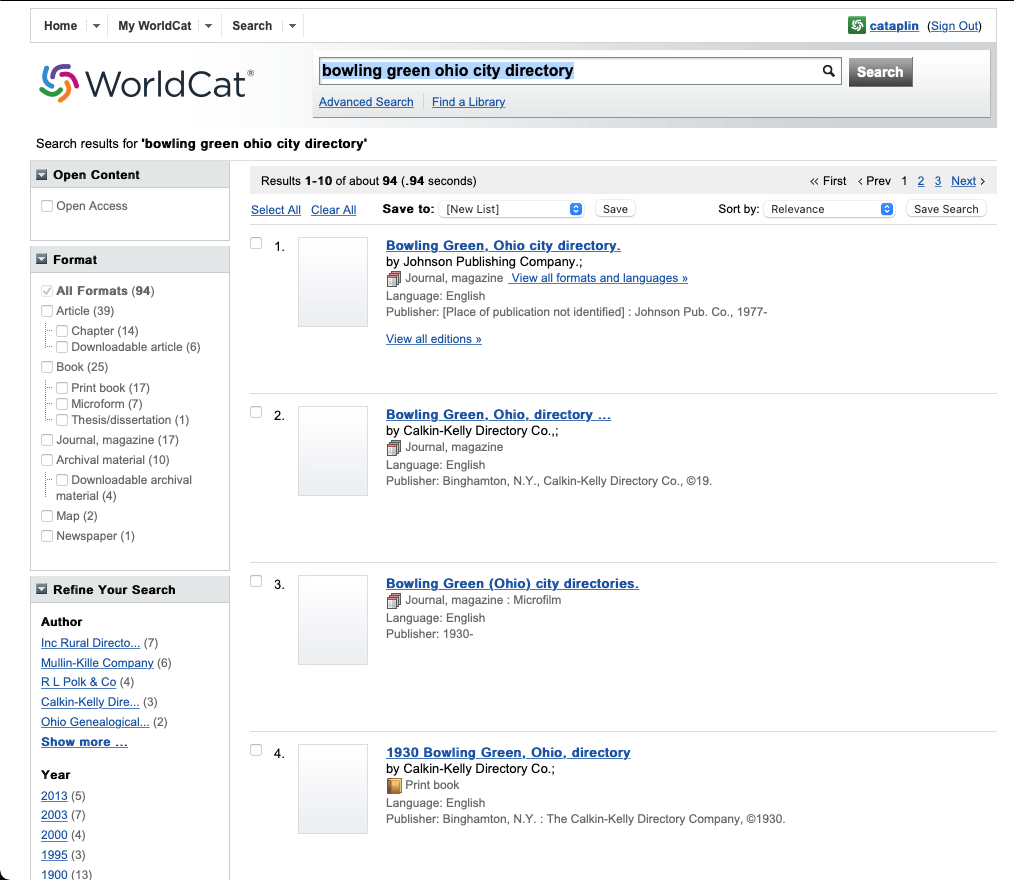
When you go to WorldCat, you treat it just like any other library catalog. You can type in a title or keywords in the search box and get results. The fun comes in what you can do with those results. Let’s look at some results for “bowling green ohio city directory.”

WorldCat Results for “bowling green ohio city directory”

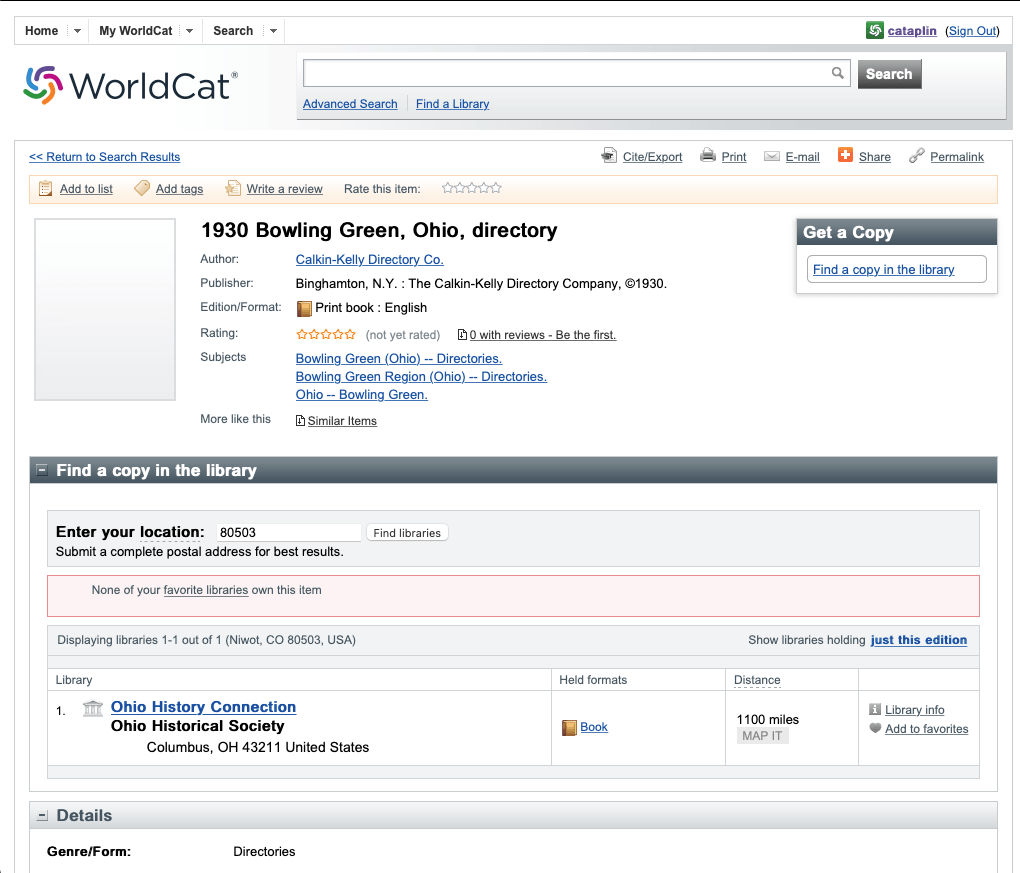
You can see at the top of the results list that there are 94 items that come back for these key words. You can see along the left some filters you can use to narrow your results if you have more specific needs. Let’s take a look at a specific directory entry and click on the 1930 Bowling Green, Ohio, directory at the bottom.

Catalog Entry for an item from the list

This page is similar to a library catalog page you’ve likely seen before. You can see the title, publisher information, subjects, and so on. WorldCat then shows you all of the libraries you can find this item in. In this particular case, only one library (well, one that participates in WorldCat, remember) has this item in their collection. It is at the Ohio History Connection in Columbus. From where I live, it is 1100 miles away. When you find an item that is located in more than one collection, you’ll be treated with a list of several libraries where the item can be located.

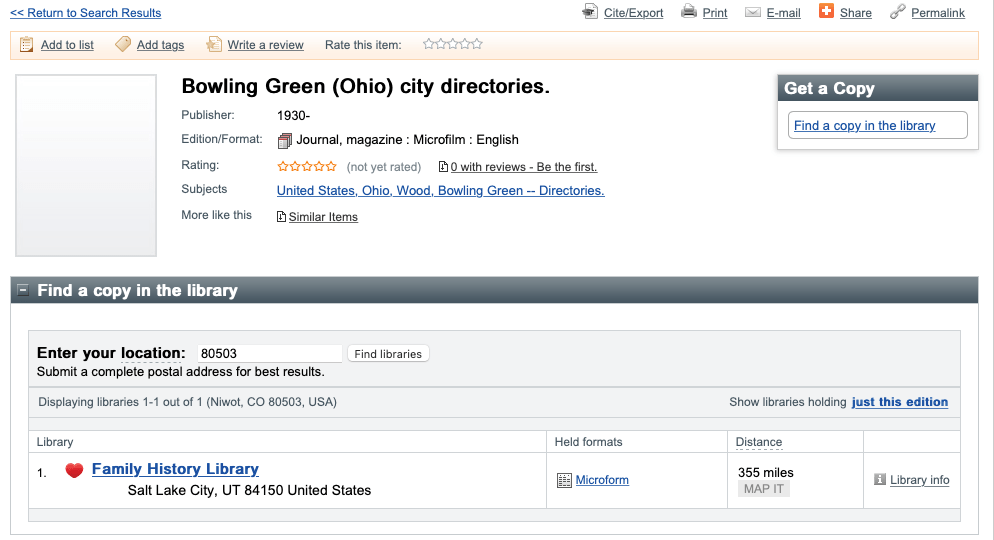
WorldCat also has a nice feature in that you can designate your favorite libraries, and they will pop to the top of your list. Another item from our search list is Bowling Green (Ohio) city directories on microfilm. That catalog entry looks like this:

Another entry from WorldCat showing a favorited library

This item is located at the Family History Library in Salt Lake City. You can see the little heart on the left which indicates that it is one of my favorite libraries. If there are libraries you frequent, having them indicated as “favorites” brings those libraries to the top of your list and makes them easy to find. When I find items at my favorite libraries, I often add them to the research list for the next time I visit that facility.

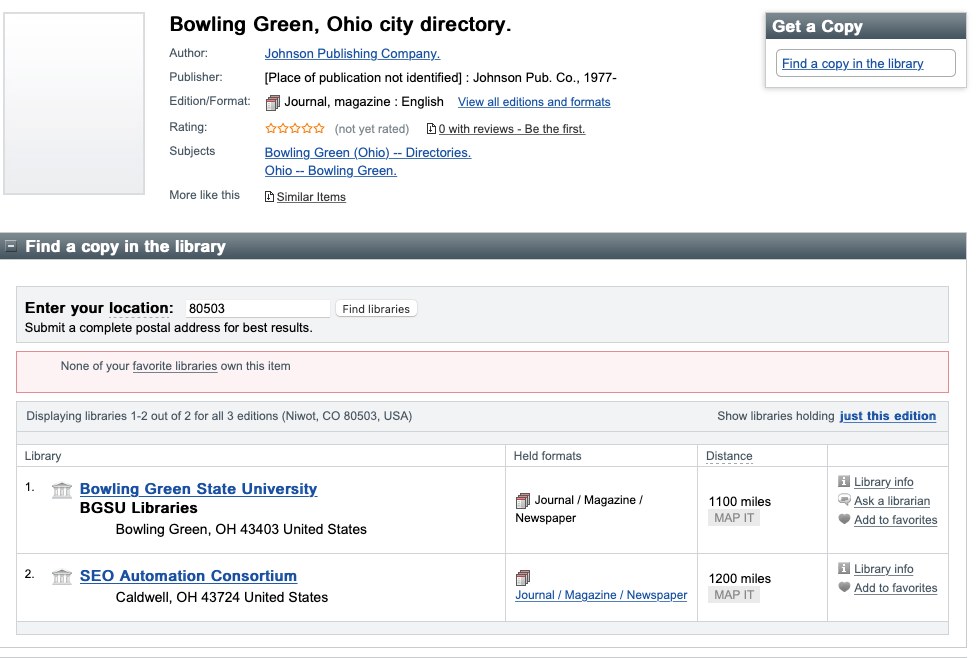
Let’s refer back to number 1 in the first results screen above. It is for Bowling Green, Ohio city directory by Johnson Publishing Company. Here is the catalog entry:

WorldCat entry

You can see there are only two locations that have this particular series of directories in WorldCat, Bowling Green State University and SEO Automation Consortium. However, having been to the Wood County District Public Library myself, I know they have a whole bunch of city directories for Bowling Green. Let’s look at their catalog:

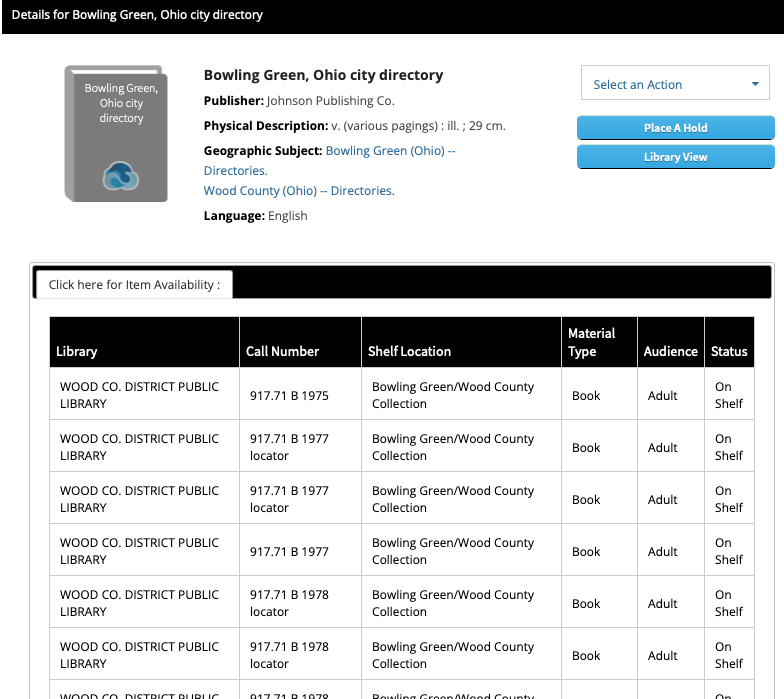
Wood County District Public Library Catalog

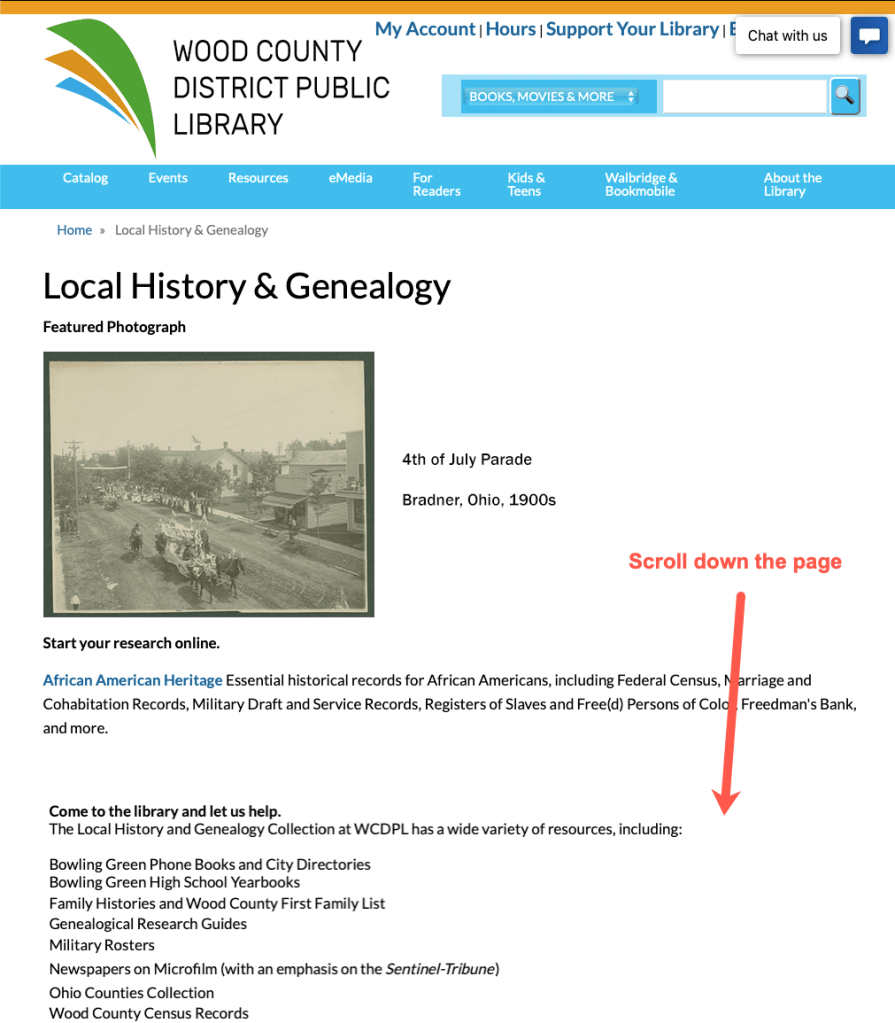
They have the Johnson city directories starting in 1975. Examining their other catalog entries reveals that they have a large number of directories, covering a wide range of years. They are not a participating library with WorldCat. In fact, their website has a Local History and Genealogy section detailing some of the resources they have that could be of use to genealogists.

WCDPL Website showing the Local History & Genealogy page

My point with this is, use WorldCat, but don’t stop there. Your next step, if you don’t find what you are looking for in WorldCat is to look at a local public library. Most often, I find these directories in those small, local libraries. Very often they have a local history and/or genealogy room. If you don’t find it in a catalog, give the library a call or send an email. I have found most of these repositories and their employees to be quite helpful. They are likely to be able to make copies or have a system for requesting copies. Or you might need to find a volunteer to help you or pay a local genealogists to look for you if you can’t make it yourself. Some items might be available via interlibrary loan.

Just don’t stop looking.